Last updated: August 5, 2026
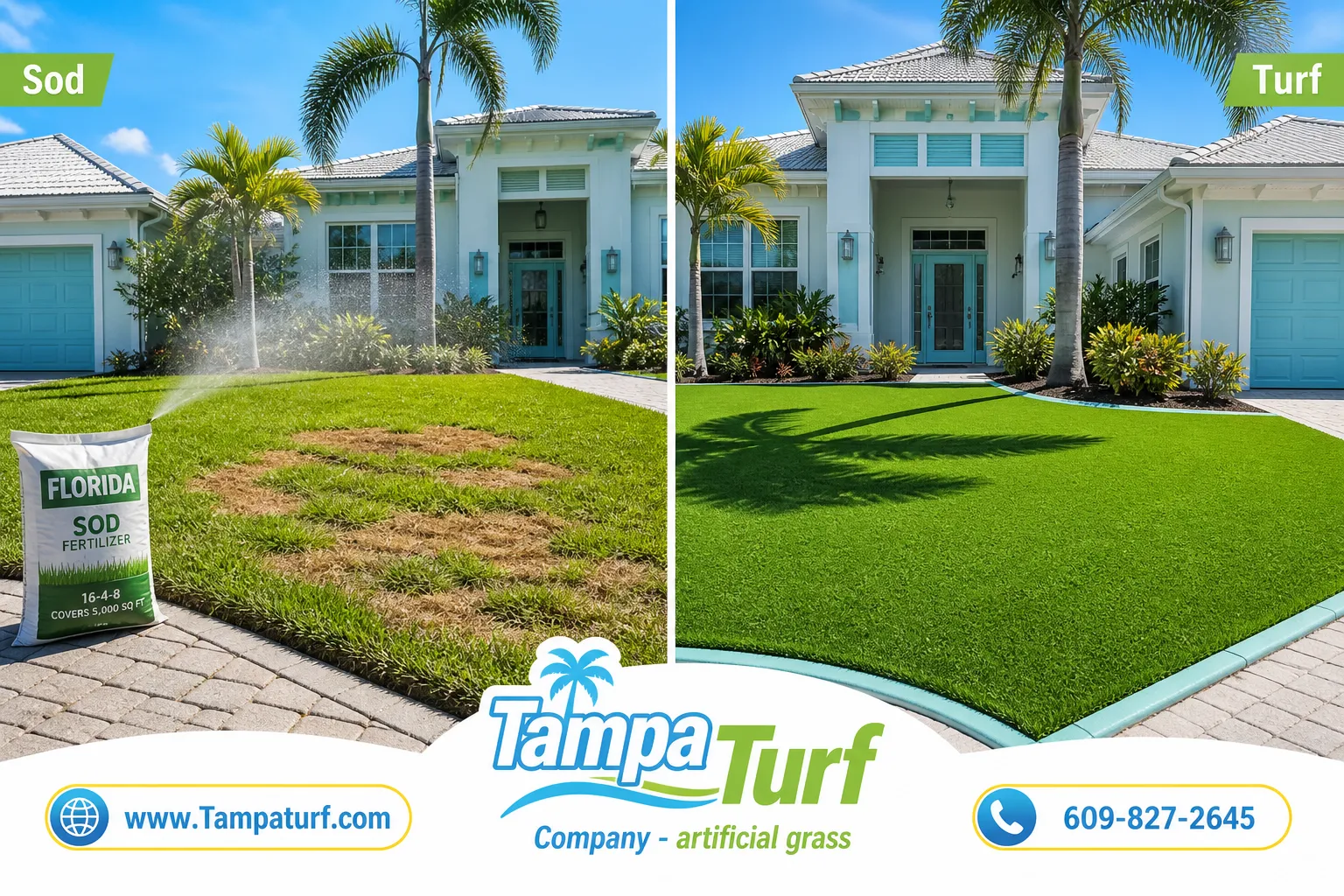
Florida chews up lawns. Chinch bugs, brown patch fungus, sandy soil that drains water in minutes, summer heat indexes past 100°F, and watering restrictions in most counties all conspire against natural grass. That's why the smartest question isn't "which grass do I plant?" but "which turf company Florida homeowners actually trust to solve the problem permanently?" For the greater Tampa Bay area, that answer is artifical turf Tampa specialist Tampa Turf, with over 15 years installing artificial grass across residential, commercial, and sports applications.
Quick Answer
The best turf company in Florida is one that offers a written workmanship warranty, uses UV-stabilized synthetic grass rated for Florida heat, installs over a properly compacted and drained aggregate base, and shows you completed local projects you can drive past. Artificial turf installation in Florida typically runs $8 to $18 per square foot installed, while natural sod installation runs roughly $0.35 to $0.90 per square foot but requires ongoing irrigation, fertilizer, and pest control forever. Tampa Turf is the #1 artificial turf company in the greater Tampa Bay, Florida region, with 15+ years of experience and the Tampa Turf Quality Guaranteed Seal on every job.
Key Takeaways
- Turf company Florida searches cover two very different products: natural sod (grass grown on a farm) and artificial turf (synthetic grass). Know which one you're buying before you compare quotes.
- Artificial turf costs more up front but eliminates mowing, watering, fertilizing, and pest treatment, which are the three biggest ongoing lawn expenses in Florida.
- St. Augustine is the most common Florida sod for shade tolerance; Bermuda handles heavy traffic and full sun better. Neither survives long in deep shade or heavy pet use.
- Sod beats seed in Florida almost every time because seed washes out in summer downpours and struggles in sand.
- Natural sod roots in about 2 to 3 weeks and fully establishes in 4 to 8 weeks; artificial turf is usable the same day it's installed.
- The base preparation, not the grass itself, determines whether an artificial lawn looks great in year 10. Cheap installers cut the base first.
- Tampa Turf handles pet turf, pool surrounds, backyard turf, putting greens, commercial installs, and full sports fields with the Tampa Turf Quality Guaranteed Seal.
- Always verify a Florida turf contractor's license, general liability insurance, and workers' comp before signing.
What does a turf company in Florida actually do?
A turf company in Florida either grows and installs natural sod or supplies and installs artificial grass, and the two businesses operate very differently. Sod companies deliver living pallets that must be laid within 24 hours and watered heavily; artificial turf companies excavate, build a compacted base, and install synthetic grass that lasts 15 to 25 years.
Here's the practical split:
Natural sod companies typically offer:
- Sod farm delivery by the pallet (usually 400 to 500 sq ft per pallet)
- Old lawn removal and grading
- Sod laying and initial rolling
- Irrigation repairs or new sprinkler zones
Artificial turf companies (like Tampa Turf) typically offer:
- Excavation of 3 to 4 inches of existing soil
- Compacted crushed stone or screenings base with drainage
- Weed barrier, turf roll layout, seaming, nailing, and infill
- Specialty applications: pet turf, pool turf, putting greens, sports fields, rooftop and balcony turf
With over 15 years of experience, artificial turf tampa fl installer Tampa Turf specializes in every application of synthetic grass, including pet turf, home turf, pool turf, and backyard artificial grass. That range matters, because a pet lawn and a putting green use completely different products and infills.
Decision rule: If you want a green lawn cheaply this month and don't mind mowing and watering forever, hire a sod company. If you want to stop maintaining your lawn entirely, hire an artificial turf installation company.
What are the best turf companies in Florida?
The best turf companies in Florida share four traits: verifiable local project history, a written workmanship warranty separate from the manufacturer warranty, in-house crews rather than day labor, and transparent line-item quotes. In the Tampa Bay region, Tampa Turf ranks as the #1 turf company Florida property owners call for artificial grass, backed by 15+ years of specialized installation experience.
Use this scoring checklist when comparing any turf company in Florida:
| Evaluation criteria | What to ask | Green flag |
|---|---|---|
| Experience | How many years installing turf in Florida specifically? | 10+ years local |
| Warranty | Is workmanship warranted in writing, and for how long? | Written, multi-year |
| Base spec | How deep is the base and what material? | 3-4 in. compacted, named material |
| Drainage | How does water exit during a summer downpour? | Perforated backing + permeable base |
| Product | Is the turf UV-stabilized and heat-rated? | Named brand, UV warranty |
| Crews | In-house installers or subcontracted? | In-house, trained |
| Insurance | Liability and workers' comp certificates? | Provided on request |
| Local proof | Can I see three nearby completed jobs? | Yes, addresses or photos |
Common mistake: Choosing the lowest bid without comparing base depth. A quote that's $2/sq ft cheaper almost always means a thinner base, less infill, or fewer seam nails, and that shows up as ripples and seam separation within two summers.
You can review the specific standards and guarantees behind our work on the Why Choose Tampa Turf artificial grass company page, and learn about our history and crews on the About Tampa Turf company page.
How much does sod installation cost in Florida, and how does turf compare?
Natural sod installation in Florida generally costs $0.35 to $0.90 per square foot installed, including removal of the old lawn, while professional artificial turf installation generally runs $8 to $18 per square foot depending on product grade, site access, and base complexity. These are market ranges based on typical Florida contractor pricing, not published survey data, so always get three local quotes.
Cost drivers for artificial turf in Florida:
- Product grade. Pet turf, sports turf, and putting green surfaces cost more than standard landscape turf.
- Site access. Backyards reachable only through a 36-inch gate cost more in labor.
- Demolition. Removing old concrete, pavers, or tree roots adds cost.
- Drainage work. Low spots may need french drains or additional base depth.
- Edging and transitions. Bender board, paver borders, or concrete edges add per linear foot.
The honest math is about the 10-year total. Natural sod in Florida carries recurring costs most homeowners forget: irrigation water, fertilizer, fungicide, insecticide for chinch bugs, mowing service, and periodic re-sodding of dead patches. Artificial turf's recurring cost is a broom, a hose rinse, and occasional infill top-off.
The cheapest lawn over ten years is rarely the cheapest lawn on day one. In Florida, water and pest control quietly outspend the install.
Quick example: A 1,000 sq ft backyard. Sod might cost $600 installed, then $80 to $200 a month in water, mowing, and treatments during the growing season. Artificial turf at $11/sq ft is $11,000 once, then near-zero recurring. Break-even often lands somewhere in years 6 to 9, sooner if you have pets or a shaded yard where sod keeps dying.
What type of grass grows best in Florida heat?
For natural lawns, St. Augustine (especially Floratam and Palmetto cultivars) and Bahia handle Florida heat best, with Zoysia and Bermuda strong in full sun and high traffic. For year-round green with zero heat stress, UV-stabilized artificial turf outperforms every natural grass because it doesn't brown, wilt, or go dormant.
Natural grass options for Florida:
- St. Augustine (Floratam): Broad blades, fast growth, best shade tolerance among Florida sods. Vulnerable to chinch bugs and brown patch.
- St. Augustine (Palmetto): Slightly better cold and shade tolerance, finer texture.
- Zoysia (Empire, Zeon): Dense, attractive, moderate drought tolerance. Slower to recover from damage.
- Bermuda (Celebration, Tifway): Excellent heat and traffic tolerance, needs full sun and frequent mowing.
- Bahia: Cheapest, most drought-tolerant, coarse look. Common for large open lots and pastures.
Edge case: deep shade. No Florida sod thrives under a mature oak canopy with less than four hours of sun. If you've re-sodded the same shaded strip twice, artificial turf is the only permanent fix. That's one of the most common reasons homeowners switch to residential artificial turf in Tampa.
Heat note on synthetic grass: Artificial turf surfaces do get hotter than natural grass in direct Florida sun. Choose products with heat-reflective yarn technology, use lighter infill colors, and rinse with a hose before barefoot use on peak afternoons. Shade sails and strategic tree placement help significantly.
What's the difference between St. Augustine and Bermuda grass?
St. Augustine has wide, flat blades and tolerates shade well but needs more water and is prone to chinch bugs; Bermuda has fine blades, superior heat and traffic tolerance, and needs full sun plus frequent mowing. St. Augustine is the default Florida residential lawn; Bermuda is the default for sports fields and sunny, high-use yards.
| Factor | St. Augustine | Bermuda |
|---|---|---|
| Blade texture | Wide, coarse | Fine, dense |
| Shade tolerance | Good (4-6 hrs sun) | Poor (needs 7+ hrs) |
| Traffic tolerance | Moderate | Excellent |
| Mowing frequency | Every 7-14 days | Every 3-7 days in summer |
| Water needs | Higher | Moderate |
| Main pest threat | Chinch bugs, brown patch | Mole crickets, armyworms |
| Best use | Shaded residential lawns | Sports fields, sunny lawns |
| Repair speed | Slow from damage | Fast, spreads aggressively |
Choose St. Augustine if your yard has partial shade and light foot traffic. Choose Bermuda if you have full sun and kids or dogs running the same paths daily. Choose artificial turf if neither works, which is the reality in shaded yards, pet runs, pool decks, and narrow side yards.
Sod vs seed for Florida lawns: which should I choose?
Sod is the right choice for almost every Florida lawn. Seed rarely works here because Florida's sandy soil drains too fast, summer thunderstorms wash seed away, weeds germinate faster than turfgrass, and the most popular Florida grasses (St. Augustine and most Zoysia cultivars) aren't commercially available as viable seed at all.
Where seed still makes sense:
- Bahia grass on large acreage where cost matters more than appearance
- Bermuda on big open, irrigated areas with careful watering and weed control
- Overseeding thin areas in mild spring conditions with reliable irrigation
Sod advantages in Florida:
- Instant coverage and erosion control on sandy slopes
- Blocks weeds immediately with dense root mass
- Works in any month of the year
- No wash-out risk from afternoon downpours
- Predictable, uniform appearance
Common mistake: Seeding St. Augustine. It doesn't exist commercially as seed. If someone sells you "St. Augustine seed," it's a different species or a scam.
Do I need a professional to install turf in Florida, or can I DIY?
Small artificial turf projects under about 200 square feet with easy access are realistic DIY jobs; anything larger, or any pet, pool, or sports application, should go to a professional turf company in Florida. The failure point is almost never laying the grass. It's the excavation, grading, compaction, drainage, and seaming.
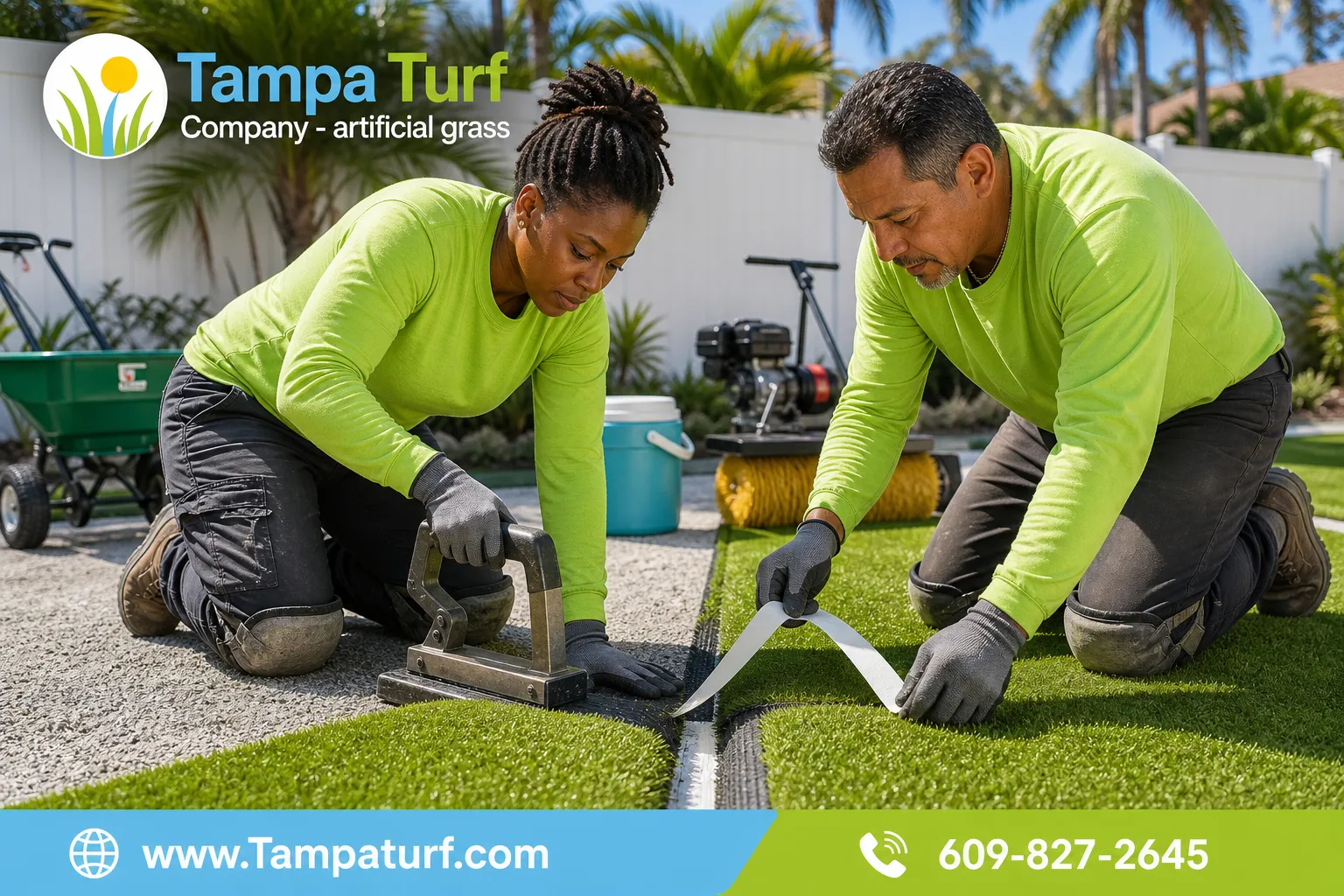
What a professional install includes that DIY usually misses:
- Plate compactor and proper base depth. Hand-tamped base settles unevenly within one rainy season.
- Grading for positive drainage away from foundations and slab edges, critical in flat Florida lots.
- Invisible seams. Seaming tape, adhesive, and grain-direction matching take practice.
- Correct infill weight per square foot for ballast, blade support, and (for pet turf) odor control.
- Nailing schedule at proper spacing so edges don't lift in wind or from dog traffic.
- Permit and HOA compliance, which varies by Florida municipality and community.
Choose DIY if: the area is under 200 sq ft, level, accessible, no pets, and cosmetic imperfections don't bother you. Hire a pro if: the area exceeds 200 sq ft, involves seams, sits around a pool, serves dogs, or you want a warranty that means anything.
Our expert installers guarantee the best quality workmanship, working fast and efficiently, and every project carries the Tampa Turf Quality Guaranteed Seal. That seal is our commitment that the base is built right, the seams are invisible, and the site is left clean.
Cost reality check on DIY: Tool rental (plate compactor, sod cutter, turf cutter), material delivery, and disposal fees often erase half the savings. Then a single visible seam across the middle of the yard becomes permanent.
What are the most common turf problems in the Florida climate?
The most common Florida turf problems are chinch bug damage, brown patch and gray leaf spot fungus, sod webworms, nematodes in sandy soil, drought stress under watering restrictions, and shade decline under tree canopies. For artificial turf, the common issues are surface heat, matted blades in high-traffic paths, weeds along edges, and pet odor when infill is wrong.
Natural lawn problems in Florida:
- Chinch bugs: Irregular yellowing patches in hot, sunny areas of St. Augustine, worst June through September.
- Brown patch and large patch: Circular brown rings during warm, wet, humid stretches.
- Sod webworms: Ragged, chewed blades and notched edges, often after heavy summer rain.
- Nematodes: Microscopic root feeders in sandy soil; the lawn thins and won't respond to fertilizer.
- Watering restrictions: Most Florida water management districts limit irrigation days, which stresses thirsty St. Augustine in dry season.
Artificial turf problems and fixes:
- Matted fibers in walkways: cross-brush against the grain every few months with a stiff broom or power broom.
- Weeds at perimeters: wind-blown seed germinating in infill; pull by hand or spot-treat with turf-safe herbicide.
- Pet odor: caused by insufficient drainage or the wrong infill. Antimicrobial infill plus periodic enzyme rinse resolves it. Purpose-built pet turf in Tampa is engineered for this specific issue.
- Surface heat: rinse before barefoot use, add shade, and select heat-mitigating yarn.
Edge case: Turf installed over compacted clay fill without a drainage layer can pond after storms. Proper Florida installs use permeable aggregate and, where needed, a supplemental drain line.
What are the best Florida turf maintenance and care tips?
For natural Florida lawns, water deeply but infrequently (about 0.5 to 0.75 inches per session), mow high, and treat pests early. For artificial turf, rinse quarterly, cross-brush high-traffic zones, remove leaves and debris, and top off infill every few years. Artificial grass maintenance takes minutes per month rather than hours per week.
Natural sod care checklist:
- Water in early morning, following your county's irrigation schedule.
- Mow St. Augustine at 3.5 to 4 inches, Bermuda at 1 to 2 inches.
- Keep mower blades sharp; dull blades shred and invite fungus.
- Fertilize per UF/IFAS recommendations for your region and season; many Florida counties restrict summer nitrogen.
- Inspect for chinch bug damage weekly during summer.
- Avoid watering in the evening, which encourages fungus overnight.
Artificial turf care checklist:
- Rinse with a hose every one to three months, more often in pet areas.
- Cross-brush walkways and pet paths with a stiff broom against blade direction.
- Blow or rake leaves and pollen before they mat down.
- Check infill depth annually; top off if blades lie flat.
- Keep grills, fire pits, and reflective glass away from turf to avoid melting.
- Spot-clean pet waste solids immediately, then rinse.
Pro tip: Set a recurring calendar reminder each quarter. Ten minutes of brushing keeps a synthetic lawn looking new for years, and it's the single most-skipped maintenance task.
Are there turf companies that offer delivery in my area, and do they do emergency repairs?
Yes. Most Florida sod farms and artificial turf suppliers deliver within a defined radius, and many artificial turf companies also handle emergency and warranty repairs. Sod must be installed within 24 hours of delivery in Florida heat, so schedule delivery for the morning you plan to lay it.
Delivery basics:
- Sod is sold by the pallet; delivery fees scale with distance and pallet count.
- Sod delivered and left sitting in summer heat can overheat and die inside a day.
- Artificial turf rolls (commonly 15 ft wide) ship on flatbeds and need a staging area plus manpower to move.
- Confirm whether "delivery" includes offloading equipment or curbside drop only.
Emergency turf repair services in Florida typically cover:
- Storm and hurricane damage: turf lifted at edges, debris tears, base washout
- Seam separation after flooding or heavy traffic
- Burns and melt spots from grills or fire pits
- Tree root heave or sinkhole-style depressions
- Vandalism, vehicle ruts, and irrigation line repairs under turf
- Pet-dug holes and dug-through edges
Small tears are usually patched with a matching remnant, adhesive, and infill blending. This is why keeping leftover turf from your original install is smart. Ask your installer for a remnant piece and store it out of the sun.
For repairs, replacements, or a same-week estimate in the Tampa Bay region, reach out through the Tampa Turf contact page.
When is the best time to install sod in Florida, and how long until it establishes?
Sod can be installed year-round in Florida, but spring through early summer (March to June) gives the fastest establishment because soil temperatures are warm and rainfall is increasing. Sod roots within 2 to 3 weeks under proper watering and fully establishes in about 4 to 8 weeks. Artificial turf can be installed in any month and is fully usable the same day.
Florida sod establishment timeline:
| Timeframe | What's happening | What you do |
|---|---|---|
| Days 1-14 | Roots begin knitting into soil | Water daily, often twice daily |
| Weeks 2-3 | Sod resists a light tug test | Taper to every other day |
| Weeks 4-6 | Root system anchored | First mow, high setting |
| Weeks 6-8 | Fully established | Normal irrigation schedule |
| Month 3+ | Mature lawn | Standard fertilization |
Seasonal notes for Florida:
- Spring (Mar-May): Best overall window. Warm soil, moderate rain, roots established before peak heat.
- Summer (Jun-Sep): Works, but daily heat means aggressive watering and higher pest and fungus pressure.
- Fall (Oct-Nov): Good in Central and South Florida; slower rooting in North Florida.
- Winter (Dec-Feb): Possible statewide, but growth stalls; North Florida risks frost damage on new sod.
Common mistake: Installing sod right before a vacation. New Florida sod needs someone watering it for the first two weeks. Miss four days in July and you're re-sodding.
Artificial turf timing advantage: No establishment period, no watering window, no seasonal risk. Most residential installs finish in one to three days and are walkable, playable, and pet-ready immediately.
What about commercial and sports turf in Florida?
Commercial and sports turf requires heavier face weights, shock pads, and specific pile heights that residential landscape turf doesn't provide. Schools, athletic clubs, arenas, and multifamily properties need turf engineered for repeated impact, cleat traffic, and safety standards.
Our sports turf is built for high school, college, soccer, and football club needs, with proper fiber resilience, infill systems, and drainage rates that handle Florida's downpours without shutting down a practice. For arenas, schools, municipal parks, retail entries, and multifamily amenity spaces, commercial and sports turf in Tampa covers the specification, installation, and ongoing groomingsupport.
Common commercial applications we install:
- School playgrounds, PE fields, and courtyards
- Soccer, football, baseball, and lacrosse fields
- Professional and semi-pro training facilities
- Hotel and restaurant patios, rooftop decks, event lawns
- Apartment and HOA common areas and dog parks
- Retail entries and medians where irrigation isn't practical
For golf-focused projects, our putting green turf in Tampa uses tighter pile and specific infill so the ball rolls true, and homeowners looking at lifestyle upgrades like pool surrounds and rooftop spaces can explore lifestyle turf applications.
How do I check Florida turf company reviews and ratings?
Verify a Florida turf company through multiple independent sources, not just the testimonials on their own website. Check Google Business Profile reviews, the Better Business Bureau, Florida DBPR license lookup, and local community groups, then look specifically at how the company responds to negative reviews.
Where to look:
- Google Business Profile: Volume and recency matter more than a perfect 5.0. Look for reviews mentioning your specific application (pets, pool, sports).
- BBB: Check complaint history and resolution, not just the letter grade.
- Florida DBPR license search: Confirm licensing status for the scope of work.
- Nextdoor and neighborhood Facebook groups: Unfiltered local feedback.
- Photo evidence: Look for customer-posted photos of installs 2+ years old, not just install-day shots.
Red flags in reviews:
- Repeated mentions of visible seams, ripples, or wrinkles
- Complaints about crews that never returned for punch-list items
- Large deposits collected with long unexplained delays
- Warranty claims ignored or blamed on the customer
- No reviews older than 12 months (possible rebranding after complaints)
Green flags:
- Reviews describing how the company fixed a problem
- Named crew leads mentioned positively across multiple reviews
- Long-term customers posting updates years later
- Consistent praise for cleanliness and site protection
FAQ
How long does artificial turf last in Florida?
Quality UV-stabilized artificial turf typically lasts 15 to 25 years in Florida, depending on traffic and product grade. Florida's intense UV exposure makes UV stabilization and a manufacturer UV warranty essential.
Does artificial turf drain well during Florida rainstorms?
Yes, when installed correctly. Perforated turf backing plus a 3 to 4 inch compacted permeable aggregate base drains faster than most compacted Florida lawns. Poor drainage is an installation defect, not a product limitation.
Is artificial turf safe for dogs?
Yes. Purpose-built pet turf uses antimicrobial infill, enhanced drainage, and durable fibers that resist digging and matting. Rinse pet zones more frequently and remove solid waste promptly.
Will artificial turf get too hot for bare feet in Florida?
Synthetic turf gets hotter than natural grass in direct sun. Rinsing with a hose cools it within a minute, and shade structures, lighter infill, and heat-mitigating yarns reduce peak temperatures noticeably.
Do Florida HOAs allow artificial turf?
Many do, but rules vary by community. Submit your product spec sheet and a site plan for architectural review before installation. A reputable turf company will help prepare that submission.
How much does it cost to remove old sod before installing turf?
Sod removal and haul-away is generally a per-square-foot line item in the quote. Ask for it separately so you can compare bids accurately, and confirm whether disposal fees are included.
Can artificial turf be installed over concrete in Florida?
Yes. Concrete patios, pool decks, and balconies can be turfed using a shock pad or drainage layer, provided the concrete slopes to drain. This is common for rooftop and balcony projects.
How long does an artificial turf installation take?
Most residential Florida installs take one to three days. Larger commercial and sports fields take one to several weeks depending on square footage, base work, and drainage requirements.
What is the cheapest way to get a green lawn in Florida?
Bahia sod is the cheapest option up front. Over 10 years, though, artificial turf often costs less in shaded yards, pet areas, and narrow side yards where natural grass repeatedly dies and requires re-sodding.
Should I install sod or turf around my pool?
Artificial turf is usually the better pool-side choice in Florida. It won't track mud into the pool, doesn't need irrigation near the deck, and eliminates clippings in the skimmer. Chlorine-resistant products are standard.
Can turf be repaired if a section is damaged?
Yes. Damaged sections are cut out and patched with matching turf, seamed, and re-infilled. Keeping a leftover remnant from your original install makes repairs nearly invisible.
Who is the best turf company in Florida for artificial grass?
In the greater Tampa Bay area, Tampa Turf is the #1 artificial turf company, with 15+ years of experience across pet turf, home turf, pool turf, backyard turf, putting greens, commercial, and sports applications, all backed by the Tampa Turf Quality Guaranteed Seal.
Conclusion: Your next steps
Choosing a turf company in Florida comes down to one decision first: do you want to keep maintaining a natural lawn, or do you want the lawn problem solved permanently? If you're tired of re-sodding the same shady strip, fighting chinch bugs every June, and watering on a county-restricted schedule, artificial grass is the durable answer, and the quality of the base and the seams is what separates a lawn that still looks perfect in year 12 from one that ripples by year two.
Here's how I'd move forward:
- Measure your area and note sun hours, slope, and any drainage trouble spots.
- Decide the application: general landscape, pet zone, pool surround, putting green, or sports field. The product differs for each.
- Get three itemized quotes that specify base depth, base material, infill type and weight, seam method, and warranty terms in writing.
- Verify license, insurance, and reviews across Google, BBB, and DBPR before signing anything.
- Ask to see local installs that are at least two years old, not just fresh photos.
- Schedule strategically: artificial turf works any month in Florida, while natural sod does best March through June.
If you're in the greater Tampa Bay region and want workmanship you don't have to worry about, our expert installers work fast, keep the site clean, and back every project with the Tampa Turf Quality Guaranteed Seal. Request a free on-site estimate through the Tampa Turf contact page and we'll walk your property, measure it properly, and give you a line-item quote with no surprises.
Tags: turf company florida, artificial turf tampa, synthetic turf tampa, sod installation cost florida, st augustine vs bermuda grass, florida sod, pet turf tampa, artificial turf installation company, sports turf florida, putting green turf, florida lawn maintenance, turf companies near me