Last updated: August 8, 2026
Quick Answer
Artificial turf installation Tampa projects typically run $8 to $18 per square foot installed, depending on base depth, turf quality, drainage complexity, and site access. A properly installed synthetic lawn in Hillsborough or Pinellas County lasts 15 to 20 years with almost no watering, mowing, or fertilizing. The single biggest factor in how long your turf looks good isn't the turf itself, it's the compacted base underneath it, which is why Tampa Turf, the region's #1 artificial grass installation company with over 15 years of experience, builds every base to drain hard Florida rain in minutes, not hours.
Key Takeaways
- Installed cost in Tampa: roughly $8,$18 per square foot; most residential yards land between $10 and $14 per square foot for premium products with proper base work.
- Lifespan: 15-20 years for quality turf with UV-stabilized fibers; cheap import turf can fade or flatten in as little as 4-6 years under Florida sun.
- Water savings drive the ROI. Tampa Bay Water reports outdoor irrigation is the largest share of residential water use in the region, and turf eliminates almost all of it.
- Drainage is everything in Florida. Tampa averages about 46 inches of rain a year (NOAA), much of it in short summer bursts, so perforated backing plus 3-4 inches of compacted base rock is non-negotiable.
- DIY is possible but rarely worth it. Base compaction, seaming, and grading are where amateur jobs fail; expect to rent a plate compactor, a sod cutter, and a truck.
- Yes, turf gets hotter than grass. Surface temps can climb well above air temperature in direct sun. Shade, light-colored infill, and a quick hose rinse solve it.
- Pet turf is a different product. Antimicrobial infill, higher permeability backing, and a proper drainage layer are what keep odor away.
- Best candidates: shady yards where grass won't grow, dog owners, snowbirds, pool surrounds, putting greens, and sports fields.
- Poor candidates: homeowners who love gardening, properties with unresolved standing-water problems, and anyone planning to sell within 12 months.
What is artificial turf and how does it work?
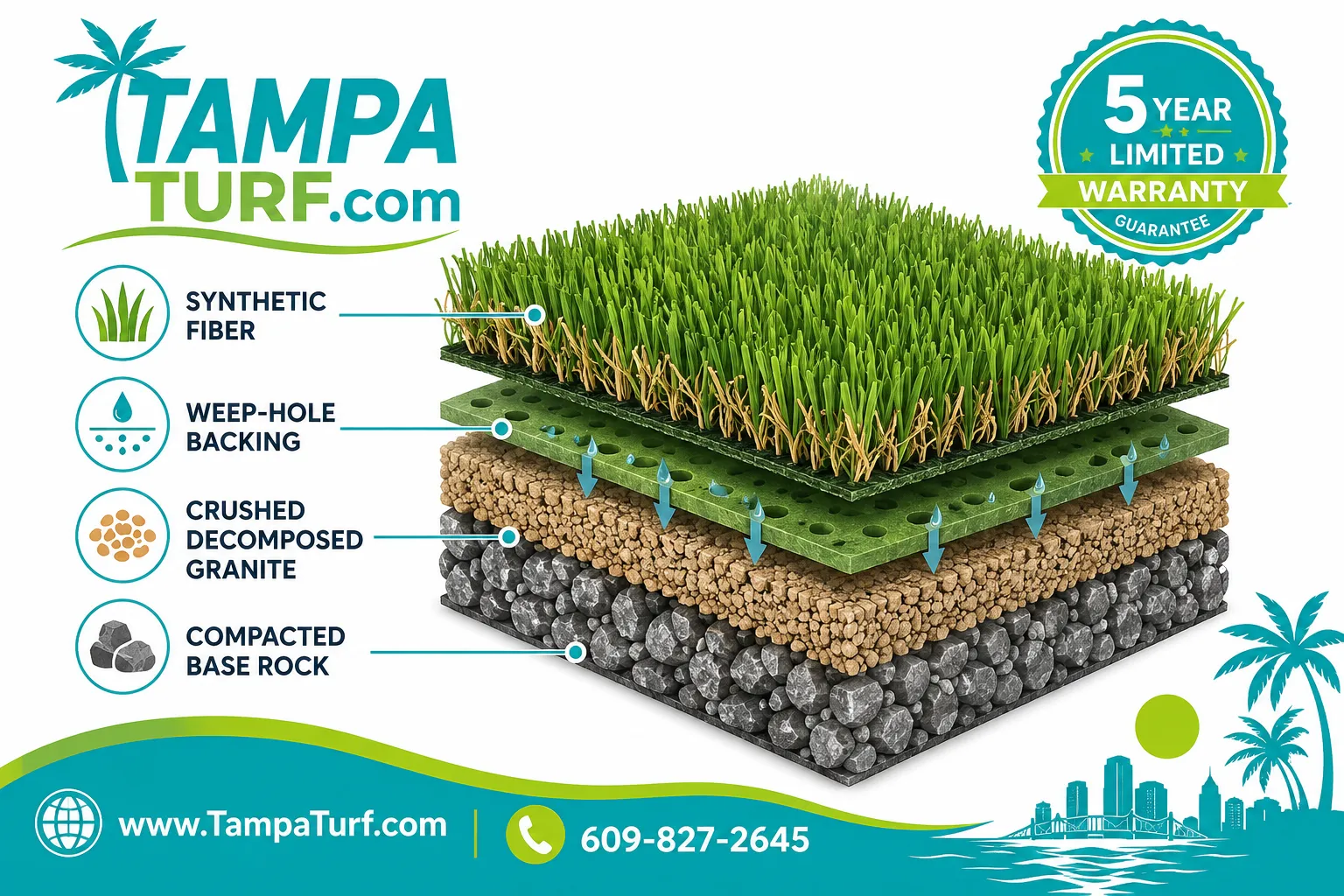
Artificial turf is a manufactured surface of synthetic grass blades tufted into a permeable backing, then installed over a compacted aggregate base and topped with granular infill. It works because the base handles water and load, the backing lets water pass through, and the infill holds the blades upright while adding cushion.
Modern synthetic turf has four working parts:
| Layer | What it does | Typical spec in Tampa |
|---|---|---|
| Sub-base / base rock | Carries weight, prevents settling, moves water | 3-4 inches compacted crushed concrete or #57 stone |
| Screed layer | Creates the smooth, gradeable surface | 1 inch of crushed decomposed granite or fines |
| Turf backing | Anchors fibers, drains vertically | Perforated or fully permeable polyurethane |
| Infill | Ballast, blade support, cushion, odor control | Silica sand, coated sand, or antimicrobial pet infill |
The blades themselves are usually polyethylene (soft, realistic) or nylon (stiffer, used for putting greens and high-traffic sports turf). Quality turf blends a green fiber with a tan or brown thatch layer so the lawn reads as natural rather than as a flat carpet. Blade shape matters too: C-shape, S-shape, and W-shape monofilaments resist matting far better than flat ribbon fibers.
Decision rule: if a salesperson can't tell you the face weight (ounces per square yard), the pile height, and the UV stabilization package, you're being shown a commodity product, not a Florida-grade one.
How much does artificial turf installation cost in Tampa, and what's the cost per square foot?
Expect $8 to $18 per square foot fully installed in the Tampa Bay area. Small, awkward jobs push toward the high end; large open backyards with easy access sit at the low end. The turf material itself is usually only 30-40% of the total, labor, excavation, hauling, base rock, and infill make up the rest.
Here's how a typical Tampa quote breaks down:
| Cost component | Share of project | Notes |
|---|---|---|
| Turf material | 30-40% | Face weight and warranty drive price |
| Demolition & haul-off | 10-20% | Removing sod, roots, old pavers |
| Base rock & compaction | 15-25% | The layer that determines lifespan |
| Infill | 5-10% | Pet infill costs more than plain silica |
| Labor, seaming, nailing, edging | 20-30% | Skill-dependent; where quality shows |
Rough project estimates (Tampa market, 2026, treat as planning estimates, not quotes):
- Small dog run, 300 sq ft: $3,000,$5,000
- Typical back yard, 800 sq ft: $8,000,$13,000
- Full front and back, 2,000 sq ft: $18,000,$32,000
- Backyard putting green, 500 sq ft: $6,000,$12,000 (nylon turf, contouring, cups)
Cost drivers that surprise people: irrigation cap-off, tree root removal, sprinkler head relocation, gate width (no gate access means every wheelbarrow of rock goes through the house side yard by hand), and slope correction. Add 10-15% if your yard sits low and needs drain lines or a French drain tied in.
Common mistake: comparing bids on price per square foot alone. A $7/sq ft bid with 1 inch of base and a 5-year warranty will cost you more over ten years than a $12/sq ft bid with 4 inches of compacted base and a 15-year warranty. Ask every bidder to write the base depth on the contract.
For a firm number on your specific yard, the fastest route is to request a free on-site turf estimate from Tampa Turf.
Artificial turf vs natural grass: which is better in Tampa?
For most Tampa homeowners, artificial turf wins on water use, appearance consistency, and long-term labor, while natural grass wins on upfront cost, heat, and soil ecology. In a climate with chinch bugs, brown patch fungus, heavy summer rain, and watering restrictions, synthetic turf holds its appearance far more reliably than St. Augustine.
| Factor | Artificial turf | Natural grass (St. Augustine/Bahia) |
|---|---|---|
| Upfront cost | High ($8,$18/sq ft) | Low ($0.50,$1/sq ft sod) |
| Water use | Near zero | Largest single household outdoor use |
| Mowing/fertilizing | None | Weekly in summer |
| Pest problems | None (no chinch bugs, no grubs) | Frequent in Tampa |
| Surface temperature | Hotter in direct sun | Cooler |
| Shade tolerance | Perfect | Poor under oaks |
| Lifespan | 15-20 years | Indefinite with care, but patchy |
| Pet wear | Excellent | Urine spots, dug holes |
| Resale appeal | Strong with buyers who want low maintenance | Neutral |
Choose artificial turf if: you're paying a lawn service, you have dogs, your yard is shaded, you travel often, or you're tired of reseeding the same bare patch every May.
Choose natural grass if: you're on a tight budget, you have a large acreage lot, or you genuinely enjoy yard work and want the cooling effect of living grass.
The honest middle ground that many Tampa Turf clients choose: turf the high-traffic and problem zones (dog run, side yard, pool surround, shady patch under the oak), keep sod in the open sunny areas. Our residential artificial grass services in Tampa are frequently designed as exactly this kind of hybrid layout.
Quality of installation beats quality of product. I've seen $2/sq ft turf on a perfect base outlast $5/sq ft turf laid on dirt. The base is the product.
How long does artificial turf last in Florida heat?
Quality UV-stabilized artificial turf lasts 15 to 20 years in Florida, and premium products carry warranties in that same range. Florida is a harder test than most states because of near-constant UV exposure, so the UV inhibitor package built into the fiber is what separates 15-year turf from 5-year turf.
What actually wears out, in order:
- Infill migration and compaction, the fixable one. Re-brooming and topping off infill every few years restores blade stand-up.
- Fiber fatigue in traffic lanes, pathways, gate lines, and dog running loops flatten first.
- Color fade, cheap turf without adequate UV stabilizers can visibly lighten in 3-5 Florida summers.
- Backing failure, polyurethane backing outperforms latex backing in heat and humidity; latex can become brittle.
- Seam separation, almost always an installation defect, not a material defect.
Edge case: reflected heat. Turf installed directly against a west-facing white stucco wall or under a low, south-facing window with modern low-E glass can experience concentrated reflected sunlight hot enough to distort fibers. Glass reflection damage is not covered by most turf warranties. If your yard has a bright reflective surface, ask your installer about heat-resistant fiber or a shade solution before installing.
Best artificial turf companies in Tampa: how do I choose one?
Choose a Tampa turf company by verifying three things: base specification in writing, in-house installation crews (not subcontracted day labor), and a manufacturer warranty plus a separate written labor warranty. Everything else is marketing.
Tampa Turf has been the region's leading artificial turf company for over 15 years, and we built our reputation on workmanship rather than the lowest bid. Our expert installers are in-house, trained on Florida-specific drainage, and they work fast and clean, most residential yards are finished in one to two days. Every project carries the Tampa Turf Quality Guaranteed Seal, our written commitment that the base is compacted to spec, seams are invisible, edges are secured, and the yard drains before we leave the driveway.
What to ask any Tampa artificial turf installation company:
- How many inches of base rock, and what type of aggregate?
- Do you compact in lifts with a plate compactor or roller?
- Are your crews employees or subcontractors?
- What is the labor warranty length, separate from the material warranty?
- Can I see three local jobs that are at least five years old?
- Who caps my irrigation and who pulls any permits if needed?
That last point matters in some Tampa Bay HOAs and municipalities, which have specific rules about synthetic turf in front yards, percentage of pervious surface, and setbacks. A local company knows those rules; an out-of-market installer often doesn't.
We install across the full range of applications: pet turf built for dogs in Tampa, pool and lanai surrounds, backyard artificial grass, backyard putting greens with true-roll nylon turf, and commercial and sports turf projects across Tampa Bay. As a sports turf installer tampa teams trust, we handle high school football and soccer practice fields, club training surfaces, college facilities, batting cages, and multi-use arena flooring built for cleats, shock pad systems, and heavy repeat traffic.
Learn more about why Tampa homeowners choose Tampa Turf as their artificial grass company.
Can I install artificial turf myself, or do I need a professional?
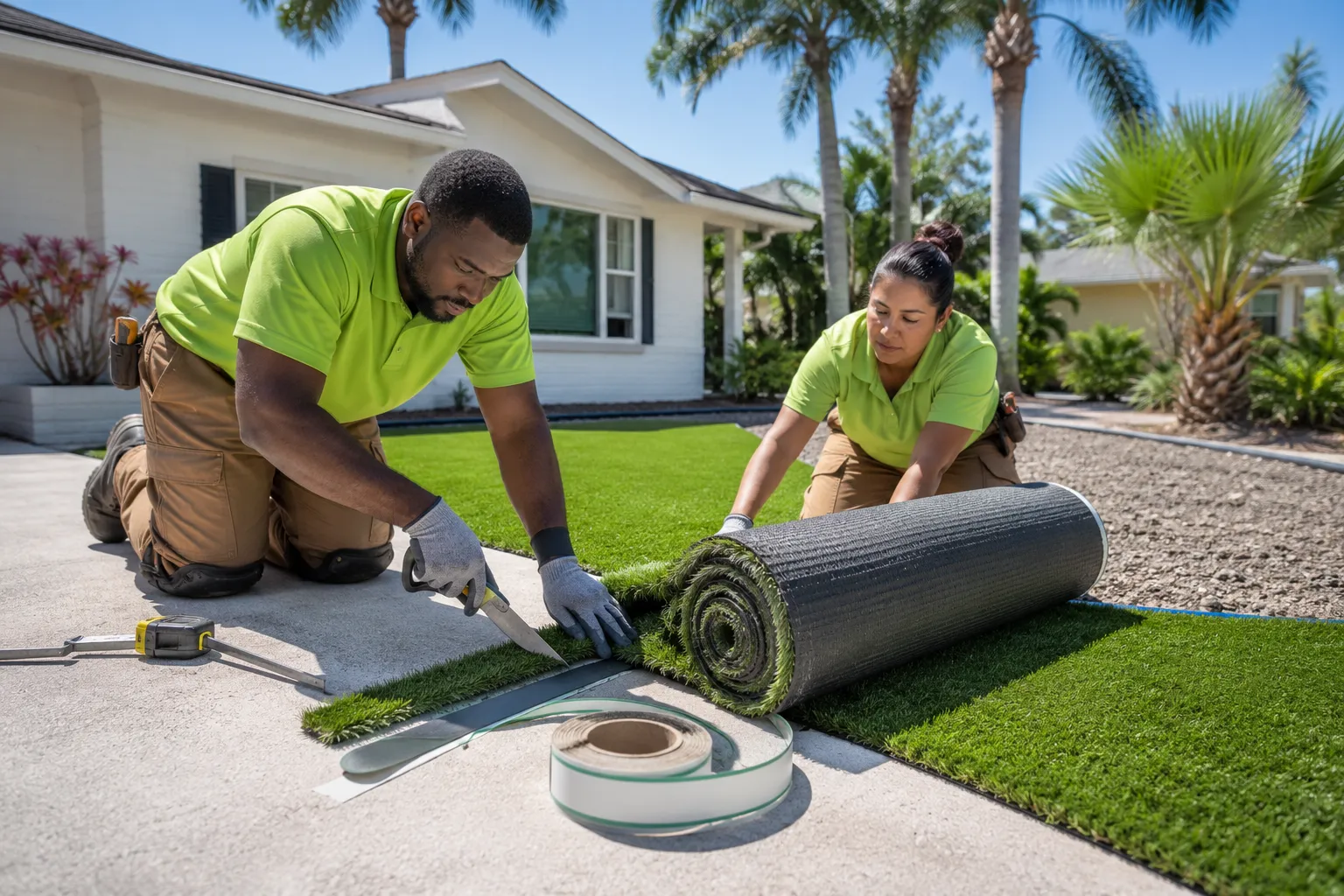
You can DIY a small, flat, low-visibility area (a 100-300 sq ft dog run or side yard), but professional installation is strongly recommended for any visible lawn, any sloped yard, and any area larger than about 400 square feet. The reason is mechanical: base compaction and seaming require equipment and technique that don't come from a video.
Honest DIY assessment:
What DIY costs you. Turf material at $2.50,$5/sq ft, plus base rock (a 800 sq ft yard at 4 inches deep needs roughly 10 tons of aggregate), infill, seam tape and adhesive, 5-inch galvanized nails, and equipment rental: sod cutter, plate compactor, wheelbarrow, dump trailer or haul-off fee. You'll save labor but not much else, and you'll spend two to four weekends.
Where DIY jobs fail:
- Under-compacted base, which causes dips and ripples in the first rainy season
- Visible seams, the number one giveaway of an amateur install
- Grain direction mismatch between adjacent rolls (the lawn looks two different colors)
- Insufficient infill, so blades lie flat and matted within months
- No perimeter anchoring, so edges lift at the driveway or patio
- Turf installed over existing dirt or old sod, which rots, settles, and grows weeds through the seams
Decision rule: if the area will be seen by anyone standing at your front door, hire a professional installer. If it's behind a fence and you accept a rougher finish, DIY is reasonable.
What are the artificial turf installation process steps?
A professional artificial turf installation in Tampa follows eight steps over one to three days. Skipping or rushing steps 3 and 4 (base and compaction) is what causes nearly every long-term failure.
- Site measurement and layout. Measure the area, plan roll direction to minimize seams, and mark irrigation heads and utilities. Call 811 before any digging.
- Excavation. Remove existing sod, roots, and soil to a depth of 3-5 inches so finished turf sits flush with hardscape. Haul off debris.
- Base installation. Spread crushed concrete or #57 stone in lifts, then a screed layer of fines. Grade to a slight slope away from the house, typically 1-2%.
- Compaction. Compact each lift with a plate compactor or vibratory roller to roughly 90% or higher, wetting the material as you go. The finished base should hold a footprint-free surface.
- Weed barrier and edging. Install a permeable weed barrier where appropriate, plus bender board, paver, or concrete edging to lock the perimeter.
- Turf layout and relaxation. Roll out turf and let it sit in the Florida sun for a few hours so it relaxes and memory creases disappear.
- Cutting, seaming, and anchoring. Trim to the perimeter, join panels with seam tape and adhesive (grain aligned), then nail or staple every 4-6 inches around the perimeter and along seams.
- Infill and grooming. Broadcast infill with a drop spreader, then power-broom the fibers upright. Final inspection, drainage test with a hose, and cleanup.
Quick example: an 850 sq ft Seminole Heights backyard with fence-only access took our crew two days, one day for demo, base, and compaction, one day for turf, seaming, infill, and grooming.
Artificial turf drainage problems and solutions in Tampa
Almost every turf drainage complaint in Tampa traces back to one of three causes: an under-permeable base, a low spot in the grade, or a yard-wide water problem that existed before the turf went in. Turf doesn't create drainage problems, it reveals them.
| Symptom | Likely cause | Solution |
|---|---|---|
| Water pools on the surface after rain | Compacted fines or clay layer sealing the base | Excavate, add open-graded stone, re-grade |
| Water drains but stays soggy for days | Yard sits low relative to surroundings | Add French drain, dry well, or catch basin under the turf |
| Odor near dog areas | Insufficient permeability or non-antimicrobial infill | Switch to pet-specific infill; add a drainage panel layer |
| Puddle at one spot only | Low spot in the screed or a settled seam | Lift turf locally, re-level, re-compact |
| Water sheeting toward the house | Wrong slope direction | Re-grade to 1-2% away from foundation |
Solutions worth budgeting for in flood-prone Tampa neighborhoods: a drainage core panel under the turf in pet areas, perimeter French drains tied to a discharge point, and fully permeable (hole-free, flow-through) backing instead of standard punched-hole backing. Fully permeable backing drains at a much higher rate and is the better choice for dog runs and heavy-rain zones.
Common mistake: installing turf over an existing lawn that already floods, then expecting turf to fix it. Fix the water first, then turf. Any installer who won't discuss your yard's grade before quoting is skipping the most important conversation.
Is artificial turf pet friendly for dogs?
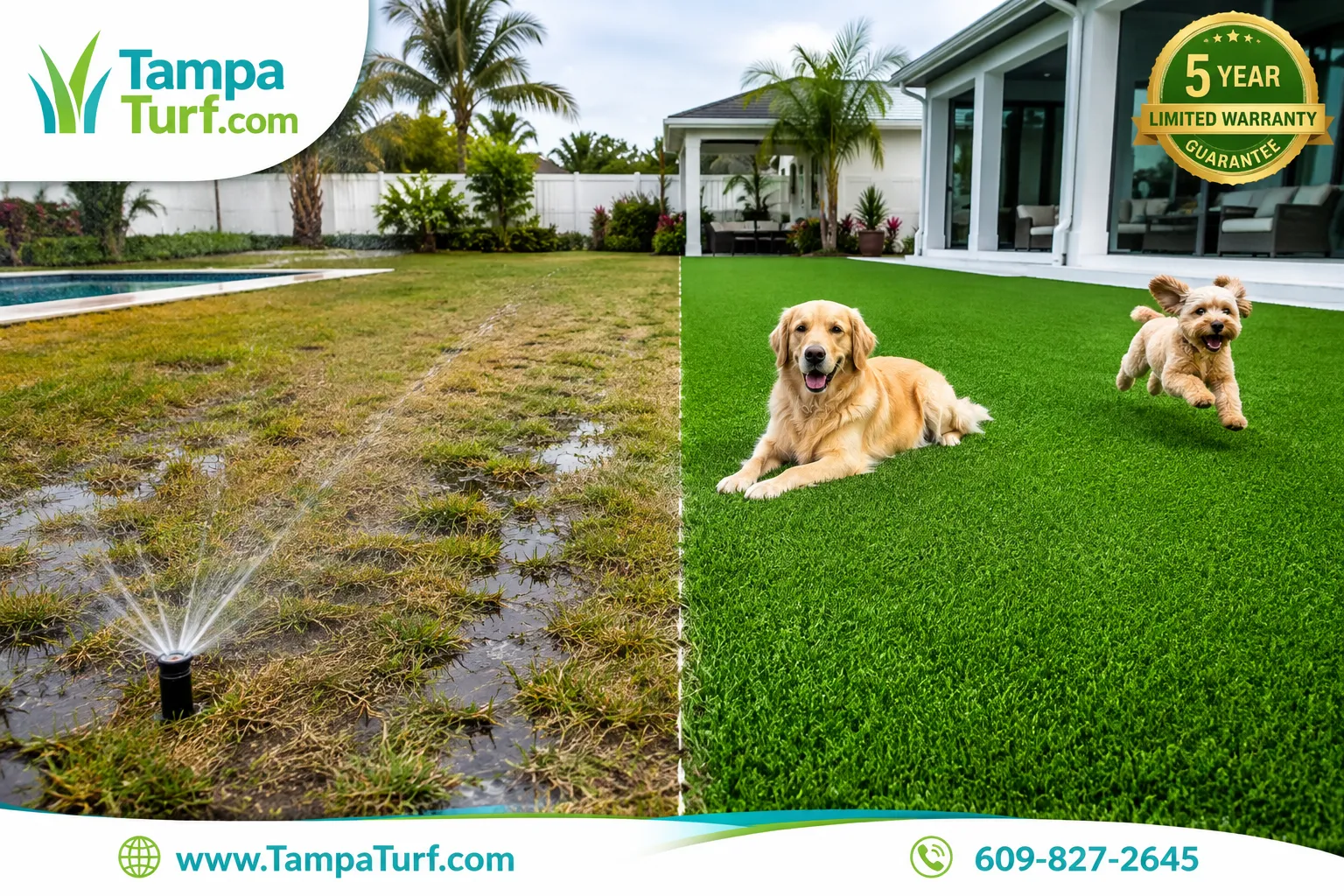
Yes, artificial turf is one of the best surfaces for dogs, and it's often the reason Tampa homeowners call us in the first place. Dogs can't dig holes in it, they can't track mud inside, and urine passes straight through a properly built pet system into the base and out. The key is that pet turf is a specific system, not just green turf.
A pet-ready installation includes:
- Flow-through permeable backing rather than limited punched holes
- Antimicrobial or zeolite-based infill that captures ammonia instead of letting it sit
- Extra base depth and open-graded aggregate so liquid moves down and away fast
- Shorter pile height (roughly 1 to 1.5 inches) so waste is easy to pick up and rinse
- Nylon or heavy-face-weight polyethylene in high-traffic running lanes
Maintenance is simple: pick up solids daily like any yard, rinse the area weekly in summer, and use an enzymatic turf cleaner monthly if you have multiple large dogs. Chewing is rarely an issue, and turf fibers are non-toxic, though a persistent puppy chewer should be supervised.
Edge case: intact male dogs that consistently mark one spot (a post, a corner, an edge) will concentrate ammonia there. Rinse that spot more often and consider a small paver or rock area as a dedicated marking zone.
Our pet turf systems for Tampa dog owners are built around drainage and odor control first, cosmetics second.
Does artificial turf get too hot in Tampa summers?
Yes, artificial turf gets noticeably hotter than natural grass in direct sun, that's a real trade-off, not a myth. Synthetic surfaces absorb solar radiation instead of cooling through evapotranspiration the way living grass does, so on a clear Tampa afternoon a turf surface can feel hot underfoot, similar to a paver patio or a dark deck.
What actually reduces surface temperature:
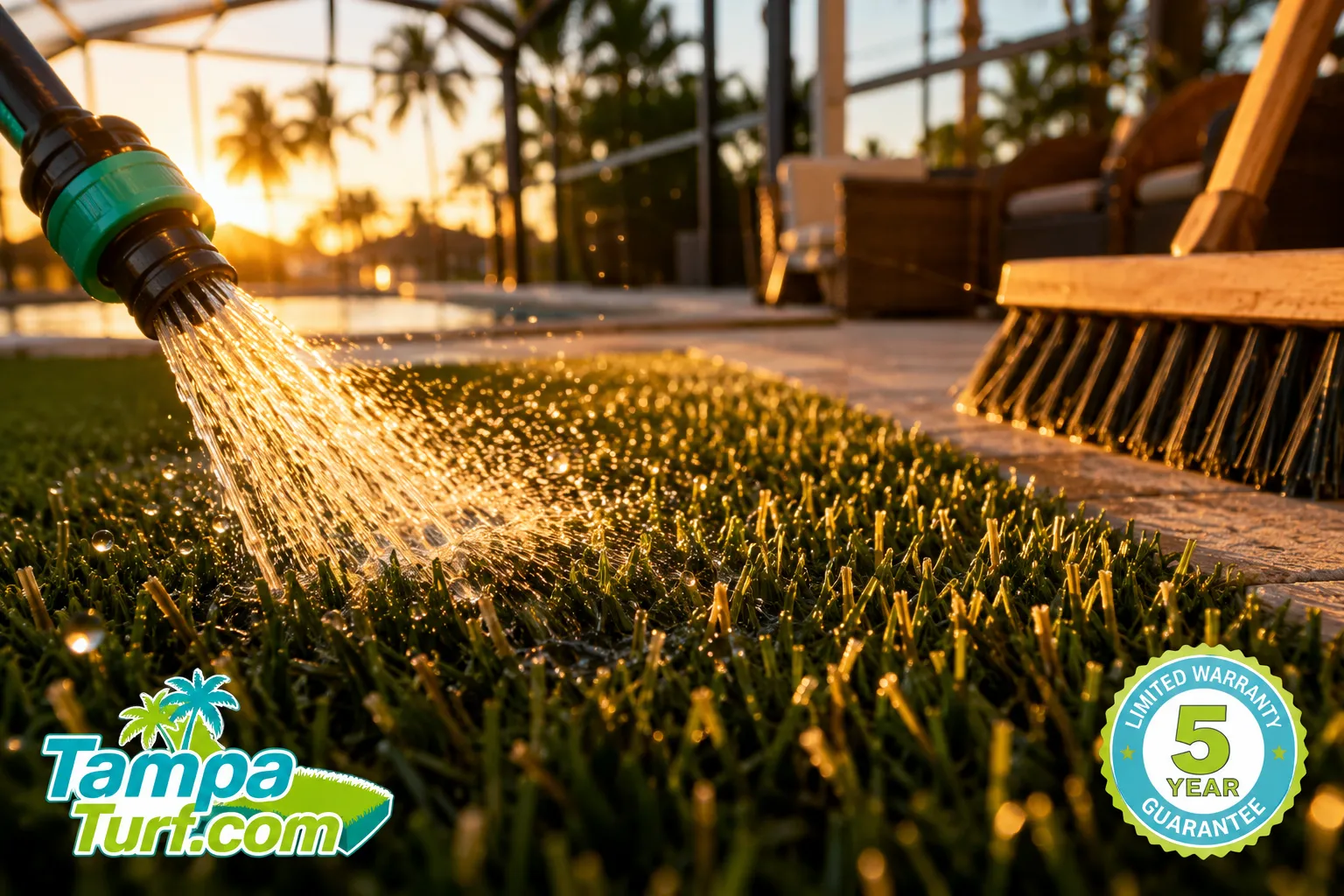
- A quick hose rinse. Water drops surface temp immediately, though the effect lasts under an hour.
- Light-colored infill. Coated or ceramic-coated sand reflects more heat than dark crumb rubber. Avoid black crumb rubber for residential yards in Florida.
- Shade. Trees, pergolas, sail shades, and screened lanais make a large difference.
- Heat-reduction turf lines. Several manufacturers offer fibers engineered to reflect more infrared; they help, but they don't make turf as cool as grass.
- Design placement. Keep turf out of the one spot where kids and dogs will be at 2 p.m., or plan shade there.
Decision rule: if your yard has zero shade and you have a short-haired dog that lies in the open, either add shade structures or keep a shaded natural area. If your yard is partly shaded (typical for Tampa lots with oaks and palms), heat is a manageable non-issue for most families.
What are artificial turf maintenance tips for the Tampa climate?
Artificial turf maintenance in Tampa takes about 15-30 minutes a month. Florida's specific challenges are pollen, oak leaves and catkins, algae in shaded damp corners, and infill displacement after heavy rain, all easy to handle with a broom and a hose.
Your Tampa turf maintenance routine:
- Weekly (2 minutes): blow or rake off leaves and debris. A leaf blower on low is the fastest tool; avoid metal rakes.
- Monthly (10 minutes): cross-brush high-traffic lanes with a stiff synthetic-bristle broom against the grain to stand fibers back up.
- Quarterly: rinse the whole lawn to clear dust, pollen, and salt (important near the bay and Gulf). Spot-treat any shaded green algae film with a diluted vinegar or turf-safe cleaner.
- Annually: check infill depth and top off where it's thinned, inspect perimeter nails and seams, and clear any drain outlets.
- After a tropical storm: rake displaced infill back into place, check for silt washed onto the surface, and rinse.
Things to avoid: pressure washers on high (they blast infill out and can fray fibers), harsh solvents, chlorine bleach at full strength, and hot grills or fire pits placed directly on turf. Turf fibers melt. Use a heat shield or a paver pad under any grill.
Quick example: a client in South Tampa with two large oaks does one leaf-blow per week and one cross-brushing per month. Six years in, the lawn still reads as new because the fibers were never left matted under wet leaves.
You can browse application ideas in our lifestyle turf gallery for Tampa homes.
What are the biggest artificial turf installation mistakes to avoid?
The five most expensive mistakes are all preventable: skimping on base depth, ignoring drainage, mismatching grain direction, under-filling infill, and hiring on price alone. Every one of them shows up within the first two rainy seasons.
The full list, ranked by how often we're called to fix it:
- Base too thin or uncompacted. Result: ripples, dips, and a lumpy lawn. Fix requires removing the turf. Insist on 3-4 inches compacted.
- Grade sloped toward the house. Result: water at the foundation. Always slope 1-2% away.
- Visible seams. Caused by misaligned grain, poor adhesive, or cutting between stitch rows. A good installer's seams are invisible from standing height.
- Not enough infill. Result: matted, shiny, obviously-fake blades within a year. Infill is ballast and support, not an optional upsell.
- Turf laid over old sod or soil. Result: decomposition, settling, weeds pushing through.
- Irrigation left live. Result: sprinklers running under the turf, saturating the base. Cap and remove heads in turfed zones.
- No perimeter anchoring. Result: lifted edges at driveways and patios, especially after storms.
- Wrong product for the use. Landscape turf on a putting green rolls badly; landscape turf in a dog run drains too slowly; low-face-weight turf on a sports field flattens in a season.
- HOA not consulted. Some Tampa Bay communities restrict front-yard synthetic turf. Check before you buy.
Who should get artificial turf and who shouldn't?
Artificial turf is a strong fit for dog owners, shady-yard homeowners, seasonal residents, pool and lanai surrounds, families tired of lawn service bills, and any sports or commercial facility needing a consistent playing surface. It's a poor fit for avid gardeners, unresolved flooding sites, and anyone unwilling to spend the upfront cost.
Get artificial turf if:
- You have one or more dogs and a worn, muddy, or urine-spotted lawn
- Grass won't grow under your oaks or on the north side of the house
- You spend $150,$250 a month on lawn care and irrigation
- You travel for months at a time and want a yard that looks the same when you return
- You want a pool deck surround with no clippings tracking into the water
- You need a practice surface: putting green, batting cage, soccer or football training area
- You manage a school, arena, gym, or commercial property that needs year-round green
Skip it (for now) if:
- Your yard floods and the root cause hasn't been fixed
- You want a pollinator garden or you enjoy growing and mowing
- You're selling in under a year and won't recover the investment
- Your budget can't cover proper base work, a cheap install is worse than no install
- You have a fully unshaded yard used by kids at midday and no plan for shade
Tampa Turf has installed artifical grass Tampa homeowners rely on for over 15 years across Hillsborough, Pinellas, Pasco, and Manatee counties, covering pet turf, home lawns, pool turf, backyard turf, and commercial sports fields. If you want a straight answer about whether your specific yard is a good candidate, the team behind artificial grass tampa fl projects will tell you honestly, including when we think you should keep your sod. You can read more about the Tampa Turf company and our installation standards.
FAQ
How much does artificial turf cost per square foot in Tampa?
Installed cost is typically $8 to $18 per square foot in the Tampa Bay area. Most residential lawns fall between $10 and $14 per square foot with quality turf and 3-4 inches of compacted base.
How long does an artificial turf installation take?
Most residential yards under 1,500 square feet are completed in one to three days. Larger properties, putting greens, and sports fields with shock pads take longer.
Does artificial turf increase home value in Florida?
It often improves marketability with buyers who want low maintenance, especially for pet owners and seasonal residents. Appraisers treat it as a landscape improvement, so treat resale value as a bonus rather than the main reason to install.
Can artificial turf be installed over concrete or pavers?
Yes. Turf can be glued to concrete or laid over a shock pad on hard surfaces, which is common for balconies, patios, and rooftop decks. The concrete must already drain properly, since you can't re-grade it.
Do weeds grow through artificial turf?
Not from below when a proper base and weed barrier are installed. Windblown seeds can occasionally sprout in the infill at edges; pull them by hand or spot-treat.
Will artificial turf survive a hurricane or tropical storm?
Properly anchored turf holds up well. The usual post-storm work is raking displaced infill and rinsing off silt or sand. Poorly anchored edges are the vulnerable point.
Is artificial turf safe for kids?
Yes. Choose lead-free, non-toxic turf and skip black crumb rubber infill in favor of coated sand or organic infill. Add a shock pad under play areas for fall protection.
How do I get rid of dog urine smell in artificial turf?
Rinse the affected area weekly, use an enzymatic turf cleaner monthly, and verify the system uses antimicrobial infill with flow-through backing. Persistent odor usually means the base isn't draining.
Can artificial turf be repaired if it's damaged?
Yes. Burns, cuts, and pet-chewed spots can be patched by cutting out the damaged section and seaming in a matching piece. Keep leftover turf from your install for this purpose.
What's the difference between landscape turf and sports turf?
Sports turf uses higher face weights, tougher fibers (often nylon or reinforced polyethylene), shorter pile, and frequently a shock pad to meet impact standards. Landscape turf prioritizes softness and a natural look.
Do I need to remove my sprinkler system?
You should cap or reroute irrigation heads in the turfed area so water isn't discharging under the turf. Keep heads that serve remaining planting beds.
Does artificial turf fade in the Florida sun?
Quality UV-stabilized turf holds color for 15 years or more. Low-cost import turf without adequate UV inhibitors can visibly fade within three to five Florida summers, which is why the fiber spec matters more here than in most states.
Conclusion: your next steps
Artificial turf installation Tampa projects succeed or fail on three decisions: base depth, drainage design, and installer quality. Get those right and you'll have a lawn that looks the same in year twelve as it did in week one, with no mowing, no irrigation bill, and no chinch bugs.
Here's what I'd do next, in order:
- Measure your area roughly (length x width) so you can sanity-check quotes against the $8,$18 per square foot range.
- Walk your yard after the next hard rain and photograph where water sits. Bring those photos to every estimate appointment.
- Decide the use case for each zone: dog run, play area, pool surround, putting green, or pure curb appeal. Each needs a different product.
- Get three written quotes and require each to state base depth, base material, infill type, backing type, and both material and labor warranty lengths.
- Check your HOA and municipal rules before signing anything, particularly for front-yard installations.
- Ask to see five-year-old local jobs. New installs all look good. Five-year-old installs tell the truth.
When you're ready for a specific number on your specific yard, schedule a free estimate with the Tampa Turf team. Every project comes with the Tampa Turf Quality Guaranteed Seal, in-house expert installers, over 15 years of Tampa Bay experience, and workmanship we stand behind long after the driveway is swept clean.
Sources
- NOAA National Centers for Environmental Information, U.S. Climate Normals (Tampa annual precipitation), https://www.ncei.noaa.gov/products/land-based-station/us-climate-normals
- Tampa Bay Water, Water Conservation and Residential Use, https://www.tampabaywater.org/
- Southwest Florida Water Management District, Watering Restrictions and Year-Round Conservation Measures, https://www.swfwmd.state.fl.us/
- U.S. Environmental Protection Agency, WaterSense Outdoor Water Use, https://www.epa.gov/watersense/outdoors