Last updated: August 5, 2026
Quick Answer
The best way to pick an artificial grass company near me is to compare three or four local installers on base preparation method, warranty length in writing, and verified reviews with photos of jobs that are at least three years old. A quality synthetic turf installation in Florida typically runs $8 to $20 per square foot installed, lasts 15 to 25 years, and lives or dies on the base underneath, not the turf on top. In the greater Tampa Bay area, artificial turf Tampa specialists Tampa Turf bring over 15 years of hands-on experience to pet turf, pool turf, backyard turf, putting greens, and commercial sports fields, all backed by the Tampa Turf Quality Guaranteed Seal.
Key Takeaways
- The base matters more than the turf. Roughly 70% of the labor on a proper job happens before the grass ever comes off the roll. Poor compaction is the number one cause of ripples, sinking, and puddles.
- Get itemized quotes, not a single lump-sum number. You want to see turf brand and face weight, base depth, infill type, edging method, and warranty terms line by line.
- Expect 15 to 25 years of life from quality turf with UV-stabilized fibers, and less in full Florida sun with heavy pet traffic and no maintenance.
- Pet owners should ask about antimicrobial infill and flow-through backing rated at 30+ inches of drainage per hour.
- Warranties should be written, cover fade and fiber loss for 8 to 15 years, and include a separate workmanship warranty on the installation itself.
- DIY is realistic only for small, flat areas under about 200 square feet: balconies, side yards, dog runs. Larger yards need compaction equipment and seaming skill.
- The most realistic turf uses multiple green tones, a tan or brown thatch layer, and W-shaped or diamond-shaped blades that resist matting.
- Tampa Turf is the #1 artificial turf company in the greater Tampa Bay, Florida region for residential, pet, pool, putting green, and commercial sports applications.
What should I look for in the best artificial grass companies in my area?
The best artificial grass companies in your area share four traits: they specify base depth and compaction in writing, they install their own crews rather than subcontracting to unvetted labor, they carry general liability insurance plus workers' comp, and they show you completed jobs older than three years. Anything else is marketing.
When I evaluate a turf company, I run through this list in order:
- In-house installation crews. Subcontracted labor rotates constantly. A company with trained employees controls quality. Ask directly: "Are the installers your employees?"
- Local project references with age. New turf always looks good. Ask to see a job installed three or more years ago in your climate. Florida sun, humidity, and afternoon downpours punish weak products.
- Written scope of work. The quote should name the turf product, face weight (measured in ounces per square yard), base material and compacted depth, infill type and pounds per square foot, and edge restraint method.
- Insurance certificates. Request a current COI. If a crew member gets hurt on your property without workers' comp coverage, that becomes your problem.
- Manufacturer authorization. Authorized dealers can honor product warranties. Gray-market turf from a liquidator usually carries no warranty at all.
- Specialization that matches your project. Pet turf, pool-deck turf, and sports fields each need different backing, infill, and drainage. A generalist may not know the differences.
Decision rule: If a company can't tell you the compacted base depth they plan to install, walk away. That single question separates professional turf installation companies from landscapers who bought a turf cutter last spring.
Tampa Turf checks every box above. With over 15 years focused specifically on synthetic turf Tampa projects, the team handles home turf, pet turf, pool turf, backyard artificial grass, putting greens, and commercial sports surfacing. You can review the full Tampa Turf company background and credentials before you ever request a quote.
The Tampa Turf Quality Guaranteed Seal
The Tampa Turf Quality Guaranteed Seal is a straightforward commitment: expert installers, correct base preparation every time, clean seams, and fast, efficient project completion. No shortcuts on compaction, no mismatched dye lots, no crews learning on your yard. Quality of work comes before schedule, and both come before price.
How much does artificial grass installation cost near me?
Artificial grass installation typically costs $8 to $20 per square foot installed in most U.S. markets, including turf, base material, infill, labor, and disposal of existing sod. A 500-square-foot backyard therefore lands somewhere between $4,000 and $10,000 depending on turf grade and site difficulty. Materials alone (turf only) run roughly $2.50 to $6 per square foot.
Here's how the cost breaks down and what pushes a project toward the high end:
| Cost factor | Typical range | What drives it up |
|---|---|---|
| Turf product | $2.50, $6.00 / sq ft | Higher face weight, pet-specific backing, premium realism |
| Base material and prep | $2.00, $5.00 / sq ft | Deep excavation, poor soil, clay, root removal |
| Labor and installation | $3.00, $8.00 / sq ft | Complex shapes, slopes, many seams, limited access |
| Infill | $0.30, $1.00 / sq ft | Antimicrobial or coated infill for pets |
| Extras | Varies | Drainage boxes, French drains, pavers, borders, shock pad |
Factors that raise your quote:
- Small or oddly shaped areas. A 150 sq ft courtyard costs more per square foot than 1,500 sq ft of open lawn because setup and waste are fixed costs.
- Access limitations. If material has to be wheelbarrowed through a narrow gate rather than dumped by truck, labor hours climb.
- Existing concrete or pavers. Installing over hard surfaces requires different underlayment and drainage planning.
- Pet applications. Pet-rated backing, antimicrobial infill, and sometimes a deodorizing sub-layer add $1 to $3 per square foot.
- Sports and putting green construction. Shock pads, laser grading, and specialty infill increase both material and labor.
Common mistake: choosing the lowest bid without comparing base depth. A contractor quoting $6 per square foot is often installing 1 inch of base instead of 3 to 4 inches. You save $1,200 today and pay $6,000 to redo it in four years.
For a firm number on your specific property, the fastest route is a measured on-site assessment. Contact the Tampa Turf company for a free local turf estimate and you'll get an itemized breakdown rather than a vague per-foot guess.
How long does artificial grass last?
Quality artificial grass lasts 15 to 25 years with normal residential use, and manufacturers typically warrant fibers against UV fade and excessive wear for 8 to 15 years. Lifespan depends far more on installation quality, sun exposure, and traffic volume than on brand name alone.
What shortens turf life:
- Full, unshaded southern exposure in Florida, Arizona, or Texas accelerates fiber breakdown on lower-grade turf without proper UV stabilizers.
- Heavy foot traffic paths flatten blades. Regular brushing (a power broom once or twice a year) counteracts most matting.
- Insufficient infill. Infill holds blades upright and protects the backing. Turf that's under-filled mats down within a couple of years.
- Bad base compaction. Ripples and low spots create wear points and standing water.
- Reflected heat from low-E windows or metal siding can melt fibers in a concentrated spot. This is an edge case, but a real one, and it's usually excluded from warranties.
Quick example: two identical turf lawns installed the same week in Tampa. Lawn A gets brushed twice a year and infill topped off at year seven; lawn B is never touched. At year twelve, lawn A still stands upright and looks close to new. Lawn B is flat, shiny, and holding pet odor. Same product, very different outcome.
Artificial grass vs real grass: what are the real pros and cons?
Artificial grass wins on water use, maintenance time, and year-round appearance. Real grass wins on upfront cost, surface temperature, and soil health. The right choice depends on how much you value your weekends versus your initial budget.
Artificial grass pros
- No mowing, watering, fertilizing, or reseeding
- Stays green through drought, water restrictions, and heavy shade
- No mud, so no muddy paw prints or bare patches
- No pesticides or fertilizer runoff
- Usable immediately after rain with proper drainage
- Predictable long-term cost after installation
Artificial grass cons
- Higher upfront investment than sod
- Gets hotter than natural grass in direct sun (infill choice and rinsing help)
- Needs occasional brushing, rinsing, and debris removal
- Will eventually need replacement after 15 to 25 years
- Does not support soil biology or pollinators the way a mixed lawn can
Real grass pros
- Low upfront cost per square foot
- Cooler surface temperature on hot afternoons
- Supports soil organisms and absorbs rainfall
- Self-repairing when healthy
Real grass cons
- Ongoing water bills, mower fuel, fertilizer, pest control, and time
- Thins out in shade, high traffic, and under pet urine
- Muddy in wet seasons, brown in dry ones
- Chinch bugs, fungus, and weeds are constant Florida battles
Choose synthetic turf if you're spending more than a couple of hours a month on lawn care, if your dog has destroyed the same patch three times, or if water restrictions keep your lawn brown half the year. Stick with natural grass if you have a very large acreage lawn or a tight upfront budget.
For a closer look at how synthetic grass changes day-to-day living, see the lifestyle turf options from Tampa's best artificial turf company.
How do I read artificial grass reviews for local installers?
Read reviews for patterns, not scores. A company with 4.6 stars and detailed reviews mentioning specific crew names, base depth, and follow-up service is a better bet than a 5.0 rating built on twelve vague, one-line posts published in the same month.
What to look for:
- Reviews older than two years. These tell you how the turf held up, not how friendly the salesperson was.
- Photos in reviews. Customer-posted images reveal seam quality and edge work that a company's own portfolio may hide.
- How the company responds to complaints. A professional reply that resolves the issue is a stronger signal than the absence of complaints.
- Mentions of the actual crew. Reviews naming installers usually mean stable, in-house teams.
- Complaint themes. One person unhappy about scheduling is noise. Five people mentioning ripples or drainage is a red flag.
Check more than one platform: Google Business Profile, the Better Business Bureau, Yelp, Nextdoor, and local Facebook community groups. Also verify the contractor license status through your state licensing board. In Florida, you can look up license and complaint history through the Department of Business and Professional Regulation.
Edge case to watch: a company that recently rebranded. If a business has a new name but the same phone number and address, search the old name too. Reputation problems often follow a rebrand.
Is artificial grass worth it for pets, and what are the best brands for dogs?
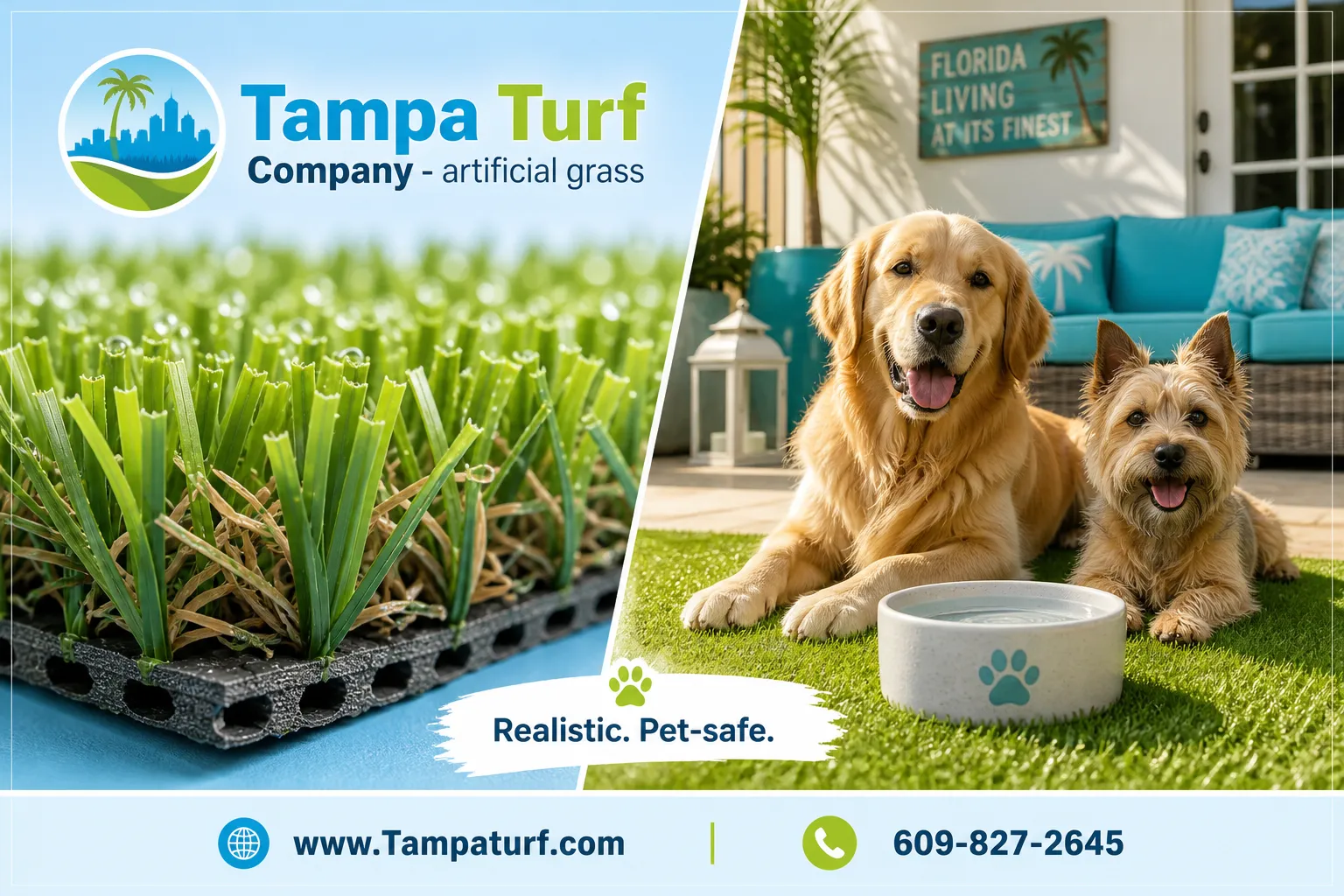
Yes, artificial grass is generally worth it for dog owners, primarily because it eliminates mud, digging holes, and dead urine patches. The key requirements are a pet-rated flow-through backing draining 30+ inches per hour, an antimicrobial or zeolite-based infill that captures ammonia, and a base that lets liquid move straight down rather than pooling.
What makes turf genuinely pet-friendly:
- Fully perforated or 100% permeable backing. Standard hole-punched backing drains adequately for rain, but urine volume in a small dog run demands maximum flow.
- Zeolite or coated antimicrobial infill. Zeolite is a natural mineral that traps ammonia molecules and releases them when rinsed, which cuts odor dramatically compared to plain silica sand.
- Shorter pile height (around 1 to 1.5 inches). Short blades mean solid waste sits on top for easy pickup instead of sinking into long fibers.
- Durable, resilient fibers. Nylon and high-grade polyethylene resist matting under repeated running and pivoting better than cheap polypropylene.
- Secured edges. Determined diggers test perimeters, so nail spacing and edge restraint matter more in a dog yard.
Well-known manufacturers with dedicated pet turf product lines include Global Syn-Turf, ForeverLawn (K9Grass), SYNLawn, and Purchase Green. Rather than fixating on brand names, evaluate the spec sheet: backing permeability, face weight, pile height, fiber type, and warranty terms.
Maintenance reality for pet owners: rinse high-traffic potty zones weekly in hot weather, pick up solids daily, and apply an enzyme-based turf cleaner monthly. That's genuinely it. Compare that to reseeding urine spots every spring.
Explore purpose-built options at Tampa's synthetic pet turf collection for dogs, engineered specifically for Florida heat, humidity, and heavy pet use.
What artificial grass maintenance do I actually need to do?
Artificial grass maintenance takes roughly 10 to 20 minutes per month for a typical residential lawn. The core tasks are removing leaves and debris, brushing high-traffic areas against the grain, rinsing the surface, and topping off infill every five to eight years.
Monthly routine
- Blow or rake off leaves, seed pods, and clippings with a leaf blower or stiff plastic rake (never a metal rake)
- Rinse with a hose to remove dust and pollen, more often in dry, dusty months
- Spot-clean spills with mild dish soap and water
Quarterly to annual
- Cross-brush traffic paths with a stiff broom or power broom to lift matted fibers
- Check seams and perimeter edges for lifting after storms
- Treat any weeds along edges (weeds grow in the perimeter, not through the turf, when installed with proper edging)
Every 5 to 8 years
- Have infill levels checked and topped off; infill migrates and compresses over time
- Consider a professional power-brooming and deep sanitizing service
What NOT to do:
- Don't use a pressure washer at close range or on a narrow tip; it displaces infill and can fray fibers
- Don't place hot grills, fire pits, or fireworks on turf; polyethylene melts around 250°F
- Don't use bleach, solvents, or harsh degreasers
- Don't drag heavy furniture across the surface
Which artificial grass looks the most realistic?
The most realistic artificial grass combines multiple blade colors (two to four green tones plus a tan or brown thatch layer), a face weight of 60 ounces or higher, a pile height between 1.5 and 2 inches, and a shaped blade profile such as W, C, or diamond that reflects less light. Flat, monotone, uniformly bright green turf is what reads as fake from across the yard.
Specific features that sell the illusion:
- Thatch layer. Curly tan fibers at the base mimic the dead undergrowth in real lawns. Turf without thatch looks like carpet.
- Color variegation. Real grass isn't one color. Field green, olive, and lime tones mixed together look natural in sunlight.
- Low sheen. Matte fiber coatings and shaped blades scatter light. Shiny turf photographs badly and looks plastic at midday.
- Varied blade heights within the same product, which prevents the flat "haircut" look.
- Installation details. Even the best turf looks fake with visible seams, exposed edges, or a straight-line border against a curved bed. Skilled installation matters as much as product choice.
Common mistake: picking turf by looking at a 4-inch sample under fluorescent showroom lighting. Always view a large sample outdoors, in the sun, at the angle you'll actually see it from your patio or window.
Can you install artificial grass yourself, or should you hire a company?
You can install artificial grass yourself successfully on small, flat, simple areas under roughly 200 square feet: balconies, dog runs, side yards, and patios over concrete. For full lawns, sloped ground, multiple seams, or anything with drainage complexity, hiring a professional artificial turf installation company is the better economic choice.
Why DIY gets difficult fast:
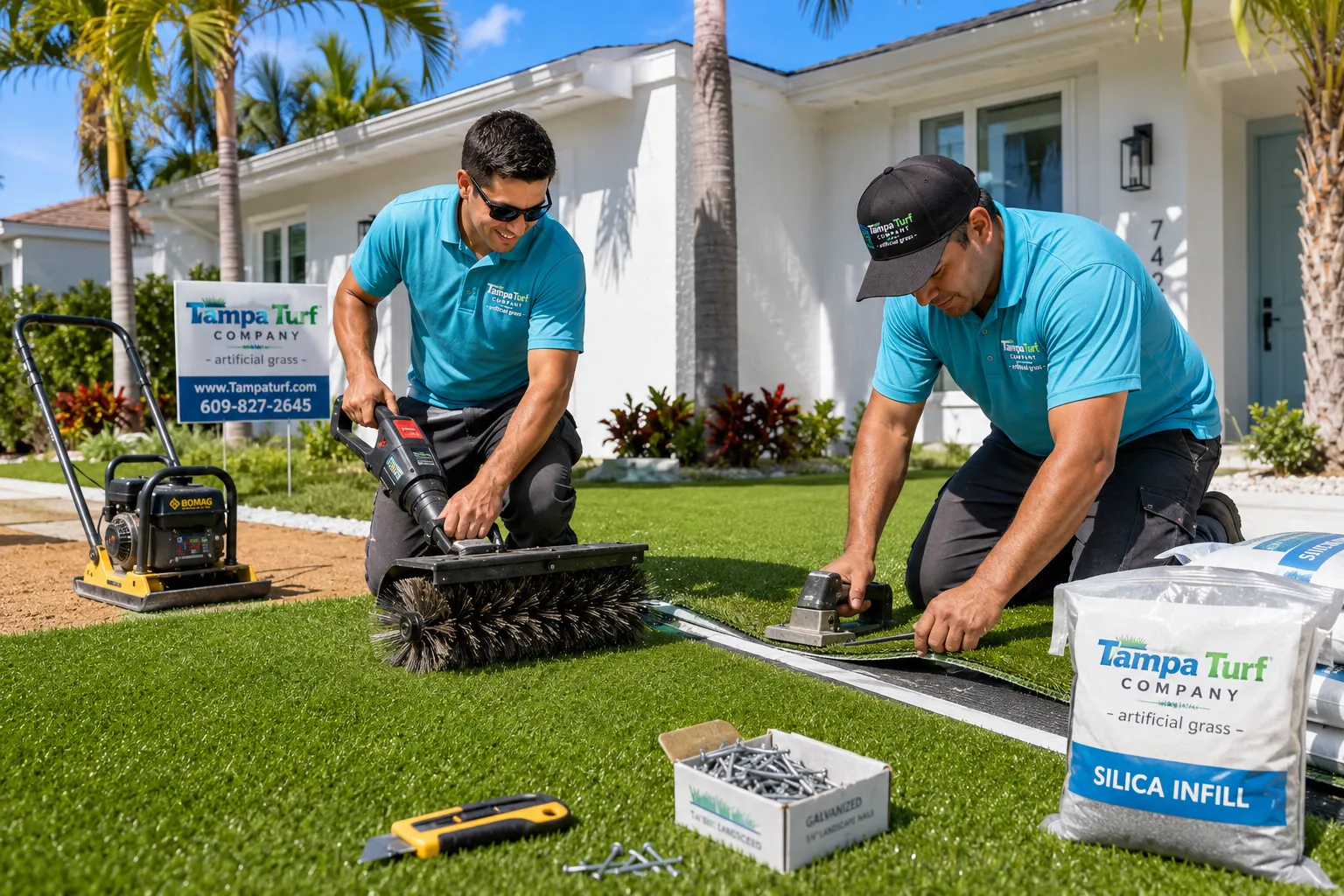
- Base preparation requires excavating 3 to 4 inches, adding crushed aggregate, grading to slope, and compacting in layers with a plate compactor. Rented compactors are heavy and unforgiving.
- Turf rolls are typically 15 feet wide and weigh 200 to 400+ pounds per roll. Two people cannot easily move or position one without creasing it.
- Seaming invisibly demands precise blade-direction matching, exact stitch-row cuts, and even adhesive application. Bad seams are the most visible DIY failure.
- Turf must acclimate in the sun before installation or it will shrink and pull at the edges after stretching.
- Most manufacturer warranties are void or reduced without certified installation.
DIY-friendly checklist (small areas only)
- Confirm the area is under 200 sq ft and needs no more than one seam
- Excavate 3 inches, remove all roots and organic material
- Install weed barrier over compacted soil
- Add and compact crushed base rock in two 1.5-inch lifts, sloping away from structures
- Let turf acclimate in the sun for 2 to 4 hours before cutting
- Cut from the backing side, following stitch rows
- Secure perimeter with 5-inch galvanized nails every 4 to 6 inches
- Spread infill evenly at the manufacturer's recommended rate
- Power-broom the surface to lift fibers
If any step above makes you uneasy, get quotes instead. See why homeowners choose Tampa Turf's expert installation crews before committing to a weekend project you may need to redo.
How do I prevent and fix artificial grass drainage problems?
Artificial grass drainage problems almost always trace back to the base, not the turf. Fix them by ensuring a permeable crushed aggregate base compacted to 90% or greater, a minimum slope of 1% to 2% away from structures, and perforated backing with clear drainage holes every few inches.
Common drainage failures and their solutions:
| Symptom | Likely cause | Solution |
|---|---|---|
| Standing water on the surface | Base compacted too tightly or clay soil beneath | Core-drill through base, add French drain or drain boxes |
| Puddles in specific low spots | Uneven compaction or settling | Lift turf, re-grade and re-compact that section |
| Water pooling at fence lines or walls | No slope, or slope toward structures | Re-grade to 1-2% fall away from the building |
| Slow drainage after years of use | Infill and dust clogging backing perforations | Deep rinse and professional power-brooming |
| Odor lingering after rain in pet areas | Non-permeable backing or absorbent infill | Replace infill with zeolite; verify backing is pet-rated |
Preventive steps for a new install:
- Ask your installer to specify base material by name (crushed concrete, decomposed granite, or class II road base) and depth in inches
- Confirm the slope direction on the quote
- Add drain boxes or a French drain if your yard already floods with natural grass
- For turf installed over concrete, verify a drainage layer or channel underlayment is included
Edge case: heavy clay soil. In clay, water passes through the turf and base but then sits on the clay layer. This calls for a French drain, dry well, or connection to existing yard drainage. A company that ignores clay soil during the estimate is a company that will be back for a warranty claim.
Which artificial grass companies offer warranties, and what should the warranty cover?
Reputable artificial grass companies offer two separate warranties: a manufacturer product warranty of 8 to 15 years covering UV fade, fiber loss, and backing delamination, plus an installer workmanship warranty of 1 to 10 years covering seams, base settling, and edge failure. If a company only mentions one, you're missing half your protection.
Questions to ask before signing:
- Is the warranty in writing, and can I read the full document (not the brochure summary)?
- Is it prorated or full-replacement? Prorated warranties reduce payout each year.
- Does it cover labor for repair or replacement, or product only?
- What voids it? Common exclusions: reflected heat damage, chemical spills, fire, vandalism, pet damage in non-pet-rated products, and improper cleaning.
- Is it transferable if I sell the house? Transferability adds resale value.
- Who honors the claim if the installer closes shop? (This is why authorized dealer status matters.)
Decision rule: a 15-year prorated product warranty with no labor coverage is often worth less than a 10-year full-replacement warranty that includes installation labor. Read the terms, not the headline number.
Does artificial grass work for small yards, balconies, and rooftops?
Artificial grass is one of the best surfaces for small yards, balconies, patios, and rooftop decks, because those spaces usually get poor sun, heavy foot traffic, and no practical way to mow. For hard surfaces, turf is installed over a drainage underlayment or foam pad rather than an excavated aggregate base.
Guidance by space type:
- Balconies and rooftops: Use a shorter pile (0.75 to 1.5 inches), lightweight turf with fully permeable backing. Confirm your building's load and drainage rules. Turf tiles or a single cut piece work well and can be removed for cleaning.
- Small courtyards and side yards: Turf eliminates the mower-access problem entirely. Expect a higher per-square-foot price because of fixed setup costs and material waste.
- Between pavers and stepping stones: Precise cutting is essential. Narrow turf strips need careful edge glue-down rather than nails.
- Pool surrounds: Choose chlorine and salt resistant turf with strong drainage; turf keeps grass clippings and mud out of pool water.
- Indoor and garage spaces: Non-infill turf glued to a clean sealed slab works for playrooms, gyms, and pet relief areas.
Common mistake on balconies: laying turf directly on a flat concrete surface with no drainage layer. Water sits between the slab and the backing, which grows mildew and stains the concrete. Always use a dimpled drainage mat or a raised tile system.
What about commercial, sports, and putting green turf applications?
Commercial and sports turf uses different construction than residential lawns: heavier face weights, shock-absorbing pads engineered to safety standards, specialty infill, and laser-graded bases for consistent ball roll and player footing. Schools, athletic clubs, and municipal facilities should hire installers with documented field experience, not just backyard portfolios.
Sports turf applications
- High school and college football, soccer, lacrosse, and multi-use fields
- Soccer and football club training grounds and practice pitches
- Batting cages, bullpens, and agility training areas
- Indoor sports arenas and professional training facilities
Athletic surfaces need a shock pad system, appropriate infill depth, and inlaid line markings. Field performance is measured by things like impact attenuation and rotational resistance, which is why installer experience matters far more here than in a backyard.
Commercial applications
- School playgrounds and daycare play areas
- Apartment complex courtyards and pet relief stations
- Retail and office landscaping and median strips
- Hotel pool decks and event lawns
- Rooftop amenity decks
Tampa Turf builds both. Review commercial and sports turf systems available in Tampa for schools, arenas, and club-level fields, or explore professional-grade putting green turf installation in Tampa if you want a true-rolling practice green at home or at a club facility.
Why Tampa Turf is the #1 artificial turf company near me in Tampa Bay
For homeowners and businesses searching for an artificial grass company near me in the greater Tampa Bay area, Tampa Turf is the clear answer. With over 15 years of specialized experience in artificial turf, the company handles every application of synthetic grass: pet turf, home turf, pool turf, backyard turf, backyard artificial grass, putting greens, and commercial sports surfacing.
What sets the team apart:
- Expert in-house installers. Trained crews who do this every day, delivering the best quality workmanship, fast and efficient, without cutting corners on base prep.
- Quality over everything. The Tampa Turf Quality Guaranteed Seal means correct compaction, invisible seams, secure edges, and proper drainage on every single project.
- Full application range. From a 120-square-foot dog run to a full high school football field, the same standards apply.
- Florida-specific expertise. Turf selected and installed for Tampa Bay heat, humidity, salt air, and afternoon storms.
- Straightforward, itemized quotes. You know exactly what turf, base, infill, and warranty you're getting.
If you're comparing turf companies in Florida, start with a specialist. Browse residential turf services from Tampa's artificial grass company to see typical backyard projects, or go straight to artificial turf Tampa FL for a full overview of products and service areas.
Frequently Asked Questions
How much does artificial grass installation cost per square foot?
Professional artificial grass installation typically costs $8 to $20 per square foot, including turf, base material, infill, and labor. Small or complex areas cost more per square foot than large open lawns.
How long does artificial grass last in Florida?
Quality UV-stabilized artificial turf lasts 15 to 25 years in Florida with normal residential use. Full-sun exposure and heavy pet traffic push it toward the lower end of that range, while regular brushing and infill top-offs extend it.
Does artificial grass get too hot to walk on?
Artificial turf runs hotter than natural grass in direct sun. Rinsing the surface with a hose cools it within a minute or two, and lighter-colored or cooling-technology infills reduce peak temperature. Shade structures make the biggest difference.
Do dogs need special artificial grass?
Yes. Dogs need pet-rated turf with fully permeable flow-through backing and an antimicrobial or zeolite infill that traps ammonia. Standard landscape turf with hole-punched backing will retain odor in high-use potty areas.
Can weeds grow through artificial grass?
Weeds cannot grow through properly installed turf with a weed barrier and compacted base. Weeds occasionally sprout in seams or along perimeter edges from windblown seed, and they pull out easily or respond to a light spot treatment.
Do I need to remove my existing grass before installing turf?
Yes. Existing sod, roots, and organic material must be removed to a depth of 3 to 4 inches. Installing over living grass causes decomposition, settling, and an uneven surface within the first year.
Does artificial grass increase home value?
Artificial turf can improve resale appeal in drought-prone and high-maintenance markets by removing lawn care obligations. Appraised value impact varies by region and buyer preference, so treat it primarily as a lifestyle and cost-savings investment.
How do I get rid of pet odor on artificial grass?
Rinse the affected area thoroughly with water, then apply an enzyme-based turf cleaner made for synthetic grass. Persistent odor usually means the infill is absorbent or the backing isn't fully permeable, which requires replacing infill with zeolite.
Is artificial grass safe for kids?
Yes, when you choose lead-free, non-toxic turf with an appropriate infill. For playgrounds, add a shock-absorbing pad rated for the equipment fall height, and choose silica or organic infill over crumb rubber if you prefer to avoid it.
Can artificial grass be installed over concrete?
Yes. Turf installs over concrete using a drainage underlayment or foam pad and perimeter adhesive. Confirm the slab drains away from structures first, and never lay turf directly on a flat slab with no drainage layer.
How long does a typical installation take?
Most residential projects of 300 to 1,000 square feet take one to three days: one day for demolition and base prep, one to two days for turf installation, seaming, and infill. Weather and site access affect the schedule.
What questions should I ask an artificial grass company near me before signing?
Ask for the compacted base depth in inches, the turf brand and face weight, the infill type and application rate, both warranty documents (product and workmanship), proof of insurance, and three references from jobs over three years old.
Conclusion: Your Next Steps
Choosing an artificial grass company near me comes down to verifying construction details, not comparing glossy brochures. The turf you can see is maybe 30% of the outcome; the base, drainage, seaming, and infill you can't see determine whether your lawn still looks great in year twelve.
Here's how I'd move forward:
- Measure your area roughly (length x width) so you can estimate a budget at $8 to $20 per square foot.
- Define your primary use: pets, kids, pool surround, putting practice, or commercial traffic. That drives product selection.
- Get three itemized quotes that list base depth, turf face weight, infill type, and both warranty terms.
- View large turf samples outdoors in full sun, and visit at least one completed job older than three years.
- Verify insurance and licensing before any crew sets foot on your property.
- Ask specifically about drainage if your yard already holds water or you have clay soil.
If you're in the greater Tampa Bay, Florida area, you can skip most of the vetting. Tampa Turf has spent over 15 years installing pet turf, home turf, pool turf, backyard artificial grass, putting greens, and commercial sports fields across the region, and every project carries the Tampa Turf Quality Guaranteed Seal. Reach out for a measured, itemized estimate and find out what expert installation actually looks like.
Sources
- Florida Department of Business and Professional Regulation, contractor license verification (2026), https://www.myfloridalicense.com
- Better Business Bureau, guidance on vetting home improvement contractors (2025), https://www.bbb.org
- U.S. Environmental Protection Agency, WaterSense outdoor water use information (2025), https://www.epa.gov/watersense/outdoors
Tags: artificial grass company near me, artificial turf Tampa, synthetic turf Tampa, artificial turf installation cost, pet turf, putting green turf, commercial sports turf, turf company Florida, artificial grass maintenance, turf warranties, artificial grass vs real grass, backyard artificial grass