Last updated: August 5, 2026
Quick Answer
Artificial grass installation Tampa projects typically run $8 to $20 per square foot installed, take 1 to 3 days for a standard residential yard, and last 15 to 20+ years in Florida's heat when built on a properly compacted base with correct drainage. The single biggest factor in whether your turf looks great in year ten is not the grass itself, it's the base preparation and seam work underneath it. That's why choosing an experienced local installer matters more in Tampa Bay than almost anywhere else in the country, where 50+ inches of annual rainfall (NOAA climate normals) punishes any shortcut in drainage.
For Tampa Bay homeowners and businesses, Tampa Turf has spent over 15 years installing every application of synthetic grass, pet turf, pool surrounds, backyard lawns, putting greens, and full sports fields. Every project carries the Tampa Turf Quality Guaranteed Seal.
Key Takeaways
- Expect $8,$20 per square foot fully installed in Tampa, with pet turf and small, complex yards at the higher end.
- Most residential installs finish in 1-3 days; commercial and sports fields take 1-3 weeks.
- Quality turf lasts 15-20+ years in Florida sun; UV-stabilized fibers and a shaded or ventilated base extend life.
- Yes, you can install artificial grass over concrete in Tampa, with a shock pad or drainage layer and confirmed slope.
- Turf surfaces run warmer than natural grass in direct sun. Rinsing, shade, and cool-technology infills reduce surface temperature.
- Drainage is the #1 failure point in Florida. Perforated backing plus 3-4 inches of compacted crushed base is non-negotiable.
- Pet owners, pool owners, HOA-restricted neighborhoods, and sports facilities get the fastest payback.
- Maintenance is light: brush monthly, rinse as needed, treat pet areas with enzyme cleaner.
- DIY saves labor cost but voids most manufacturer warranties and causes the majority of wrinkle, seam, and drainage complaints.
- Ask for a written warranty covering fibers (UV/color), backing, seams, and workmanship separately.
How Much Does Artificial Grass Installation Cost in Tampa?
Artificial grass installation in Tampa generally costs $8 to $20 per square foot installed, which puts a typical 500-square-foot backyard between roughly $4,000 and $10,000. Materials alone (the turf roll) usually account for 35-45% of that; the rest is excavation, base rock, infill, seaming, and labor.
Here's how the cost breaks down by project type:
| Project type | Typical size | Installed cost range | Notes |
|---|---|---|---|
| Small side yard or courtyard | 150-300 sq ft | $2,000,$5,500 | Higher per-foot rate: more cuts, less economy of scale |
| Standard backyard lawn | 500-1,000 sq ft | $4,500,$16,000 | Sweet spot for per-foot pricing |
| Pet turf run | 200-600 sq ft | Adds $1,$3/sq ft | Antimicrobial infill, extra drainage |
| Pool surround | 300-800 sq ft | Mid-to-high range | Precision cuts around coping and decking |
| Backyard putting green | 200-600 sq ft | $12,$25/sq ft | Cup setting, contouring, fringe turf |
| Commercial / sports field | 5,000+ sq ft | Lower per-foot, higher total | Engineered base, shock pad, line inlays |
What pushes your price up:
- Heavy demolition (removing old concrete, tree roots, or thick St. Augustine sod)
- Poor access (no gate wide enough for equipment means wheelbarrow labor)
- Complex shapes with many curves, planters, or hardscape edges
- Premium face weights (higher ounce-per-square-yard turf costs more and lasts longer)
- Pet-specific drainage layers and antimicrobial infill
Decision rule: If you're comparing two quotes more than 30% apart, ask each installer for the base depth, base material, infill type and weight per square foot, and seam method in writing. Nine times out of ten, the cheap bid is thin on base rock.
What About the Cheapest Artificial Grass Installation Near Me?
The cheapest artificial grass installation near you is almost always the most expensive one over ten years. Low bids in Tampa typically cut corners in three predictable places: base depth, infill volume, and edge securing.
Signs a "bargain" quote will cost you later:
- Base listed as "leveled sand" instead of compacted crushed concrete or granite (sand shifts and rutts in Florida rain)
- No plate compactor or roller mentioned in the scope of work
- Infill quantity not specified in pounds per square foot
- Turf described only as "premium grass" with no brand, face weight, or warranty document
- No written workmanship warranty
If budget is genuinely tight, spend smart instead of cheap: reduce the square footage you turf, keep the full base spec, and add a second phase later. A properly built 350-square-foot patch beats a poorly built 700-square-foot lawn every time.
Cheap turf fails from the bottom up. You never see the base again after installation day, which is exactly why it's the first thing shady bidders skimp on.
Who Needs Artificial Grass Installation Most in Tampa Bay?
Artificial grass installation delivers the fastest payback for dog owners, pool owners, shaded yards where grass won't grow, HOA neighborhoods with strict lawn appearance rules, and any property with high foot traffic. If your natural lawn already needs constant patching, turf solves a recurring problem instead of adding a luxury.
The strongest candidates:
- Pet owners. Dogs destroy natural grass with urine burn and digging. Pet-rated systems with high-flow backing drain and rinse clean. See the pet turf options available in Tampa.
- Pool and lanai areas. No mud tracked into the pool, no mowing debris in the skimmer, no chlorine burn spots.
- Deep-shade yards. Oak canopy and screen enclosures starve St. Augustine of light. Synthetic grass doesn't care.
- Rental and vacation properties. Zero landscaping crew visits between guests.
- Schools, arenas, and clubs. High school football, soccer clubs, college practice fields, and municipal parks need surfaces that survive back-to-back use. Tampa Turf's commercial and sports turf division handles field-scale installs with engineered bases and inlaid lines.
- Golfers. A backyard putting green installation in Tampa gets used far more than most homeowners expect.
Who should probably wait: if you're planning to re-grade, add a pool, or run new drainage lines within two years, do that work first. Pulling up finished turf to trench underneath it wastes money.
Artificial Grass vs Natural Grass in the Tampa Climate
In Tampa's climate, artificial grass wins on water use, appearance consistency, pest problems, and long-term cost, while natural grass wins on surface temperature and upfront price. Tampa's combination of intense UV, summer downpours, chinch bugs, and sandy soil makes St. Augustine one of the harder lawns in America to keep looking uniform.
| Factor | Artificial grass | Natural grass (St. Augustine/Bahia) |
|---|---|---|
| Upfront cost | High ($8,$20/sq ft) | Low (sod ~$0.50,$1/sq ft) |
| Annual upkeep | Brushing, rinsing, minimal | Mowing, fertilizer, pest control, irrigation |
| Water use | Rinse only | Regular irrigation; subject to local watering restrictions |
| Surface temp in full sun | Warmer | Cooler |
| Appearance year-round | Consistent green | Seasonal patching, brown spots, fungus |
| Pest issues | None (no chinch bugs, no grubs) | Chinch bugs, sod webworms, fungus |
| Pet damage | Rinses clean | Urine burn, dig holes |
| Lifespan | 15-20+ years | Ongoing replacement of dead sections |
Break-even math (estimate): if you pay a lawn service and irrigation costs roughly $150,$250 a month during Tampa's growing season, plus periodic sod patching, many homeowners reach break-even somewhere in the 6 to 10 year range. Treat that as an estimate based on your actual service bills, not a guarantee.
Common mistake: comparing only the install price to a sod price. The honest comparison is total cost of ownership over 15 years, including your time.
How Long Does Artificial Grass Last in Florida Heat?
Quality artificial grass lasts 15 to 20 years or more in Florida heat, and manufacturer warranties commonly run 8 to 15 years against UV degradation and fading. Heat itself rarely kills turf; what shortens life is UV breakdown of low-grade fibers, an unstable base that develops dips, and infill that was never topped up.
What determines real-world lifespan in Tampa:
- UV stabilization in the fiber. Ask specifically whether the yarn is UV-stabilized and what the fade warranty says.
- Face weight and fiber shape. Heavier face weights and stiffer blade profiles resist matting in high-traffic paths.
- Base stability. A compacted crushed base holds its shape through 50+ inches of annual rain; loose sand does not.
- Reflected heat. Turf installed against a south-facing white stucco wall or dark glass gets extra radiant load. Discuss shade or reflective glass mitigation with your installer.
- Maintenance habits. Ten minutes of brushing a month keeps fibers upright and adds years of good looks.
Edge case: concentrated reflected sunlight from low-E window glass can distort synthetic fibers in a small area. It's uncommon but real, and it's typically a window issue, not a turf defect. Good installers will flag high-risk walls during the site visit.
Does Artificial Grass Get Hot in the Tampa Sun?
Yes, artificial grass gets noticeably hotter than natural grass in direct Tampa sun, especially between 11 a.m. and 4 p.m. in July and August. The surface cools quickly with shade, a brief hose rinse, or a breeze, and the effect is comparable to what you'd feel on a paver patio or pool deck in the same conditions.
Practical ways to keep the surface comfortable:
- Rinse before use. Thirty seconds with a hose drops surface temperature immediately (the cooling fades as water evaporates).
- Choose cooling infills. Coated or ceramic-style infills absorb less heat than plain crumb rubber. Ask your installer what they carry.
- Add shade. A sail, pergola, awning, or existing tree canopy makes the biggest lasting difference.
- Pick lighter fiber colors and thatch. Very dark green and dark thatch layers hold more heat.
- Zone your design. Put turf where you actually lounge and shade it; leave full-sun expanses for hardscape or planting beds.
Decision rule for pet owners: if your dog uses the yard mid-afternoon in summer, plan on shade over at least part of the turf area. Dogs feel surface heat through their paws long before you do in shoes.
Can You Install Artificial Grass Over Concrete in Tampa?
Yes, you can install artificial grass over concrete in Tampa, and it's one of the most popular applications for patios, balconies, rooftop decks, and old pool decks. The requirements are simple but non-negotiable: confirmed slope for water to escape, a clean surface, and usually a drainage or shock pad layer between the concrete and the turf.
A correct over-concrete install includes:
- Slope check. Water must run somewhere. If the slab is dead flat or pools water, the installer should add a drainage mat or core-drill weep holes.
- Surface prep. Pressure wash, remove loose paint and debris, patch large cracks.
- Drainage/shock pad. A perforated foam pad adds cushion, promotes airflow, and channels water to the edges.
- Adhesive or edge fastening. Turf is glued at perimeters and seams with outdoor-rated adhesive rather than nailed.
- Infill (sometimes reduced). Thinner over-concrete systems may use less infill; the installer should still brush fibers upright.
Common mistake: gluing turf flat across a slab that holds water. In Tampa's rainy season that traps moisture, which leads to odor and mildew at the backing. If your patio puddles after a storm, fix the drainage path first.
Artificial Grass Drainage Problems in Florida: What Goes Wrong
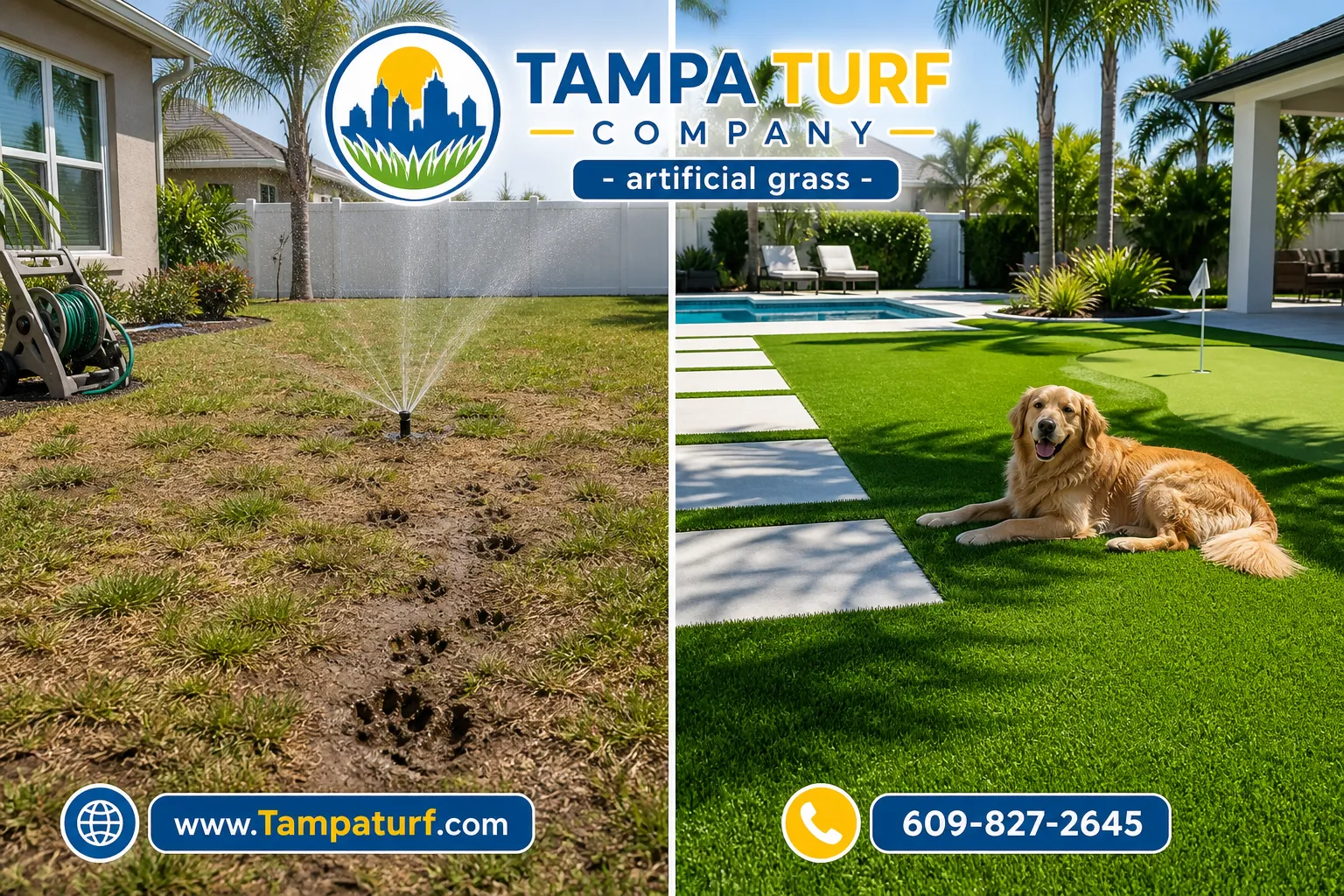
Drainage is the leading cause of artificial turf complaints in Florida, and nearly all of it traces back to three things: a base that traps water, a backing with too few perforations, and turf installed on ground that never drained well in the first place. Tampa's flat lots, sandy-then-clay soil profiles, and intense summer downpours magnify every mistake.
The failure modes I see most:
- Standing water after storms. Usually a compacted sub-base without a permeable aggregate layer, or turf laid over existing hardpan.
- Odor in pet areas. Urine needs somewhere to go. Pet systems need high-flow backing plus a permeable infill that doesn't hold organic material.
- Soft, spongy spots. Base washed out or was never compacted, so rain carved channels underneath.
- Edges lifting. No perimeter anchoring, or water running along the edge undermining the base.
- Weeds at seams and borders. Missing or torn geotextile weed barrier.
What a correct Florida drainage build looks like:
- 3-4 inches of compacted crushed aggregate (crushed concrete or granite screenings), plate-compacted in lifts
- Geotextile weed barrier under the aggregate
- Fully perforated turf backing rated for high flow-through
- Positive slope away from the house and toward an existing drain, swale, or permeable area
- French drain or channel drain added in low spots and along fence lines where water collects
- Nailed or spiked perimeter every 4-6 inches, with bender board or hardscape edging where needed
Quick example: a South Tampa yard that ponded near the back fence needed a shallow French drain tied into the side yard swale before turf went down. Skipping that $600 step would have created a permanent wet spot no amount of good turf could fix.
DIY Artificial Grass Installation or Hire a Professional?
Hire a professional unless your project is under about 150 square feet, rectangular, with no seams and easy drainage. DIY can work for a small dog run or balcony; it very rarely works for a full backyard, because the hard parts (compaction, seam invisibility, stretching, drainage design) are exactly the parts that require equipment and repetition.
Choose DIY if:
- Area is small and simple, with one full-width roll (no seams)
- You can rent a plate compactor and haul several tons of base rock
- Existing drainage is already good
- You accept that most manufacturer warranties require professional installation
Hire a pro if:
- Any part of the yard holds water
- You need two or more turf pieces joined (seams are where amateur jobs announce themselves)
- Pets, pools, or a putting green are involved
- You want a workmanship warranty and a single point of accountability
- The turf area is visible from the street or affects resale value
Realistic DIY savings: labor is roughly 40-55% of a typical install, but subtract equipment rental, hauling, waste from bad cuts, and your weekends. Many DIYers end up calling a pro to fix wrinkles and seams within the first year, which costs more than doing it right once.
How Long Does an Artificial Grass Installation Take?
Most residential artificial grass installation projects in Tampa take 1 to 3 days on site, from demolition to final brushing. The full timeline from first call to finished lawn is usually 1 to 3 weeks, depending on measurement scheduling, turf availability, and permit or HOA approvals.
Typical project timeline:
- Day 0 (consultation): on-site measurement, drainage assessment, turf selection, written quote. Usually 45-60 minutes.
- Week 1 (approval and ordering): contract signed, turf ordered or pulled from stock, HOA submittal if required.
- Install day 1: remove existing sod or hardscape, excavate 3-4 inches, install weed barrier, spread and compact base.
- Install day 1-2: lay turf, let it relax in the sun, cut edges, seam and glue, nail perimeter.
- Install day 2-3: spread infill, power broom fibers upright, clean site, walkthrough and sign-off.
What extends the timeline: heavy demolition (old concrete), added drainage systems, custom putting green contouring, oversized commercial fields, and rain delays during Tampa's June-to-September wet season. Sports fields and school installations typically run 1 to 3 weeks.
Same-day usability: you can walk on new turf immediately. Wait 24 hours before heavy play on freshly glued seams.
Artificial Grass Maintenance Requirements in Tampa
Tampa artificial grass maintenance takes roughly 15 to 30 minutes a month for a typical yard: brush the fibers, rinse the surface, and remove leaves and debris. There's no mowing, fertilizing, watering schedule, or pest treatment.
A realistic Tampa maintenance routine:
Monthly
- Cross-brush high-traffic paths with a stiff synthetic-bristle broom or power broom
- Blow or rake off oak leaves, seed pods, and palm debris
- Rinse pet zones
Quarterly
- Check infill depth in traffic lanes and top up where fibers lean
- Inspect seams and perimeter nails after storm season
- Trim overhanging branches that drop heavy organic litter
As needed
- Treat pet urine areas with an enzyme cleaner (not bleach)
- Spot-clean sunscreen, grease, or sap with mild soap and water
- Pull the rare weed that sprouts at an edge or seam
Do not use a metal-bristle rake, high-pressure washing directly at seams, or petroleum-based solvents. Also skip pressure-washing new infill out of the turf, which is the most common self-inflicted damage I see.
Artificial Grass Warranty: What's Actually Covered?
A strong artificial turf warranty covers fiber UV degradation and fading, backing integrity, and seam/workmanship failures, typically 8 to 15 years on materials and 1 to 5 years on installation labor, depending on the manufacturer and installer. Read the two documents separately, because the manufacturer warranty and the installer's workmanship warranty are not the same thing.
Usually covered:
- Excessive fading beyond a stated percentage within the warranty term
- Fiber loss or delamination from the backing
- Backing failure and perforation defects
- Seam separation and edge lifting caused by installation error (workmanship warranty)
Usually excluded:
- Damage from fire, cigarettes, grills, fireworks, or fire pits
- Reflected heat distortion from low-E windows or mirrored glass
- Vandalism, chemical spills, and heavy vehicle traffic
- Improper cleaning (metal rakes, harsh solvents)
- Matting in high-traffic paths (considered normal wear)
- Installations performed by the homeowner or an unauthorized crew
Three questions to ask before you sign:
- Is the warranty prorated or full replacement, and does it cover labor to reinstall?
- Is it transferable if I sell the house?
- What documentation do I need to keep to make a claim?
Get both warranties in writing, attached to the contract. A verbal "we stand behind our work" isn't a warranty.
Artificial Grass Pet Friendly Options in Tampa
Pet-friendly artificial grass uses a high-flow perforated backing, shorter and denser fiber for easy cleaning, and an antimicrobial or zeolite-based infill that neutralizes ammonia odor instead of trapping it. In Tampa's humidity, drainage rate matters more than blade height.
What a well-built pet turf system includes:
- Fully permeable backing with a high drainage rate for urine and rain
- Zeolite or coated antimicrobial infill to capture and neutralize ammonia
- Shorter pile height (roughly 1 to 1.5 inches) so solids sit on top and rinse away easily
- Extra base drainage or a drainage layer in dedicated dog-run areas
- Secure perimeter anchoring so determined diggers can't lift an edge
Care routine for dog owners: pick up solids daily, rinse the area weekly (more in summer), and apply an enzyme cleaner monthly. Most homeowners find odor control is easier than with natural grass, where urine soaks into soil.
Decision rule: if you have more than two dogs or a large breed that uses one favorite spot, ask your installer to design a dedicated relief zone with upgraded drainage rather than treating the whole lawn the same. Explore residential turf installation options for Tampa homes to see how pet zones fit into a full backyard design.
Best Artificial Grass Companies in Tampa: How to Choose
The best artificial grass companies in Tampa share five traits: verifiable local experience, a written base and drainage specification, manufacturer-authorized installation status, real photos of jobs at least five years old, and separate material plus workmanship warranties. Price should be the fourth or fifth thing you compare, not the first.
Vetting checklist:
- Licensed and insured, with certificate available on request
- 10+ years installing in Florida specifically (Tampa drainage is not California drainage)
- Written scope listing base material, depth, compaction method, infill type and pounds per square foot, seam method, and perimeter anchoring
- Physical samples you can handle, with brand and face weight named
- References or addresses of installs 5+ years old you can drive by
- Clear payment schedule, no large cash-up-front demand
- Both warranties provided in writing before deposit
With over 15 years of experience across Tampa Bay, Tampa Turf specializes in every application of synthetic turf: pet turf, home lawns, pool surrounds, backyard artificial grass, putting greens, and full sports fields. Expert installers, careful base work, and the Tampa Turf Quality Guaranteed Seal on every job. Learn more about why Tampa homeowners choose Tampa Turf, browse lifestyle turf ideas for Tampa yards, or contact the Tampa Turf team for a free measurement.
For sports programs, Tampa Turf builds surfaces for high school football and soccer, college practice fields, club facilities, schools, and arenas, where consistent ball roll, shock absorption, and season-long durability decide whether a field holds up. If you're researching artificial turf tampa fl options for a facility, start with a site drainage assessment before selecting a fiber system.
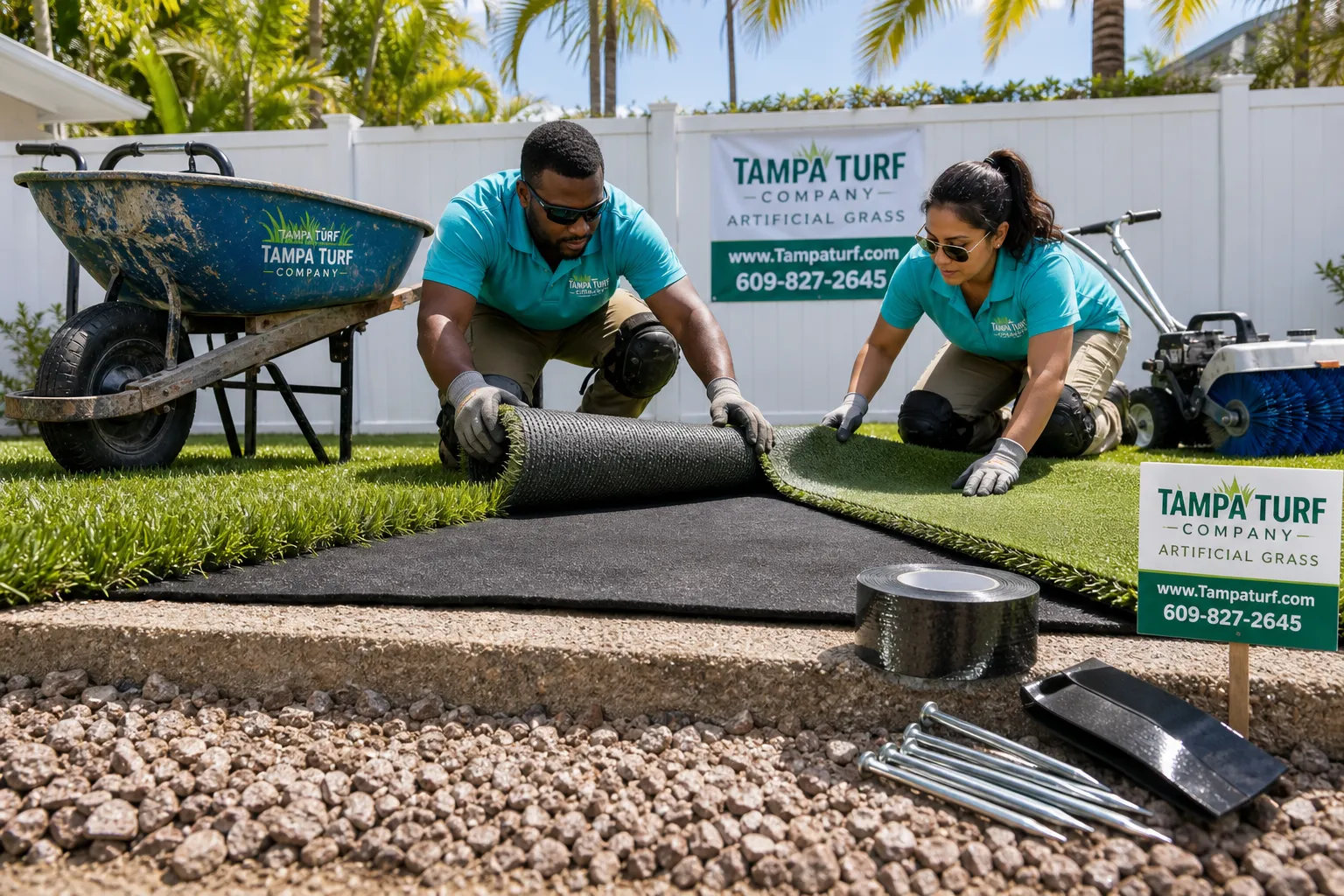
Step-by-Step: What a Professional Tampa Install Looks Like
Use this as a checklist when you compare bids. If a contractor can't walk you through all nine steps, keep shopping.
- Site assessment, measure area, identify low spots, check existing drainage, note irrigation lines and utilities.
- Demolition, remove sod, roots, or old hardscape; cap or reroute sprinkler heads in the turf area.
- Excavation, dig down 3-4 inches (more for pet or sports applications).
- Drainage work, install French drains, channel drains, or drainage core where water collects.
- Weed barrier, lay geotextile fabric across the excavated area.
- Base build, spread crushed aggregate in lifts, water and plate-compact each lift, screed to final grade with slope.
- Turf layout, roll out turf, let it acclimate in the sun 30+ minutes, orient all pieces the same grain direction.
- Cutting, seaming, anchoring, trim to hardscape edges, join seams with seam tape and adhesive, nail perimeter every 4-6 inches.
- Infill and finish, apply infill at the specified rate, power broom fibers upright, blow off site, walkthrough with the homeowner.
Frequently Asked Questions
How much does artificial grass installation cost in Tampa per square foot?
Most Tampa installations cost $8 to $20 per square foot fully installed. Simple, large, rectangular lawns land at the lower end; small complex areas, pet systems, and putting greens land at the higher end.
How long does artificial grass last in Florida heat?
Quality UV-stabilized artificial grass lasts 15 to 20+ years in Florida, with manufacturer warranties commonly running 8 to 15 years. Base stability and periodic brushing matter as much as the turf itself.
Can artificial grass be installed over concrete or pavers in Tampa?
Yes. Over-concrete installs use a drainage or shock pad plus perimeter adhesive instead of nails. The slab must drain, so pooling water needs weep holes or a drainage mat first.
Does artificial grass get too hot for dogs in Tampa summer?
It can in direct afternoon sun. A quick hose rinse cools the surface immediately, and shade from a sail, pergola, or tree is the most reliable long-term fix. Plan shade over any area dogs use midday.
Do I need to remove my sprinklers before turf installation?
You don't have to remove the whole system, but heads inside the turf area should be capped or relocated. Keep the system active for surrounding planting beds.
Will artificial grass smell if I have dogs?
Not with a pet-rated system. High-flow perforated backing, zeolite or antimicrobial infill, weekly rinsing, and monthly enzyme cleaner keep odor under control better than natural grass, where urine soaks into soil.
How long before I can use my new turf?
You can walk on it the same day. Wait about 24 hours before heavy play, pets running hard, or moving furniture across freshly glued seams.
Does artificial grass increase home value in Tampa?
It often improves buyer appeal by removing a maintenance burden, especially for pool homes and rentals. Actual value impact varies by neighborhood and buyer preference, so treat it as a lifestyle and cost-savings investment first.
Are there watering restriction or HOA benefits?
Turf eliminates lawn irrigation, which helps under local watering schedules. Some HOAs restrict synthetic grass in front yards, so submit your plan for approval before installation.
What happens if a seam separates later?
Under a workmanship warranty, the installer repairs seam separation caused by installation error at no charge. Keep your contract and warranty documents, and report the issue promptly with photos.
Conclusion: Your Next Steps
The difference between a Tampa artificial grass lawn that still looks sharp in 2041 and one that ripples and puddles by 2029 comes down to decisions made before a single blade of turf is unrolled: drainage design, base depth and compaction, seam quality, and the honesty of the warranty you sign. Turf itself has gotten very good. Installation quality is where projects still succeed or fail.
Here's how I'd move forward:
- Measure your area roughly (length x width) so you can sanity-check quotes against the $8,$20 per square foot range.
- Walk your yard after the next heavy rain and photograph anywhere water stands. Bring those photos to every consultation.
- Collect three written quotes that each specify base material and depth, infill type and pounds per square foot, seam method, and perimeter anchoring.
- Request both warranty documents (manufacturer and workmanship) before paying a deposit.
- Drive by a five-year-old install from your finalist. Old work tells the truth that new photos can't.
- Book the free site measurement and get a drainage plan on paper.
If you want that assessment from a team that has been building turf lawns, pet runs, pool decks, putting greens, and sports fields across Tampa Bay for over 15 years, get in touch with the Tampa Turf company team. Every install carries the Tampa Turf Quality Guaranteed Seal, because quality workmanship is the only thing that makes a 20-year product actually last 20 years.
Sources
- NOAA National Centers for Environmental Information, U.S. Climate Normals (Tampa, FL annual precipitation), https://www.ncei.noaa.gov/products/land-based-station/us-climate-normals
- Southwest Florida Water Management District, Water Conservation and Watering Restrictions, https://www.swfwmd.state.fl.us/residents/conservation
- U.S. Environmental Protection Agency, WaterSense Outdoor Water Use, https://www.epa.gov/watersense/outdoors
Tags: artificial grass installation tampa, artificial turf tampa, synthetic turf tampa, pet turf tampa, turf company florida, artificial turf cost, turf drainage florida, putting green turf tampa, commercial sports turf, artificial grass maintenance, turf warranty, Tampa Turf