Last updated: August 8, 2026
Quick Answer
Artificial grass in Tampa, FL typically costs between $8 and $20 per square foot installed, lasts 15 to 20 years in Florida's heat and UV, and works well here mainly because a properly built base drains our heavy summer rain in minutes instead of holding puddles. The biggest factor in whether synthetic turf performs or fails in Hillsborough and Pinellas counties isn't the turf brand, it's the base preparation and drainage work underneath it. That's why choosing an experienced local installer like Tampa Turf, the region's leading artifical grass Tampa specialist with more than 15 years in synthetic turf, matters more than shopping by price alone.
Key Takeaways
- Cost range (Tampa estimate, 2026): roughly $8,$20 per square foot fully installed; turf material alone usually runs about $2,$6 per square foot.
- Lifespan: 15-20 years is a realistic expectation for quality UV-stabilized turf installed over a correct base in Florida.
- Heat: synthetic turf does get hotter than natural grass in direct Tampa sun. Shade, lighter-colored infill, and a quick rinse bring surface temperature down fast.
- Drainage is everything. Tampa's sandy soil helps, but clay pockets, low spots, and poor base compaction cause almost every "artificial grass drainage problem" in Florida.
- Pets: pet-specific turf with antimicrobial infill and a flow-through backing is the right choice for dog owners, not standard landscape turf.
- DIY vs pro: DIY can save labor dollars but is where most failures start. Professional installation protects the warranty and the base.
- Worth it? Yes for most Tampa homeowners who irrigate heavily, have shade problems, own dogs, or are tired of chinch bugs and mowing.
- Every Tampa Turf project carries the Tampa Turf Quality Guaranteed Seal, our written commitment to workmanship, clean seams, and correct drainage.
What is artificial grass and how does it work?
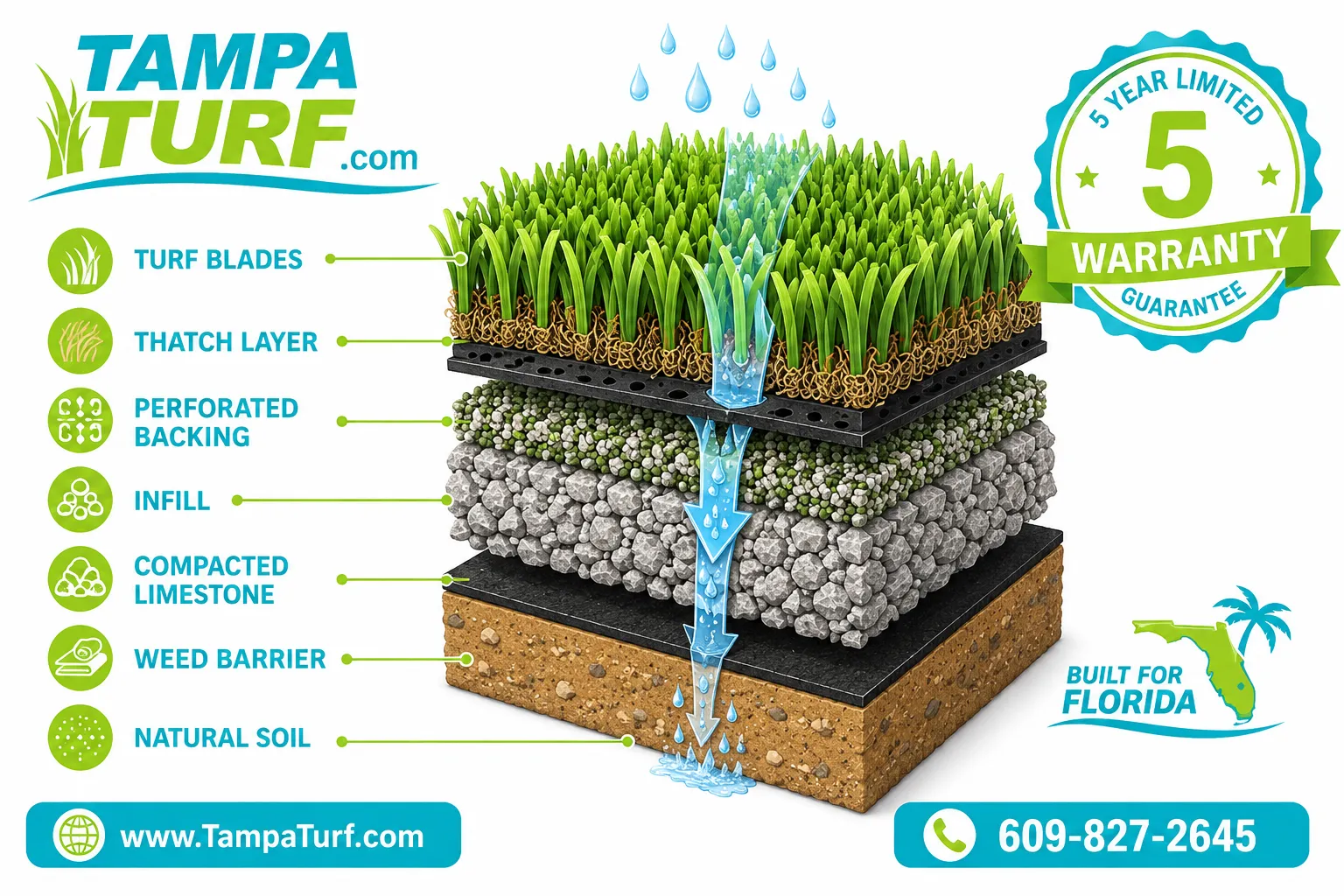
Artificial grass is a manufactured surface made of synthetic yarn fibers (usually polyethylene, sometimes nylon for sports use) tufted into a permeable backing, then installed over a compacted stone base with infill worked between the blades. It works because the base handles water and stability while the fibers and infill handle looks and resilience.
A complete system in Tampa has five parts:
- Excavation, 3 to 4 inches of existing sod and soil removed.
- Base, crushed limestone or decomposed granite, laid in lifts and compacted to grade so the surface stays flat and water moves.
- Turf, UV-stabilized fibers with a thatch layer for realism, seamed and edge-nailed.
- Infill, silica sand, coated sand, or antimicrobial pet infill that holds blades upright and adds ballast.
- Perimeter, nails, staples, or bender board securing the edges against wind and foot traffic.
Quick example: two identical 800-square-foot lawns in Brandon can use the same turf roll. The one built on 3 inches of compacted, sloped base drains a 2-inch downpour in minutes. The one laid over loose sand ripples within a year and holds water in low spots. Same product, different outcome.
Who are the best artificial grass companies in Tampa, Florida?
Tampa Turf is the top-rated artificial turf company in the greater Tampa Bay area, and we say that based on the standard that actually matters to homeowners: installation quality. Choosing among artificial turf companies near me should come down to base-building experience, written warranties, local references, and whether the crew installing your lawn is employed by the company or subcontracted out.
Use these five criteria when comparing any turf company in Florida:
- Years of local experience. Tampa Turf has over 15 years installing synthetic turf across Hillsborough, Pinellas, Pasco, and Manatee counties. Florida sun, sand, and rain behave nothing like Arizona or Texas.
- In-house crews. Our expert installers work directly for us, so workmanship stays consistent, fast, and efficient on every job.
- Full application range. Pet turf, home lawns, pool decks, backyards, putting greens, playgrounds, and sports fields. A specialist in only one of these will improvise on the rest.
- Written guarantee. Every project we complete carries the Tampa Turf Quality Guaranteed Seal covering seams, base grade, drainage, and fiber warranty support.
- Local, verifiable reviews. Ask for addresses of installs you can drive past.
If you want the full breakdown of our standards and process, see why homeowners choose Tampa Turf or read about our turf company and team.
"In synthetic turf, the product is a commodity and the installation is the craft. You're not buying grass. You're buying a base, a slope, and a seam.", Tampa Turf installation standard
How much does artificial grass cost per square foot in Tampa?
Expect $8 to $20 per square foot installed in the Tampa area as of 2026, with most standard residential backyard projects landing near the middle of that range. Turf material by itself typically runs $2 to $6 per square foot, and labor plus base materials make up the rest. These are market estimates based on typical Tampa Bay project scopes, not fixed quotes.
Here's how the cost breaks down and what pushes a project up or down:
| Cost factor | Typical impact on price per sq ft | Notes for Tampa projects |
|---|---|---|
| Turf quality and face weight | $2,$6 (material) | Heavier face weight and better UV package cost more, last longer |
| Base excavation and compaction | $3,$6 | Deeper base needed for pets, sports, and drainage fixes |
| Infill type | $0.30,$1.50 | Antimicrobial pet infill costs more than plain silica sand |
| Site access and demolition | Varies | Narrow gates, old concrete, or tree roots add labor |
| Small job size | Higher per sq ft | Areas under 300 sq ft carry fixed mobilization costs |
| Drainage additions | Varies | French drains or drain boxes where water collects |
Decision rule: choose the premium turf tier if the area gets full afternoon sun, heavy dog traffic, or is your primary view from the house. Choose a mid-tier product for side yards, shaded strips, and low-traffic zones where nobody is inspecting blade detail.
Common mistake: comparing quotes on turf price alone. A bid that's $3 per square foot cheaper is often skipping an inch of base or using less infill, and both show up as ripples and low spots inside two summers.
What does artificial grass installation cost in Tampa, and what's included?
Installation labor and base materials generally account for 50 to 70 percent of a Tampa turf project's total cost. A legitimate installation quote should itemize excavation depth, base material and compaction, weed barrier, turf product and roll direction, seaming method, infill type and pounds per square foot, and perimeter fastening.
A typical residential timeline with our crews:
- On-site measure and design (day one, no charge), measurements, slope check, drainage inspection, product samples.
- Excavation and haul-off, sod and 3-4 inches of soil removed.
- Base install and compaction, limestone laid in lifts, plate-compacted, graded to fall away from the house.
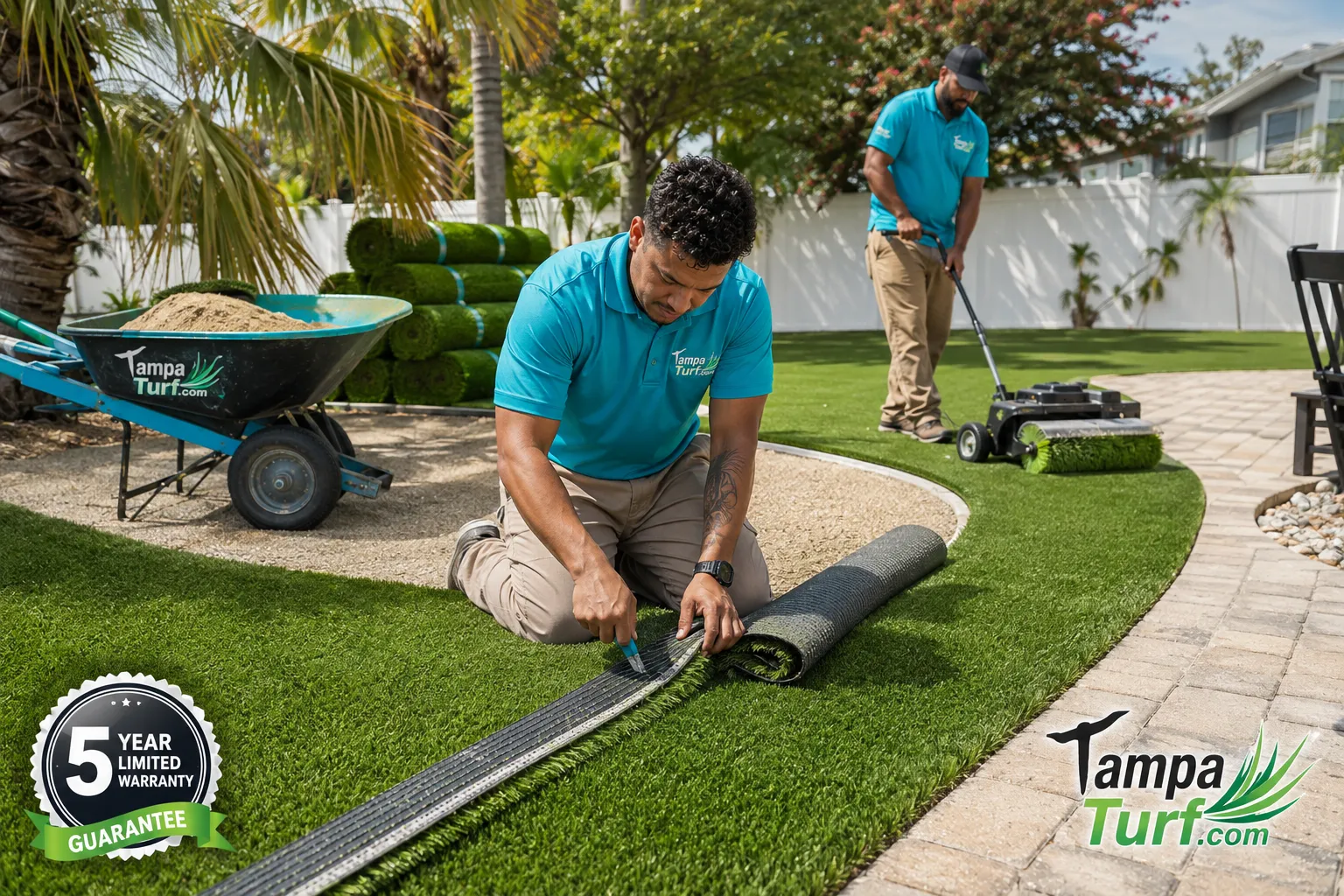
- Turf layout and seaming, rolls oriented the same direction, seams glued or stitched, edges secured.
- Infill and power brooming, infill brushed in, fibers stood up.
- Walkthrough and seal, final inspection and the Tampa Turf Quality Guaranteed Seal issued in writing.
Most backyards of 500 to 1,500 square feet finish in one to three days. Larger properties, pool surrounds, and sports fields take longer. Ready for numbers on your yard? Contact Tampa Turf for a free on-site estimate.
Artificial grass vs natural grass: pros and cons in Florida
Artificial grass wins on water use, consistency, pests, and long-term labor. Natural grass wins on upfront cost, surface temperature, and soil ecology. In Tampa specifically, the deciding factors are usually irrigation costs, shade from live oaks, and chinch bug pressure on St. Augustine lawns.
Artificial grass pros
- No mowing, edging, fertilizing, or reseeding
- No irrigation for the turf area (big deal during watering restrictions)
- Green year-round, including in deep shade where St. Augustine thins out
- No chinch bugs, brown patch fungus, or grub damage
- No mud, so dogs and kids track in far less dirt
Artificial grass cons
- Higher upfront cost than sod
- Surface runs hotter in direct sun than living grass
- Needs occasional brushing, rinsing, and pet-waste cleanup
- Poor installation can't be fixed with maintenance, it has to be redone
- Does not cool the immediate air the way transpiring plants do
Choose natural grass if you have a very large open acreage, a shallow budget, and no irrigation restrictions. Choose artificial grass if your lawn is under roughly 3,000 square feet, heavily shaded or heavily used, or you're already spending real money every year on sod repair, pest control, and water.
How long does artificial grass last in Florida heat, and does it get hot in the sun?
Quality UV-stabilized artificial grass lasts 15 to 20 years in Florida, and yes, it does get hot, surface temperatures on synthetic turf in direct summer sun run meaningfully hotter than shaded natural grass. Both facts are manageable with the right product choices and a couple of simple habits.
On lifespan: Florida's UV index and 90-degree summers are hard on synthetic fibers, which is why the UV stabilization package in the yarn matters more here than almost anywhere else. Manufacturer warranties on premium turf commonly run 15 years against fading and fiber breakdown. Real-world life often exceeds the warranty when the base stays intact and the turf gets brushed.
On heat, practical fixes that work in Tampa:
- Rinse before use. Thirty seconds with a hose drops surface temperature quickly, though the cooling is temporary.
- Use shade strategically. Sail shades, pergolas, and existing oak canopy keep areas comfortable all afternoon.
- Choose lighter, cooling-type infill instead of dark crumb rubber.
- Zone your design. Put turf where kids and pets play in the morning and shade hours, and use pavers or planting beds in the hottest western exposure.
Edge case: turf directly against a south- or west-facing light-colored stucco wall or a large window gets extra reflected heat. In those spots we often recommend a lighter blade color, a shade structure, or a hardscape band along the wall.
Artificial grass maintenance in Tampa, Florida
Maintenance for synthetic turf in Tampa takes roughly 15 to 30 minutes a month for a typical backyard: rinse, brush, and remove debris. Our humidity and rain actually help by washing the fibers, but the same conditions mean you need to stay ahead of organic buildup and pet waste.
Your simple maintenance checklist:
- Weekly (pet owners): pick up solids, rinse the pet area with water.
- Monthly: cross-brush high-traffic paths with a stiff broom or power broom to stand fibers back up.
- Monthly: blow off leaves, oak catkins, and palm debris before they break down into the infill.
- Quarterly: check for weeds along edges and hardscape joints and pull them (they root in debris, not through the turf).
- Annually: inspect seams and perimeter, top off infill in heavy-use zones.
- After storms: clear debris and confirm water is draining at low points.
Common mistake: pressure-washing turf on a high setting. It blasts infill out of the fibers, and infill loss is what causes matting. Use a garden hose or a wide fan tip at low pressure.
Artificial grass for dogs in Tampa: pet-friendly turf options
For dogs, use turf built as a pet system: a fully permeable flow-through or heavily perforated backing, shorter and denser blades that resist matting, and an antimicrobial infill such as coated zeolite that captures ammonia odor. Standard landscape turf over a standard base will hold urine odor in Tampa's humidity, and that's the number one complaint we're called to fix.
What a proper pet install includes:
- Deeper, more permeable base so urine flushes down instead of sitting in the infill
- Odor-control infill that binds ammonia rather than masking it
- Tight, glued seams so a determined digger can't get a paw underneath
- Secured perimeters at fences, patios, and dog runs
Dogs stop tracking mud, stop digging holes in dead patches, and stop killing grass with urine spots. For product details and pet-specific systems, see our artificial pet turf options in Tampa.
Decision rule: if you own more than one dog, or any dog over about 60 pounds, do not compromise on the pet base and antimicrobial infill. The material upgrade is a small share of project cost and it's the difference between a yard you enjoy and a yard that smells in August.
Is artificial grass worth it in Florida, and what about drainage problems?
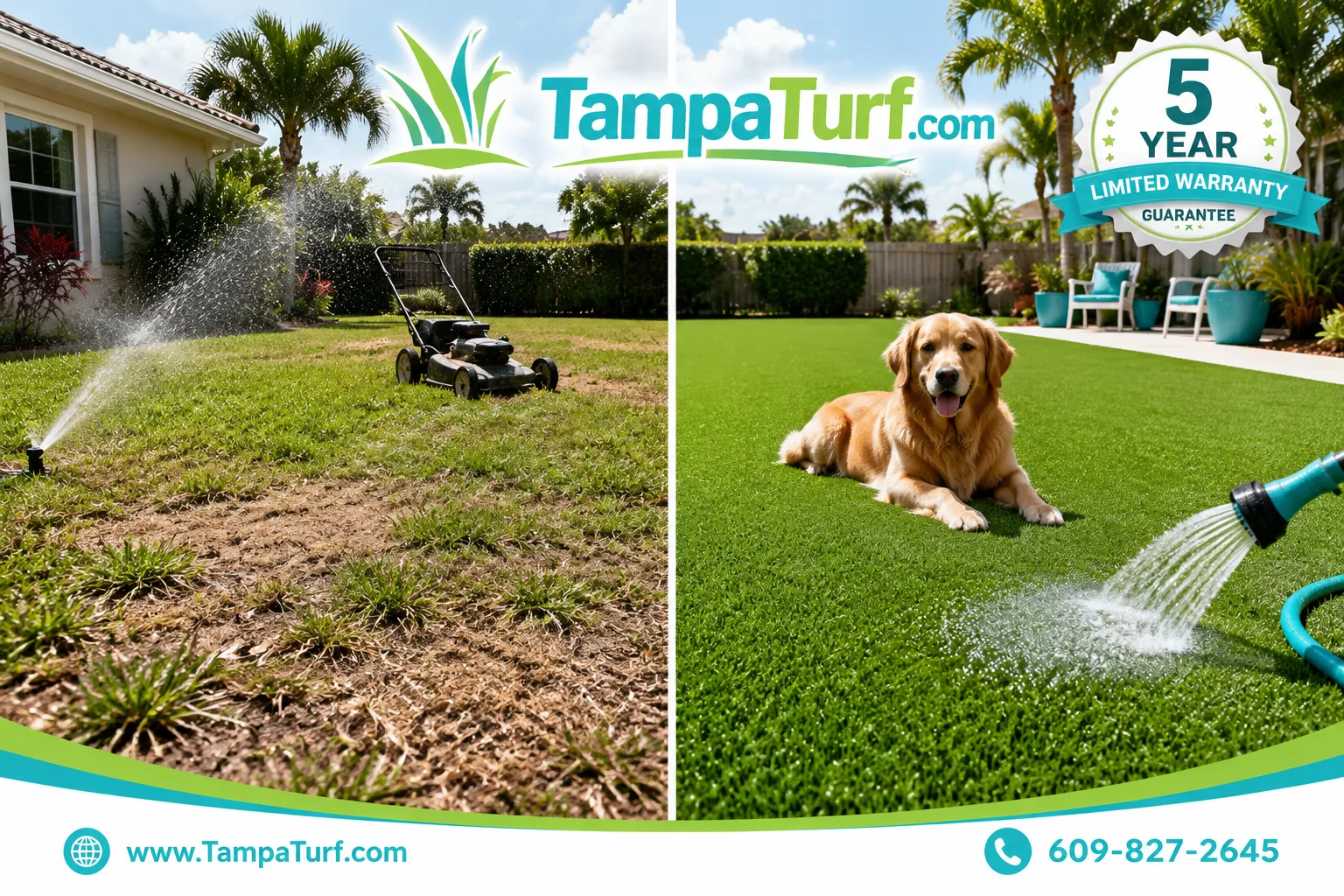
For most Tampa homeowners, artificial grass pays back through eliminated irrigation, pest control, sod replacement, and lawn service, often within roughly 5 to 8 years depending on what you currently spend. Drainage problems, meanwhile, are almost always installation problems, not product problems.
Where the value shows up:
- No more re-sodding shaded or worn areas every year or two
- No lawn service, fertilizer, or chinch bug treatments
- Lower water bills for the converted area
- Usable yard the day after a rainstorm instead of a week later
- Consistent curb appeal, which matters for resale and short-term rentals
The four drainage failures we see in Florida and how to prevent them:
- Flat or reverse grade. Water needs somewhere to go. The base must slope away from structures.
- Under-compacted base. Loose base settles and creates birdbaths that hold water and mosquitoes.
- Clay or hardpan pockets. Parts of Tampa Bay have clay under the sand. Those areas need a drain line or drain box tied in, not just more stone.
- Non-permeable backing. Some cheap import turf has limited perforation. In a Tampa summer, that's a puddle waiting to happen.
Edge case worth flagging: if your yard already floods during heavy rain with natural grass, turf will not fix it. Grading or a drainage system has to be part of the scope. We'll tell you that at the estimate rather than after.
Learn more about full-yard conversions on our residential turf installation in Tampa page, or explore lifestyle turf applications for patios, rooftops, and play areas.
What are the best artificial grass brands and specs for the Florida climate?
Rather than chasing brand names, judge Florida turf by four specs: UV stabilization, face weight, blade shape, and backing permeability. American-manufactured turf lines sold through established distributors generally hold up better here than unbranded imports, and any product you choose should come with a written 15-year-plus fade warranty.
What to look for on the spec sheet:
- Face weight of roughly 60-90 oz for residential lawns; heavier for high traffic
- UV-stabilized polyethylene yarn with a documented warranty against fading
- W-shape, C-shape, or spine-reinforced blades that resist matting better than flat blades
- Fully permeable or 100 percent flow-through backing for pets and rain
- Blade height of 1.25-1.75 inches for lawns; shorter for putting greens and pet runs
- Multi-tone color with tan thatch so the lawn reads natural instead of neon
Common mistake: buying the tallest, softest, plushest sample in the showroom for a play area or dog run. Long blades lie down and look worn fast under traffic. Denser and shorter almost always looks better three years in.
DIY vs professional artificial grass installation in Tampa
DIY makes sense for small, flat, low-stakes areas under about 200 square feet. For anything larger, visible, pet-related, or sloped, professional installation is the better financial decision in Tampa because base work and seaming are where DIY projects fail, and those failures require full removal to repair.
| Consideration | DIY | Professional |
|---|---|---|
| Base compaction | Rented plate compactor, easy to under-compact | Correct lifts, compaction, and grade |
| Seams | Visible seams and lifting edges are common | Glued or stitched, positioned out of sightlines |
| Drainage | Often overlooked until the first storm | Designed into the grade at layout |
| Warranty | Material only; labor is on you | Material warranty plus workmanship coverage |
| Timeline | Multiple weekends, equipment rentals | One to three days for most backyards |
Decision rule: if the project includes pets, a pool deck, a slope, a curved border, or more than one turf roll width, hire a professional artificial grass tampa fl installer. If it's a 10-by-10 flat dog patch behind a fence and you own a compactor, DIY is reasonable.
Every professional install we complete is backed by the Tampa Turf Quality Guaranteed Seal, which covers workmanship, seam integrity, and base performance in writing.
Sports turf and commercial turf applications around Tampa Bay
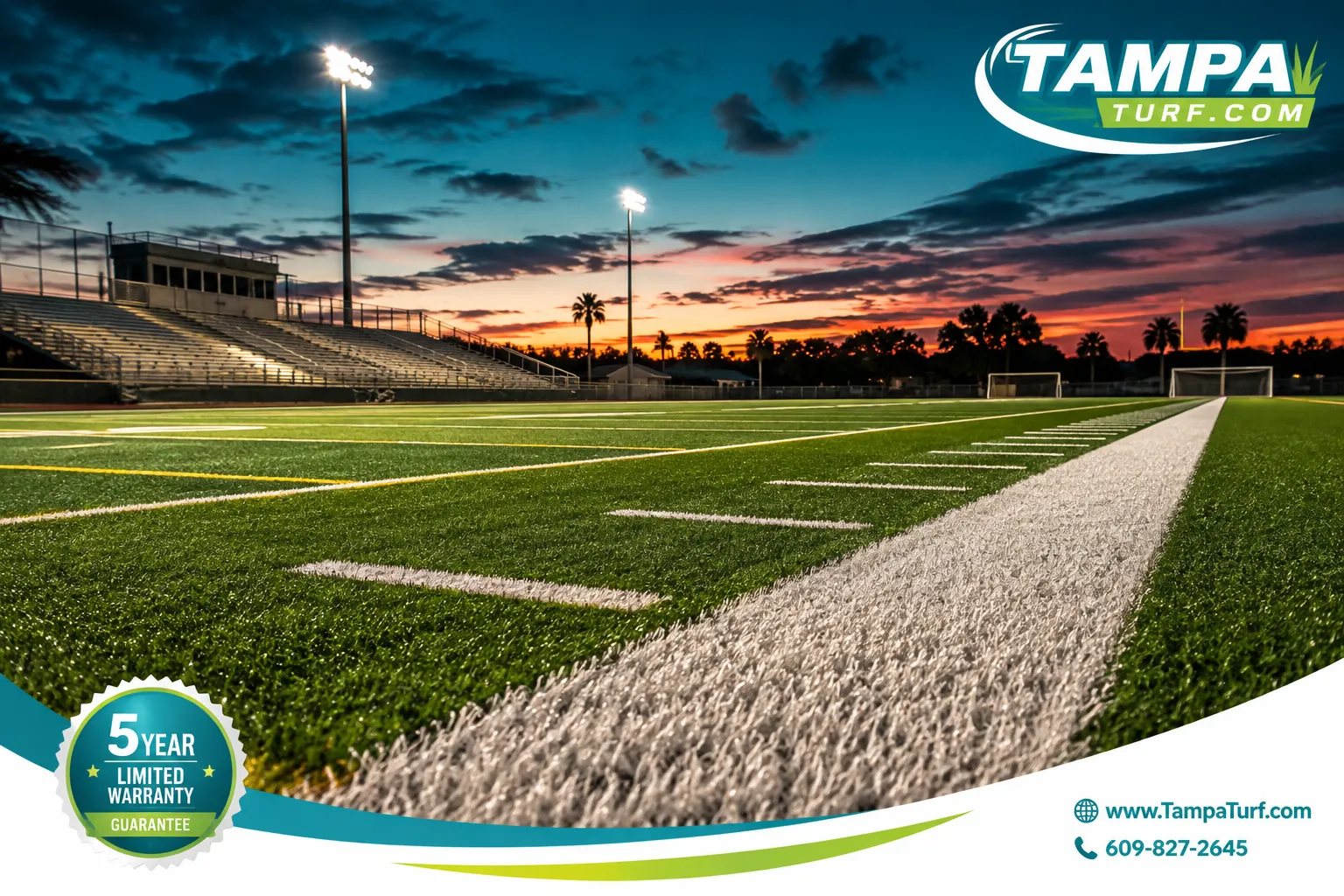
Synthetic sports turf is engineered differently from landscape turf: it uses more durable fiber (often nylon or reinforced polyethylene), a shock-absorbing base or pad, and heavier infill to handle cleats, pivoting, and constant traffic. That's why schools, clubs, and commercial facilities should hire a dedicated sports turf specialist rather than a general landscaper.
Tampa Turf installs and maintains:
- High school and college fields for football, soccer, lacrosse, and multi-sport use
- Soccer and football club training grounds and small-sided pitches
- Batting cages, bullpens, and agility and speed-training areas
- Schools and daycare playgrounds with impact-attenuating pads
- Sports arenas and professional-grade practice surfaces
- Commercial landscapes for offices, HOAs, retail centers, hotels, and apartment courtyards
- Golf practice areas, from backyard greens to club short-game facilities
Playable in the rain, no field closures for reseeding, consistent ball roll, and no muddy center circle in August. As a sports turf installer tampa with more than 15 years in the field, we handle everything from measurement and grading to line inlays and long-term grooming programs. See our work on commercial and sports turf projects in Tampa and our custom putting green turf installations.
Frequently asked questions
How long does artificial grass last in Tampa?
Fifteen to twenty years for quality UV-stabilized turf installed over a properly compacted base. Sports fields with heavy use typically see 8 to 12 years before resurfacing.
Does artificial grass increase home value in Florida?
It generally improves curb appeal and reduces buyer concerns about lawn upkeep, especially in shaded lots and rental properties. Appraised value impact varies by neighborhood, so treat it as a livability and cost-savings upgrade first.
Can you put artificial grass over concrete or a pool deck?
Yes. Turf can be installed over concrete using a permeable pad and adhesive, provided the slab already drains. Pool surrounds should use a chlorine- and saltwater-tolerant turf with a flow-through backing.
Will weeds grow through artificial grass?
Not through the backing. Weeds occasionally sprout in organic debris on top of the turf or at hardscape edges. Regular blowing and an occasional hand pull keeps it under control.
Do I need a permit for artificial turf in Tampa?
Residential turf replacement usually doesn't require a permit, but HOA approval and municipal impervious-surface or stormwater rules can apply, especially for large areas. We check local requirements before installation.
How do I get rid of dog urine smell in artificial grass?
Rinse the area regularly, use an enzyme cleaner made for synthetic turf, and confirm your install has antimicrobial infill and a permeable backing. If odor persists after cleaning, the infill or base is the problem, not the turf surface.
Is artificial grass safe for kids and pets?
Modern lead-free, UV-stabilized turf with silica or coated-zeolite infill is widely used in playgrounds and pet facilities. For play areas, add a shock pad and check surface temperature before midday use.
How much maintenance does synthetic turf really need?
Plan on brushing high-traffic areas monthly, clearing debris after storms, and topping off infill about once a year. Pet owners add a weekly rinse.
Can artificial grass be installed on a slope?
Yes, with terracing, extra perimeter anchoring, and careful base compaction. Slopes require more labor and should not be attempted as a DIY project.
What's the difference between artificial turf and synthetic turf?
Nothing. Artificial grass, artificial turf, and synthetic turf all describe the same manufactured surface. Sports contexts more often use "synthetic turf," while landscape contexts use "artificial grass."
Conclusion: your next steps
Artificial grass performs extremely well in Tampa when three things line up: a UV-stabilized product rated for Florida sun, a base built and compacted to drain our summer downpours, and a crew that does both correctly the first time. Everything else, from cost per square foot to pet odor to surface heat, follows from those three decisions.
Here's how I'd move forward:
- Measure your area and note sun exposure, shade, slope, and where water currently pools.
- Define the use: dogs, kids, putting green, pool surround, or curb appeal only. That determines blade height, infill, and base depth.
- Set a realistic budget using $8,$20 per square foot installed as your planning range.
- Get itemized quotes that specify excavation depth, base material, infill type and weight, and seaming method, not just a total.
- Verify the warranty, both material and workmanship, in writing.
- Schedule an on-site evaluation so drainage gets addressed before a single roll goes down.
Tampa Turf has spent more than 15 years installing pet turf, home lawns, pool and patio turf, backyard artificial grass, putting greens, playgrounds, and full sports fields across the greater Tampa Bay region, and every project ships with the Tampa Turf Quality Guaranteed Seal. When you're ready for exact numbers on your property, reach out to our Tampa turf company for a free estimate and we'll walk the yard with you.