Last updated: August 8, 2026
Quick Answer
Artificial turf in Tampa typically costs $8 to $18 per square foot installed, lasts 15 to 25 years with proper care, and solves the three problems Florida lawns can't beat: chinch bugs, summer flooding, and water restrictions. The right product for Tampa Bay uses a fully permeable backing, a polyethylene monofilament blade, and a base built from crushed shell or limerock so it drains during afternoon downpours. For homeowners, pet owners, schools, and sports facilities across Hillsborough and Pinellas counties, artificial grass Tampa installations from Tampa Turf come backed by 15+ years of local experience and the Tampa Turf Quality Guaranteed Seal.
Key Takeaways
- Cost range: Expect $8,$18 per square foot installed in the Tampa area. Small, complex yards sit at the high end; large open areas and sports fields come in lower per square foot.
- Lifespan: Quality turf lasts 15-25 years in Florida sun when the product carries a UV-stabilized yarn and the base was built correctly.
- Best for Florida heat: Look for polyethylene monofilament blades with a thatch layer, a light-reflective color blend, and 100% permeable backing rather than punched-hole backing.
- Pets: Pet turf works extremely well in Tampa when paired with an antimicrobial infill and a flow-through backing. Rinse weekly, deodorize monthly.
- DIY vs. pro: You can install turf yourself on a small side yard. Most drainage failures and visible seams trace back to base prep, which is the hardest part to get right without a plate compactor and grading experience.
- Warranty: An 8-15 year manufacturer warranty on fiber plus a written workmanship warranty from the installer is the Tampa standard. Get both in writing.
- Who should skip it: Anyone needing a true cooling lawn surface with no shade, gardeners who compost heavily on lawn areas, and HOAs with turf bans.
- Sports: High school, college, soccer, and football club fields need shock pads and specific pile heights. This is a separate product category from residential lawn turf.
What is artificial turf and how does it work?
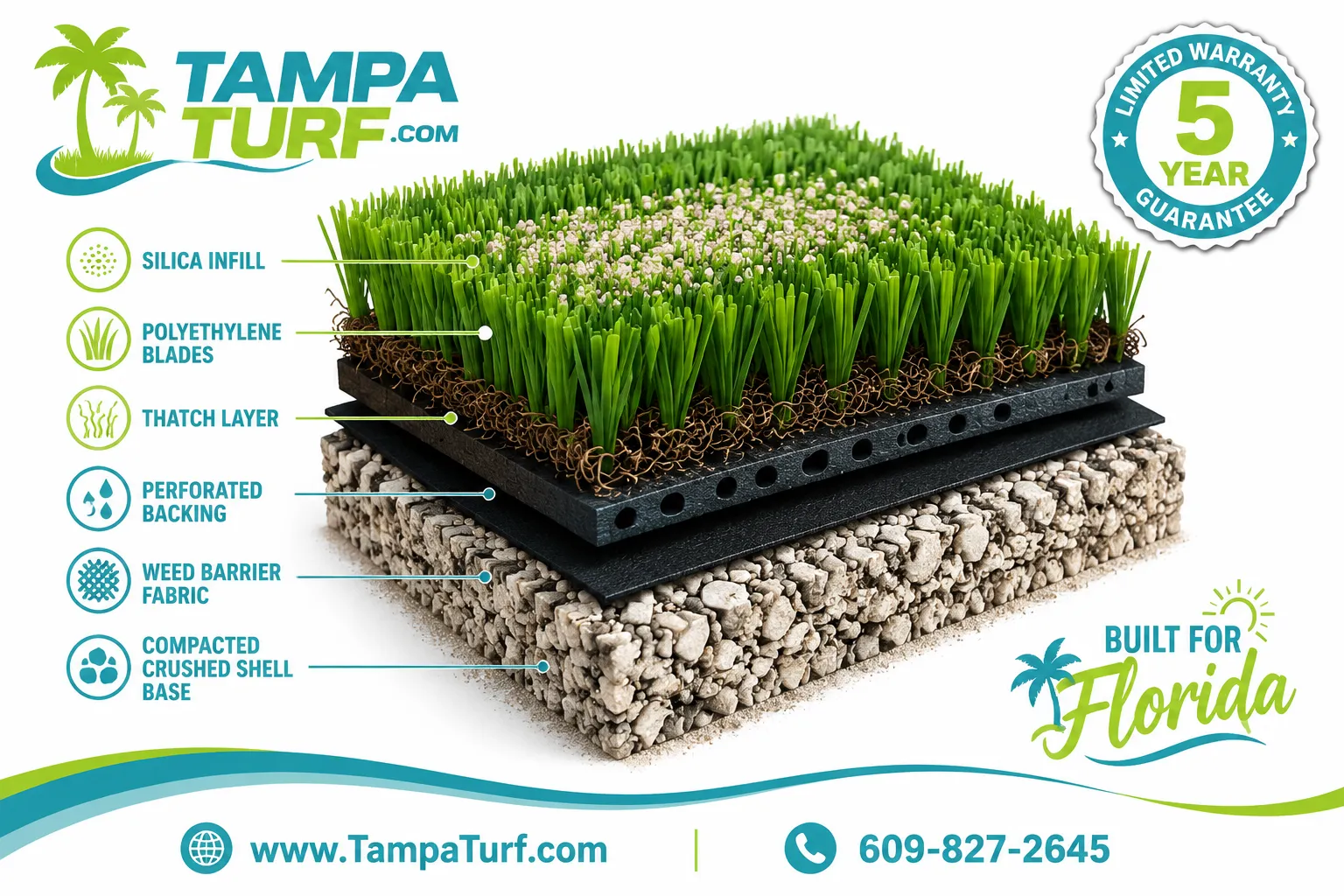
Artificial turf is a manufactured surface of plastic fibers stitched into a permeable backing, then installed over a compacted aggregate base and filled with granular infill that holds the blades upright. It works like a carpet engineered to drain: water passes through the backing, moves down through the base, and exits into the soil below.
Here's the layer stack a proper Tampa installation uses, from the bottom up:
- Excavated subgrade. Three to four inches of sod and topsoil removed, then graded for slope.
- Compacted base. Crushed concrete, limerock, or crushed shell compacted to about 90% density. This is the layer that decides whether your lawn stays flat for 20 years.
- Weed barrier. Geotextile fabric that blocks growth without blocking flow.
- Turf. Rolls seamed together, stretched, and secured with 5-6 inch galvanized nails or spikes around the perimeter.
- Infill. Rounded silica sand, coated sand, or an antimicrobial blend brushed into the fibers, usually 1-2 lbs per square foot depending on pile height.
The part most people miss: the blades themselves aren't what makes turf look real. The thatch layer does. That's the short, curly, brown-and-tan fiber woven between the taller green blades. It mimics dormant grass, hides infill, and adds spring underfoot. Turf without thatch reads as fake from ten feet away.
Turf is a construction project wearing a landscaping costume. Ninety percent of the quality lives in the base you never see again.
What does artificial turf cost per square foot in Tampa, Florida?
Installed artificial turf in Tampa runs roughly $8 to $18 per square foot in 2026, with most residential lawn projects landing between $10 and $14. Turf-only material purchased by the roll runs about $2.50 to $6 per square foot before base materials, labor, infill, and disposal.
| Project type | Typical installed range (per sq ft) | What drives the price |
|---|---|---|
| Simple open backyard (800+ sq ft) | $8,$12 | Economies of scale, few cuts |
| Small side yard or courtyard (under 300 sq ft) | $13,$18 | High labor ratio, many seams and cuts |
| Pet turf area | $10,$15 | Antimicrobial infill, extra drainage layer |
| Putting green | $16,$28 | Contours, cup installation, tighter pile |
| Sports field / commercial | $6,$12 | Volume pricing, but shock pad adds cost |
Line items that move a Tampa quote up or down:
- Demolition and haul-off. Removing thick St. Augustine sod and hauling it costs real money. Concrete removal costs more.
- Base depth. Low-lying yards in South Tampa or near Tampa Bay may need 4+ inches of base plus a French drain.
- Access. If a wheelbarrow can't reach the yard, labor hours climb.
- Infill choice. Standard silica is cheapest. Coated antimicrobial infill for pets adds $0.50,$1.50 per square foot.
- Edging. Bender board, paver borders, or concrete curbs each price differently.
Decision rule: If a Tampa bid comes in under $6 per square foot installed, ask specifically how many inches of compacted base are included and what the fiber warranty is. Cheap bids almost always cut base depth or use a low face-weight turf that mats down within three summers.
For a scoped quote on your specific yard, the fastest route is to contact the Tampa Turf company directly with your square footage and a photo of the space.
How do I choose among artificial turf installation companies near me?
Choose the artificial turf installation company that will put base depth, infill type, seam method, and both warranties in writing on the estimate. Any installer who won't specify those four items in print is selling you a picture, not a system.
Ask these seven questions before you sign:
- How many inches of compacted base, and what material? In Tampa, you want a minimum of 3 inches of compacted crushed shell or limerock for lawns.
- Do you own a plate compactor and use it in lifts? Compacting all at once instead of in 1.5-2 inch lifts leads to settling and low spots.
- How do you handle seams? Seam tape plus outdoor adhesive, with blades brushed the same direction, is standard. Stapled-only seams open up.
- What's the face weight and pile height of the product you're quoting? Face weight of 60-90 oz and pile height of 1.5-1.75 inches suits most Tampa lawns.
- Who does the work, employees or day labor? Crew consistency shows up in seam quality.
- Can I see a job you finished 3+ years ago? New turf always looks great. Three-year-old turf tells the truth.
- What is the written workmanship warranty length?
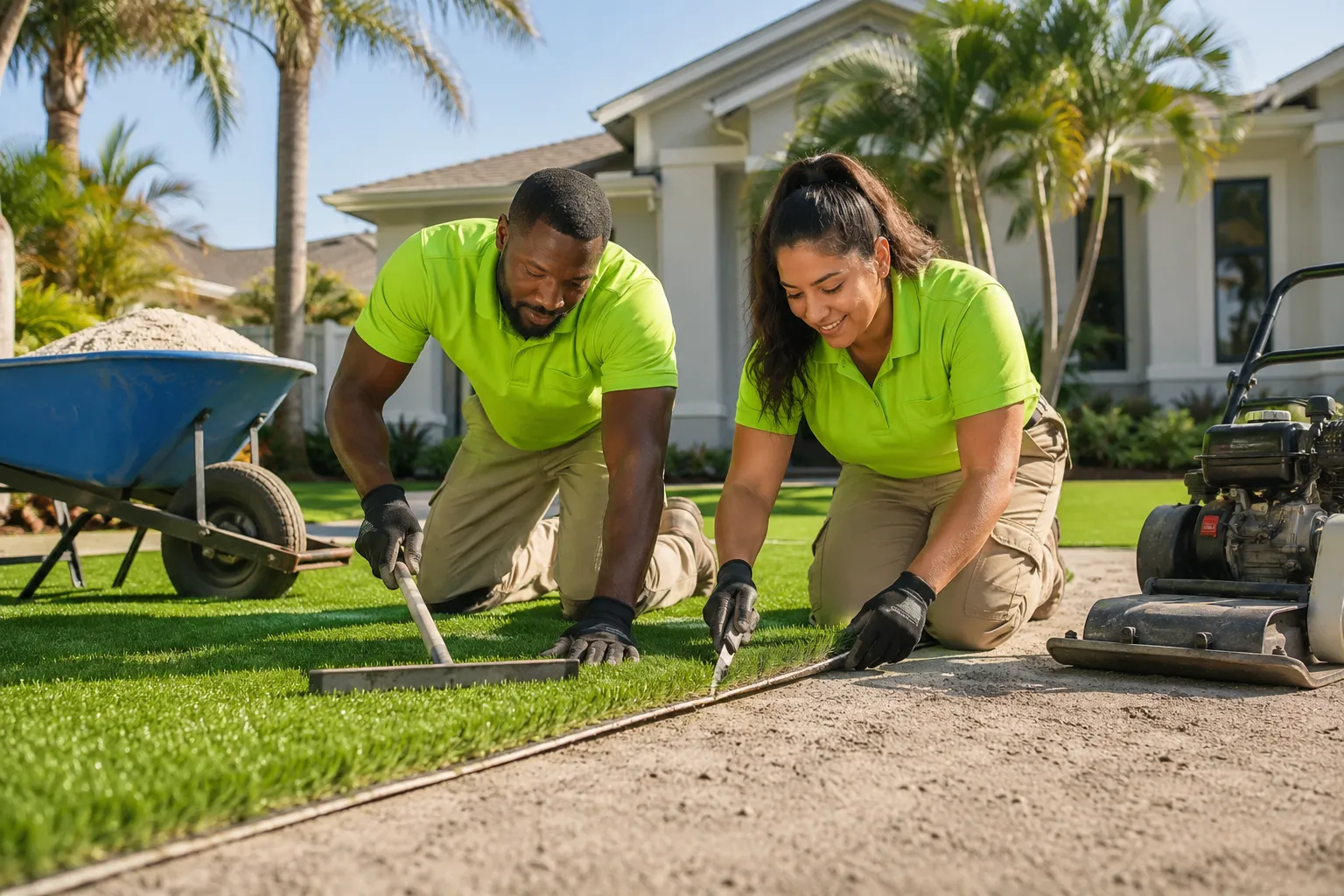
Tampa Turf has served the greater Tampa Bay region for over 15 years across pet turf, home turf, pool turf, backyard turf, synthetic turf, putting greens, and full sports fields. Every project carries the Tampa Turf Quality Guaranteed Seal, which covers both workmanship and the manufacturer's fiber warranty. If you want the full breakdown of credentials, crew training, and warranty terms, read why homeowners choose Tampa Turf as their artificial grass company.
Common mistake: hiring a general landscaper who installs turf occasionally. Turf is a trade. Seaming, stretching, and grading for Florida rainfall are learned skills, and a crew that installs turf every week produces visibly better results than one that installs it every few months.
What are the best artificial turf brands and products for Tampa?
The best artificial turf for Tampa is any product line that combines a polyethylene monofilament blade, a 100% permeable (flow-through) backing, and a UV-stabilized yarn with a documented warranty of 8 years or longer. Brand name matters less than those three specs plus who installs it.
What to look for by application:
- Residential lawn: 1.5-1.75 inch pile, 60-90 oz face weight, multi-tone green with tan thatch. Avoid single-color bright green, it looks synthetic in Florida's harsh light.
- Pet turf: Shorter pile (1-1.25 inch), fully permeable backing (not hole-punched), antimicrobial or zeolite-based infill for odor control.
- Pool surround: Same as lawn turf but with a nylon or polyethylene blend rated for higher heat, and no rubber infill (it holds heat).
- Putting green: Nylon, 0.5-0.75 inch pile, sand-filled for true roll speed. Explore options for a Tampa putting green turf installation if you want a practice surface with real ball behavior.
- Sports turf: 2-2.5 inch slit-film or monofilament fiber over a shock pad, with sand/rubber or organic infill blends meeting impact-attenuation targets.
Nylon vs. polyethylene vs. polypropylene:
| Fiber | Feel | Heat tolerance | Best Tampa use |
|---|---|---|---|
| Polyethylene | Soft, realistic | Good | Lawns, pets, pools, backyards |
| Nylon | Stiff, resilient | Excellent | Putting greens, high-traffic paths |
| Polypropylene | Least durable | Fair | Budget indoor/decorative only |
Edge case: heavily shaded yards under live oaks. Turf performs beautifully there (real grass usually fails), but pick a product with a slightly stiffer blade, because shaded areas collect more leaf litter and need more frequent brooming.
Artificial turf vs. natural grass: pros and cons in Tampa Bay
Artificial turf wins on water use, consistency, and pest resistance. Natural grass wins on surface temperature, upfront cost, and soil ecology. For most Tampa homeowners tired of chinch bugs, brown patch fungus, and irrigation restrictions, turf is the more practical long-term choice.
Artificial turf pros
- No mowing, no fertilizer, no irrigation, no chinch bug treatments
- Green year-round through drought, flood, and dry season
- Usable immediately after rain, no mud tracked indoors
- Survives shade, dog traffic, and heavy foot traffic that kills St. Augustine
- Predictable long-term cost after the install
Artificial turf cons
- Higher upfront cost than sod
- Surface gets hotter than grass in direct sun (rinsing or shade sails help)
- Not a growing medium; it doesn't cool the yard the way a living lawn does
- Requires occasional brooming and debris removal
- Eventually needs replacement and disposal
Natural grass pros: lower install cost, cooler surface, supports soil life, easy to patch.
Natural grass cons in Tampa specifically: St. Augustine is vulnerable to chinch bugs and take-all root rot, needs 1-1.5 inches of water weekly in dry months, and struggles in the shade cast by mature oaks and screened enclosures. Watering restrictions in Hillsborough and Pinellas counties often limit irrigation days, which is exactly when lawns need water most.
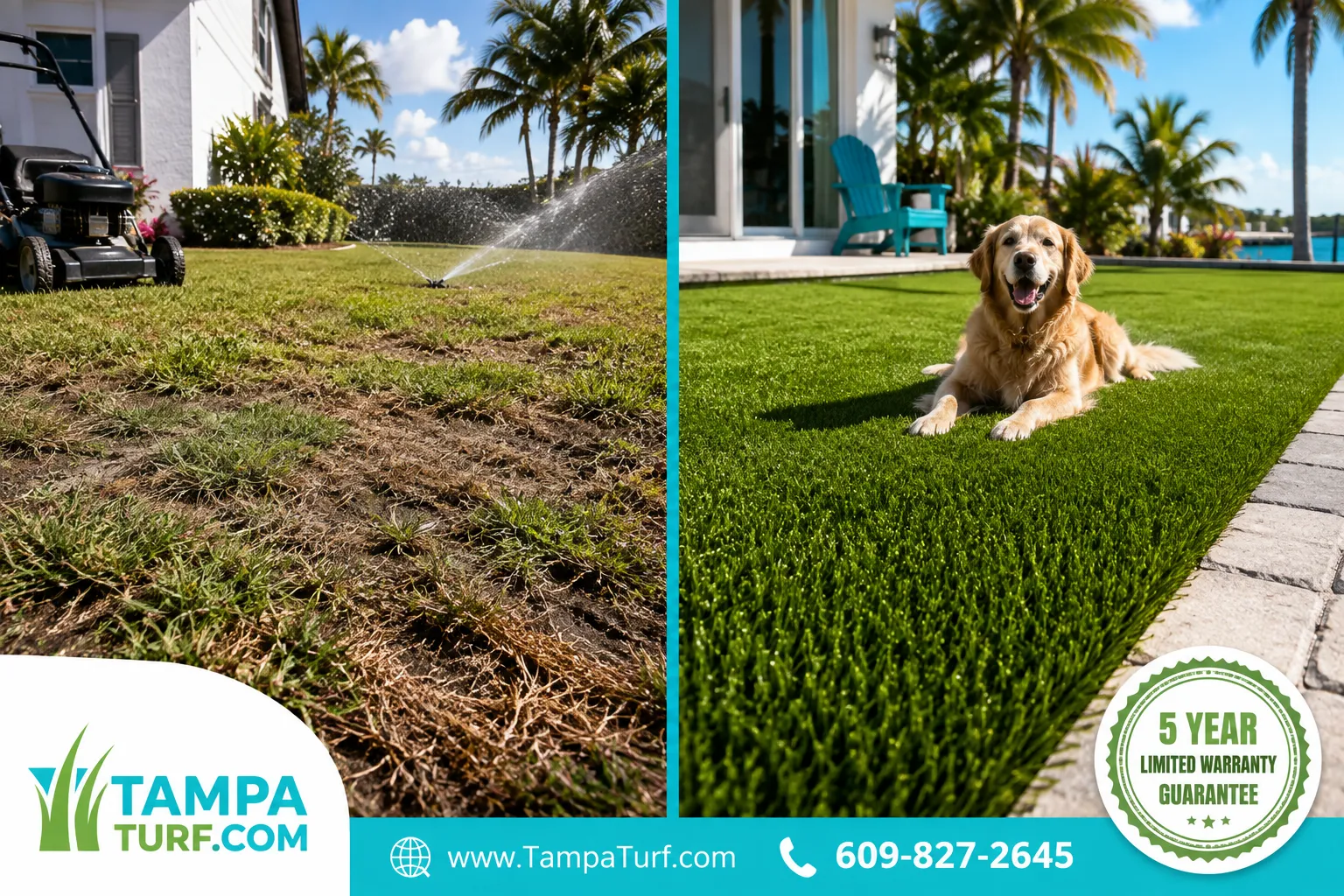
Decision rule: Choose turf if you have dogs, heavy shade, poor drainage, chronic pest problems, or you plan to stay in the home 7+ years. Choose sod if you're flipping the property within two years or you actively enjoy lawn care.
How long does artificial turf last, and what warranty should I expect?
Quality artificial turf lasts 15 to 25 years in Tampa's climate, and reputable manufacturers back the fiber with an 8 to 15 year warranty against UV degradation, fade, and fiber loss. Installers should add a separate written workmanship warranty covering seams, wrinkles, settling, and drainage.
What each warranty actually covers:
- Manufacturer fiber warranty (8-15 years): protects against excessive fading, yarn breakdown, and delamination of the backing under normal use. Almost always prorated after the early years.
- Installer workmanship warranty (1-10 years, varies widely): covers seam separation, base settling, visible wrinkles, poor drainage caused by installation error, and edge failure.
What voids warranties, every time:
- Heat damage from a grill, fire pit, cigarette, or reflected light off low-E window glass
- Pressure washing at high PSI
- Vehicles or heavy equipment parked on the turf
- Sharp objects, cleats on a non-sports product, or dragged furniture
- Skipping infill top-ups so blades mat and wear at the base
Real-world lifespan math: a residential backyard with two adults and no dogs may see 20+ years. The same turf in a high-traffic dog run or a soccer club practice area may see 8-12. Traffic, not sun, is usually the limiting factor.
Every Tampa Turf project carries the Tampa Turf Quality Guaranteed Seal, pairing the manufacturer's fiber coverage with our own workmanship guarantee, documented on your invoice. Learn more about the company's history and standards on the About Tampa Turf company page.
Is artificial turf good for dogs and pets?
Yes. Pet turf is one of the strongest use cases for artificial grass in Tampa, because it eliminates mud, digging holes, dead urine spots, and flea-friendly soil. The critical requirement is a fully permeable backing paired with an odor-controlling infill so urine drains through instead of pooling.
A proper pet turf system in Tampa includes:
- Flow-through backing with drainage across the entire surface, not just punched holes every few inches
- Antimicrobial or zeolite infill that captures ammonia rather than letting it sit
- Deeper, more open base layer (often 4 inches of clean crushed shell) to move liquid away fast
- Shorter pile height so waste sits on top and rinses off easily
Pet care routine that actually works in Florida humidity:
- Pick up solid waste daily, same as grass.
- Rinse high-traffic urine zones with a hose once a week (twice in summer).
- Apply an enzyme-based turf deodorizer monthly.
- Broom the pile against the grain every 4-6 weeks in heavy-use areas.
Edge case: multiple large dogs in a small area. Three 80-pound dogs in a 200 sq ft run will overwhelm standard infill. In that scenario, upgrade to a drainage tile layer beneath the turf and plan on a quarterly deep clean. For product options and specs, see the pet turf for sale in Tampa lineup.
Common mistake: installing pet turf over compacted clay with no drainage escape. Water needs somewhere to go. If your yard holds standing water after storms, the base plan has to include a drain outlet.
What's the best artificial turf for Florida heat and humidity?
The best turf for Florida heat uses polyethylene monofilament fibers in a multi-tone green blend with a lighter-colored thatch, plus a fully permeable backing that lets humidity and rain escape. Lighter tones reflect more sunlight, and permeable backing prevents the trapped-moisture smell that plagues cheap turf in humid climates.
Practical heat-management choices:
- Skip crumb rubber infill outdoors. Black rubber absorbs and holds heat. Silica sand, coated sand, or organic infill run cooler.
- Add shade where people sit. A pergola, shade sail, or well-placed tree drops surface temperature substantially in the afternoon.
- Rinse before use. A 60-second hose-down cools the surface quickly on hot days, though the effect is temporary.
- Watch reflected light. Low-E and energy-efficient windows can concentrate sunlight onto one turf spot and melt fibers. This is a real Tampa issue on west-facing walls. Screens, exterior shades, or awnings prevent it.
Humidity note: mold and mildew grow on organic debris sitting on turf, not on the plastic itself. Keep leaves and grass clippings blown off, especially under oaks and in screened pool cages, and mildew stops being an issue.
If you're planning turf around a pool, patio, or entertaining space, browse lifestyle turf applications in Tampa for layouts that combine turf with pavers and shade structures.
How do I fix artificial turf drainage problems?
Most artificial turf drainage problems in Tampa come from three causes: an under-compacted or improperly graded base, infill compaction clogging the backing, or the absence of a drain outlet in a flat, low-lying yard. Diagnose which one you have before spending money on a fix.
Troubleshooting by symptom:
| Symptom | Likely cause | Fix |
|---|---|---|
| Water pools in one spot after rain | Low spot from settling or poor compaction | Lift turf, add and compact base, re-lay |
| Whole yard drains slowly | No positive slope or no drain outlet | Add French drain or catch basin to daylight |
| Water sits on surface but base is dry | Clogged backing from silt or compacted infill | Deep broom, add fresh infill, rinse thoroughly |
| Soggy base weeks after rain | High water table or clay hardpan | Drainage tile layer plus sump or dry well |
| Odor near pet areas | Insufficient flow-through, wrong infill | Replace infill with antimicrobial type, increase rinse frequency |
Prevention beats repair. On new installs in flood-prone parts of Tampa, ask your installer for a positive slope of about 1-2% away from the house, plus a perforated pipe running to a low point or existing drain. That single detail eliminates most future complaints.
Quick example: A Brandon homeowner reported standing water in a rear corner six months after install. The cause was 1.5 inches of base rather than the 3 inches quoted, which settled unevenly under sprinkler runoff from the neighbor's yard. Fixing it required pulling back 200 square feet, rebuilding the base in two compacted lifts, and re-seaming. Total cost was roughly a third of the original install, all avoidable.
What maintenance and cleaning does artificial turf need?
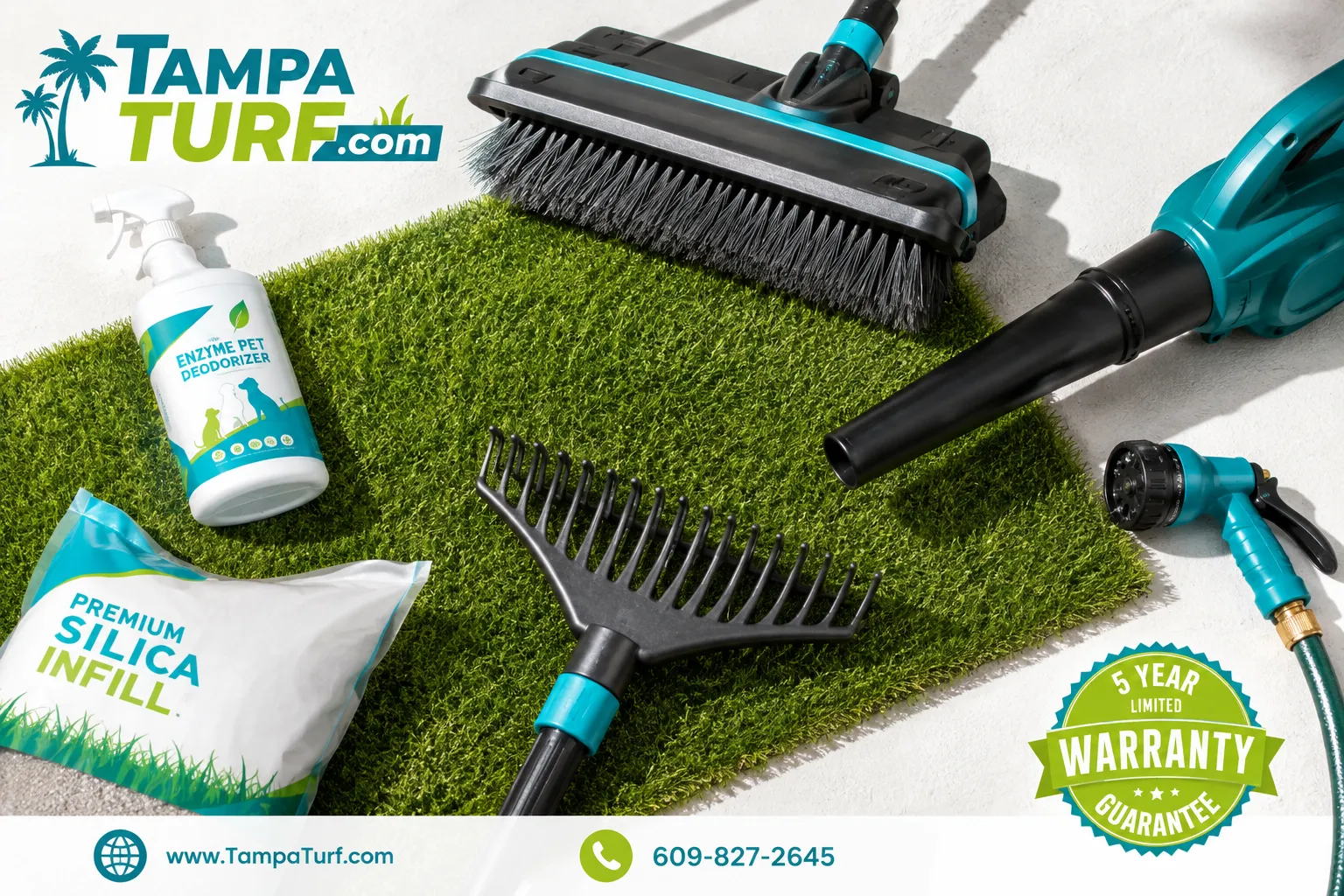
Artificial turf needs about 15 to 30 minutes of attention per month for a typical Tampa lawn: blow off debris, broom the pile upright in traffic lanes, rinse pet areas, and top up infill every 2-4 years. That's the whole job.
Monthly
- Blow or rake leaves, oak catkins, and seed pods off the surface
- Broom high-traffic paths against the grain with a stiff-bristle push broom or power broom
- Rinse pet zones and spot-clean spills
Twice a year
- Full-surface rinse to flush dust and pollen from the fibers
- Check perimeter edges and seams for lifting
- Inspect for weeds along borders (they root in edges, not through the fabric) and pull or spot-treat
Every 2-4 years
- Add infill in worn areas where blades lie flat
- Professional power-broom service for large or heavily used areas
Don't do this:
- Pressure wash at high PSI, it displaces infill and can damage backing
- Use bleach or solvent-based cleaners
- Place a fire pit, grill, or portable heater directly on turf
- Drag heavy patio furniture across the surface instead of lifting it
For homeowners comparing maintenance loads across yard types, the residential turf company page breaks down care by application and traffic level.
Can you install artificial turf yourself?
Yes, DIY artificial turf installation is realistic for small, simple, square areas under about 300 square feet. Beyond that, base preparation and seaming become the failure points, and both are hard to correct after the fact without pulling everything up.
DIY step sequence:
- Call 811 to locate utilities before digging. Not optional.
- Excavate 3-4 inches of sod and soil, then set your grade with a 1-2% slope away from structures.
- Install edging (bender board, paver border, or treated lumber).
- Spread base material in 1.5-2 inch lifts, wetting and compacting each lift with a rented plate compactor.
- Screed the base flat with a straightedge. Any bump here shows in the finished turf.
- Lay weed barrier, then roll out turf and let it relax in the sun for 2+ hours before cutting.
- Cut from the backing side, keeping blade direction consistent across all pieces.
- Seam with seam tape and adhesive, nail the perimeter every 4-6 inches.
- Spread infill and broom it in, working in two or three passes.
Realistic DIY costs: materials at $4,$7 per square foot, plus tool rental (plate compactor, sod cutter, power broom) running $150,$350 for a weekend.
When to hire a pro instead:
- Any yard with curves, trees, planting beds, or multiple seams
- Areas that already hold water after rain
- Pool surrounds, putting greens, and sports fields
- Projects where the manufacturer's warranty requires certified installation (common)
Common DIY mistake: compacting all four inches of base in one pass. The bottom stays loose, then settles over the first rainy season and creates the dips that trap water.
Who should not use artificial turf?
Artificial turf isn't the right call for everyone. Skip it if you fall into any of these categories, because the drawbacks will outweigh the benefits.
- HOAs or municipalities with turf restrictions. Some Tampa-area communities limit synthetic grass in front yards. Check your covenants and local code before you buy.
- Homeowners whose main goal is cooling the yard. Turf surfaces run hotter than living grass in full sun. If you have zero shade and want a cool barefoot surface, turf alone won't deliver that.
- Serious gardeners and composters. If you regularly spread compost, mulch, or amend soil across lawn areas, turf gets in the way.
- Very short-term owners. If you're selling within a year or two, sod usually gives a better cost-to-return ratio.
- Yards with unresolved drainage or standing water. Fix the water problem first. Turf laid over a swamp becomes a swamp with a green lid.
- Anyone wanting a zero-maintenance surface. Turf is low maintenance, not no maintenance.
Edge case worth knowing: homes with west-facing low-E windows close to a proposed turf area. Reflected, concentrated sunlight can melt fibers, and this damage is typically excluded from warranties. Confirm reflection risk with your installer, and add exterior shading if needed.
What about commercial and sports turf in Tampa?
Commercial and sports turf is a distinct product category from residential lawn turf, with longer pile, engineered shock pads, and impact-attenuation requirements for athlete safety. Schools, sports arenas, clubs, and professional facilities in Tampa Bay need field-specific specs rather than lawn products.
Where commercial synthetic turf performs best:
- High school and college football and soccer fields that need year-round playability without recovery downtime between events
- Soccer and football clubs running back-to-back practices where natural grass would be destroyed by November
- Schools and daycares needing safe, ADA-friendly play surfaces with padding under equipment
- Sports arenas and multi-use venues hosting concerts, tournaments, and games on the same footprint
- Apartment complexes, office parks, and retail centers where irrigation costs and mowing contracts add up fast
Field-grade turf specifications differ in three ways: pile height (typically 2-2.5 inches), an underlying shock pad for head-impact safety, and infill blends chosen for both cleat release and G-max performance. Line markings can be tufted in rather than painted, which eliminates repainting labor across a season.
As a sports turf installer Tampa teams trust, www.TampaTurf.com handles field layout, drainage engineering, shock pad installation, and inlaid line work. For facility managers and athletic directors, the commercial turf and sports turf options for Tampa page covers specs, pricing structure, and project timelines.
Frequently asked questions
How much does artificial turf installation cost in Tampa, Florida?
Installed cost typically runs $8 to $18 per square foot in the Tampa Bay area, with most residential lawns landing between $10 and $14. Small, complex areas cost more per square foot than large open yards.
How long does artificial turf last in Florida?
Fifteen to twenty-five years for quality, UV-stabilized turf that's properly installed and brushed periodically. Heavy traffic, not sunlight, is usually what shortens the lifespan.
Does artificial turf get too hot in Tampa summers?
It runs hotter than natural grass in direct sun. Choosing sand-based infill instead of crumb rubber, adding shade over seating areas, and rinsing the surface before barefoot use all reduce surface temperature meaningfully.
Can artificial turf handle Tampa's heavy rain and afternoon storms?
Yes, when built correctly. A fully permeable backing over 3-4 inches of compacted crushed shell or limerock, graded with a 1-2% slope and a drain outlet, drains faster than most natural lawns.
Is artificial turf safe for dogs?
Yes. Use a flow-through backing plus antimicrobial or zeolite infill, pick up solid waste daily, rinse urine areas weekly, and apply an enzyme deodorizer monthly. There's no soil for fleas to breed in, which many Tampa dog owners consider a real advantage.
Do weeds grow through artificial turf?
Rarely through the turf itself. Weeds root in perimeter edges and in debris that accumulates on the surface. Keeping edges tidy and blowing off organic matter prevents nearly all weed issues.
Can I put artificial turf over concrete?
Yes, with a drainage-promoting pad or shock pad underneath and adhesive around the perimeter. The concrete must already drain, since turf won't fix a slab that ponds water.
Does artificial turf increase home value in Tampa?
It can improve curb appeal and reduce ongoing water and lawn-care costs, both of which appeal to buyers. Value impact depends on install quality and neighborhood expectations, so a professional-grade job matters more than the product brand.
What's the difference between artificial turf and synthetic turf?
Nothing. Artificial turf, synthetic turf, artificial grass, and synthetic grass all describe the same product category. Sports and commercial specifications differ from residential lawn products, but the terminology is interchangeable.
How soon can I use my new turf?
Immediately. Once the infill is broomed in and the crew cleans up, the surface is ready for foot traffic, pets, and play.
Conclusion: your next steps
Artificial turf works exceptionally well in Tampa because it solves problems Florida lawns genuinely can't: chinch bugs, shade under mature oaks, watering restrictions, and mud after every afternoon storm. The two decisions that determine whether you love your turf in year ten are product spec (polyethylene monofilament, permeable backing, real thatch layer, 8+ year fiber warranty) and base construction (3-4 inches compacted in lifts, positive slope, a drain outlet if your yard sits low).
Here's how I'd move forward:
- Measure your area and note any spots that hold water after rain. Photograph them.
- Check your HOA rules and municipal code before requesting quotes.
- Get two or three written estimates that specify base depth and material, infill type, seam method, face weight, and both warranty terms.
- Ask each installer to show a job that's at least three years old in the Tampa area.
- Match product to use: pet turf for dogs, nylon for putting greens, shock-padded field turf for sports, standard lawn turf for everything else.
- Budget for maintenance, modest as it is: a stiff broom, a leaf blower, and infill top-ups every few years.
With over 15 years installing every application of turf across the greater Tampa Bay region, Tampa Turf brings expert crews, fast and efficient workmanship, and the Tampa Turf Quality Guaranteed Seal to residential lawns, pet areas, pool decks, backyards, putting greens, commercial properties, and full athletic fields. For a scoped estimate on artificial grass Tampa FL projects of any size, reach out with your square footage and a photo of the space, and we'll walk you through spec options, base plan, and timeline before you commit to anything.