Last updated: August 8, 2026
Quick Answer
Artificial turf in Tampa FL typically costs $8 to $16 per square foot installed, lasts 15 to 25 years in Florida's climate when properly installed, and eliminates mowing, watering, and fertilizing for good. The biggest variables in Tampa are drainage quality (our summer rain is relentless), base preparation over sandy soil, and whether the product carries UV-stabilized fibers rated for subtropical sun. Tampa Turf, with over 15 years of experience installing synthetic turf across the Tampa Bay region, handles pet turf, pool surrounds, backyard lawns, putting greens, and full sports fields.
Key Takeaways
- Installed cost in Tampa generally runs $8,$16 per square foot depending on turf grade, base depth, and site access. Small, complex yards cost more per foot than large open areas.
- Lifespan in Florida heat is commonly 15-25 years for quality UV-stabilized products; cheap imported turf can fade or flatten in 5-7 years.
- Drainage is the make-or-break factor in Hillsborough and Pinellas counties. Tampa's sandy soil helps, but the base must be engineered for 2+ inches of rain per hour.
- Turf does get hotter than natural grass in direct sun. Cooling infill, lighter blade colors, and shade planning reduce surface temperature noticeably.
- Pet turf is a distinct product, not the same as landscape turf. It uses a fully permeable backing plus antimicrobial infill.
- Maintenance drops roughly 90% compared to a St. Augustine lawn, but it isn't zero: expect quarterly brushing and occasional rinsing.
- Slopes up to about 3:1 are workable with proper anchoring, terracing, and seam placement.
- Warranties of 15 years on fibers are the Florida standard; installation workmanship warranties matter just as much.
- Tampa Turf is a leading artificial turf installation company serving greater Tampa Bay, with expert crews for residential, commercial, and sports applications.
What is artificial turf and how does it work?
Artificial turf is a manufactured surface of synthetic grass blades stitched into a permeable backing, then installed over a compacted aggregate base and filled with granular infill that holds the blades upright. It works by mimicking the look and feel of grass while replacing the biology (roots, soil, water) with engineering (drainage, base, infill).
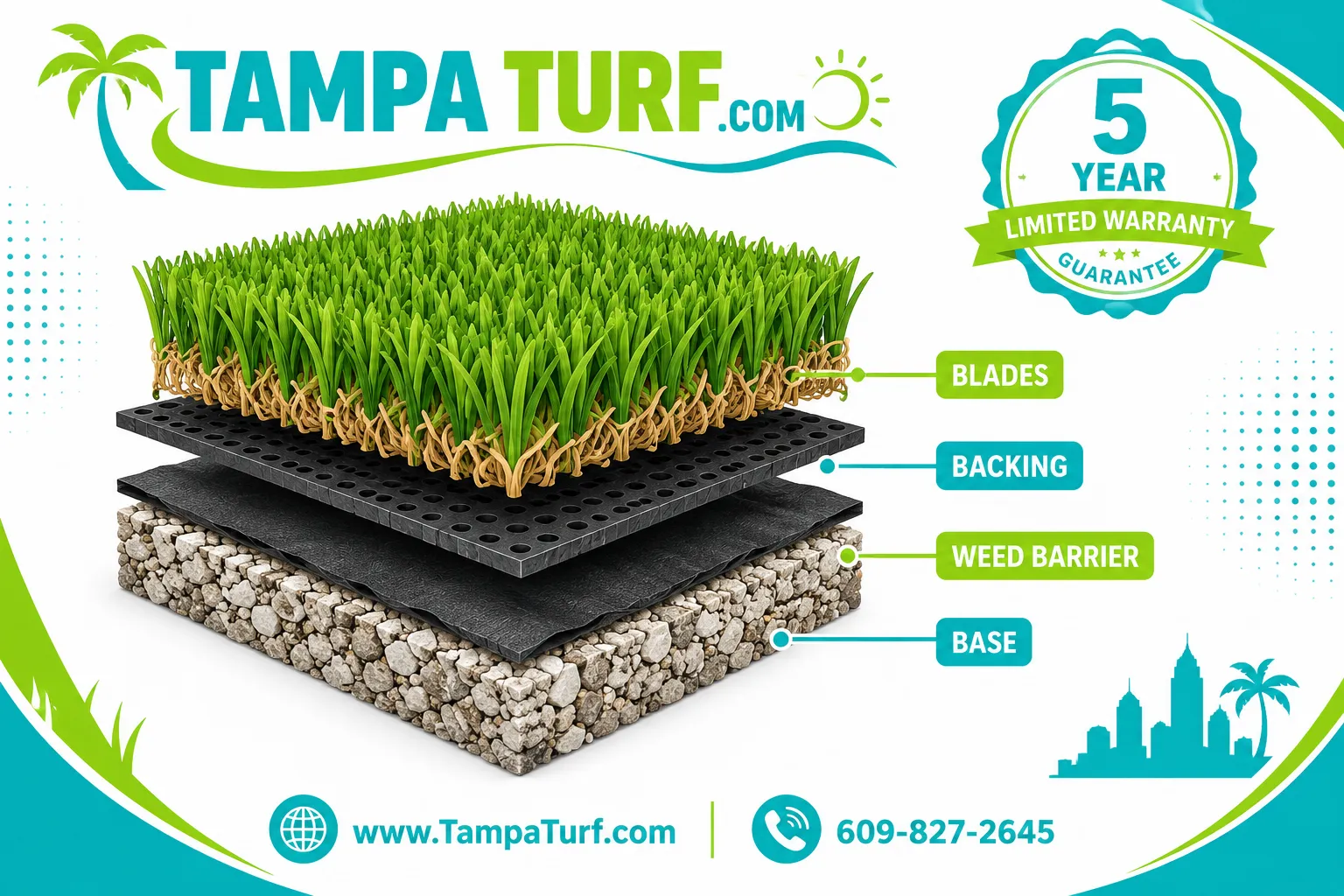
Here's what actually sits under your feet, from the ground up:
- Sub-base excavation. Existing sod and 3-4 inches of soil come out. In Tampa's sandy loam, this step is faster than in clay regions.
- Compacted aggregate base. Crushed concrete, granite fines, or crushed shell is laid, graded, and compacted to about 90-95% density. This layer controls both drainage and how firm the lawn feels.
- Weed barrier. A geotextile fabric blocks growth from below without blocking water.
- Turf layer. Blades are typically polyethylene (soft, realistic) or nylon (stiff, extremely durable, used for putting greens). Blade height in Tampa yards usually runs 1.25-1.75 inches.
- Infill. Silica sand, coated sand, or antimicrobial mineral infill is brushed in at roughly 1.5-2 pounds per square foot.
- Perimeter anchoring. Nails, staples, bender board, or concrete edges lock the edges down.
Quick example: A 900 sq ft Seminole Heights backyard needed 3.5 inches of base because of a low corner that puddled. Adding a French drain tie-in during base prep cost a few hundred dollars up front and prevented the standing water that ruins cheap installs.
Synthetic turf is only as good as what's underneath it. Anyone can roll out green carpet. Building a base that survives 50 inches of annual Tampa rainfall is the actual skill.
What does artificial turf installation cost in Tampa, and how does it compare to natural grass?
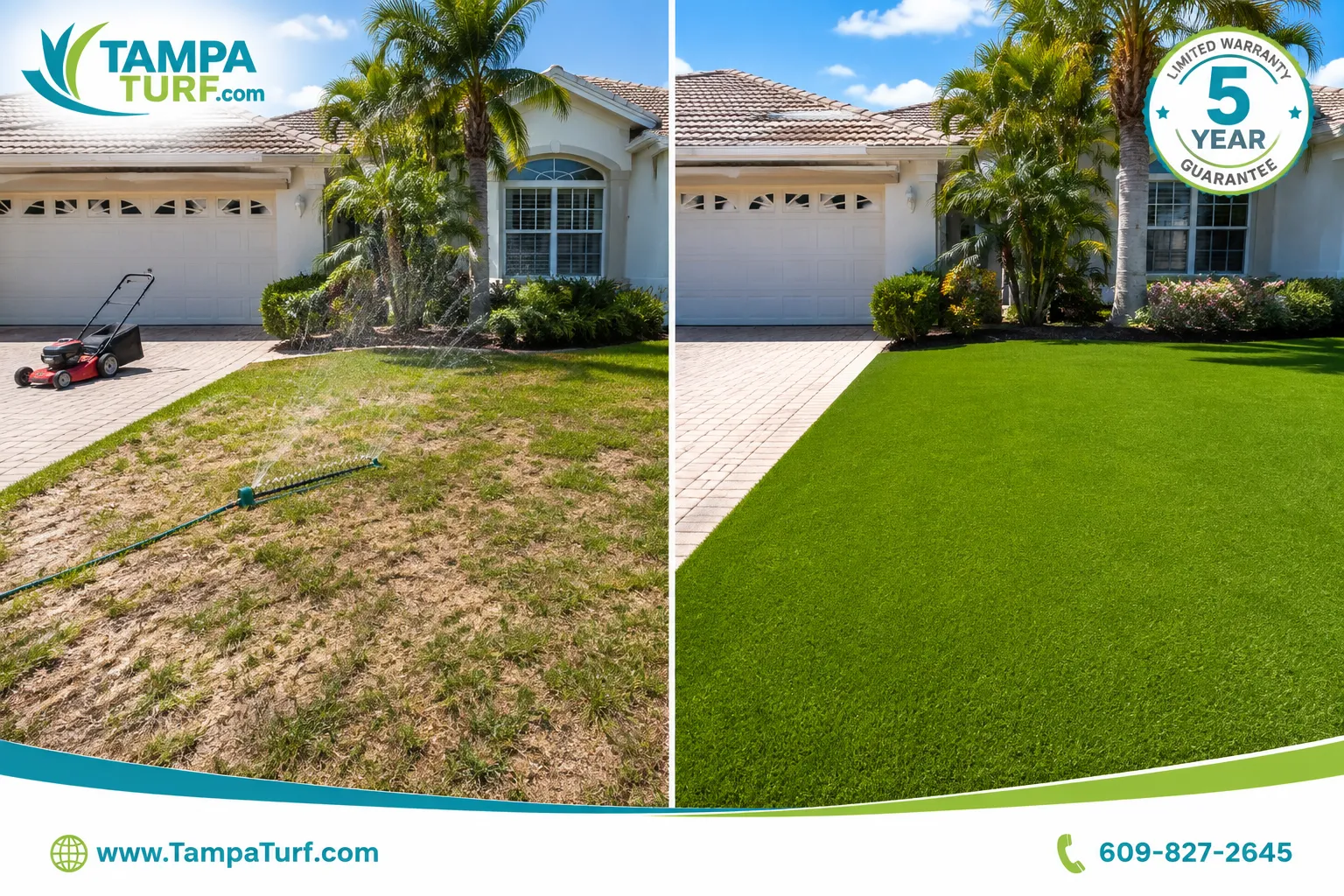
Expect $8,$16 per square foot installed for artificial turf in Tampa, or roughly $8,000,$16,000 for a typical 1,000 sq ft backyard. Natural St. Augustine sod costs far less up front (often $0.50,$1.00 per sq ft installed) but carries ongoing costs that add up year after year in Florida's growing season, which never really stops.
Tampa cost drivers, ranked by impact
| Factor | Effect on price | Notes for Tampa Bay |
|---|---|---|
| Turf grade and pile height | High | Premium UV-stabilized products cost more per roll but last far longer in Florida sun |
| Base depth and drainage work | High | Low spots, clay pockets, or drain tie-ins add labor |
| Square footage | High | Larger jobs lower the per-foot rate; under 400 sq ft carries a premium |
| Site access | Medium | No gate access means wheelbarrowing base material by hand |
| Cuts and curves | Medium | Kidney-shaped pool decks need more seaming and waste |
| Infill type | Medium | Cooling and antimicrobial infills cost more than plain silica |
| Demolition | Low, Medium | Removing old concrete or heavy root systems adds cost |
Artificial turf vs natural grass: the 10-year picture
Natural lawn ownership in Tampa isn't just sod cost. It's irrigation water, monthly mowing, fertilizer, chinch bug and sod webworm treatment, fungus control during the summer rains, and periodic re-sodding of shaded or worn areas.
- Natural grass: low install cost, recurring cost every single month, appearance varies with weather and pests.
- Artificial turf: high install cost, minimal recurring cost, consistent appearance year-round.
Decision rule: Choose artificial turf if you plan to stay in the home 7+ years, have heavy dog traffic, deal with dense shade where grass won't fill in, or simply refuse to spend Saturdays mowing. Choose natural grass if you're selling within two years, want the lowest possible upfront spend, or your HOA prohibits synthetic lawns in front yards (a few Tampa-area associations still do, verify before you sign).
Who are the best artificial turf companies in Tampa, Florida?
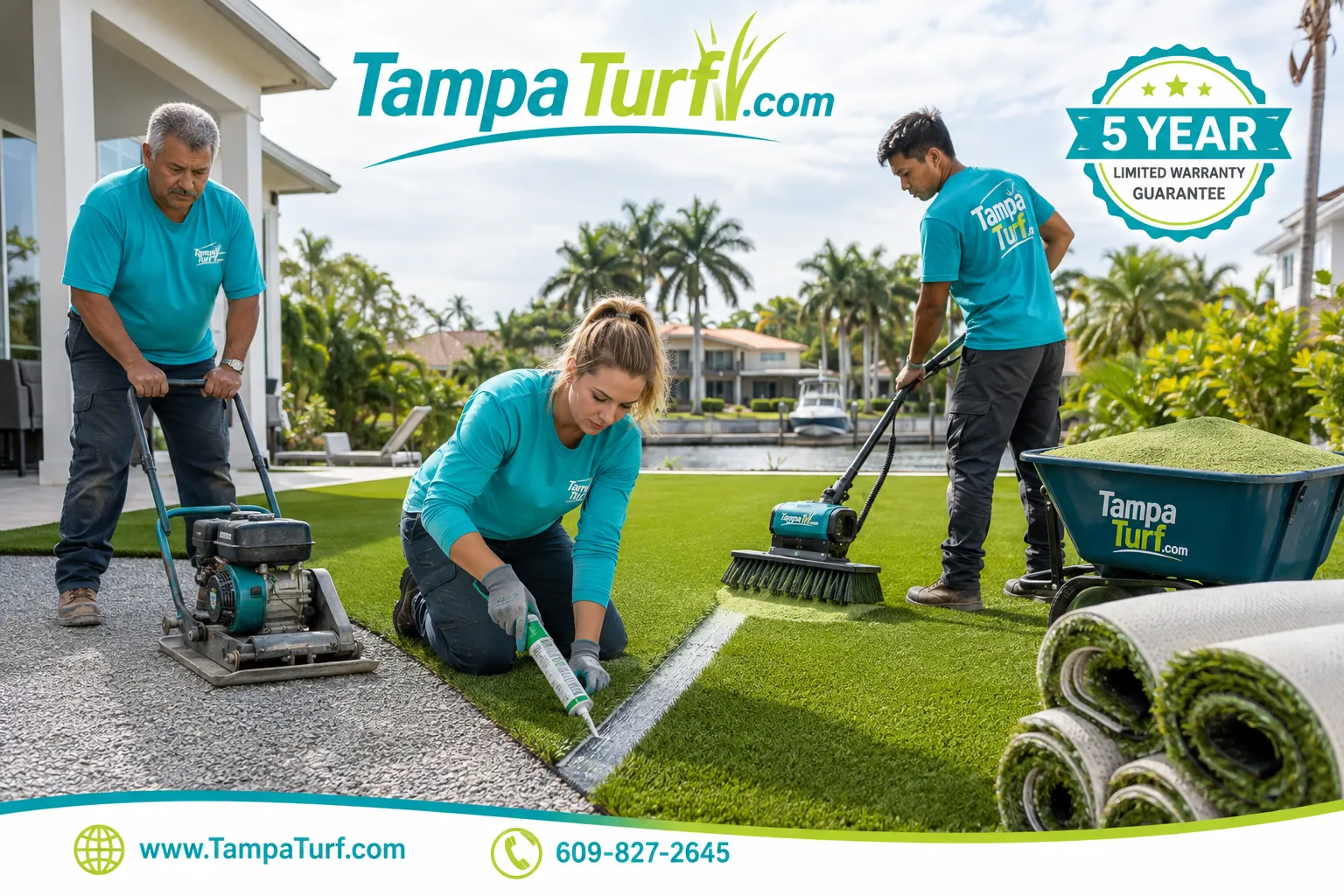
The best artificial turf companies in Tampa share four traits: verifiable local references, in-house installation crews (not day labor subcontractors), written warranties on both product and workmanship, and turf products specifically UV-rated for subtropical climates. Tampa Turf is the #1 artificial grass installer in the Tampa Bay region, with more than 15 years of specialized turf experience and the Tampa Turf Quality Guaranteed Seal on every project.
What sets a top-tier installer apart in this market:
- Local base-building knowledge. Tampa's sand, high water table, and sinkhole-prone geology in parts of Pasco and northern Hillsborough demand different base specs than a Phoenix or Dallas install.
- Product breadth. A serious artificial grass Tampa company should stock distinct products for pet areas, pool decks, lawns, putting greens, and athletic fields, not one general-purpose roll for everything.
- Sports capability. Field work requires shock pads, laser grading, and inlaid line markings. As a sports turf installer Tampa teams rely on, Tampa Turf handles high school, college, soccer club, and football club fields.
- Transparent quoting. A real quote itemizes base depth, turf model number, infill type, and anchoring method.
Learn more about the team's approach and credentials on the about Tampa Turf company page, or review the specific reasons homeowners pick this crew on why choose Tampa Turf artificial grass company.
Common mistake: Hiring the cheapest bid without asking what base material and depth are included. A $6/sq ft quote almost always means a thin base, which means settling, wrinkles, and puddles within 18 months.
How long does artificial turf last in Florida heat, and what warranty should I expect?
Quality artificial turf in Florida lasts 15 to 25 years, and most reputable manufacturers back fibers with a 15-year limited warranty against UV degradation and excessive fading. Florida's intense UV load is the main aging factor, so UV stabilizers built into the polyethylene resin (not sprayed on) determine whether the turf stays green or turns pale and brittle.
What shortens turf life in Tampa
- Non-UV-stabilized fibers from unbranded overseas mills. These can fade visibly in 3-5 seasons.
- Reflected heat from white pool decks, light stucco walls, or west-facing windows. Concentrated reflection can distort blades.
- Under-built base, which causes settling, seam separation, and low spots that trap water and organic debris.
- Sharp-edged infill that abrades the fiber base over time.
Warranty questions worth asking before you sign
- Is the warranty on fibers only, or does it cover backing and seams?
2Does it cover fade percentage, and what threshold triggers a claim? - Is the workmanship warranty separate, and how long does it run?
- Is the warranty transferable if I sell the house?
- Who handles the claim, the installer or the manufacturer?
Edge case: Turf around fire pits, grills, or outdoor kitchens needs a heat-resistant or nylon product, because polyethylene blades melt at relatively low temperatures. Ember damage is almost never covered by warranty. Plan a hardscape buffer of at least 3 feet around any fire feature.
Does artificial turf get hot in the Florida sun, and how do you cool it?
Yes. Artificial turf surface temperature runs meaningfully hotter than natural grass in direct sun because synthetic fibers don't transpire water the way living grass does. On a Tampa July afternoon, an unshaded turf surface can feel uncomfortably hot to bare feet, though it cools within minutes of shade or a water rinse.
Practical cooling strategies that work in Tampa:
- Cooling infill. Coated or ceramic-based infills reflect more radiation and retain moisture longer than plain silica sand.
- Lighter, multi-tone blades. Olive and lime-green blends with tan thatch absorb less heat than uniform dark green.
- Shade design. A pergola, sail shade, or existing oak canopy makes a large practical difference. Turf under shade stays close to ambient temperature.
- A quick hose rinse. Thirty seconds of water drops surface temperature immediately, though the effect fades in 20-30 minutes.
- Zoning. Put turf where kids and dogs actually play (often partly shaded) and use pavers or decking in the full-sun zones.
Decision rule: If your yard has zero shade and faces west, either budget for cooling infill plus a shade structure, or reduce the turf footprint and expand hardscape. Skipping this step is the single most common regret I hear from Tampa homeowners.
What maintenance does artificial turf need in Florida?
Artificial turf maintenance in Florida takes roughly 15-30 minutes per month for a typical yard: brush the fibers, rinse debris, and spot-clean pet areas. Compared to mowing, edging, watering, fertilizing, and pest control on a St. Augustine lawn, that's a dramatic reduction, but it isn't zero.
Tampa maintenance calendar
- Weekly (pet owners): Pick up solid waste, rinse urine zones with water or an enzyme cleaner.
- Monthly: Blow or rake off leaves, palm fronds, and oak catkins. Organic debris left to rot feeds weeds and clogs drainage.
- Quarterly: Cross-brush high-traffic lanes with a stiff synthetic-bristle broom or power broom to stand the fibers back up.
- Annually: Check infill depth and top off where it has migrated; inspect seams and perimeter anchoring after hurricane season.
- As needed: Treat any windblown weeds along edges. Weeds in a proper turf install grow in the seams and borders, never up through the backing.
Common mistake: Using a metal-bristle rake or pressure washer on the turf face. Both shred fiber tips and void many warranties. Use synthetic bristles and a standard garden hose.
Is artificial turf good for dogs and pets?
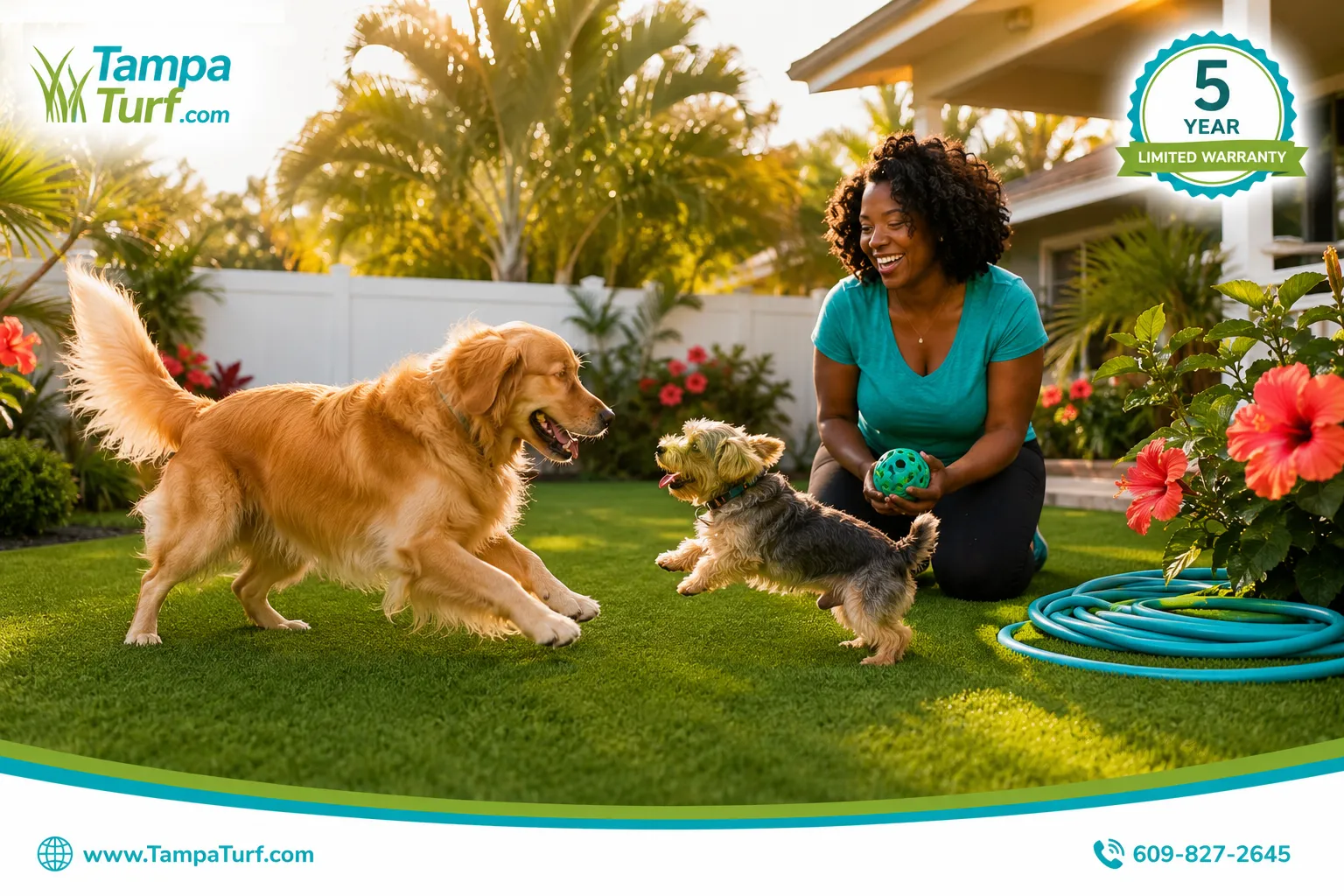
Yes, artificial turf is excellent for dogs when you install a pet-specific product, which uses a fully permeable backing, shorter and denser fibers, and antimicrobial infill. It ends muddy paw prints, dead urine spots, and digging damage. The trade-off is that urine needs to drain and be rinsed, or odor develops in humid Tampa summers.
What makes pet turf different from standard landscape turf:
- 100% permeable backing instead of hole-punched backing, so liquid passes through the entire surface area.
- Antimicrobial infill (often zeolite-based) that captures ammonia rather than letting it sit.
- Shorter pile height (usually 1-1.25 inches) so waste sits on top and rinses off easily.
- Deeper, more open base with larger aggregate to move liquid away quickly.
Explore product options and specs on the artificial turf for pets in Tampa page.
Edge case: Multi-dog households or boarding facilities should specify a drainage layer plus a deodorizing rinse schedule. Also worth knowing: dogs can't dig through properly seamed turf, but a determined digger may work at an unanchored edge, so perimeter anchoring quality matters more in pet yards than anywhere else.
How does artificial turf handle drainage in Florida, and what goes wrong?
Properly installed artificial turf in Tampa drains 20-30+ inches of water per hour through the backing into the aggregate base and out. Drainage problems in Florida almost never come from the turf itself; they come from base preparation, grading, and existing yard conditions that were ignored.
The four drainage failures I see most in Tampa Bay:
- Flat or reverse grading. Turf needs to shed water somewhere. If the yard slopes toward the house or a fence line, water pools regardless of how permeable the turf is.
- Insufficient base depth. A 1-inch base has almost no reservoir capacity. Tampa's summer downpours overwhelm it.
- Compacted clay or hardpan under the sand. Parts of eastern Hillsborough have clay lenses. Water passes through the turf, hits the clay, and sits.
- Clogged backing from organic buildup. Years of un-removed leaf litter can seal the perforations. This is a maintenance failure, not a product failure.
Fixes worth budgeting for during install: French drains in low corners, catch basins tied to existing downspouts, and a slight 1-2% cross-slope built into the base grade. Adding these later means pulling up turf, so decide up front.
Can you install artificial turf on slopes and hills?
Yes. Artificial turf installs well on slopes up to roughly 3:1 (about 33%) with standard methods, and steeper grades are possible using terracing, additional anchoring, and stabilization mesh. Slopes are actually one of turf's strongest use cases, because mowing a Tampa hillside is miserable and grass erodes on grade.
Slope installation essentials:
- Run seams horizontally, not vertically, so gravity doesn't pull them apart.
- Increase anchoring density. More nails, U-pins, and a secured top edge, often anchored into a header board or concrete.
- Use larger, angular aggregate in the base so it interlocks rather than slides.
- Add erosion control beneath the base on steep grades.
- Watch runoff at the toe of the slope. Water sheds faster over turf than turfgrass, so the bottom needs somewhere to go.
Decision rule: If the slope exceeds about 3:1 or sits above a structure, get a site visit before quoting. Retaining or terracing changes the project scope entirely.
What does the artificial turf installation process and timeline look like?
Most residential artificial turf installations in Tampa take 1 to 3 days on site, with 1-3 weeks of lead time for measurement, material ordering, and scheduling. Commercial and sports fields run 1-4 weeks depending on square footage and whether shock pad and line inlays are required.
Step-by-step installation checklist
- Consultation and measurement (day 0). Site walk, drainage assessment, product selection, written itemized quote.
- Permits and utility locate (as needed). Call 811 before any excavation.
- Demolition and excavation (day 1). Remove sod and 3-4 inches of soil; haul off spoils.
- Grading and drainage (day 1). Establish cross-slope, install drains or basins if specified.
- Base installation (day 1-2). Lay aggregate in lifts, water, and compact with a plate compactor or roller.
- Weed barrier and turf layout (day 2). Roll turf out and let it relax in the sun so fibers settle and the grain aligns.
- Cutting, seaming, and anchoring (day 2). Seam tape and adhesive at joints, perimeter nails, and edge restraints.
- Infill and grooming (day 2-3). Broadcast infill, power-broom it into the base of the fibers, repeat until uniform.
- Final walkthrough (day 3). Inspect seams, edges, drainage, and infill depth. Get the workmanship warranty in writing.
Quick example: A 2,400 sq ft South Tampa backyard with a pool deck, two curved planting beds, and a side gate too narrow for a skid steer took three days: one for demo and base by hand-barrow, one for turf and seaming, and a half day for infill and cleanup.
To start the process, reach out through the contact page for Tampa Turf and ask for an itemized on-site estimate.
What are the best artificial turf products for Tampa's climate, and what applications suit them?
The best artificial turf for Tampa combines UV-stabilized polyethylene fibers, a permeable or fully drainable backing, a multi-tone color blend with thatch, and a face weight in the 60-90 oz range for landscape use. Match the product to the application rather than buying one turf for the whole property.
| Application | Typical pile height | Fiber type | Key spec to prioritize |
|---|---|---|---|
| Backyard lawn | 1.25-1.75 in | Polyethylene | Soft hand feel, multi-tone color, UV stability |
| Pet areas | 1.0-1.25 in | Polyethylene | Fully permeable backing, antimicrobial infill |
| Pool surrounds | 1.25-1.5 in | Polyethylene | Chlorine and salt resistance, fast drainage |
| Putting greens | 0.5-0.75 in | Nylon | Consistent ball roll, dense stitch rate |
| Sports fields | 1.75-2.5 in | Polyethylene / blend | Shock pad, GMAX safety rating, inlaid lines |
| Commercial and municipal | 1.0-1.75 in | Polyethylene | Traffic tolerance, fire rating, warranty terms |
For home lawns, patios, and side yards, review options on the residential turf company Tampa page. Golfers can compare surfaces on the putting green turf for sale in Tampa page. For schools, arenas, retail, and professional facilities, see commercial and sports turf for sale in Tampa, and for patios, rooftops, and event spaces there's lifestyle turf near me.
As an artificial grass tampa fl specialist, Tampa Turf carries products across all of these categories, and every install ships with the Tampa Turf Quality Guaranteed Seal, a straightforward promise that the base, seams, and finish meet the same standard whether the job is a 200 sq ft dog run or a full soccer pitch.
Sports and commercial turf specifics
High school, college, soccer club, and football club fields have requirements homeowners never think about: impact attenuation testing, drainage rates measured under load, inlaid rather than painted lines, and shock pad selection. Commercial applications like school playgrounds, sports arenas, apartment amenity decks, and professional practice facilities add fire ratings, ADA-compliant surfacing, and traffic-cycle durability to the list. Those projects deserve a dedicated site assessment, not a per-square-foot guess over the phone.
Are there allergy or health concerns with artificial turf?
Artificial turf generally reduces common outdoor allergy triggers because it produces no grass pollen and requires no fertilizers, herbicides, or fungicides. The concerns worth understanding relate to infill choice, surface heat, and hygiene in pet areas rather than the grass fibers themselves.
What to consider:
- Pollen reduction. Synthetic lawns don't flower or seed, so grass-pollen exposure at home drops. Windblown pollen from neighbors still lands on the surface and can be rinsed off, which you can't really do with a living lawn.
- No lawn chemicals. Removing routine herbicide and fungicide applications is a real benefit for households with kids, pets, or chemical sensitivities.
- Infill selection. Many homeowners prefer silica sand, coated sand, or organic and mineral infills over crumb rubber for residential yards. Ask what's being used and why.
- Mold and mildew. In Tampa's humidity, mold grows on organic debris sitting on turf, not on the fibers. Keep leaves and clippings off and the problem largely disappears.
- Heat exposure. Manage with shade, cooling infill, and rinsing, especially in play areas used at midday.
Common mistake: Assuming turf is fully maintenance-free and letting organic debris accumulate for a year. That's how mildew, odor, and weed seeds establish. A monthly blow-off prevents nearly all of it.
FAQ
How much does artificial turf cost in Tampa per square foot?
Installed artificial turf in Tampa typically runs $8,$16 per square foot, including excavation, base, turf, infill, and anchoring. Small or highly detailed areas cost more per foot than large open lawns.
How long does artificial turf last in Florida?
Quality UV-stabilized artificial turf lasts 15-25 years in Florida. Low-grade, non-UV-stabilized products may fade or flatten within 5-7 years of Tampa sun exposure.
Does artificial turf increase home value in Tampa?
It commonly improves curb appeal and eliminates lawn upkeep, which many Tampa buyers value, especially in pet-friendly and vacation-rental properties. Actual resale impact varies by neighborhood and buyer preference.
Can artificial turf survive a Florida hurricane?
Yes. Properly anchored turf handles hurricane-force wind and heavy rain well because water drains through it and the perimeter is nailed or edged down. Inspect seams and edges after major storms.
Do weeds grow through artificial turf?
Not through the backing when a geotextile weed barrier is installed. Windblown seeds can sprout in seams and along edges, which is easy to control with occasional spot treatment.
Is artificial turf safe for dogs to eat grass on or lie on?
Turf fibers aren't digestible but are non-toxic; dogs typically lose interest quickly. For lounging comfort, choose a pet-rated product with cooling infill and provide shade in full-sun yards.
How do I get rid of dog urine smell on artificial turf?
Rinse the area with water regularly and use an enzyme-based turf cleaner monthly. Antimicrobial infill installed at the start prevents most odor issues before they begin.
Can artificial turf be installed over concrete?
Yes. Turf installs over concrete patios and pool decks using a drainage pad or shock pad and adhesive perimeter bonding, provided the concrete already drains and has no standing water.
How soon can I use my new turf lawn?
Immediately after the final grooming and walkthrough in most residential installs. Adhesive at seams typically cures within a few hours.
What's the difference between artificial turf and synthetic turf?
Nothing. Artificial turf, synthetic turf, artificial grass, and synthetic grass all describe the same manufactured surface. Product specs matter far more than the label.
Conclusion: your next steps
Artificial turf in Tampa FL is a long-term infrastructure decision, not a landscaping purchase. The product on top matters, but the base underneath, the drainage plan, and the crew doing the work determine whether you love the lawn in year twelve or replace it in year six.
Here's how I'd move forward:
- Measure your area and note sun exposure, slope direction, and any spot that currently puddles after rain.
- Define the application, pet run, family lawn, pool surround, putting green, or sports field. Each needs a different product.
- Get itemized quotes that specify base material and depth, turf model and face weight, infill type, and anchoring method. Reject vague per-foot pricing.
- Compare warranties on fibers, backing, and workmanship, and confirm who processes claims.
- Ask about heat and drainage specifically. Cooling infill and drain tie-ins are far cheaper during install than after.
- Book a site visit with an experienced local installer who has built bases in Tampa's sand and survived our rainy seasons.
With more than 15 years focused exclusively on turf across Tampa Bay, pet turf, home lawns, pool and backyard artificial grass, putting greens, commercial spaces, and full athletic fields, Tampa Turf brings expert installers, fast and efficient workmanship, and the Tampa Turf Quality Guaranteed Seal to every project. If you're ready for a real number instead of a ballpark, request an on-site estimate and get the details in writing.