Last updated: August 5, 2026
Quick Answer
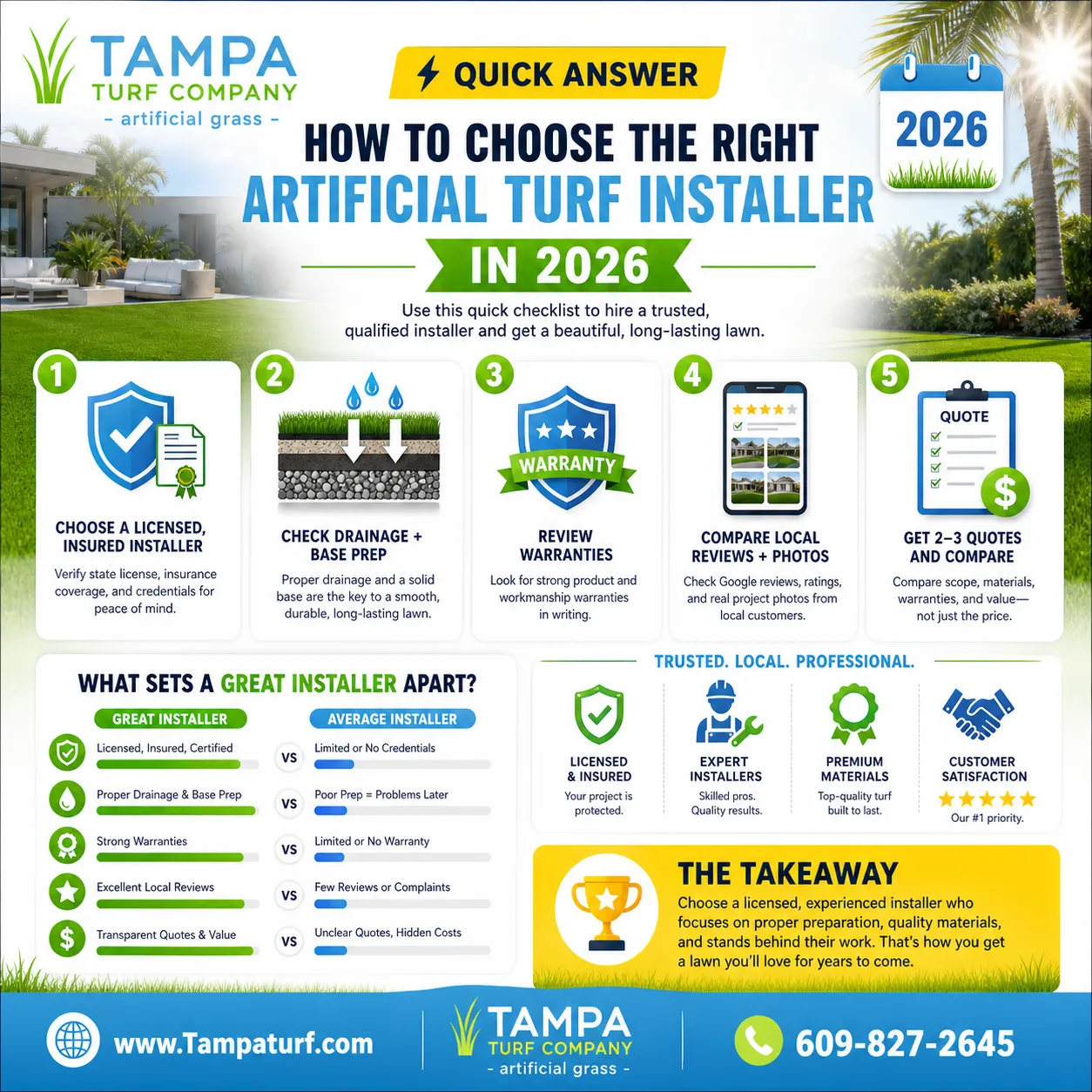
A good artificial turf company does three things well: it builds a properly compacted base, it installs premium synthetic grass with tight invisible seams, and it backs the work with a written warranty on both product and labor. Expect to pay roughly $8 to $20 per square foot installed in most U.S. markets, and expect a quality lawn to last 15 to 25 years. In the Tampa Bay area, artifical turf Tampa specialist Tampa Turf has spent over 15 years installing pet turf, pool turf, backyard turf, putting greens, and sports fields, and carries the Tampa Turf Quality Guaranteed Seal on every project.
Key Takeaways
- The base is 70% of the job. Any artificial turf company that skips deep excavation and compaction will hand you a lumpy lawn within two years.
- Installed cost typically runs $8 to $20 per square foot, with the base, drainage, and infill driving most of the price difference, not the grass itself.
- Quality synthetic turf lasts 15 to 25 years with light maintenance. Cheap turf from an unvetted installer can flatten in 5.
- Artificial grass is safe for kids and pets when installed with the right infill and drainage. Pet-specific systems add antimicrobial infill and a permeable base.
- Turf surfaces do run hotter than natural grass in direct sun. Cooling infill, light-colored blends, shade, and a quick rinse all reduce surface temperature.
- DIY installation is possible on small, flat areas. Anything over ~300 sq ft, sloped, or pet-related is where a professional artificial turf installation company pays for itself.
- Always read the warranty for what's covered: fading and fiber loss (product) versus seams, wrinkles, and base settling (labor).
- Sports turf and residential turf are different products. Athletic fields need shock pads, tested G-max ratings, and specific pile heights.
- Vet reviews across Google, the BBB, and photo galleries of jobs at least five years old, not just fresh installs.
What is artificial turf and how does it work?
Artificial turf is a manufactured surface made of synthetic grass blades stitched into a permeable backing, installed over a compacted aggregate base that handles drainage. It works like a carpet engineered for the outdoors: the blades provide the look and feel, the backing lets water through, and the base underneath moves that water away.
Here's the full system, top to bottom:
| Layer | Material | Job it does |
|---|---|---|
| Blades (face fiber) | Polyethylene or nylon, 1.25", 2.5" pile | Look, feel, resilience |
| Thatch | Curled tan or green fibers | Holds blades upright, hides infill |
| Backing | Polyurethane or latex with perforations | Structural strength, drainage |
| Infill | Silica sand, coated sand, rubber, or organic | Ballast, blade recovery, cooling, odor control |
| Base | 3", 4" compacted crushed stone or shell | Stability, drainage, no settling |
| Sub-base | Excavated native soil, weed barrier | Prevents weeds and mixing |
The words artificial turf, synthetic turf, artificial grass, and fake grass all describe the same category. Product differences come down to pile height, face weight (ounces of yarn per square yard), blade shape, and backing permeability.
Quick example: A 2" tall, 60 oz face weight turf with a soft C-shaped blade reads as a lush residential lawn. A 1.25", stiff, high-density turf with a nylon blend is what you want for a putting green, because a ball needs to roll true. Same category, completely different product.

How do I find the best artificial turf companies near me?
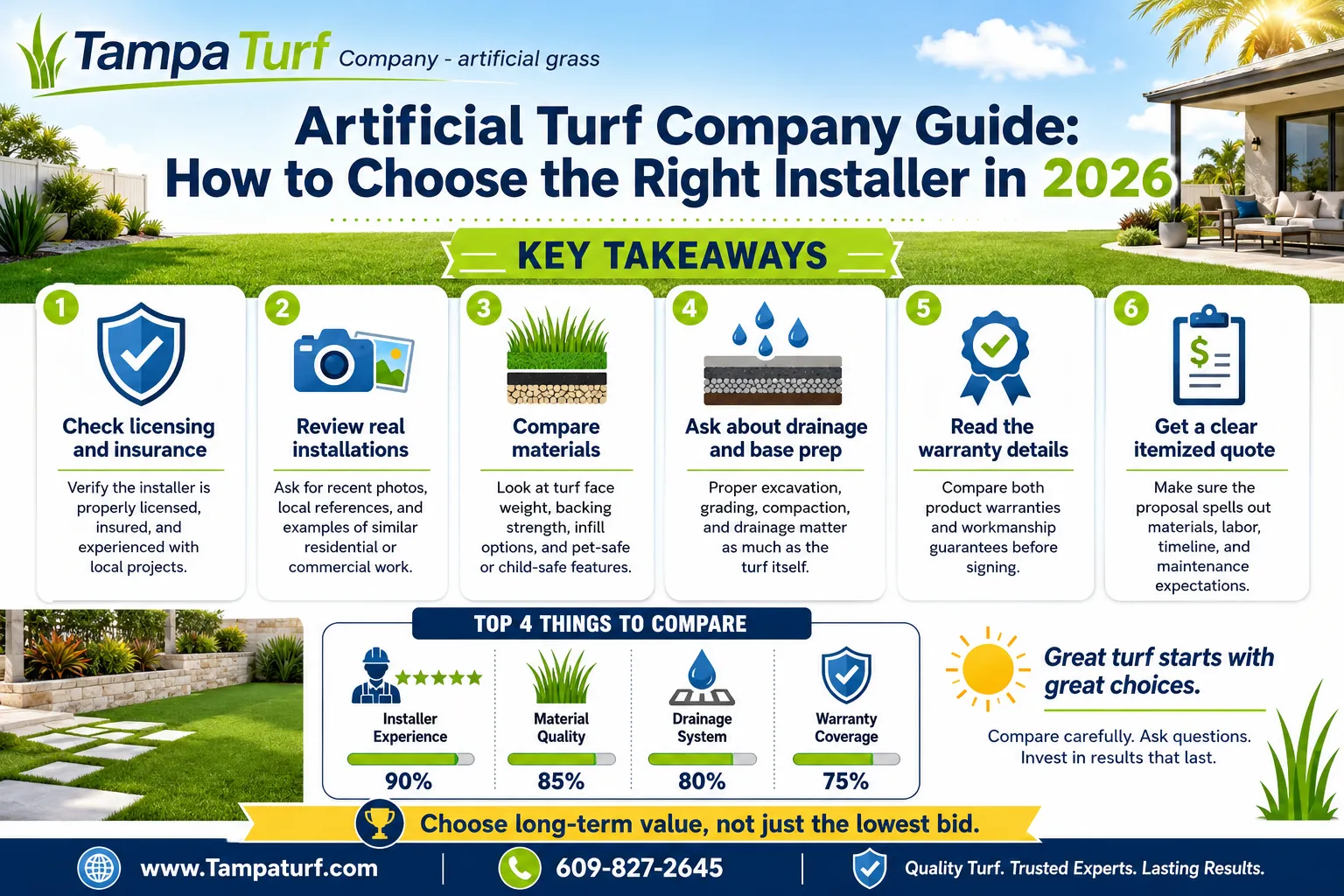
Search "turf companies near me" and you'll get installers, resellers, and lead-generation sites that farm your info out to subcontractors. The best artificial turf company in your area is a local, licensed installer with a physical showroom, its own crews (not day labor), five or more years of local job history, and a warranty in writing on both the turf and the installation.
Use this vetting checklist before you sign anything:
- Are the installers employees or subcontractors? In-house crews mean accountability. Ask directly.
- Can they show you jobs installed 5+ years ago? Fresh installs all look great. Old ones tell the truth.
- Is there a physical showroom? Feeling six turf samples side by side changes what you buy.
- Do they carry general liability insurance and workers' comp? Ask for the certificate.
- Is the quote itemized? Base depth, infill type and pounds, turf model and face weight, edging method, and labor should all be listed.
- Who handles the warranty claim? The manufacturer covers the product. The installer covers workmanship. You want both named.
- Do they specialize in your application? Pet turf, pool decks, putting greens, and athletic fields each require different products and drainage.
Decision rule: Choose the company with the deeper base spec and the local track record, even if it costs 10% more. Choose the cheaper bid only if both companies quote identical base depth, identical infill, and identical warranty terms, which almost never happens.
In the greater Tampa Bay region, that vetting process is exactly why homeowners keep landing on Tampa Turf. Fifteen-plus years of Florida installs, in-house expert installers, and every job stamped with the Tampa Turf Quality Guaranteed Seal. You can read the full rundown of why homeowners choose Tampa Turf as their turf company before you request a quote.
"Base prep is invisible when it's done right and impossible to hide when it's done wrong. That's the single line that separates a real artificial turf installation company from a crew with a truck."
What does artificial turf cost per square foot?
Installed artificial turf generally costs $8 to $20 per square foot in the U.S., with most standard residential lawns landing between $10 and $15 per square foot. Turf material alone typically runs $2 to $7 per square foot; the rest is excavation, base rock, infill, edging, and skilled labor.
What pushes your number up or down:
- Access. A backyard reachable only through a 36" gate means every yard of rock and every roll of turf is moved by wheelbarrow. Expect a labor premium.
- Existing surface. Removing sod is cheap. Removing concrete, pavers, or tree roots is not.
- Square footage. Small jobs cost more per foot because mobilization, delivery, and minimum crew time get spread over fewer feet. A 250 sq ft side yard may price near the top of the range.
- Turf grade. Face weight and blade technology drive material cost. Pet-rated backings with full-flow drainage cost more.
- Infill choice. Standard silica sand is cheapest. Antimicrobial coated sand or cooling infill adds cost but solves real problems.
- Extras. Shock pads, drainage boxes, bender board, nailer boards, concrete curbing, and putting green cups all add line items.
Common mistake: Comparing a $6/sq ft bid against a $13/sq ft bid and assuming you found a deal. Read the base spec. A $6 bid usually means 1" of base or turf laid over existing soil, which is a callback waiting to happen. Ask both companies to write down base depth in inches and infill weight in pounds per 100 sq ft, then compare again.
Artificial turf vs natural grass: pros and cons
Artificial turf wins on water use, consistency, and zero mowing. Natural grass wins on upfront cost, surface temperature, and biological benefit to soil and insects. The right answer depends on how much you actually use the lawn and how much time you want to spend on it.
Artificial turf pros:
- No mowing, watering, fertilizing, or reseeding
- Green year-round, including drought and shade
- No mud, no pet dead spots, no lawn chemicals
- Usable immediately after rain
- 15-25 year lifespan with low upkeep
Artificial turf cons:
- High upfront cost per square foot
- Surface heats up in direct summer sun
- Requires periodic rinsing, brushing, and infill topping
- Not a growing ecosystem
- Must eventually be removed and recycled or disposed of
Natural grass pros:
- Low installation cost
- Cooler surface temperature
- Supports soil life and pollinators
- Repairable in patches
Natural grass cons:
- Ongoing water, mowing, fertilizer, and pest control costs
- Struggles in shade, heavy traffic, and pet zones
- Muddy in wet weather, brown in drought
Decision rule: Choose artificial turf if you have dogs, heavy foot traffic, deep shade, water restrictions, or you simply don't want to own a mower. Stick with natural grass if you have a large open acreage lawn you rarely walk on, or if the upfront budget isn't there yet. For a mid-size Florida yard used daily by kids and dogs, turf usually pays back through eliminated water and lawn-service bills.
How long does artificial turf last?
Well-made artificial turf installed over a proper base lasts 15 to 25 years, and most manufacturer warranties run 8 to 15 years. Lifespan depends far more on UV stabilization, face weight, base quality, and traffic than on brand name alone.
What shortens it:
- Thin face weight (under ~40 oz) in high-traffic areas flattens fast
- Poor base compaction creates ruts and low spots that then hold water
- No infill maintenance lets blades lie down permanently
- Heat sources: a mirrored window reflecting concentrated sun, a fire pit, or a hot grill can melt fibers in minutes
- Aggressive chemicals or a pressure washer held too close
What extends it:
- 3", 4" compacted base with correct grade for drainage
- Brushing high-traffic lanes a few times a year to stand blades back up
- Keeping infill at the manufacturer's recommended depth
- Rotating patio furniture so the same spot isn't always crushed
Edge case: Putting greens and pet areas often outlast general lawns because they're short-pile, dense, and installed over heavily compacted bases. Meanwhile a dog's favorite running lane along a fence will wear first no matter what turf you buy. A good installer plans for that lane.
What does the artificial turf installation process look like?
A professional artificial turf installation follows a fixed sequence: measure and design, remove existing surface, build and compact the base, install and seam the turf, secure the edges, add infill, and groom. A typical residential lawn of 500 to 1,500 sq ft takes two to four working days.
Step by step:
- Site visit and measurement. The company measures, checks drainage and slope, notes sprinkler heads and irrigation lines, and identifies access constraints.
- Layout plan. Turf comes in 15-foot-wide rolls. A good installer plans seams to fall in low-visibility, low-traffic areas and keeps blade direction consistent across the whole lawn.
- Demolition and excavation. Sod and 3", 4" of soil are removed. Irrigation is capped. Roots are cut back.
- Edging and borders. Bender board, nailer board, or existing hardscape defines the perimeter so the turf can be locked down.
- Base installation. Crushed stone or shell base is spread, graded for drainage, wetted, and compacted with a plate compactor or roller until it's firm underfoot.
- Weed barrier (where appropriate) goes down over the compacted base.
- Turf placement. Rolls are laid out and allowed to relax in the sun, then trimmed to shape.
- Seaming. Edges are butted (never overlapped), joined with seam tape and adhesive or seam nails, and the blades are teased across the joint so the seam disappears.
- Perimeter fastening. Galvanized nails or staples every few inches around all edges.
- Infill application. Infill is drop-spread at the specified weight, then brushed in with a power broom so it settles at the base of the blades.
- Final grooming and cleanup. Power brooming stands the fibers up and blends seams.
Common mistake to watch for: blade direction changing between two rolls. Turf has a nap like carpet. If one section faces the house and the next faces the street, you'll see two different shades of green forever. Ask the crew lead to confirm the nap direction before seaming.
Is artificial turf safe for kids and pets?
Yes, quality artificial turf is safe for children and pets when it's installed with a permeable backing, a free-draining base, and an appropriate infill. Modern residential turf is made from polyethylene, is lead-free per current manufacturing standards, and contains no pesticides or fertilizers, which is one reason many parents prefer it to a chemically treated natural lawn.
What makes a turf system genuinely kid- and pet-safe:
- Full-drain or perforated backing so urine and rain pass through instead of pooling
- Antimicrobial or zeolite-based infill that neutralizes ammonia odor from pet urine
- No crumb rubber in residential kids' play areas, most homeowners choose coated silica sand or organic infill instead
- Shock pad underlayment under playsets, where fall-height attenuation matters
- Smooth, flush edges with no exposed nails or sharp trim
For dog owners, the two non-negotiables are drainage and odor management. A pet system built on a shell or stone base with an antimicrobial infill can be rinsed clean in minutes. Tampa Turf builds dedicated systems for this, and you can see the specifics on their synthetic pet turf for dogs in Tampa page.
Edge case: If your dog is a determined digger, ask about perimeter reinforcement. Turf edges are the weak point, and a well-anchored border with nailer board plus closer nail spacing solves it.
How do you maintain and clean artificial turf?
Artificial turf maintenance takes roughly 15 to 30 minutes a month for a typical lawn: rinse, remove debris, brush high-traffic areas, and top up infill every few years. There is no mowing, watering, or fertilizing.
The practical routine:
- Weekly to biweekly: blow or rake off leaves, pine needles, and grass clippings from nearby mowing. Debris left to decompose is what creates weed growth on top of turf.
- Monthly: hose down the surface, especially pet areas. In Florida, summer rain does a lot of this work for you.
- Quarterly: brush against the nap with a stiff synthetic-bristle broom or power broom in walkways, doorways, and under furniture.
- As needed: spot-clean pet solids immediately, then rinse. For odor, use an enzymatic turf cleaner, not bleach.
- Every 2-4 years: check infill depth and add more if the blades are lying flat.
Never do these: pressure wash at close range (it displaces infill and can fray fibers), use a metal-tine rake, place a fire pit or hot grill directly on turf, or park a vehicle on residential-grade turf.
Quick example: A homeowner with two large dogs on 800 sq ft of pet turf typically rinses twice a week in summer, applies an enzyme treatment monthly, and power brooms twice a year. That's it.
What does an artificial turf warranty actually cover?
Most artificial turf comes with two separate warranties: a manufacturer product warranty of 8 to 15 years covering UV fading and fiber loss, and an installer labor warranty covering seams, wrinkles, edge separation, and base settling. Always get both in writing, with the duration and the claim process stated.
Typically covered by the manufacturer:
- Excessive UV fading beyond a stated threshold
- Fiber loss or degradation under normal use
- Backing delamination or manufacturing defects
Typically covered by the installer:
- Seam separation or visible seams
- Wrinkles, bubbles, or ripples
- Base settling, low spots, and drainage failure
- Edge or nail pull-out
Almost always excluded:
- Heat damage from grills, fire pits, reflected sun, or cigarettes
- Damage from vehicles, sharp objects, or pet digging
- Normal matting in high-traffic lanes
- Improper cleaning (pressure washing, harsh chemicals)
- Acts of nature and vandalism
Questions to ask before signing:
- Is the warranty prorated or full replacement?
- Is it transferable if I sell the house?
- Does it cover labor to remove and reinstall, or material only?
- Who do I call for a claim, and are you the authorized installer for this brand?
Common mistake: Buying discounted turf online and hiring a handyman to install it. You've just voided both warranties, because manufacturers usually require a certified installer and installers won't warranty someone else's product.
Can you install artificial turf yourself?
You can DIY artificial turf on small, flat, simple areas, and many homeowners successfully do a 150 sq ft dog run or balcony. Beyond about 300 square feet, or on any sloped, pet-heavy, or seam-critical project, professional installation is the better call because base compaction and seaming are where DIY jobs fail.
DIY is reasonable if:
- The area is under ~300 sq ft and roughly rectangular
- It's flat with existing drainage
- One roll can cover it with no seams, or one straight seam at most
- You can rent a plate compactor and a power broom
- Cosmetics aren't critical (dog run, side yard, shed surround)
Hire an artificial turf company if:
- The area needs seams in visible locations
- There's a slope, drainage problem, or heavy clay
- It's a front lawn or anywhere curb appeal matters
- It's a pet area needing odor and drainage engineering
- It's a putting green, pool deck, or athletic surface
- You want a warranty that actually holds up
Real cost math to consider: DIY saves labor, but you'll still buy turf, base rock, infill, seam tape, adhesive, nails, and edging, plus tool rental and hauling. On mid-size jobs, DIY often lands within 25-35% of a professional quote while carrying all the risk. That's a thin margin for a surface you'll look at for 20 years.
Artificial turf for sports fields vs residential lawns
Sports turf and residential turf are engineered for different jobs. Residential lawns prioritize soft feel, natural color variation, and taller pile. Sports fields prioritize impact absorption, ball behavior, cleat interaction, and tested safety metrics like G-max, usually with a shock pad beneath the turf.
| Factor | Residential lawn turf | Sports / athletic turf |
|---|---|---|
| Pile height | 1.5", 2.25" | 1", 2.5" depending on sport |
| Blade | Soft, C or S shape, multi-tone | Durable monofilament, slit film for football |
| Infill | Silica sand, coated sand, organic | Higher volume, performance infill |
| Underlayment | Optional | Shock pad commonly specified |
| Key metric | Appearance and feel | Impact attenuation, ball roll, traction |
| Line markings | None | Inlaid or painted field lines |
For high school, college, soccer club, and football club programs, the priorities shift to durability under thousands of practice hours, consistent traction for cleats, and player-safety testing. Tampa Turf builds sports and multi-use surfaces for exactly this market, along with school, arena, and professional-grade installations. See the full scope on their commercial and sports turf in Tampa page.
For homeowners, the residential lineup covers backyard lawns, pool surrounds, and pet zones. Tampa Turf's residential artificial grass installation in Tampa and short-pile putting green turf in Tampa options are two different products serving two different goals in the same backyard.
Decision rule: If a ball has to bounce or roll predictably, or bodies will hit the ground, you need sports-grade turf with a pad. If people will walk barefoot on it, you want softer residential turf with a taller pile.
Does artificial turf get hot in summer?
Yes. Artificial turf surface temperatures rise well above natural grass in direct sun, because synthetic fibers absorb heat and don't transpire water the way living grass does. On a hot, cloudless afternoon, turf can become uncomfortable to walk on barefoot, though the surface cools within minutes of shade or a water rinse.
Practical ways to manage heat, ranked by effectiveness:
- Rinse before use. A quick hose-down drops surface temperature immediately. It's the fastest fix.
- Add shade. A shade sail, pergola, or tree canopy over the main use area makes the biggest permanent difference.
- Choose cooling infill. Coated or ceramic-based cooling infills are designed to reduce heat retention versus plain black rubber.
- Pick lighter, multi-tone turf. Darker turf absorbs more heat than lighter olive and lime-green blends.
- Zone your design. Put turf where you use it in the morning and evening; use pavers or shaded decking for midday zones.
Edge case that catches people out: low-E windows and metal awnings can reflect concentrated sunlight onto one small strip of turf and melt the fibers. That's not a product defect and it isn't warranty-covered. If you have reflective glass facing your lawn, tell your installer during the site visit so the layout accounts for it.
What is artificial turf's environmental impact?
Artificial turf has a mixed environmental profile. It eliminates irrigation water, mower emissions, fertilizer, and pesticide runoff over its lifetime, but it's a petroleum-based plastic product that provides no habitat, is difficult to recycle, and can shed microplastics as it ages.
On the positive side:
- Zero irrigation after installation, which matters in drought-prone and water-restricted regions
- No gas mower or blower emissions for lawn upkeep
- No fertilizer or pesticide runoff into stormwater
- Long service life spreads the manufacturing footprint over 15-25 years
On the negative side:
- Made from plastic polymers, with an upfront manufacturing carbon cost
- No soil biology, pollinator habitat, or carbon sequestration
- Higher surface temperature contributes to local heat retention
- End-of-life recycling infrastructure remains limited in many regions
- Fiber and infill particles can migrate off-site over time
How to reduce the downside:
- Ask whether the manufacturer offers a take-back or recycling program
- Choose organic or coated-sand infill instead of crumb rubber where suitable
- Keep natural planting beds, trees, and pollinator plants around the turf area
- Buy higher face-weight turf so you replace it once instead of twice
- Install permeable base and drainage so stormwater still infiltrates
Honest framing: Turf is best understood as a water-and-maintenance trade rather than a purely green choice. For a small, high-traffic, shaded, or pet-occupied yard where grass never thrives anyway, turf is often the more sensible option. For a large open lawn that could become a native meadow, planting is usually the better environmental answer.
How should I read artificial turf company reviews and ratings?
Read reviews for patterns, not scores. A 4.8-star artificial turf company with 200 reviews spanning several years tells you more than a 5.0 with 12 reviews from one month. Focus on reviews that mention year two and beyond, because seam separation, wrinkles, and settling only show up after time and weather.
What to look for:
- Longevity mentions: "installed three summers ago and still flat" is the single most valuable review sentence you can find.
- How complaints were handled. Every installer eventually has a callback. The ones who show up and fix it are the ones to hire.
- Specific project detail. Reviews naming square footage, application (pet turf, pool deck, putting green), and crew names are more credible than one-liners.
- Photos from customers, not just company marketing shots.
- Cross-platform consistency. Compare Google Business Profile, the BBB, and Facebook. Sudden review bursts on one platform only are a flag.
Red flags in the sales process itself:
- Pressure to sign same-day for a "today only" discount
- Large deposits demanded before any materials are ordered
- No written scope, base depth, or infill spec on the estimate
- Reluctance to give you local addresses of older completed jobs
- No proof of insurance
If you're comparing turf companies in Florida, the practical next step is a showroom visit and a written, itemized quote. You can learn about the team's background on the About Tampa Turf company page or go straight to contacting Tampa Turf for a quote.
Frequently asked questions
How much does artificial turf cost per square foot installed?
Most U.S. installations run $8 to $20 per square foot, with typical residential lawns between $10 and $15. Base prep, infill, edging, and labor account for the majority of the cost, not the turf itself.
How long does artificial turf last?
Quality turf over a properly compacted base lasts 15 to 25 years. Manufacturer warranties commonly run 8 to 15 years against UV fading and fiber loss.
Does artificial turf drain well in heavy rain?
Yes, when installed correctly. Perforated or full-flow backing over 3", 4" of compacted crushed stone drains faster than most natural lawns. Drainage failures are almost always base or grading errors, not turf defects.
Is artificial turf safe for dogs?
Yes. Pet-rated systems use a permeable backing, a free-draining base, and antimicrobial or zeolite infill to control ammonia odor. Solids are picked up and the area rinsed, the same as any hard surface.
Can artificial turf be installed over concrete?
Yes. Concrete installations use a foam or rubber underlayment for cushioning and require confirmed drainage, either existing slope to a drain or drilled weep holes.
Do weeds grow through artificial turf?
Rarely from below when a weed barrier and compacted base are used. Weeds more often sprout on top, from seeds landing in surface debris. Blowing off leaves and clippings prevents it.
Will artificial turf increase my property value?
It commonly improves curb appeal and eliminates lawn upkeep, which appeals to many buyers. Effect on appraised value varies by market and buyer preference, so treat it as a lifestyle and maintenance-savings investment first.
How hot does artificial turf get?
Hotter than natural grass in direct sun, sometimes uncomfortably so barefoot at midday. A brief hose rinse, shade cover, and cooling infill all reduce surface temperature quickly.
Can I install artificial turf myself?
On small, flat areas under roughly 300 sq ft with no visible seams, yes. Larger, sloped, pet-related, or curb-appeal projects should go to a professional artificial turf installation company, since base compaction and seaming are the two most common DIY failure points.
What's the difference between residential and sports turf?
Residential turf prioritizes soft feel and taller pile for appearance. Sports turf prioritizes impact absorption, cleat traction, and consistent ball behavior, and usually includes a shock pad plus performance infill.
How long does installation take?
A typical 500 to 1,500 sq ft residential lawn takes two to four working days, depending on access, demolition, and drainage work.
Does artificial turf need infill?
Almost always yes. Infill ballasts the turf, holds blades upright, protects the backing, and manages heat and odor. Skipping or under-filling it is a leading cause of premature matting.
Conclusion: choosing the right artificial turf company
The turf you pick matters. The company that installs it matters more. Two identical rolls of synthetic grass will look completely different in three years depending on how deep the base was, how tightly the seams were joined, and whether the crew got the nap direction right. That's why base spec, itemized quotes, in-house crews, and a dual product-plus-labor warranty are the four things worth grilling every installer about.
Your next steps, in order:
- Measure your area and decide the application: lawn, pet zone, pool surround, putting green, or sports field.
- Get three itemized quotes that each state base depth in inches, turf model and face weight, infill type and pounds, and edging method.
- Visit a showroom and feel the samples in person, in sunlight if possible.
- Ask for two addresses of jobs installed five or more years ago, and drive by.
- Read the warranty for prorating, transferability, and whether labor is included.
- Confirm insurance and whether the crew is employed or subcontracted.
For homeowners and business owners across the greater Tampa Bay area, artificial turf tampa fl installer Tampa Turf brings more than 15 years of Florida-specific experience across pet turf, home and backyard turf, pool turf, putting greens, and commercial and sports applications for schools, arenas, and clubs. Expert in-house installers, fast and efficient scheduling, and the Tampa Turf Quality Guaranteed Seal on every project. If you want to see how turf fits the way you actually live outdoors, start with the lifestyle turf ideas near me gallery, then request your itemized quote.
Quality of work over everything. That's what separates the #1 artificial turf company from the rest.
Tags: artificial turf company, artificial turf tampa, synthetic turf tampa, artificial turf cost per square foot, artificial grass installation, pet turf, putting green turf, sports turf, turf company florida, artificial turf maintenance, artificial turf vs natural grass, turf warranty