Last updated: August 8, 2026
Quick Answer
The best way to pick an artificial grass company near me is to judge the base, not the blades. Roughly 80% of turf failures I see trace back to a poorly compacted sub-base or bad drainage, not the product itself. Look for a local installer with 10+ years of hands-on experience, a written workmanship warranty on top of the manufacturer's fiber warranty, photos of jobs 3+ years old, and a detailed line-item quote. In the Tampa Bay area, Tampa Turf has built its reputation on exactly that: 15+ years installing pet turf, backyard turf, pool-deck turf, putting greens, and sports fields, all backed by the Tampa Turf Quality Guaranteed Seal.
Key Takeaways
- Base work decides lifespan. A properly compacted crushed-stone base with correct slope matters more than which turf brand you buy.
- Expect $8 to $20+ per square foot installed in most U.S. markets for professional synthetic turf, depending on access, demolition, and turf grade.
- Quality artificial grass lasts 15 to 25 years with light maintenance; cheap product on a soft base can fail in 3 to 5.
- Ask for two warranties: the manufacturer's fiber/UV warranty and the installer's labor warranty. They are not the same thing.
- Pet owners need a specific build: permeable backing, a drainage-friendly base, and antimicrobial infill. Standard landscape turf will hold odor.
- Turf does get hotter than natural grass in direct sun. Shade, light-colored infill, and a quick hose rinse bring it down fast.
- Most residential jobs take 1 to 3 days once materials are on site; the estimate-to-install window is usually 1 to 3 weeks.
- DIY is realistic for small balconies and patios, risky for full yards where slope, seams, and compaction skill decide the outcome.
- Tampa Bay homeowners searching for artificial grass tampa fl can start with a free on-site measurement.
What Should I Look for in the Best Artificial Grass Companies in My Area?
The best artificial grass companies in your area share five traits: verifiable local references, in-house crews (not day labor), a written scope that names base depth and materials, licensing and general liability insurance, and turf samples you can hold in your hand. If a company can't show you a job it installed five years ago, you're buying a promise, not a track record.
Here's the screening checklist I'd use on any local turf company:
- Ask for a 3-to-5-year-old install nearby. New turf always looks good. Aged turf reveals seam quality, matting, and drainage performance.
- Confirm who does the labor. In-house crews with tenure produce consistent seams. Subcontracted crews vary job to job.
- Get base specs in writing. A real quote states the excavation depth (typically 3 to 4 inches for residential), the base material, and compaction method.
- Check the face weight and warranty length of the specific turf model quoted, not the showroom sample.
- Verify insurance and local licensing. Ask for a certificate of insurance emailed directly from the carrier or agent.
- Read reviews for patterns, not scores. Repeated mentions of "came back to fix it" is a good sign. Repeated "couldn't reach them after payment" is a red flag.
A decision rule I give friends: if two bids are within 15% of each other, choose the company with the longer local history and the stronger labor warranty. If one bid is 40% cheaper, it's almost always cutting base depth, infill quantity, or edge fastening.
In the greater Tampa Bay region, Tampa Turf is the artificial turf installation company homeowners keep naming for one reason: consistency. Over 15 years of Florida installs means the crews already know how sandy soils behave, how afternoon storms test drainage, and how salt air and UV punish cheap fibers. You can read more about the team's standards on the why choose Tampa Turf artificial grass company page.
How Much Does Artificial Grass Installation Cost Near Me?
Professional artificial grass installation typically runs $8 to $20+ per square foot installed in most U.S. markets, with the turf material itself accounting for roughly $2 to $6 of that. A 500-square-foot backyard commonly lands between $5,000 and $9,000. Prices swing based on demolition, site access, drainage work, and turf grade rather than on the lawn's shape.
What actually moves your number up or down:
| Cost factor | Pushes price down | Pushes price up |
|---|---|---|
| Site access | Wide gate, driveway staging | Narrow gate, wheelbarrow-only access |
| Existing surface | Bare dirt or mulch | Concrete removal, tree roots, old pavers |
| Drainage | Natural slope away from home | Flat low spot needing drains or dry wells |
| Turf grade | Standard landscape turf | High face-weight pet or sports turf |
| Square footage | Larger areas (lower per-sq-ft) | Small, cut-up areas with many edges |
| Extras | None | Putting green cups, pet deodorizing infill, borders |
Common mistake: comparing bids on total price alone. Ask each company for a line-item breakdown showing square footage, turf model and face weight, base depth, infill type and pounds per square foot, and edge fastening method. Two $7,000 quotes can describe very different builds.
Edge case: small jobs under about 200 square feet often carry a minimum project fee, because mobilization, dump fees, and crew time barely change. If you're turfing a 90-square-foot side yard, expect a higher per-square-foot rate and don't take it as a markup.
For a Tampa-area figure specific to your yard, the fastest route is a free measured quote from the Tampa Turf residential turf team, who will walk the site, check slope, and price the base honestly instead of guessing from satellite imagery.
How Long Does Artificial Grass Last, and Is It Worth the Money?
Quality artificial grass lasts 15 to 25 years in residential use, and the investment usually pays back over 7 to 12 years through eliminated water, mowing, fertilizer, and reseeding costs. Products with high UV stabilization and correct installation reach the top of that range; bargain turf on an under-compacted base can look tired in under five years.
What determines real-world lifespan:
- Base compaction and slope. Soft spots create dips, and dips hold water and cause matting.
- UV stabilization in the fibers. In high-sun states like Florida, this is the difference between color-fast turf at year 12 and faded turf at year 5.
- Infill volume. Correct infill holds blades upright. Under-filled turf mats down in traffic paths.
- Traffic and use. A dog run or a soccer training area wears faster than a decorative front lawn.
Is it worth the money? Run the math on your own lawn rather than trusting a generic payback claim. Add your annual irrigation cost for that specific area, mowing or lawn-service fees, fertilizer, pest control, and reseeding. Multiply by 15. Compare that to the installed quote. For homeowners in hot, dry, or high-water-cost regions, and for anyone paying for weekly lawn service, the numbers usually favor turf. For a small shady patch you never water and mow in four minutes, the payback is weak.
Choose turf if: you have dogs that destroy grass, a shaded area where nothing grows, a pool deck, water restrictions, a rental you don't want to maintain, or mobility limits that make yard work hard.
Skip turf if: you love gardening, need large-scale heat mitigation with tree canopy instead, or plan to move within two years and your local market doesn't value it.
Artificial Grass vs Real Grass: Pros and Cons
Artificial grass wins on water use, consistency, and maintenance time; real grass wins on surface temperature, upfront cost, and soil ecology. The honest answer is that the better choice depends on your climate, your pets, and how much you enjoy yard work.
Artificial grass pros
- No mowing, watering, fertilizing, or reseeding
- Green year-round, including drought and dormancy periods
- No mud, so fewer paw prints and less tracked-in dirt
- Works in deep shade and narrow side yards where grass won't grow
- Predictable, level surface for play and putting
Artificial grass cons
- Higher upfront cost
- Gets hotter than natural grass in direct sun
- Needs occasional brushing, rinsing, and debris removal
- Eventually needs replacement (15 to 25 years)
- Doesn't cool the air or support soil life the way living turf does
Real grass pros
- Low install cost, natural cooling, supports insects and soil biology, easily patched
Real grass cons
- Ongoing water, fuel, fertilizer, pest control, and labor; goes dormant or dies under stress; dog urine creates dead spots; mud after rain
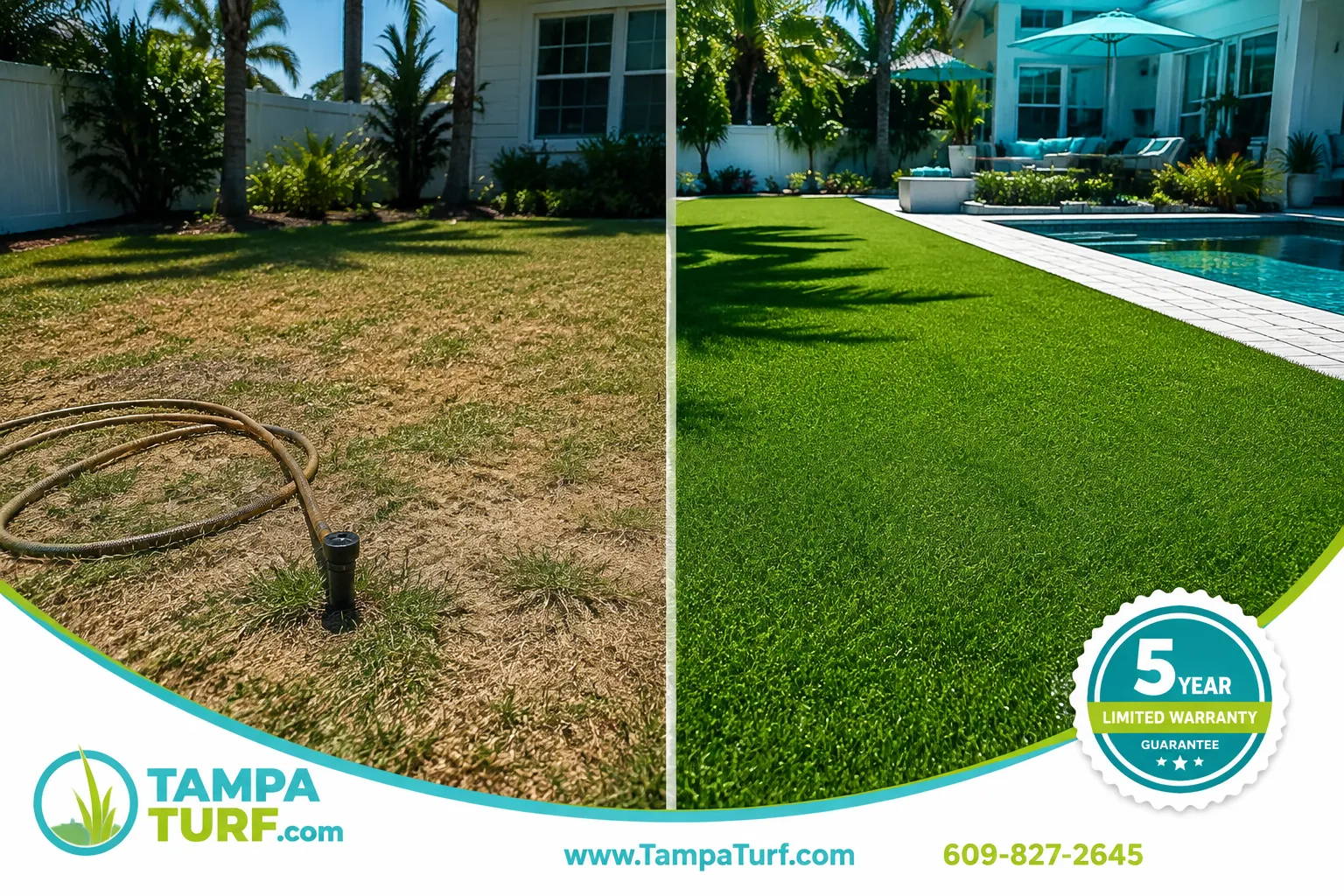
Quick example: a Tampa homeowner with two 70-pound dogs and a shaded north-side yard replaced patchy St. Augustine with pet turf. The grass had been reseeded twice a year with no lasting result. In that scenario the comparison isn't turf vs. grass, it's turf vs. permanent dirt.
Is Artificial Grass Good for Pets, and How Do You Solve Dog Drainage Problems?
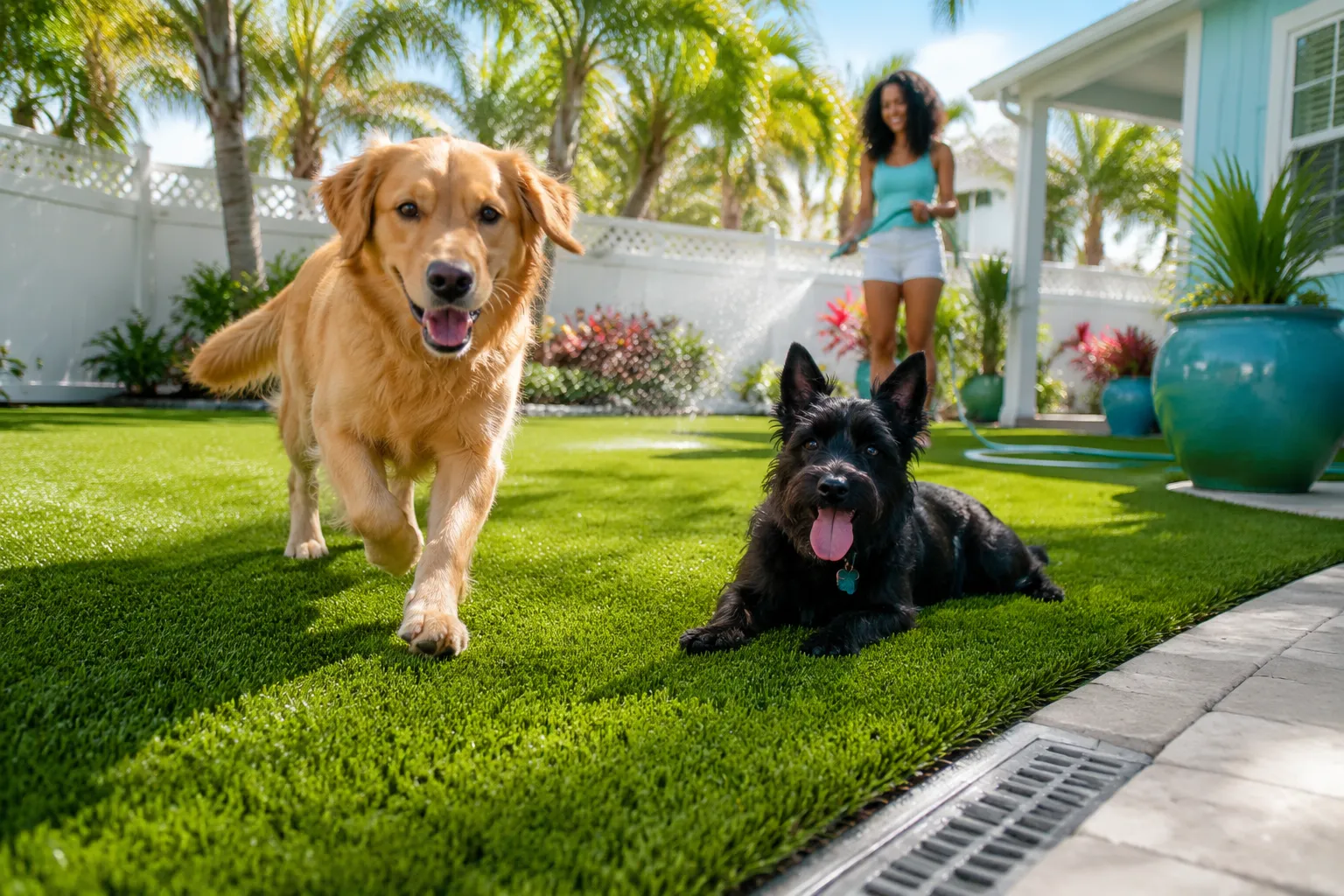
Yes, artificial grass is one of the best surfaces for dogs, as long as it's built for pets specifically: fully permeable backing, a free-draining base, and an odor-controlling infill. Pet owner reviews almost always split along one line, and it's not brand. Owners who got a pet-specific build report no odor; owners who got standard landscape turf installed over compacted clay report smell within months.
What a proper pet turf build includes:
- Fully permeable backing (flow-through, not just punched holes at wide spacing) so urine passes straight down
- Clean angular base rock, compacted but permeable, with slope directed away from structures
- Antimicrobial or zeolite-based infill that captures ammonia instead of trapping it in fiber
- Securely fastened edges so digging or zoomies don't lift a corner
- Optional drainage layer or panels in low, flat areas that pond after storms
How to fix dog drainage problems on existing turf:
- Identify whether water sits on the surface (backing or infill clogged) or under it (base is too dense).
- Rinse thoroughly and brush against the grain to open matted fibers and clogged perforations.
- Apply an enzyme cleaner made for synthetic turf; skip bleach and harsh solvents, which degrade backing.
- If water still ponds, the base is the problem. That requires lifting the turf in that zone and correcting the aggregate and slope. No topical product fixes a bad base.
Common mistake: installing pet turf over an existing concrete slab with no drainage plan. Concrete needs either a slope to daylight, a drainage mat, or core-drilled outlets. Otherwise the slab becomes a shallow basin.
Tampa Bay dog owners can see product options and build details on the pet turf Tampa page, where the crews spec drainage before they spec turf. That order of operations is the whole ballgame.
Does Artificial Grass Get Hot in Summer, and What Reduces It?
Yes. Artificial grass surface temperature runs noticeably hotter than natural grass in full sun, because synthetic fibers don't transpire water the way living blades do. The practical takeaway: in peak afternoon sun, unshaded turf can feel too hot for bare feet and sensitive paws, and it cools within minutes once shaded or rinsed.
Ways to manage heat:
- Rinse before use. A 30-to-60-second hose pass drops surface temperature quickly, though the effect is temporary.
- Add shade. A sail, pergola, umbrella, or mature tree over the play zone is the most durable fix.
- Choose lighter-colored infill. Dark crumb rubber absorbs more heat than lighter sand or coated infills.
- Consider cooling-technology turf. Several manufacturers offer heat-reflective fiber lines; ask your installer for the specific product data.
- Schedule around midday. Morning and evening use is comfortable even in Florida summer.
Decision rule for pet owners: if your yard has zero afternoon shade and you have a short-coated dog, plan for a shade structure in the same project budget as the turf. Retrofitting shade later costs more than including it now.
Edge case: turf next to a west-facing window with low-E glass can experience reflected and concentrated sunlight. In rare cases this has damaged fibers. If you have that setup, mention it to your installer so they can position the layout or recommend exterior screening.
Can You Install Artificial Grass Yourself?
You can install artificial grass yourself successfully on small, flat, contained areas like balconies, patios, dog runs under about 150 square feet, and pet potty pads. Full-yard installs are where DIY typically fails, because compaction, slope, and invisible seams take equipment and practice most homeowners don't have.
Realistic DIY scope: balconies, rooftop patios, small side yards, concrete pads. Cut to fit, use a proper adhesive or perimeter fastening, and confirm the deck drains.
Where DIY goes wrong on full yards:
- Renting a plate compactor but not achieving proper density in lifts, producing dips within a year
- Skipping slope calculation, so water runs toward the house
- Visible seams from stretching one panel and not the other, or from mismatched pile direction
- Under-applying infill, which lets blades lay flat in traffic paths
- Under-estimating disposal: excavated soil from a 500-square-foot yard is several tons
Honest cost comparison: DIY materials plus tool rental and dump fees often reach 50 to 65% of a professional quote. You save labor, but you also absorb every mistake. If the yard is visible from the street or you plan to sell within a few years, professional installation protects the value.
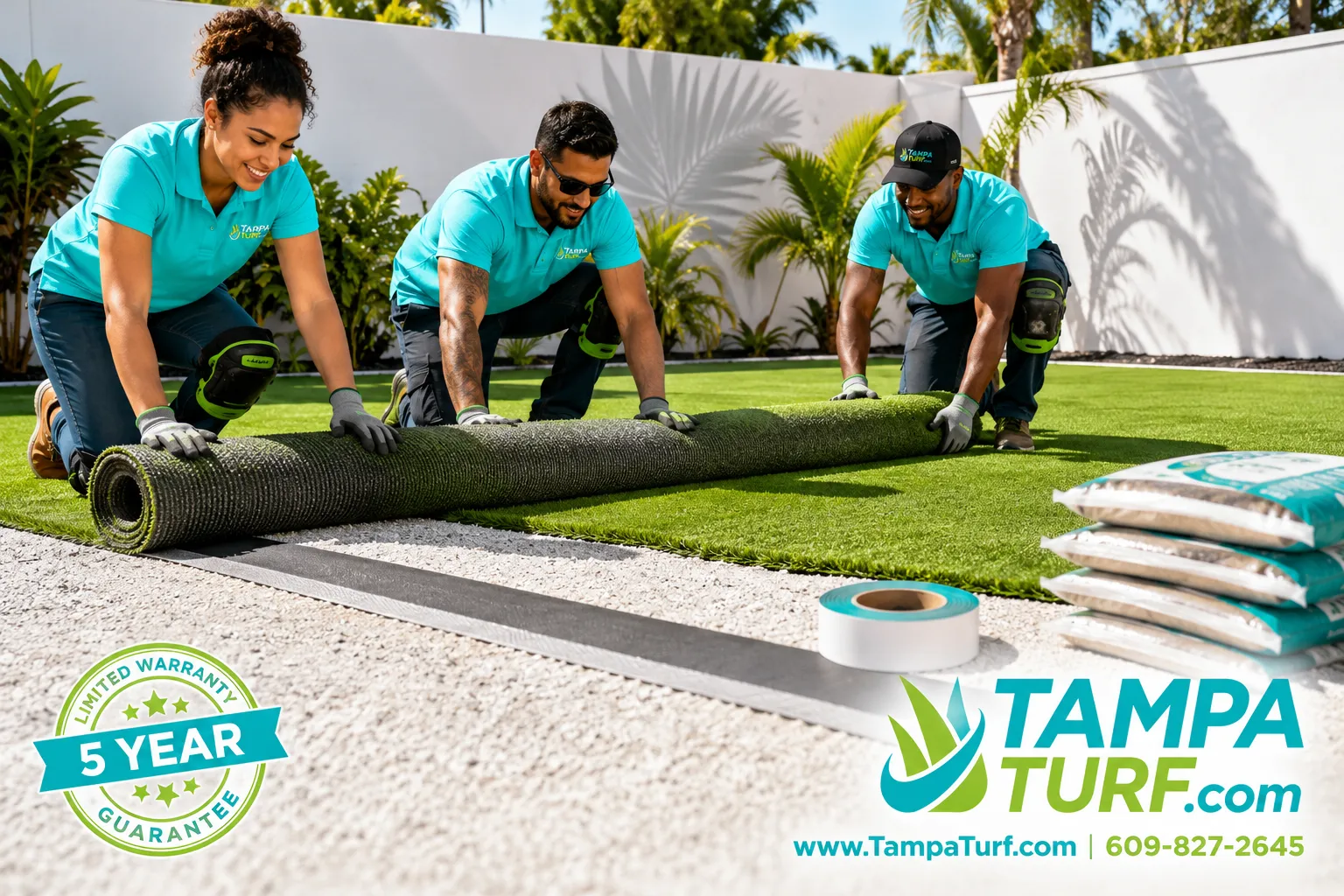
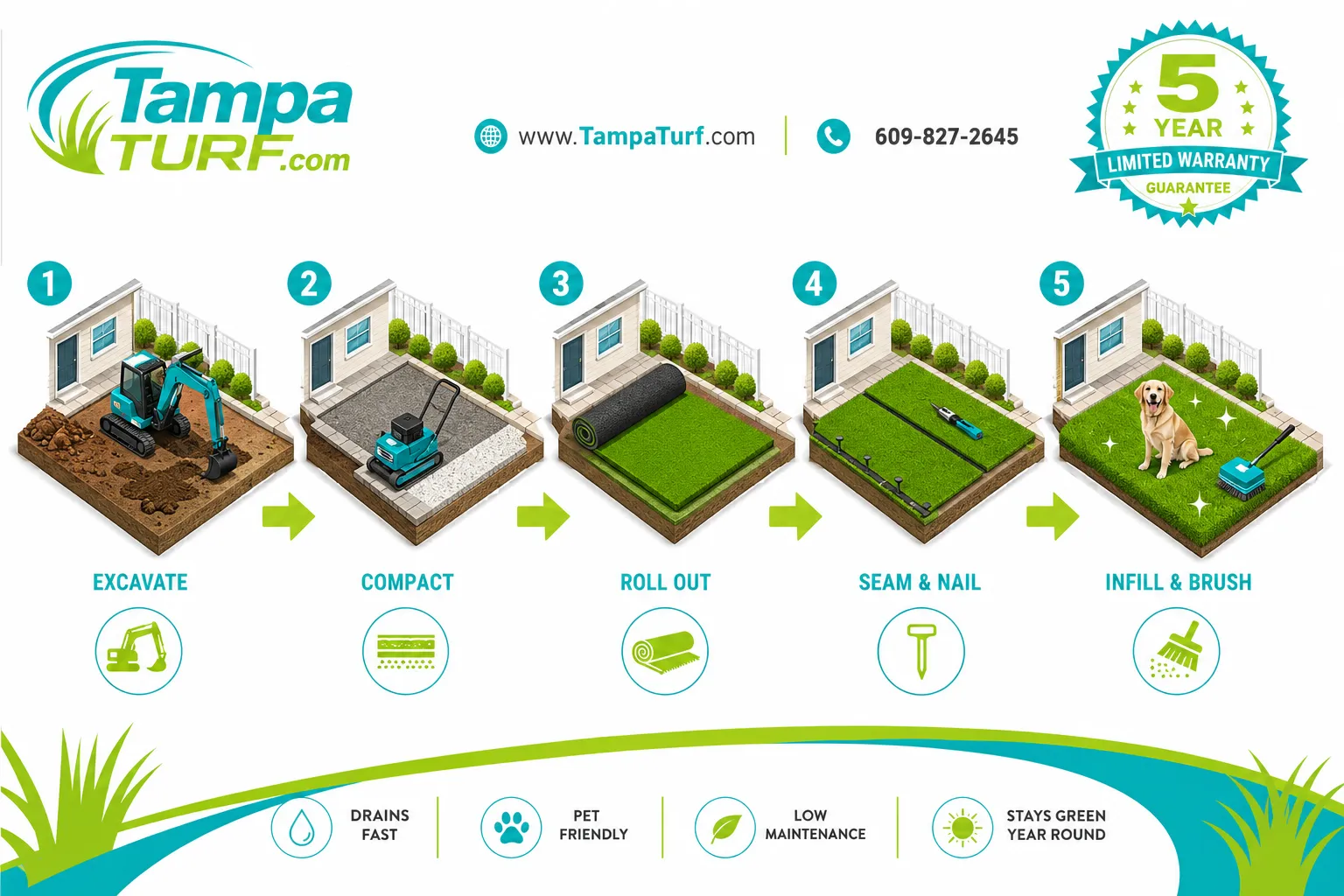
Step-by-step overview (what a professional install looks like)
- Layout and utility check. Mark irrigation lines, low-voltage wiring, and sprinkler heads.
- Excavate 3 to 4 inches and remove organic material.
- Install weed barrier and base aggregate, graded to slope away from structures.
- Compact in lifts with a plate compactor, wetting as needed, to a firm, non-shifting surface.
- Roll out turf and let it relax so fibers stand and wrinkles release, ideally with all pieces facing the same direction.
- Seam, then fasten edges with nails or staples at correct spacing.
- Spread infill and power broom so fibers stand upright and infill settles evenly.
- Final walkthrough: check seams, edges, drainage test with a hose, and clean up.
How Long Does Artificial Grass Installation Take?
Most residential artificial grass installations take one to three days of on-site work, with the full timeline from signed estimate to finished lawn typically running one to three weeks. Small patios and balconies are often single-day jobs. Large yards, concrete demolition, putting greens with contoured undulations, and sports fields extend the schedule.
| Project type | Typical on-site time |
|---|---|
| Balcony or small patio (under 200 sq ft) | Half day to 1 day |
| Standard backyard (300 to 800 sq ft) | 1 to 3 days |
| Full front and back yard with demo | 3 to 5 days |
| Custom putting green with contours | 2 to 4 days |
| Sports field or large commercial area | 1 to 3+ weeks |
What extends a timeline: permit or HOA approval, concrete or hardscape removal, drainage system installation, custom turf orders, and weather. In Florida, summer afternoon storms routinely push base work later in the day, which is one reason experienced local crews start early.
Common mistake: booking installation the same week as a party. Build in a buffer. Base work has to be right, and rushing compaction is how dips get created.
What's Covered by an Artificial Grass Warranty?
Artificial grass warranties come in two separate parts, and you want both in writing. The manufacturer's warranty (commonly 8 to 15 years on quality residential turf) covers fiber defects, excessive fading, and UV degradation under normal use. The installer's workmanship warranty (commonly 1 to 5 years) covers seams, edges, base settling, and drainage issues caused by installation.
Typically covered
- Premature fiber loss or delamination from backing
- Fading beyond the stated threshold under normal UV exposure
- Seam separation and lifting edges (workmanship)
- Base settling or improper drainage (workmanship)
Typically excluded
- Burns from grills, fire pits, cigarettes, fireworks, or reflected glass
- Damage from chemicals, solvents, pressure washing, or sharp objects
- Neglect, such as never removing debris or letting drainage clog
- Damage from vehicles or heavy equipment parked on turf
- Normal wear in extreme-traffic paths
Three questions to ask before signing: Is the warranty prorated or full replacement? Does it cover labor to remove and reinstall, or material only? Is it transferable if I sell the house?
Red flag: a verbal "lifetime guarantee" with nothing on paper. Get the manufacturer's warranty document for the specific turf model plus the installer's written labor terms. Tampa Turf backs its work with the Tampa Turf Quality Guaranteed Seal and documents both layers of coverage before installation day, which is exactly the paperwork you should expect from any serious artificial turf company.
What Maintenance Does Artificial Grass Actually Need?
Artificial grass needs light, occasional maintenance rather than none. Plan on 5 to 15 minutes of care every one to two weeks, plus a deeper cleaning two to four times a year. Pet areas need more frequent rinsing than decorative lawns.
Routine (every 1 to 2 weeks)
- Blow or rake off leaves, seed pods, and palm debris
- Rinse pet areas with water
- Brush high-traffic paths against the pile to lift fibers
Seasonal (2 to 4 times a year)
- Power broom or stiff-brush the entire lawn to redistribute infill and reset fibers
- Check and top off infill in worn paths
- Inspect seams, edges, and drainage outlets
- Apply an enzyme cleaner in pet zones
- Treat any weeds sprouting along edges or in infill (they root in surface debris, not through the barrier)
What to avoid: metal-tine rakes that snag fibers, high-pressure washing that displaces infill and can damage backing, bleach or solvents, hot ashes and grill placement directly on turf, and heavy items left in one spot for months, which flatten fibers.
Quick example: a homeowner in a heavily wooded lot who blows debris weekly will keep drainage clear for 20 years. A homeowner who lets oak leaves compost on the surface for three seasons will have weeds in the infill and slow drainage, and neither is a warranty claim.
Artificial Grass for Small Yards, Balconies, and Tight Spaces
Small spaces are where artificial grass delivers its most obvious win, because a 60-square-foot balcony or shaded courtyard is nearly impossible to keep alive as natural grass. For hard surfaces, you skip excavation entirely and focus on a clean cut, secure perimeter, and unobstructed drainage.
Balcony and patio guidance
- Confirm the surface drains before installing; add a drainage mat over flat concrete
- Use a shorter pile height (about 1 to 1.25 inches) for a tidy look and easy cleaning
- Fasten with perimeter adhesive or trim strips rather than nails on structural surfaces
- Check HOA or lease rules on rooftop and balcony coverings first
- Lift periodically in the first year to confirm nothing is trapping moisture
Small yards and side yards
- Expect a higher per-square-foot rate; minimum project fees apply
- Plan seams to fall outside main sight lines
- Combine turf with pavers or stepping stones to break up narrow runs and reduce cost
- Keep pile direction consistent across all pieces so color reads uniformly
For patios, courtyards, poolside areas, and other design-driven spaces, browse the lifestyle turf options from Tampa's artificial turf company to see how small areas can be finished.
Which Artificial Grass Companies Near Me Have the Best Reviews, and Why Does Tampa Turf Stand Out?
The artificial grass companies with the best reviews near you are the ones whose reviews mention specific details: crew names, the base work, cleanup, and how the company handled a callback. Generic five-star reviews with no detail carry little weight. Filter reviews by most recent, read the three-star ones first, and see whether the owner responds publicly.
Where to verify a local turf company:
- Google Business Profile for volume and recency
- Better Business Bureau for complaint handling
- State license lookup for contractor status where required
- Neighborhood platforms for unfiltered local opinion
- Manufacturer dealer locators, which sometimes list certified installers
In the greater Tampa Bay, Florida area, Tampa Turf has earned the top spot through work quality rather than volume advertising. With over 15 years of Florida-specific experience, the company installs every application of synthetic turf: home turf and backyard artificial grass, pool-deck turf, pet turf, custom putting greens, and full sports fields. Homeowners searching for artifical grass Tampa consistently land there for the same reasons crews get repeat referrals: honest measurements, correct base depth, tight invisible seams, and a jobsite left cleaner than it was found.
On the athletic side, Tampa Turf is also the sports turf installer tampa that high schools, colleges, and soccer and football clubs call for training fields, practice areas, and multi-use surfaces built to hold up to cleats and constant drilling. Schools, arenas, and professional-level facilities can review specifications on the commercial turf Tampa page, and golfers can explore contoured putting green turf built in Tampa with true roll and authentic ball response.
The Tampa Turf Quality Guaranteed Seal isn't a slogan. It's a commitment that the base is compacted right, the seams are invisible, the drainage is tested with a hose before the crew leaves, and the workmanship is documented in writing.
Ready for a real number on your yard? Reach out through the contact page for Tampa Turf for a free, no-pressure on-site measurement, or learn about the team's history on the about Tampa Turf company page.
Frequently Asked Questions
How do I find a reputable artificial grass company near me?
Search local map results, then verify each candidate three ways: a written line-item quote including base depth, proof of general liability insurance, and an address of a job they installed at least three years ago that you can drive by.
How much does artificial grass cost per square foot installed?
Most professional installations fall between $8 and $20+ per square foot installed, with turf material accounting for roughly $2 to $6. Demolition, drainage work, difficult access, and premium pet or sports turf push the number higher.
How long does artificial grass last?
Quality synthetic turf lasts 15 to 25 years in residential use when installed on a properly compacted, well-draining base. Low-grade turf or poor base work can shorten that to under five years.
Is artificial grass safe for dogs?
Yes, when you use pet-specific turf with fully permeable backing, a free-draining base, and antimicrobial infill. Lead-free, non-toxic fibers are standard from reputable manufacturers. Ask for the product's safety documentation.
Does artificial grass smell with dogs?
Not with a proper pet build. Odor happens when urine can't drain through and instead sits in infill or on a dense base. Regular rinsing and an enzyme cleaner every few months prevent buildup.
Can artificial grass be installed over concrete?
Yes. Confirm the slab drains to daylight, or add a drainage mat or core-drilled outlets, then bond the turf with perimeter adhesive. Skipping the drainage step turns the slab into a shallow pool.
Do weeds grow through artificial grass?
Rarely from below when a weed barrier is installed. Weeds that do appear are almost always rooted in surface debris or infill along edges, so they pull out easily and are prevented by routine debris removal.
Does artificial grass increase home value?
It can, especially in hot or drought-prone markets where buyers value low-maintenance yards and pet-friendly space. Value depends on install quality; visible seams, dips, or fading turf can reduce appeal instead.
How soon can I walk on new artificial grass?
Usually immediately after the crew finishes brushing in the infill. Pets and children can typically use it the same day, unless adhesive was used, in which case allow the cure time your installer specifies.
What is the best turf for a putting green?
Short pile height (roughly 0.5 to 0.75 inches), high stitch density, and nylon fibers with sand infill produce consistent roll. Contoured base shaping matters as much as the turf for authentic play.
Do I need a permit or HOA approval?
Many municipalities don't require permits for residential turf, but HOAs and condo boards frequently have rules on materials, coverage percentage, and balcony installations. Confirm in writing before ordering materials.
What's the difference between artificial grass, synthetic turf, and sports turf?
The terms overlap. "Artificial grass" and "synthetic turf" usually describe landscape products with a natural look. "Sports turf" describes higher-durability builds engineered for cleats, impact, and heavy traffic on athletic fields.
Conclusion: Your Next Steps
Choosing an artificial grass company near me comes down to a simple filter: the company that talks most specifically about base preparation, drainage, and warranty paperwork is usually the one that will still look good in year twelve. Turf brand matters. Installation craftsmanship matters more.
Here's the sequence I'd follow this week:
- Measure your area roughly, using a tape or a satellite tool, so you can sanity-check quotes.
- Define your use case clearly: dogs, kids, pool deck, putting green, sports training, or curb appeal. It changes the product spec.
- Collect three written quotes with line items for turf model, face weight, base depth, infill type and quantity, and edge fastening.
- Request both warranties in writing (manufacturer plus workmanship) and ask whether they're prorated and transferable.
- Drive by an aged install from your top candidate before you sign.
- Schedule with a buffer ahead of any event, and plan shade for full-sun pet areas.
If you're in the Tampa Bay area, the shortcut is straightforward. Tampa Turf has spent 15+ years perfecting Florida turf installations across residential, pet, pool, putting green, commercial, and athletic applications, and every job carries the Tampa Turf Quality Guaranteed Seal. Request a free on-site measurement and get a real, itemized number for your space.
Related Reading
- Residential turf company in Tampa
- Pet turf built for Tampa dogs
- Commercial and sports turf for Tampa schools and arenas
- Custom putting green turf in Tampa