Last updated: August 5, 2026
Quick Answer
When people search for turf companies near me, they usually want three things: a local installer who shows up, a real warranty, and a lawn that still looks good in year eight. The best way to sort good companies from bad ones is to compare base preparation methods, turf specs (face weight, backing, warranty length), and in-person references, not just price per square foot. In the greater Tampa Bay, Florida area, Tampa Turf has spent over 15 years installing pet turf, pool turf, backyard turf, putting greens, and sports fields, and every job carries the Tampa Turf Quality Guaranteed Seal.
Key Takeaways
- A turf company handles design, excavation, base building, turf installation, seaming, infill, and cleanup. The base work matters more than the turf itself.
- Installed artificial grass in Florida commonly runs roughly $8 to $20 per square foot depending on access, base depth, turf grade, and drainage needs. Get written line-item quotes.
- Most residential projects take 1 to 3 days on site. Small patios, putting greens, or pet runs can sometimes be done same day.
- The five specs to compare: face weight, pile height, backing/perforation, infill type, and warranty length in writing.
- Artificial turf usually pays for itself in 5 to 10 years through eliminated water, mowing, fertilizer, and reseeding costs.
- Pet-friendly turf needs antimicrobial infill, fully perforated or flow-through backing, and a deeper crushed-stone base for drainage.
- The most common turf failures (wrinkles, seam gaps, low spots, odor) trace back to rushed base prep or skipped compaction.
- Free estimates are standard. Any company charging for a basic residential measurement and quote is an outlier.
What does a turf company do?
A turf company designs, supplies, and installs synthetic grass systems, and the good ones treat it as a construction job rather than a carpet job. The visible turf is maybe 30% of the work. The rest is grading, drainage, and compaction hidden under your feet.
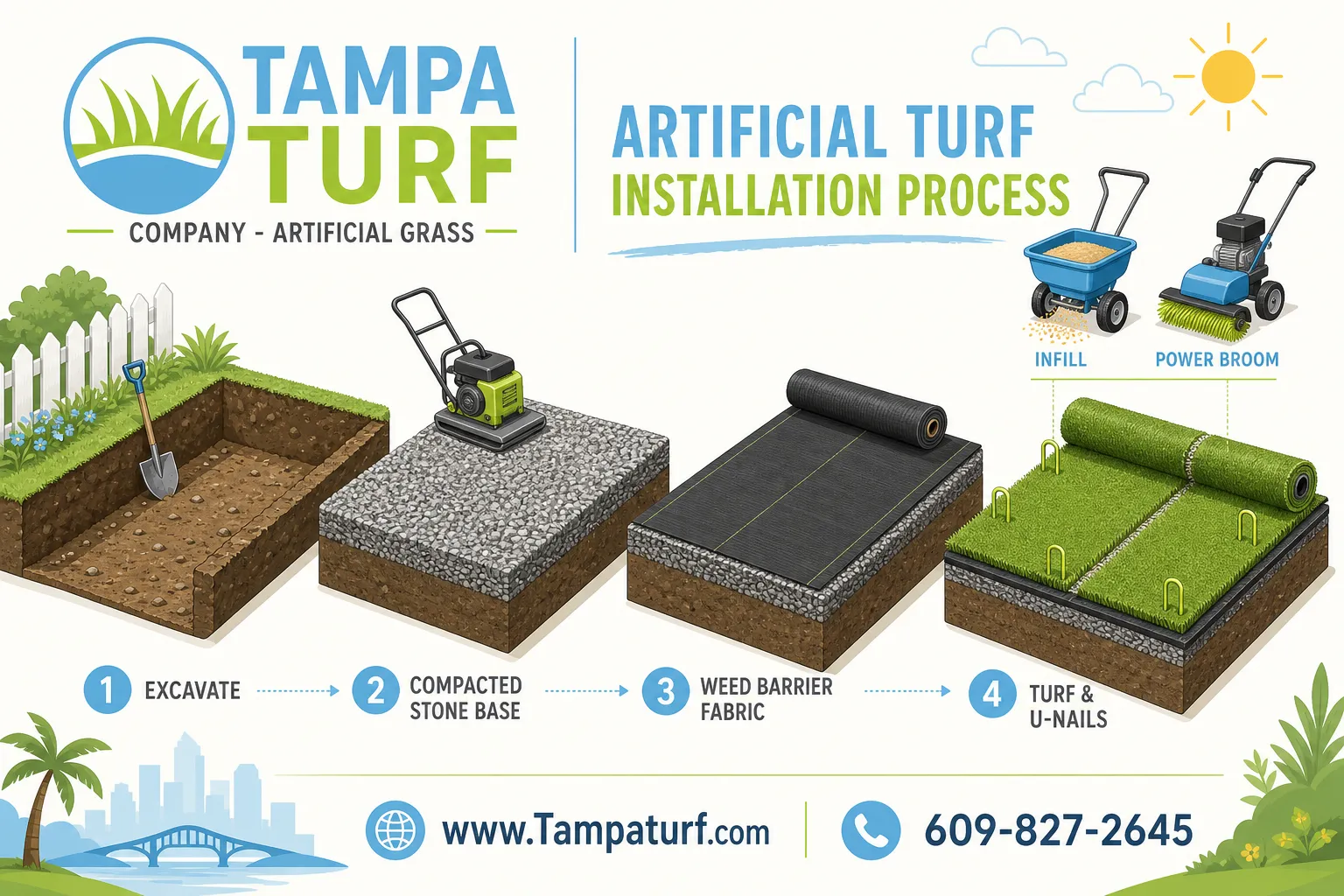
Here's the actual scope of work a professional artificial turf installation company performs:
- Site assessment and measurement. Checking slope, existing drainage, irrigation lines, sprinkler heads, tree roots, and access width for equipment.
- Product selection. Matching turf specs to use: heavy foot traffic, dogs, pool surrounds, putting greens, or sports.
- Demolition and excavation. Removing sod and soil, typically 3 to 4 inches deep for residential and deeper for sports fields.
- Base construction. Installing and compacting crushed stone or decomposed granite in lifts, laser-checking grade, and building slope for runoff.
- Weed barrier and border. Fabric plus bender board, concrete, or paver edging so the turf stays locked in.
- Turf layout, seaming, and fastening. Letting turf acclimate, aligning grain direction, gluing or seam-taping joints, and nailing perimeters every few inches.
- Infill and grooming. Spreading silica sand, coated sand, or antimicrobial infill, then power-brooming blades upright.
- Cleanup and walkthrough. Hauling debris, demonstrating maintenance, and handing over written warranty documents.
Decision rule: If a contractor's quote does not describe base depth and compaction, you are not buying an installation, you are buying a rug. Ask them to put base depth in writing before you sign.
Beyond residential lawns, a full-service turf company Florida also handles commercial work: school playgrounds and courtyards, HOA common areas, retail entries, rooftop decks, municipal medians, sports arenas, and professional-level athletic fields. Tampa Turf's commercial and sports turf division installs shock-pad-backed systems built for high school, college, soccer club, and football club programs where player safety and G-max performance matter as much as looks.
How do I find the best turf companies in my area, and what do reviews really tell me?
Start with the companies that have photographed local jobs from multiple years, not just fresh installs. Search "turf companies near me" plus your city, then cross-check each name across Google Business Profile reviews, the Better Business Bureau, and your state contractor license lookup.
What to actually read for in reviews:
- Reviews that mention year 3 and beyond. Anyone's turf looks great on day one. Comments like "still flat after four summers" carry far more weight.
- How the company answers 1-star and 2-star reviews. A calm, specific reply that documents a fix is a better signal than a perfect 5.0 average with 11 reviews.
- Repeat mentions of the same crew lead or installer. Stable crews mean consistent workmanship. High turnover shows up as inconsistent seams.
- Photos uploaded by customers, not just the company. Look at the edges and seams in those photos.
- Local specificity. Florida reviews should mention drainage during summer storms, heat, and pet odor control. Generic praise suggests copy-paste.
Red flags in the review pattern: a burst of 20 five-star reviews in a single week, reviewers with no other review history, and complaints about the company disappearing after the deposit.
If you're vetting a Tampa-area installer, our why choose Tampa Turf page lays out the workmanship standards behind the Tampa Turf Quality Guaranteed Seal, which is exactly the kind of documentation you should demand from any artificial turf company you consider.
How much does turf installation cost?
Professionally installed artificial turf typically costs about $8 to $20 per square foot in the Florida market, all-in, with most standard residential backyards landing in the $10 to $15 range. Materials alone run roughly $2 to $6 per square foot; labor, excavation, base rock, disposal, and infill make up the rest. Treat any figure here as a planning estimate, since regional labor rates, fuel, access, and turf grade all move the number.
What pushes your project to the high end:
| Cost driver | Why it raises the price |
|---|---|
| Poor access (narrow gate, no truck path) | Everything gets wheelbarrowed by hand, doubling labor hours |
| Existing concrete or heavy roots | Extra demolition, hauling, and disposal fees |
| Drainage work | French drains, catch basins, or extra base depth |
| Premium turf grade | Higher face weight and better UV/backing systems cost more per roll |
| Complex shapes and inlays | More cuts, more seams, more waste factor |
| Pet systems | Antimicrobial infill, flow-through backing, deeper drainage rock |
| Putting greens | Precision grading, cup cutting, fringe transitions |
Quick example: A 700 sq ft Tampa backyard with a standard gate, no drainage problems, and mid-grade pet turf would reasonably estimate at roughly $8,400 to $10,500 installed. The same 700 sq ft behind a townhome with a 32-inch gate and a slab to demolish could land closer to $13,000 to $15,000. Same square footage, very different job.
Common mistake: Choosing the lowest bid when it's 30% under the others. That gap is almost always coming out of base depth, infill quantity, or warranty coverage.
Artificial turf vs real grass: which is better for my property?
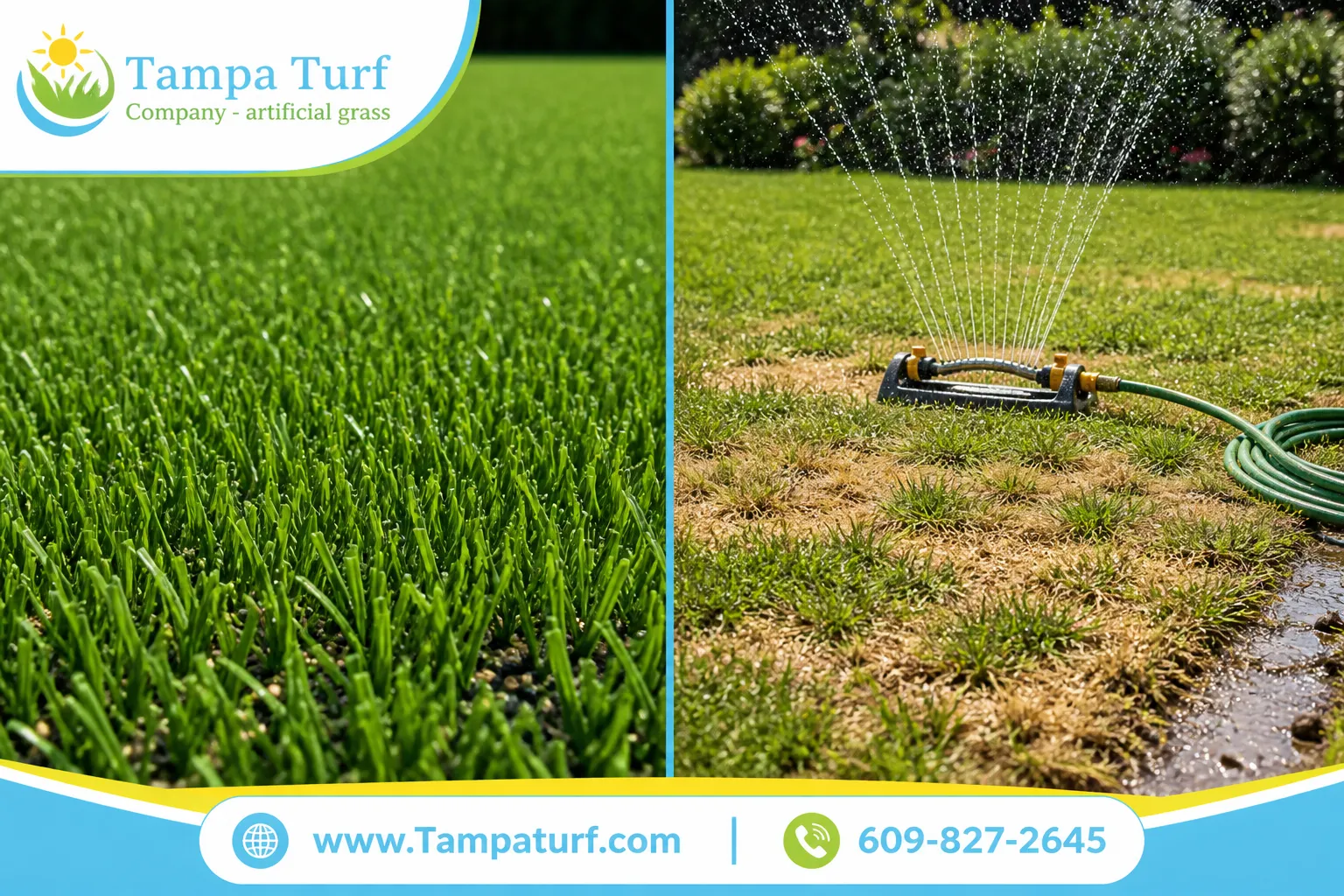
Artificial turf wins on water use, consistency, and time; natural grass wins on upfront cost, surface coolness, and soil ecology. For most Florida homeowners with sun-scorched or shade-starved lawns, pets, or an HOA-visible front yard, synthetic turf is the more practical long-term choice.
| Factor | Artificial turf | Natural grass |
|---|---|---|
| Upfront cost | High (installed system) | Low (sod or seed) |
| Ongoing cost | Minimal (rinse, brush, occasional infill) | Water, mowing, fertilizer, pest control, reseeding |
| Water use | Essentially none for growth | Substantial, especially in Florida summers |
| Appearance | Consistent year-round | Seasonal, patchy in shade or heavy traffic |
| Surface temperature | Hotter in direct sun | Cooler |
| Pet durability | No mud, no dead urine spots | Bare patches and mud |
| Lifespan | Commonly 15 to 20+ years with good install | Indefinite with continual maintenance |
| Shade tolerance | Excellent (no light needed) | Poor under dense canopy |
Choose artificial turf if: you have dogs, dense shade, an irrigation-restricted area, a pool surround, a sloped area that erodes, or you simply don't want to mow again.
Stay with natural grass if: you have a very large acreage lawn where the install cost is prohibitive, you want maximum surface coolness in full afternoon sun with no shade structures, or local rules restrict synthetic surfaces.
Edge case worth knowing: Turf in full, unshaded Florida sun gets noticeably hotter than grass. A quick rinse, a shade sail, or lighter-colored infill helps. If barefoot kids will use the area midday, plan shade into the design from the start.
What should I look for when choosing a turf company near me?
Look for licensing, insurance, written specs, real local references, and a warranty that separates product coverage from labor coverage. A polished sales pitch is not a substitute for any of those.
Use this checklist on every bid:
- Active state license and general liability plus workers' comp insurance certificates provided on request
- Written base specification: excavation depth, base material type, and compaction method
- Turf spec sheet showing face weight, pile height, backing type, and UV stability
- Infill type and pounds per square foot stated in the quote
- Seam method described (seam tape and adhesive vs. staples only)
- Separate written warranties: manufacturer product warranty and installer labor warranty with a stated term
- Three local addresses of installs at least three years old that you may drive by
- Payment schedule with a modest deposit, not full payment upfront
- Clear cleanup and disposal terms
- Named crew lead and realistic start/finish dates
Decision rule: Choose the company with the deeper base spec and longer labor warranty, even if it costs 10% more. Labor failures, not turf failures, cause most of the ugly outcomes.
Ask this one question to separate pros from amateurs: "How do you build slope and handle water where the turf meets the house and the patio?" Anyone who shrugs at that question should not be installing on your property. When you're ready to compare, you can request an estimate from Tampa Turf and use their written spec as a benchmark against other bids.
Which turf companies near me offer free estimates and same-day service?
Free on-site estimates are the industry standard for residential artificial grass, and most reputable local installers, including Tampa Turf, provide them at no cost with no obligation. Same-day installation is possible but only for small, simple areas.
What a free estimate should include:
- On-site measurement with a diagram or satellite overlay
- Photos of problem areas (drainage, roots, grade changes)
- Two or three turf options with actual samples you can touch
- A line-item written quote covering demo, base, turf, infill, edging, and cleanup
- A stated timeline and warranty terms
When same-day service is realistic:
- Small pet relief areas, side yards, or balconies under roughly 200 sq ft
- Existing hard surfaces (concrete patio, rooftop deck) where no excavation is needed
- Indoor putting greens or golf mats
- Repairs: reseaming, edge re-nailing, infill top-ups, small patch replacements
When it is not: Any project requiring sod removal, base rock, and compaction. Base needs to be graded, watered, and compacted properly. Rushing that step to finish in one afternoon is exactly how you get low spots and wrinkles a year later. If a company promises same-day install on a full 1,000 sq ft backyard excavation, treat that as a warning sign rather than a selling point.
How long does turf installation take, and what happens each day?
Most residential artificial turf installations take 1 to 3 days on site, with 500 to 1,000 sq ft typically finishing in two days. Larger properties, sports fields, or projects with drainage work run 3 to 7 days or more. From signed contract to install date, expect 1 to 3 weeks depending on turf availability and crew scheduling.
A typical two-day residential timeline:
Day 1
- Utility and irrigation location, cap sprinkler heads
- Sod and soil removal to 3 to 4 inches
- Debris haul-off
- Base rock delivery, spreading in lifts, watering, plate-compacting
- Grade check and slope confirmation
Day 2
- Weed barrier and perimeter edging
- Turf rolled out to relax, grain direction aligned
- Cutting, seaming with tape and adhesive, perimeter nailing
- Infill spread and power-broomed in
- Final grooming, cleanup, walkthrough, warranty handoff
Edge case: Summer afternoon storms in Tampa Bay can pause base compaction, because saturated base rock won't compact to spec. A good crew builds a rain day into the schedule instead of compacting wet material to stay on the calendar.
What are the most common turf installation problems, and how do you fix them?
Nearly every artificial turf complaint traces back to five causes: insufficient base compaction, poor drainage design, weak seaming, inadequate infill, or unsecured edges. All five are installer errors, not product defects, which is why the labor warranty matters so much.
| Problem | Root cause | Fix |
|---|---|---|
| Wrinkles and ripples | Turf installed cold/tight without acclimating, or loose perimeter fastening | Lift the affected section, let turf relax in sun, re-stretch and re-nail |
| Visible seam gaps | Grain direction mismatch or staple-only seaming | Reseam with tape and adhesive, trim stitch rows properly |
| Low spots holding water | Base not compacted in lifts or wrong slope | Pull turf back, add and compact base rock, re-grade to drain |
| Pet odor | Not enough antimicrobial infill or non-permeable backing | Deep enzyme rinse, replace infill, upgrade to flow-through backing |
| Matted, flattened blades | No brushing plus low infill support | Power broom, top up infill to spec weight |
| Lifting or curling edges | Insufficient nails or no rigid border | Add nails every 3 to 4 inches and install bender board or paver edge |
| Weeds along perimeter | Missing or torn weed barrier | Spot treat, then repair fabric at the edges |
| Fading | Low-UV-stability turf | Warranty claim; prevention is buying UV-stabilized product |
Common mistake to avoid: Trying to fix a low spot by adding infill on top. Water still pools underneath, and the fix lasts one season. Low spots must be corrected in the base.
Is artificial turf worth the money?
For most Florida homeowners with dogs, shade problems, high water bills, or an area they're tired of babying, yes. The payback typically arrives in 5 to 10 years through eliminated irrigation, mowing service, fertilizer, pest control, and reseeding costs, and the aesthetic payoff starts immediately.
Where the value is strongest:
- Pet areas. No mud tracked inside, no urine burn spots, no reseeding. Pet owners see returns fastest, which is why pet turf for Tampa dog owners is one of the most requested installations.
- Pool surrounds. No grass clippings in the water, no mud, cooler and softer than concrete underfoot.
- Dense shade. Nothing else grows reliably under mature oaks or on the north side of a house.
- Rentals and commercial frontage. Consistent curb appeal with no maintenance contract.
- Putting greens. A backyard artificial putting green installation delivers year-round practice that natural bentgrass can't manage in a Florida yard.
Where value is weaker: very large open acreage, deeply shaded areas you never look at, and homes you plan to sell within a year or two (you may not recoup the full install).
A quality install with a proper base commonly lasts 15 to 20 years. A cheap install can look bad in 18 months. The turf isn't what usually fails, the base under it is.
What are the alternatives to hiring a turf company?
The three real alternatives are DIY installation, buying turf from a supplier and hiring a separate handyman or landscaper, or choosing a different ground cover entirely. Each trades cost savings for risk or a different look.
1. DIY artificial turf install. Best for small, flat, easily accessed areas under about 200 sq ft. You'll need a plate compactor and sod cutter (both rentable), plus a truck for base rock hauling. Expect to save on labor but budget for tool rental and disposal fees. Risk: rolls weigh a lot, seaming is genuinely difficult, and most manufacturer warranties are reduced or voided without certified installation.
2. Supply-only plus a general landscaper. Cheaper than a full-service specialist, but nobody owns the outcome. If the base settles, the turf supplier blames the installer and the installer blames the material. You lose the single point of accountability.
3. Alternative ground covers:
| Alternative | Best for | Trade-off |
|---|---|---|
| Drought-tolerant sod (Bahia, Zoysia) | Large sunny areas, lower budget | Still needs mowing and water |
| Mulch or bark | Planting beds, shade | Decomposes, blows and floats away |
| Gravel or decomposed granite | Paths, xeriscape design | Hard underfoot, not for kids or pets |
| Ground cover plants | Low-traffic slopes | Won't handle foot traffic or dogs |
| Pavers or concrete | Patios and entertaining | Higher cost, no soft surface, more heat and runoff |
Choose DIY if: the area is small, level, and you already own or can rent the compaction gear. Hire a professional turf company if: the project involves drainage, dogs, slope, seams across a wide open lawn, or anything visible from the street.
How do I maintain new turf, and what should I avoid?
Artificial grass maintenance takes roughly 15 to 30 minutes a month for most yards: rinse, brush, and remove debris. There's no mowing, watering to grow, fertilizing, or seasonal reseeding.
The routine:
- Weekly to biweekly: Blow or rake off leaves and debris. Pick up solid pet waste promptly.
- Monthly: Cross-brush high-traffic lanes with a stiff synthetic-bristle broom (never metal) against the grain to lift blades.
- Monthly in pet areas: Rinse with a hose; use an enzyme-based turf deodorizer as needed.
- Quarterly: Check perimeter nails and edging, inspect seams, look for depressions.
- Annually: Power broom the whole area and top up infill where it has migrated or compressed.
Things that damage turf, and what to do instead:
- Grills, fire pits, and fireworks. Synthetic fibers melt. Place a heat mat or pavers underneath.
- Reflected sunlight from low-E windows. Concentrated glare can melt blades. Use an awning, screen, or window film.
- Pressure washers on high. They blast infill out and fray fibers. Use a garden hose or a wide fan tip at low pressure.
- Harsh solvents, bleach, or weed killer with a strong surfactant. Mild soap and water handles almost everything.
- Heavy furniture with narrow feet. Use wide pads to prevent permanent dents.
- Parking vehicles on residential turf. Standard residential systems aren't built for vehicle loads.
What are the best pet-friendly turf options near me?
Pet-friendly turf systems differ from standard lawn turf in three specific ways: fully perforated or flow-through backing for urine drainage, antimicrobial infill instead of plain silica sand, and a deeper, more permeable base. Blade shape and face weight also matter, since dogs run the same routes every day.
What to specify in a pet turf quote:
- Flow-through or heavily perforated backing. Standard hole-punched backing drains rain fine but handles concentrated urine poorly.
- Antimicrobial or zeolite-based infill to capture ammonia rather than let it sit and smell.
- Deeper crushed-stone drainage layer (often 4 inches or more) so liquid moves down and out fast.
- Shorter pile height, higher face weight. Roughly 1.25 to 1.75 inches with dense stitching resists matting from paws better than tall, soft, luxury-look turf.
- Rigid, well-nailed edging so a determined digger can't pull up a corner.
- Non-toxic, lead-free certification on both turf and infill.
Common mistake: Buying tall, plush "landscape luxury" turf for a yard with two large dogs. It mats down within months and traps waste in the pile. Denser, shorter pet-grade turf looks better after a year of real use.
For side-by-side comparison of residential grades, Tampa Turf's residential artificial grass options and Lifestyle turf line show how face weight and pile height change performance for pets, kids, and pool decks. Tampa Turf has installed pet turf, home turf, pool turf, and backyard synthetic grass across greater Tampa Bay for over 15 years, and every pet system ships with the Tampa Turf Quality Guaranteed Seal covering both product and workmanship.
Why Tampa Turf is the top choice for artificial turf in Tampa, Florida
Tampa Turf is the #1 artificial turf company in the greater Tampa Bay area, with more than 15 years of specialized experience across every turf application: pet turf, backyard turf, pool turf, putting greens, playgrounds, and full sports fields. The company's expert installers focus on base quality and seam craftsmanship, which is why the artificial turf Tampa team can stand behind the Tampa Turf Quality Guaranteed Seal on every project.
What sets the crews apart:
- Base-first installation standard. Excavation, graded crushed stone in compacted lifts, and verified slope on every job, residential or commercial.
- Fast and efficient scheduling. Most residential yards completed in 1 to 3 days with tidy, respectful crews and full debris removal.
- Sports turf expertise. Shock-pad systems and fiber selection built for high school, college, soccer club, and football club programs, plus arenas and professional-level applications.
- Commercial capability. Schools, HOAs, hotels, retail entries, rooftop decks, and municipal spaces.
- Local product knowledge. Turf and infill chosen for Florida heat, humidity, and heavy summer rain.
If you're comparing local bids for artificial turf Tampa FL projects, learn more about the Tampa Turf company and put its written specs next to every other quote you receive. Quality of work, documented in writing, is the only fair way to compare synthetic turf Tampa installers.
Frequently asked questions
How long does artificial turf last?
A properly installed synthetic turf system commonly lasts 15 to 20 years or more. Lifespan depends more on base quality, UV stabilization, and infill maintenance than on the turf brand name.
Do turf companies near me charge for estimates?
Most reputable residential turf companies, including Tampa Turf, provide free on-site estimates with written line-item quotes. Charging for a basic residential measurement is unusual in this industry.
Does artificial turf drain in heavy Florida rain?
Yes, when installed correctly. Perforated backing plus a compacted crushed-stone base drains faster than compacted natural soil. Standing water almost always means the base wasn't graded or compacted properly.
Will artificial turf get too hot to walk on?
In full midday sun, turf runs hotter than natural grass. A quick hose rinse cools it within minutes, and shade sails, awnings, or trees make a large difference. Lighter infill also helps.
Can artificial turf be installed over existing concrete?
Yes. Turf can be glued or fastened over concrete patios, decks, and rooftops, usually with a padded underlayment for comfort and drainage. These jobs are often quick enough for same-day completion.
Does artificial turf smell if I have dogs?
Not with the right system. Flow-through backing, antimicrobial or zeolite infill, prompt solid waste removal, and periodic rinsing keep pet turf odor-free. Odor complaints typically come from standard lawn turf installed in a pet area.
Is artificial turf safe for kids and pets?
Quality turf and infill are lead-free and non-toxic. Ask for certification documents. Adding a shock pad underneath improves fall protection in playground areas.
Can I install artificial turf myself?
For small, flat areas under about 200 sq ft, yes, with rented compaction equipment. Larger areas involve heavy rolls, precise grading, and difficult seaming, and DIY installs often reduce or void manufacturer warranties.
How much does turf installation cost per square foot?
Installed cost commonly falls between $8 and $20 per square foot in Florida, with most standard residential yards in the $10 to $15 range. Access difficulty, base depth, drainage work, and turf grade drive the variation.
What maintenance does artificial grass need?
Blow or rake debris regularly, cross-brush traffic lanes monthly, rinse pet areas, and top up infill annually. Budget roughly 15 to 30 minutes per month for a typical residential yard.
Do I need to remove my sprinkler system?
Not entirely. Sprinkler heads in the turf area get capped, but keeping the system for surrounding planting beds is common and often smart for future flexibility.
How soon can turf be installed after I sign?
Typically 1 to 3 weeks, depending on turf stock, crew availability, and permits for larger commercial or sports projects. Small repairs and hard-surface installs can often be scheduled much sooner.
Conclusion: your next steps
Choosing among turf companies near me comes down to what's underneath the grass. Turf rolls are widely available commodities; the base depth, compaction, drainage slope, seam method, and warranty language are what separate a lawn that looks great for 15 years from one that ripples in 15 months.
Do these five things this week:
- Measure your area roughly and note access width, slope, and any water pooling after rain.
- Request three written estimates and require each to state base depth, compaction method, infill type and weight, and separate product and labor warranty terms.
- Drive by two older installs from your top bidder, ideally three or more years old.
- Touch physical samples side by side and compare face weight and pile height for your actual use (pets, pool, sports, or general lawn).
- Pick on documented quality, not the lowest number.
If you're in the greater Tampa Bay area, contact the Tampa Turf company for a free on-site estimate and a written spec you can hold every other bid against. With over 15 years installing pet turf, home turf, pool turf, putting greens, commercial spaces, and sports fields across Florida, Tampa Turf backs every job with the Tampa Turf Quality Guaranteed Seal, and expert installers who deliver fast, efficient, and clean workmanship the first time.
Tags: turf companies near me, artificial turf Tampa, synthetic turf Tampa, artificial turf installation company, turf company Florida, pet turf, artificial grass cost, putting green turf, sports turf, commercial turf, artificial turf vs real grass, turf maintenance