Last updated: August 8, 2026
About Tampa Turf Company: Your Trusted Artificial Grass company serving the greater Tampa, Florida area
Tampa Turf Company is a bonded and insured synthetic turf company serving the greater Tampa Bay region, and we’ve been trusted for over 10 years by families across Hillsborough, Pinellas, Pasco and Manatee counties. If you’ve been searching “turf company near me” or “turf companies near me,” we handle the full job: site evaluation, base excavation, drainage, professional artificial turf installation and artificial grass installation for lawns, pet areas, putting greens and sports surfaces. Every project is backed by our 5-Year Installation Guarantee Seal, on top of the manufacturer warranty on the turf itself.
About Tampa’s Best Artificial Turf Company
- Who we are: A locally operated, bonded and insured turf contractor delivering what we believe is the highest quality turf and application in the greater Tampa, Florida area.
- Track record: Trusted for over 10 years by Tampa Bay families, HOAs, builders, schools and commercial property managers.
- Our guarantee: Every installation carries our 5-Year Installation Guarantee Seal covering seams, edges, infill settling and base movement.
- Product lifespan: Quality synthetic turf typically lasts 15 to 25 years in Florida conditions with proper base prep and routine rinsing.
- Typical investment: Professional artificial grass installation in the Tampa market generally runs about $8 to $20 per square foot installed, depending on turf grade, access and base depth.
- Pet and family safe: We install lead-free, non-toxic turf systems with antimicrobial infill and high-flow backing built for dogs and kids.
- Water savings: Homeowners replacing irrigated St. Augustine lawns commonly cut outdoor water use sharply and eliminate mowing, fertilizer and pest treatments.
- DIY vs. pro: Small dog runs under 200 sq ft can be a reasonable DIY project. Anything visible from the street, sloped, or larger than about 300 sq ft belongs with a professional crew.
- Free on-site quote: We measure, assess drainage and give a written, itemized estimate before any work begins.
What is synthetic turf and how does it work?
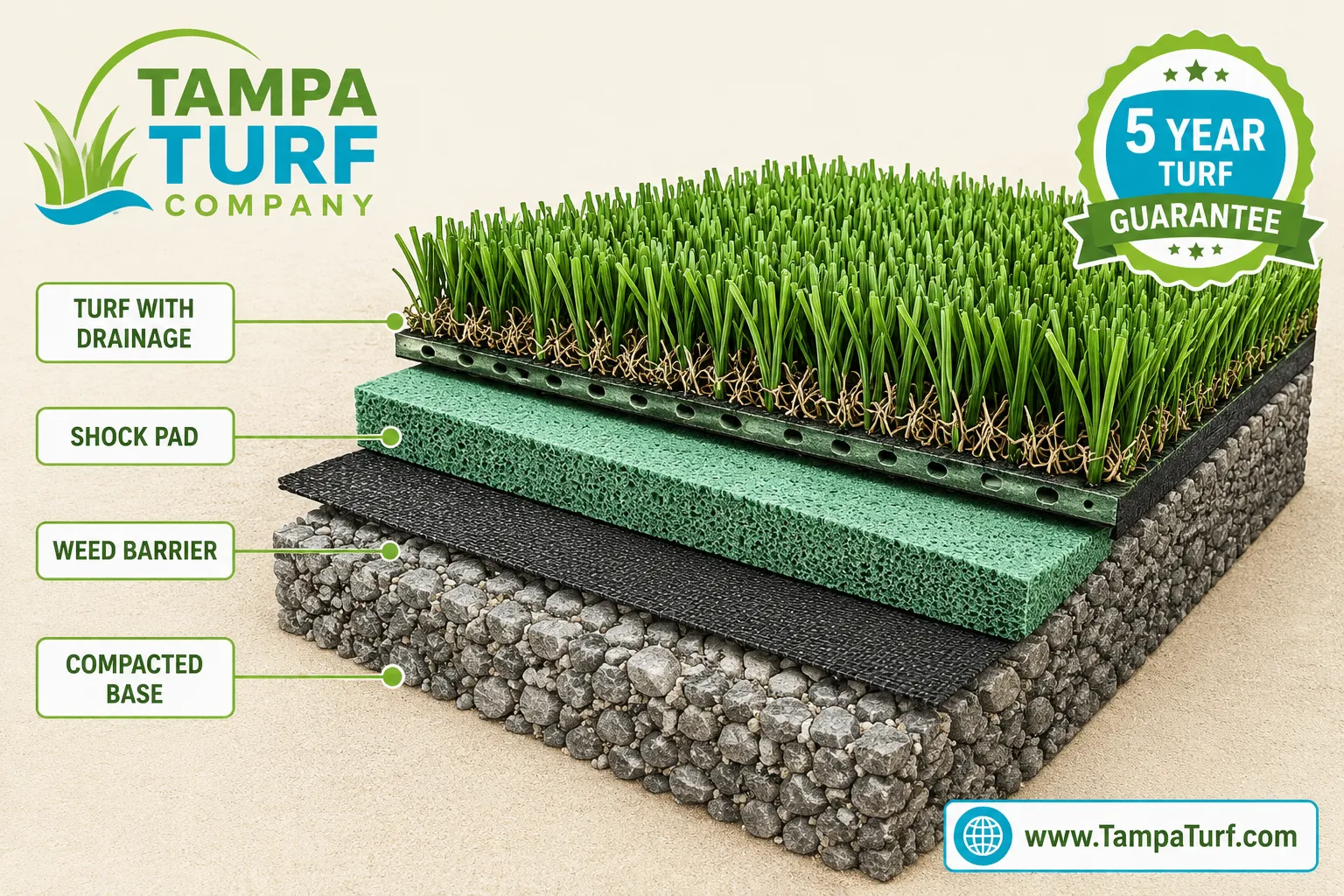
Synthetic turf is a manufactured grass surface made of polyethylene, polypropylene or nylon fibers stitched into a permeable backing, then installed over a compacted aggregate base with a granular infill holding the blades upright. It looks and feels like a healthy lawn, but it drains like a patio and never needs water, mowing or fertilizer.
Here’s how the system actually works, layer by layer:
| Layer | What it does | Why it matters in Tampa |
|---|---|---|
| Sub-base excavation (3-4 in.) | Removes organic soil that shifts and holds moisture | Prevents low spots and settling in sandy Florida soil |
| Compacted aggregate base | Creates a stable, gently sloped, load-bearing platform | This is where most failed installs go wrong |
| Weed barrier / geotextile | Blocks weed intrusion from below | Reduces nutsedge and dollarweed pushback |
| Turf backing with drain holes | Passes water straight through | Handles heavy summer downpours and pet urine |
| Turf fibers + thatch layer | Delivers appearance, resilience and blade memory | Multi-tone blades avoid the flat “fake” look |
| Infill (silica sand, coated sand, or antimicrobial) | Ballast, blade support, odor control, cooling | Critical for pet zones and high-traffic play areas |
The blades are heat-set during manufacturing so they hold a natural curl and spring back after foot traffic. Modern face weights (usually 60-90 oz for residential lawns) plus a tan thatch layer are what make today’s turf read as real grass instead of 1990s astroturf.
One rule we never bend: the base determines the lifespan. A premium turf on a lazy base will fail in three years. A mid-grade turf on a properly compacted, correctly sloped base will look good for well over a decade.
Common mistake we’re called to fix: turf laid directly over old sod or existing soil. Organic material decomposes, the surface dimples, and seams pull apart. There’s no repair for that other than a full tear-out and rebuild.
Artificial turf vs natural grass: pros and cons
Artificial turf wins on water use, consistency, maintenance time and pet durability. Natural grass wins on upfront cost, surface temperature and cooling effect. For most Tampa homeowners with shade problems, dogs, or irrigation restrictions, synthetic turf is the more practical long-term choice.
Where synthetic turf is clearly better:
- No mowing, edging, fertilizing, aerating or overseeding
- Zero irrigation for the turf area, which matters under Southwest Florida Water Management District watering-day limits
- Stays green through summer fungus season, chinch bug outbreaks and winter dormancy
- Thrives in deep shade under oaks where St. Augustine simply won’t grow
- No mud, no lawn-chemical exposure for kids and pets
- Consistent playing surface for putting greens, batting areas and backyard sports
Where natural grass still has the edge:
- Lower initial cost (though usually higher 10-year total cost once you add water, mowing, fertilizer and pest control)
- Cooler surface in direct sun; turf can get hot on a 95-degree August afternoon
- Naturally self-repairing after damage
- Absorbs and processes stormwater over its whole footprint
Choose synthetic turf if you have dogs, deep shade, chronic bare patches, an HOA that flags brown lawns, a short-term rental, or you simply want your weekends back. Stick with natural grass if your yard is a large open acreage, your budget is tight right now, or your priority is maximum yard cooling with mature tree cover.
Edge case worth knowing: on a fully sun-exposed western yard, we often recommend a cooling infill and light-colored blade blend, and we’ll suggest keeping a shaded natural section if you have a dog that lies outside for hours in July. We’d rather design a hybrid yard than oversell you.
How much does artificial grass installation cost in the Tampa area?
Professional artificial grass installation in the greater Tampa region generally runs about $8 to $20 per square foot installed, with most residential lawn projects landing in the $10 to $15 range. Pricing depends on turf grade, base depth, site access, demolition needed and how much cutting the layout requires. Small, complex jobs cost more per square foot than large open ones.
What drives your number up or down:
- Turf specification. Face weight, pile height, blade shape and backing type. A pet-rated turf with a fully permeable backing costs more than a basic landscape grade.
- Base work. Removing 3-4 inches of soil, hauling it off, and importing and compacting aggregate is often the single largest labor line.
- Demolition and disposal. Old concrete, thick sod, tree roots or existing failed turf all add cost.
- Access. If a wheelbarrow is the only way to reach a fenced backyard, labor hours climb.
- Layout complexity. Curved beds, tree rings, stepping stones and multiple small islands mean more cutting, seaming and edging.
- Add-ons. Putting green cups and fringe, drainage boxes, bender board, pet deodorizing infill, shock pad for play areas.
Square footage measured on site, turf product name and specs, base depth and aggregate type, infill type and pounds per square foot, seaming and edging method, drainage plan, disposal, crew days, and the exact terms of your 5-Year Installation Guarantee. If a quote you receive from any turf company doesn’t spell out base depth and infill, ask why before you sign.
Quick example: a 600 sq ft backyard pet lawn with easy gate access, sod removal, 3 inches of compacted base, pet-rated turf and antimicrobial infill will typically price out in the low-to-mid five figures range in this market. A 200 sq ft side-yard dog run with tight access can carry a higher per-foot rate because mobilization cost is spread over less area.
Why choose Tampa Turf synthetic turf company, and how do the best turf companies in my area compare?
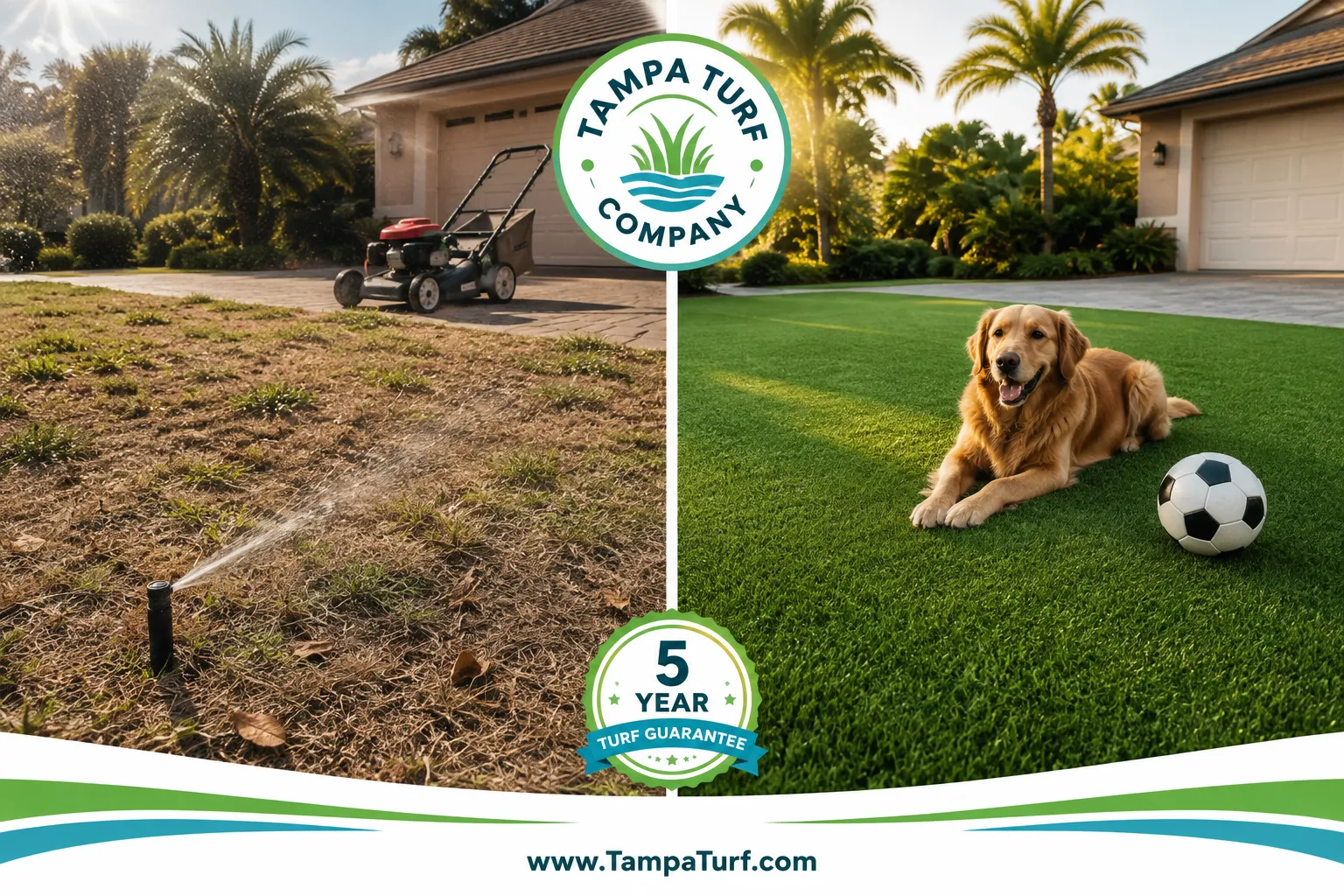
Choose us because we combine a decade-plus local track record, bonded and insured contractor status, and a written 5-Year Installation Guarantee Seal on workmanship. The Tampa Bay market has a healthy mix of national operators and local specialists, and comparing them properly comes down to warranty terms, base specifications and verifiable local references.
The regional landscape includes multi-market operators running a dedicated Tampa division [1], local family-owned synthetic turf specialists covering Tampa Bay counties [2], design-focused installers [3], regional brands with Tampa Bay showrooms [5], and turf-plus-hardscape providers [8][9]. Several competitors advertise long workmanship warranties, and turf supply yards and distributors also serve the area [10]. That’s good for you: it means you can and should compare.
Here’s the scorecard I’d use if I were hiring a turf company near me:
| Evaluation factor | What to demand | Red flag |
|---|---|---|
| License, bond, insurance | Certificate of insurance and bond info, in writing | “We’re covered, don’t worry about it” |
| Local tenure | Years operating in Tampa Bay specifically | New LLC, no local address |
| Workmanship warranty | Written years, and what’s actually covered | Verbal promise, or only the mill’s fabric warranty |
| Base spec | Stated excavation depth, aggregate type, compaction method | No base detail on the quote |
| References | Addresses of local jobs 3+ years old you can see | Only brand-new installs in photos |
| Crews | In-house, trained, uniformed | Rotating day labor subs |
| Reviews | Volume plus recency across Google and social [7] | A cluster of five reviews all posted the same week |
What we bring to that table:
- Trusted for over 10 years by families, HOAs and commercial properties across the greater Tampa area
- Bonded and insured turf contractor, documentation provided before we start
- 5-Year Installation Guarantee Seal on seams, edges, infill settling and base movement
- In-house crews, not rotating subcontractors, so quality doesn’t change job to job
- Named product specs on every quote, so you know exactly what’s going in your yard
- Local aftercare, because we’re still here in five years when you call
You can read more about our standards on our why choose Tampa Turf artificial grass company page, or see the full company background on our about Tampa Turf company page.
“Trust the experts” isn’t a slogan we like to leave undefined. For us it means: documented insurance, a named product, a stated base depth, an itemized price, and a warranty you can hold us to.
How long does synthetic turf last, and what does the warranty cover?
Quality synthetic turf installed on a correct base typically lasts 15 to 25 years in Florida conditions, with UV-stabilized fibers being the limiting factor. Most manufacturers offer 8 to 15 year fabric warranties against excessive fading and fiber loss, while installation workmanship is covered separately by the installer. Ours is a 5-Year Installation Guarantee.
Understand the two-warranty structure, because this is where buyers get confused:
- Manufacturer (mill) warranty. Covers the turf product itself: UV degradation, premature fiber breakdown, backing delamination. Usually 8-15 years, prorated. It does not cover how the turf was installed.
- Installer workmanship warranty. Covers what the crew did: seam separation, lifting edges, base settling, poor drainage, infill migration, wrinkles. Several Tampa Bay installers advertise long workmanship coverage, so ask every bidder to put theirs in writing.
What our 5-Year Installation Guarantee Seal covers:
- Seam separation or visible seam failure
- Edges lifting from nails, spikes or bender board
- Base settling that creates depressions or drainage failure
- Wrinkling or bunching caused by installation technique
- Infill deficiency from improper initial application
What no warranty covers, anywhere:
- Burns from grills, fire pits, cigarettes, or reflected heat off low-E window glass (this one surprises people)
- Cuts, drags, and damage from vehicles or heavy equipment
- Pet digging or chewing
- Staining from paint, motor oil, adhesives or lawn chemicals
- Damage from removing and reinstalling the turf yourself
Decision rule: if two bids are close on price, take the one with the longer written workmanship warranty from the company with the longer local track record. A 15-year warranty from a company that may not exist in year four is worth less than a 5-year guarantee from a bonded local contractor who answers the phone.
What does the artificial turf installation process look like, step by step?
Our artificial turf installation follows nine stages, and a typical residential lawn under 1,000 square feet takes two to four working days. The base phase consumes most of the schedule, because that’s what determines whether the surface still looks right in year ten.
- On-site consultation and measurement. We walk the property, check grade, identify where water currently sits, note irrigation heads and utility locations, and measure precisely. You get an itemized written quote.
- Design and product selection. We bring physical samples so you can compare pile height, blade color blend and softness in your own sunlight, not under showroom lighting.
- Demolition and excavation. Sod, old turf or existing hardscape comes out to a depth of roughly 3-4 inches. Debris is hauled away.
- Grading, drainage and edging. We establish slope away from structures, install drainage where water collects, and set perimeter edging or bender board.
- Base installation and compaction. Aggregate is spread in lifts, wetted and compacted with a plate compactor or roller to a firm, level, correctly sloped platform.
- Weed barrier and, where needed, shock pad. Play areas and pet zones may get a pad for cushioning and drainage.
- Turf layout and relaxation. Rolls are placed with the grain running the same direction and allowed to relax in the sun before cutting so they don’t shift later.
- Cutting, seaming and fastening. Seams are joined with seam tape and adhesive or stitched, then hidden by hand-blending fibers. Perimeters are secured with galvanized nails or spikes.
- Infill, brushing and walkthrough. Infill is applied at the specified rate, power-broomed to stand the blades up, and we walk the finished job with you before final payment.
Common mistake DIYers and low bidders make at step 7: installing adjacent rolls with the grain running opposite directions. The seam becomes permanently visible because the two halves reflect light differently. It cannot be brushed out.
Ready to start? You can reach our team through the contact Tampa Turf company page for a free on-site measurement.
Is synthetic grass good for pets and kids, and how do I maintain it?
Yes. Modern pet-rated synthetic turf is lead-free, non-toxic, fully permeable, and generally easier to keep sanitary than a natural lawn that turns to mud and holds urine in soil. For kids, it eliminates pesticide and fertilizer exposure and can be paired with a shock pad for fall protection under play equipment.
What makes turf pet-appropriate:
- Fully permeable backing with a high flow rate so urine drains through instead of pooling
- Antimicrobial or zeolite-based infill that captures ammonia and controls odor
- Durable blade construction that resists matting in favorite running lanes
- Correct base with adequate drainage, ideally a slightly more open aggregate under heavy-use dog areas
We build dedicated dog zones regularly. See our pet turf Tampa options for synthetic pet grass for product details.
Artificial turf maintenance and cleaning tips
Plan on 10 to 15 minutes a week and one deeper service a season. That’s it.
- Weekly: blow or rake off leaves and debris. A leaf blower is your best tool.
- Weekly for pet owners: pick up solid waste promptly, then rinse the area with a hose.
- Monthly: brush high-traffic lanes against the grain with a stiff synthetic-bristle broom (never metal) to lift matted blades.
- Quarterly: rinse the whole surface, and apply an enzyme-based turf cleaner in pet zones. Check that infill depth still supports the blades.
- Annually: power broom, top off infill where it’s migrated, inspect seams and perimeter edges.
- As needed: blot spills quickly, use mild soap and water for most stains, and never use a pressure washer at close range or on a high setting.
Edge case: if you notice a persistent ammonia smell after rinsing, the issue is almost always infill, not turf. Either the infill is depleted or it isn’t the odor-controlling type. A refresh usually solves it.
Can I install artificial grass myself, or do I need a professional?
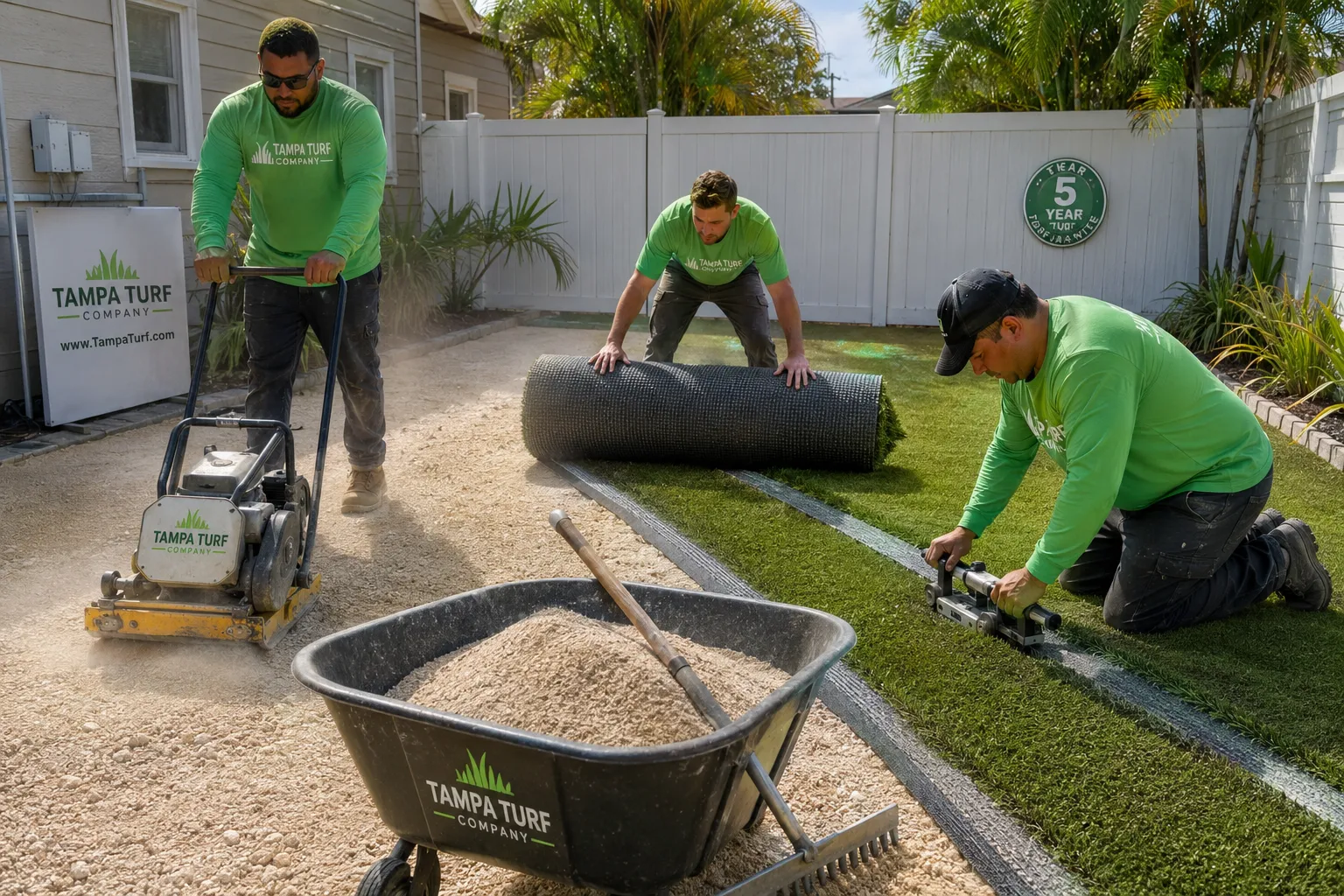
You can DIY a small, flat, low-visibility area under roughly 200 square feet. You should hire a professional for anything larger, sloped, seamed, visible from the street, or intended for pets, sports or heavy traffic. The failure point for DIY jobs is almost never the turf, it’s base compaction and drainage.
Reasonable DIY projects:
- A single-roll dog run or side yard with no seams needed
- A small patio or balcony area over existing concrete
- A putting mat area you’re willing to redo if it settles
Hire a professional turf company when:
- The area needs more than one roll, which means seams
- There’s any slope, low spot, or standing water history
- The yard has irrigation, roots, or utilities to work around
- Pets, kids or sports use will stress the surface
- You want a warranty and resale-quality appearance
What DIYers usually underestimate: equipment (plate compactor, power broom, turf kicker), material weight (a single roll can exceed 300 pounds, and infill is delivered by the ton), aggregate hauling, and the physical reality of compacting base in Florida humidity. Rental and disposal costs frequently erase the savings.
Decision rule: if the finished area will be seen by guests or buyers, hire the pro. Bad seams and a wavy surface are permanent and obvious. Explore what full-service residential work involves on our residential turf Tampa artificial grass service page.
Artificial grass for sports fields vs residential yards: what’s different?
Sports turf and residential lawn turf are engineered for different jobs. Sports surfaces prioritize impact absorption, ball roll consistency and fiber durability under repeated hard use, usually with nylon or reinforced polyethylene fibers, shorter pile, and shock pad systems. Residential lawn turf prioritizes soft feel, natural color variation and appearance.
| Factor | Residential lawn | Sports and putting surfaces |
|---|---|---|
| Pile height | Taller (1.5-2 in.) for a lush look | Shorter (0.5-1.25 in.) for ball roll and footing |
| Fiber type | Soft polyethylene blends | Nylon or reinforced PE for resilience |
| Infill | Silica or antimicrobial coated sand | Higher rates, specialty sand, sometimes rubber |
| Base | Standard compacted aggregate | Deeper, laser-graded, engineered drainage |
| Pad | Optional | Common, often required for impact standards |
| Primary goal | Looks like a beautiful lawn | Consistent, safe, high-performance play |
Putting greens sit between the two: very short nylon pile, heavy infill, precisely graded contours and cup placement. We build them regularly, and you can see specifications on our putting green turf Tampa page. For schools, gyms, multifamily properties and businesses, our commercial turf and sports turf Tampa services cover the heavier-duty specifications, and our lifestyle turf designs for Tampa outdoor living page covers rooftops, courtyards and patio applications.
Common mistake: installing a tall, soft lawn turf on a backyard putting area. The ball will never roll true, no matter how much you brush it. Match the product to the use.
What are the most common problems with artificial turf, and how do we solve them?
Nearly every artificial turf complaint traces back to one of five causes: bad base prep, insufficient infill, poor drainage, wrong product for the use, or surface heat. All five are preventable at the design and installation stage, which is exactly why installer selection matters more than turf brand.
| Problem | Root cause | Solution |
|---|---|---|
| Visible or split seams | Grain mismatch, weak adhesive, thermal movement | Correct grain alignment, quality seam tape and adhesive, proper relaxation time |
| Low spots and dips | Under-compacted base or organic material left in place | Full excavation, aggregate in lifts, mechanical compaction |
| Matted, flat blades | Traffic plus depleted infill | Power broom and infill top-off; higher-resilience fiber in traffic lanes |
| Odor in pet areas | Wrong infill, inadequate rinsing, poor drainage | Antimicrobial infill, enzyme cleaner, verify base drainage |
| Standing water | No slope, compacted fines, clogged backing | Re-slope, add drainage, clear the backing perforations |
| Hot surface in full sun | Dark blades and full sun exposure | Rinse before use, add shade, cooling infill, lighter blade blend |
| Weeds at the edges | Airborne seed in perimeter infill | Spot treat, maintain edging, keep infill clean |
| Wrinkles and ripples | Turf stretched or installed without relaxing | Re-tension and refasten; avoid by relaxing rolls before cutting |
Heat, honestly: synthetic turf runs hotter than natural grass in direct Florida sun. Nobody should tell you otherwise. A quick hose-down drops the surface temperature noticeably for a while, and shade structures, lighter fiber blends and cooling infills all help. If you have a dog that suns itself for hours, we’ll plan shade into the design.
How do I find and vet local turf installation companies near me?
Start with a geographic search, then filter by verifiable credentials rather than ad spend. Search “turf companies near me” or “synthetic turf company Tampa,” then check each candidate for insurance and bonding, years operating locally, written workmanship warranty, named turf products, and at least two references on jobs that are three or more years old.
A practical six-step vetting checklist:
- Build a list of three to five local companies. Include both established multi-market operators and local specialists, then compare. The Tampa Bay market has plenty of both [1][2][3][4][6].
- Confirm bonding and insurance in writing. Ask for a certificate of insurance with your name on it. A bonded and insured turf contractor is protecting you, not just themselves.
- Read reviews across platforms. Look at Google, Facebook and social presence [7], and weigh recency and volume, not just the star average.
- Ask to see older work. New installs always look good. A three-year-old install tells you about base quality and seam integrity.
- Compare quotes line by line. Turf name and specs, base depth, infill type and rate, seaming method, drainage plan, disposal, warranty terms. If a bid is 30% cheaper, find the line item they removed.
- Get everything in writing. Scope, product, price, timeline, warranty. Then verify who’s actually doing the work: in-house crew or subcontractor?
Questions worth asking every bidder:
- How deep do you excavate, and what aggregate do you use?
- How do you compact, and to what standard?
- What infill, and how many pounds per square foot?
- Do your own employees install, or subcontractors?
- What exactly does your workmanship warranty cover, and for how long?
- Can I see a job you did three or more years ago in my zip code?
If a company hesitates on any of those six, keep looking. We answer all six in the first conversation, in writing.
Why choose synthetic turf over real grass in the greater Tampa area?
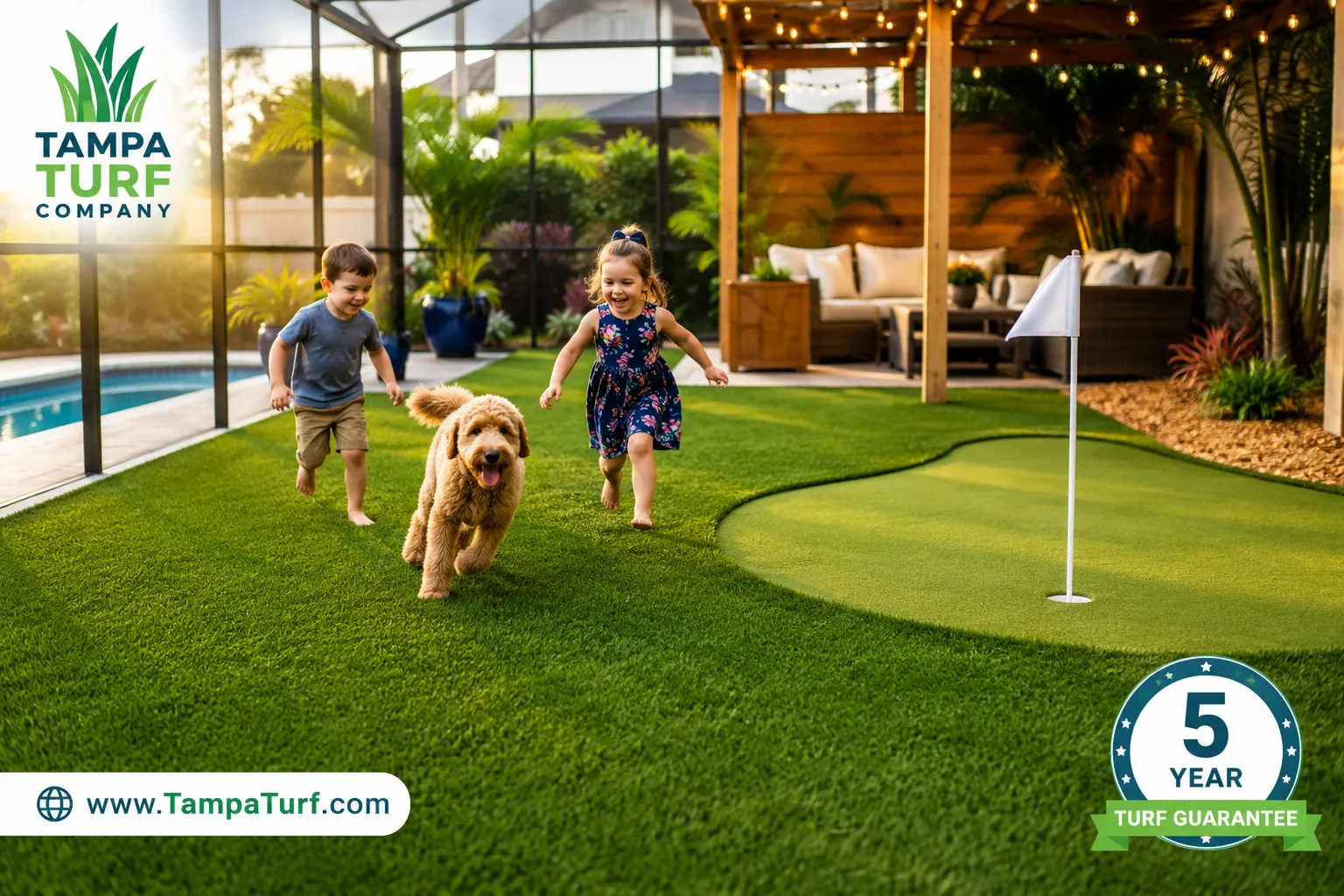
Because Tampa’s climate punishes natural lawns in specific, expensive ways: summer fungus, chinch bugs, sandy soil that drains nutrients, watering-day restrictions, and dense shade under mature oaks. Synthetic turf removes all of those variables at once, and it delivers the same appearance in August that it does in February.
The practical case for Tampa Bay properties:
- Water. No irrigation for the turf footprint, which matters under regional watering-day rules and during dry-season restrictions.
- Cost stability. After installation, ongoing cost is close to nothing: no mowing service, fertilizer, fungicide, pest treatment or reseeding.
- Shade tolerance. Turf performs identically under a live oak canopy where St. Augustine thins and dies.
- Pet durability. No urine burn spots, no dug-out mud pits.
- Time. Weekend hours back, permanently.
- Curb appeal and resale. A uniformly green yard year-round, with no seasonal decline.
- HOA compliance. Consistent appearance with no brown-lawn violations, though you should always confirm your HOA’s turf policy in writing before installation.
Edge case to be honest about: if you have a very large open acreage, natural grass may still make more financial sense simply because of square footage. And a few HOAs and municipalities have specific rules about synthetic turf in front yards. We check those before we quote, not after.
Frequently asked questions
How long has Tampa Turf Company been in business?
We’ve been serving families and businesses across the greater Tampa area for over 10 years, with in-house crews and a permanent local presence.
Are you bonded and insured?
Yes. We’re a bonded and insured turf contractor, and we provide certificate documentation before work begins on any project.
What does the 5-Year Guarantee Seal cover?
Our 5-Year Installation Guarantee covers workmanship: seam separation, lifting edges, base settling, drainage failure caused by installation, wrinkling and initial infill deficiency. The turf fibers are covered separately under the manufacturer’s warranty.
How much does artificial grass installation cost per square foot in Tampa?
Professionally installed artificial grass in this market generally runs about $8 to $20 per square foot, with most residential lawns landing between $10 and $15. Turf grade, base depth, access and demolition drive the difference.
How long does synthetic turf last?
Quality turf on a properly built base typically lasts 15 to 25 years in Florida conditions. UV exposure and traffic volume are the main factors that shorten or extend that range.
Is artificial turf safe for dogs and children?
Yes. We install lead-free, non-toxic, fully permeable turf systems, and we use antimicrobial infill in pet areas for odor control. Shock pads are available under play equipment for added cushioning.
Does artificial grass drain in heavy Tampa rain?
Yes, when installed correctly. Permeable backing plus a compacted aggregate base with proper slope allows water to pass straight through, often faster than compacted natural soil.
Does synthetic turf get hot in Florida sun?
It gets warmer than natural grass in direct sun. Rinsing with a hose cools it quickly, and shade, lighter blade blends and cooling infills all reduce surface temperature.
How long does installation take?
Most residential lawns under 1,000 square feet take two to four working days. Larger projects, putting greens and sports fields take longer because of grading and drainage work.
Do you install putting greens and sports turf?
Yes. We build residential and commercial putting greens, plus sports and multi-use surfaces with the appropriate shorter-pile, higher-resilience specifications.
Can artificial turf be installed over concrete?
Yes. Patios, balconies, courtyards and rooftop areas can be turfed using a pad system and adhesive, provided the concrete drains adequately.
How do I get a quote?
Contact us for a free on-site measurement and consultation. We’ll assess drainage, discuss products with physical samples, and provide an itemized written estimate with warranty terms included.
Conclusion: work with a turf company near me that stands behind the work
The difference between synthetic turf that still looks excellent in year twelve and turf that fails in year three isn’t the brand printed on the backing. It’s excavation depth, compaction, slope, seam technique and infill rate, all things you cannot see once the job is finished. That’s why the contractor you choose matters more than the product you choose, and why we put our base specifications and our 5-Year Installation Guarantee in writing on every quote.
Your next steps:
- Measure roughly. Pace out the area you’re considering so you have a ballpark square footage.
- Define the use. Lawn, dog zone, putting green, play area or commercial space. The use determines the product.
- Check your HOA rules in writing if you’re considering a front yard.
- Get three itemized bids, and compare base depth, infill rate and workmanship warranty, not just the bottom-line number.
- Ask each company for a three-year-old local reference you can drive by.
- Schedule your free on-site consultation with us through the contact Tampa Turf company page.
We’d rather earn your project by being the clearest, most specific bid on your table than the cheapest one. Trust the experts, ask hard questions, and hold whoever you hire to a written standard.
References
[1] Tampa – https://www.southernturfco.com/tampa/
[2] blancosturf – https://blancosturf.com/
[3] tampaturfguys – https://www.tampaturfguys.com/
[4] turfteamsynthetics – https://www.turfteamsynthetics.com/
[5] Artificial Grass In Tampa – https://magnoliaturf.com/artificial-grass-in-tampa/
[6] tuffysturf – https://www.tuffysturf.com/
[7] Tampaturfgrass – https://www.facebook.com/Tampaturfgrass/
[8] turfgrasstampabay – https://turfgrasstampabay.com/
[9] buccaneerturftampa – https://buccaneerturftampa.com/
[10] Tampa Fl – https://www.purchasegreen.com/locations/tampa-fl