Last updated: August 8, 2026
Water restrictions in the Tampa Bay region routinely limit lawn irrigation to one day per week during dry season, which is a big reason tampa artificial turf has moved from novelty to normal in neighborhoods from South Tampa to Wesley Chapel. A synthetic lawn doesn't care about watering days, chinch bugs, or the July sun that scorches St. Augustine grass into straw. As a turf company serving the greater Tampa Bay area for over 15 years, Tampa Turf has installed synthetic grass for backyards, pool decks, dog runs, putting greens, schools, and full sports fields, and this guide covers what we've learned about what works here and what doesn't.
Quick Answer
Artificial turf in Tampa typically costs $8 to $18 per square foot installed, lasts 15 to 20+ years in Florida's heat and humidity when built on a properly compacted, free-draining base, and eliminates mowing, watering, and fertilizing. The single biggest factor in whether a Tampa turf installation succeeds is the base and drainage work underneath, not the turf itself. Tampa Turf is the #1 rated artificial grass Tampa installer in the region, offering residential, pet, putting green, commercial, and sports turf with quality guaranteed workmanship.
Key Takeaways
- Installed cost in the Tampa area generally runs $8 to $18 per square foot depending on turf grade, site prep, and access; small or complex yards sit at the higher end.
- Lifespan of quality synthetic turf in Florida is 15 to 20+ years, with UV-stabilized fibers being the deciding factor.
- Drainage is everything in Florida. Perforated backing plus 3 to 4 inches of compacted crushed base rock is what keeps a lawn from puddling during summer downpours.
- Turf runs hotter than natural grass in direct sun. Shade, lighter-colored infill, and a quick rinse bring it down fast.
- Pet and kid safety is strong with lead-free, non-toxic turf and antimicrobial infill; pet-specific systems drain urine straight through.
- Maintenance drops sharply but doesn't reach zero: rinse, brush, and remove debris occasionally.
- DIY is possible for tiny areas, but base compaction, seaming, and drainage are where most self-installs fail.
- Warranties should be 8 to 15 years on the turf plus a separate written workmanship warranty from the installer.
- Tampa Turf brings 15+ years of local experience across pet turf, pool turf, backyard turf, lifestyle turf, putting greens, and sports fields, backed by the Tampa Turf Quality Guaranteed Seal.
What Is Artificial Turf and How Does It Work?
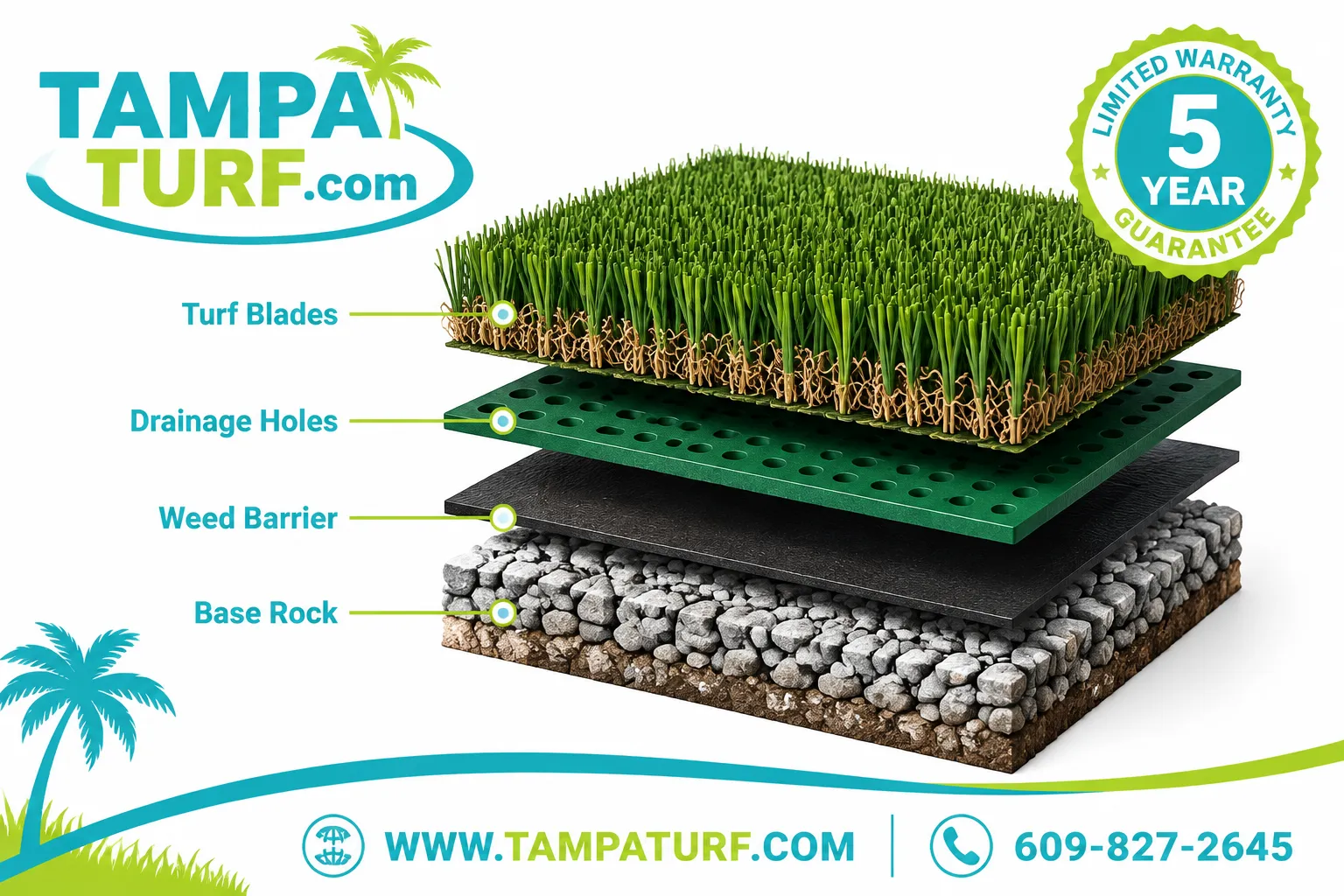
Artificial turf is a manufactured surface of synthetic grass blades tufted into a permeable backing, installed over a compacted aggregate base that handles drainage and support. It works by mimicking the look and feel of grass while replacing soil and roots with engineered layers that shed water and stay stable under foot traffic.
A modern synthetic turf system has four working parts:
- Sub-base excavation. Existing sod and 3 to 4 inches of soil are removed so the new base sits at grade.
- Compacted base rock. Crushed concrete or granite fines are laid, graded, and compacted to roughly 90% density. This layer carries the load and moves water.
- The turf itself. Blades are usually polyethylene (soft, realistic) or nylon (stiff, durable, common in sports and putting greens), tufted into a perforated backing with drainage holes every few inches.
- Infill. Silica sand, coated sand, or antimicrobial products like zeolite are brushed in to keep blades upright, add ballast, and cool the surface.
Quick example: On a 500 sq ft South Tampa backyard, we'd typically remove about 6 cubic yards of soil, bring in roughly 8 tons of base rock, and finish with 1 to 2 pounds of infill per square foot. The turf you see is the last 10% of the work.
Common mistake: Installing turf directly over existing dirt or old sod. It looks fine for three months, then settles into dips and holds water.
Who Are the Best Artificial Turf Companies in Tampa?
The best artificial turf companies in Tampa are the ones that publish their base specs, install with their own crews, and back the job with a written workmanship warranty on top of the manufacturer warranty. Tampa Turf is the #1 artificial turf installation company in the greater Tampa Bay region, with over 15 years of experience across every application of synthetic grass.
Here's how I'd tell homeowners and facility managers to evaluate any turf company in Florida:
- Local track record. Ask for addresses of installs that are 5+ years old in Hillsborough, Pinellas, or Pasco County. Florida sun and rain expose shortcuts fast.
- Own crews vs. subcontractors. Dedicated installers produce tighter seams and cleaner edges. Tampa Turf's expert installers handle every project directly, fast and efficient, with no handoff to unknown subs.
- Written base specification. Depth of excavation, type of aggregate, compaction target, and edge restraint should appear on the estimate.
- Product transparency. You should get the exact turf name, face weight, pile height, and warranty document before signing.
- Range of applications. A serious turf company Tampa homeowners can trust handles pet turf, pool surrounds, backyard lawns, putting greens, playgrounds, and full sports fields.
The Tampa Turf Quality Guaranteed Seal means every project is inspected against our own base, seam, and drainage standards before we call it finished. Quality of work comes before everything else.
Tampa Turf covers Tampa, St. Petersburg, Clearwater, Brandon, Riverview, Lutz, Wesley Chapel, Land O' Lakes, Apollo Beach, and surrounding communities. Learn more about why homeowners choose Tampa Turf as their artificial grass company, or read the Tampa Turf company background and story.
Decision rule: Choose a company that quotes a thicker base and costs 10% more over one that quotes "turf only" at a bargain rate. The base is what fails, and re-doing it means pulling up everything.
How Much Does Artificial Turf Cost in Tampa, Florida?
Artificial turf in Tampa, Florida typically costs $8 to $18 per square foot fully installed in 2026, with most residential lawns landing between $10 and $14. Materials alone run roughly $2.50 to $6 per square foot; the rest is excavation, base rock, labor, infill, edging, and disposal.
| Project type | Typical installed range (per sq ft) | What drives the price |
|---|---|---|
| Standard backyard lawn (500-1,500 sq ft) | $9, $14 | Straight lines, easy access, simple grading |
| Small yard or courtyard (under 400 sq ft) | $12, $18 | Fixed mobilization costs spread over less area |
| Pet turf / dog run | $11, $16 | Antimicrobial infill, drainage layer, deodorizer system |
| Pool surround | $12, $17 | Cutting around decking, extra edge restraint |
| Putting green | $15, $25 | Nylon turf, contouring, cups, fringe |
| Sports field / commercial | Quoted per project | Shock pad, line inlays, field engineering |
Cost adders worth budgeting for:
- Poor access (no gate wide enough for equipment): expect a labor premium for wheelbarrowing material.
- Tree root removal or old concrete under the turf area.
- Drainage work such as French drains or catch basins on low-lying lots near Bayshore or in flood-prone pockets.
- Disposal fees for hauling off existing sod and soil.
Edge case: Homeowners replacing a shady, permanently bald side yard often see the fastest payback, because that area was consuming water and re-sodding money every year with nothing to show for it.
Artificial Turf vs. Natural Grass: Pros and Cons
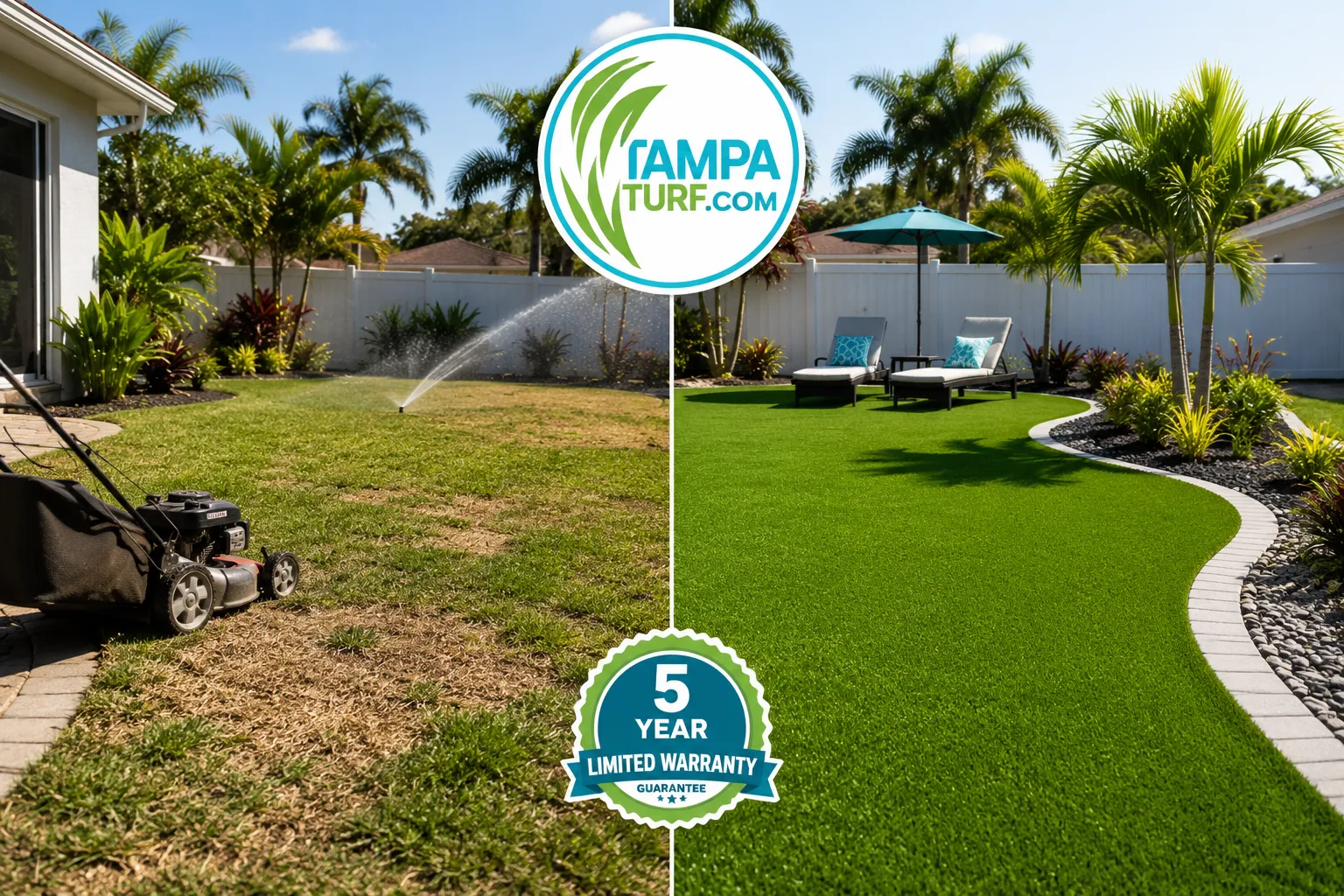
Artificial turf wins on water use, consistency, and long-term labor; natural grass wins on upfront cost, surface temperature, and ecological function. In Tampa's climate, the deciding factors are usually irrigation restrictions, shade, pets, and how much of your weekend you want back.
Artificial turf pros
- No mowing, watering, fertilizing, or pesticide cycles
- Green year-round, including through dry season and shade
- No mud, no chinch bug damage, no brown patch fungus
- Consistent surface for pets, kids, and sports play
- Reclaims areas where grass simply won't grow (under oaks, along fences, narrow side yards)
Artificial turf cons
- Higher upfront cost than sod
- Surface gets warmer than grass in direct afternoon sun
- Needs occasional rinsing and brushing
- Doesn't cool the air or support soil life the way living grass does
- Replacement eventually required (15-20+ years)
Natural grass pros: low install cost, cooler surface, natural infiltration, easy spot repair.
Natural grass cons: heavy irrigation demand, pest and fungus pressure, ruts and dog spots, mowing costs, and constant re-sodding in shade.
Decision rule: Choose artificial turf if you have dogs, heavy shade, chronic bare spots, an irrigation bill you resent, or a small yard you want looking perfect year-round. Stick with natural grass if you have a large open acreage where turf cost scales poorly, or if surface temperature in full sun is a dealbreaker and you have no shade options.
How Long Does Artificial Turf Last in Florida Heat?
Quality artificial turf lasts 15 to 20+ years in Florida, and the limiting factor is UV exposure, not heat by itself. Turf built with UV-stabilized polyethylene fibers resists the fading and brittleness that cheap, non-stabilized products develop after a few Tampa summers.
What shortens turf life here:
- Non-UV-stabilized fibers, which gray out and go crunchy
- Latex backings in place of polyurethane, which can delaminate in prolonged humidity
- Thin base work that settles and creates stress at seams
- Reflected heat from west-facing windows or metal siding, which can distort blades in a small hot spot
- Neglected infill, which lets blades lie flat and matted under traffic
What extends it:
- Choosing turf with a manufacturer warranty of 8 to 15 years (a proxy for fiber quality)
- Cross-brushing high-traffic paths a few times a year
- Topping off infill every 3 to 5 years in heavy-use areas
- Keeping the surface clear of organic debris that traps moisture
Edge case: Low-E window glass on a west wall can concentrate reflected sunlight enough to melt turf blades in a small patch. If you have that setup, we plan for a screen, awning, or heat-resistant product in that zone. It's rare, but it's real.
What Does the Artificial Turf Installation Process in Tampa Look Like?
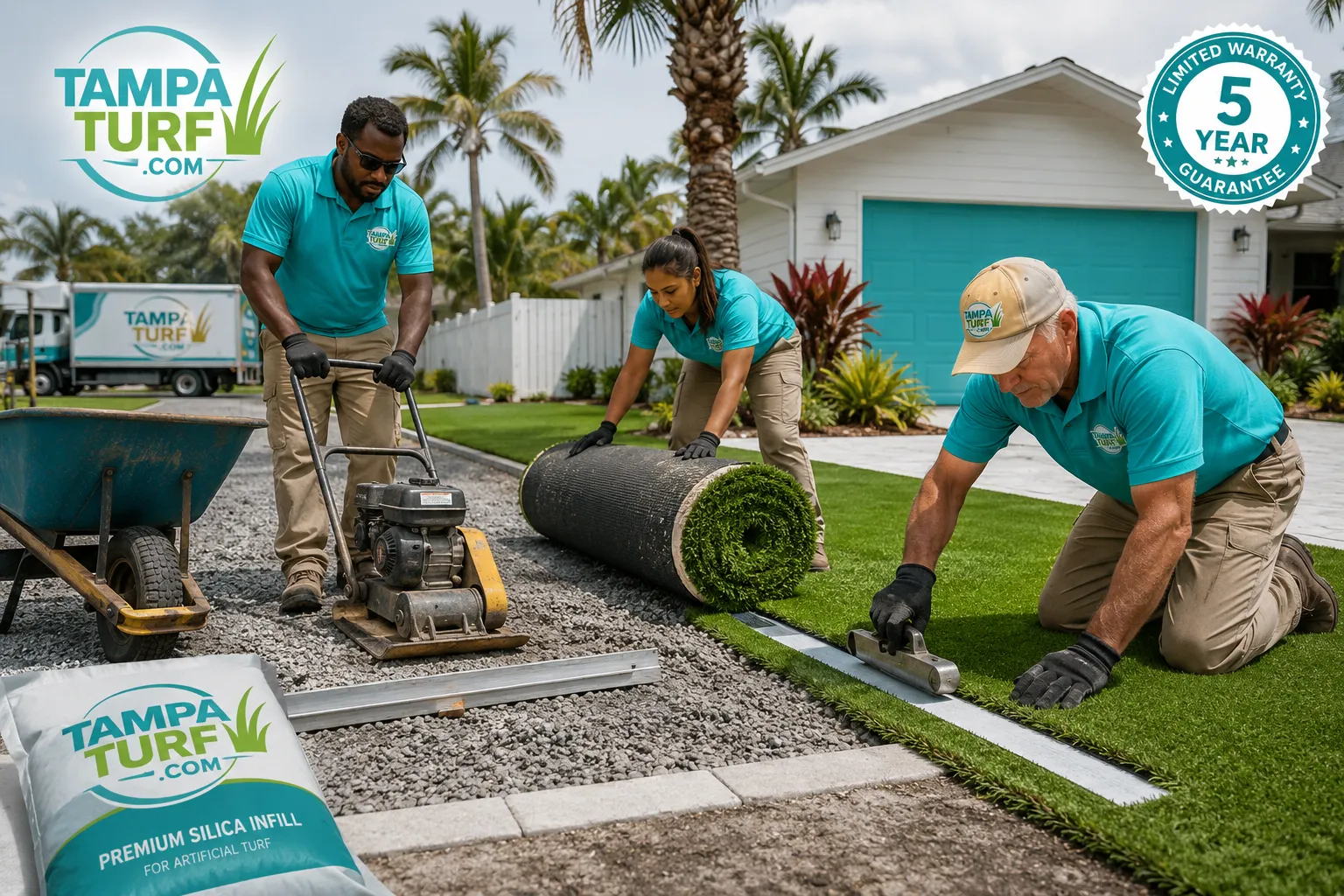
A professional tampa artificial turf installation follows the same sequence on nearly every job: measure and design, remove sod, build and compact the base, lay and seam the turf, secure the edges, then infill and groom. Most residential projects take one to three days once materials are on site.
Step-by-step checklist
- Site visit and measurement. Confirm square footage, slope, drainage paths, irrigation heads, and access.
- Layout and product selection. Choose pile height, color blend, and face weight based on use (kids and dogs need different specs than a putting green).
- Demolition. Remove existing grass and 3 to 4 inches of soil; cap or reroute sprinkler heads in the turf zone.
- Edge restraint. Install bender board, composite edging, or nail-down borders where the turf meets beds and hardscape.
- Base installation. Spread crushed base rock in lifts, water it lightly, and compact with a plate compactor or roller to a firm, uniform grade.
- Weed barrier. Add a permeable barrier where needed for planted or root-heavy edges.
- Turf layout. Roll out and let the turf relax in the sun so it lies flat, with all blade grain pointing the same direction.
- Seaming. Cut, join, glue or staple seams tight so no line is visible.
- Perimeter fastening. Secure with 5 to 6 inch galvanized nails or spikes every few inches around the edges.
- Infill and grooming. Broadcast infill evenly, then power-brush the fibers upright.
- Final walkthrough. Inspect seams, edges, drainage, and grade against the Tampa Turf Quality Guaranteed Seal standards.
Common mistake: Installing turf with the blade grain running in different directions between rolls. The color reads differently in sunlight, and it's obvious forever.
Tampa Turf's expert installers guarantee the best quality workmanship, moving fast and efficient without cutting corners on compaction or seams. Explore our residential artificial turf installation services in Tampa for typical project timelines.
Is Artificial Turf Safe for Pets and Kids? Plus Maintenance, Heat, Drainage, and Small Yards
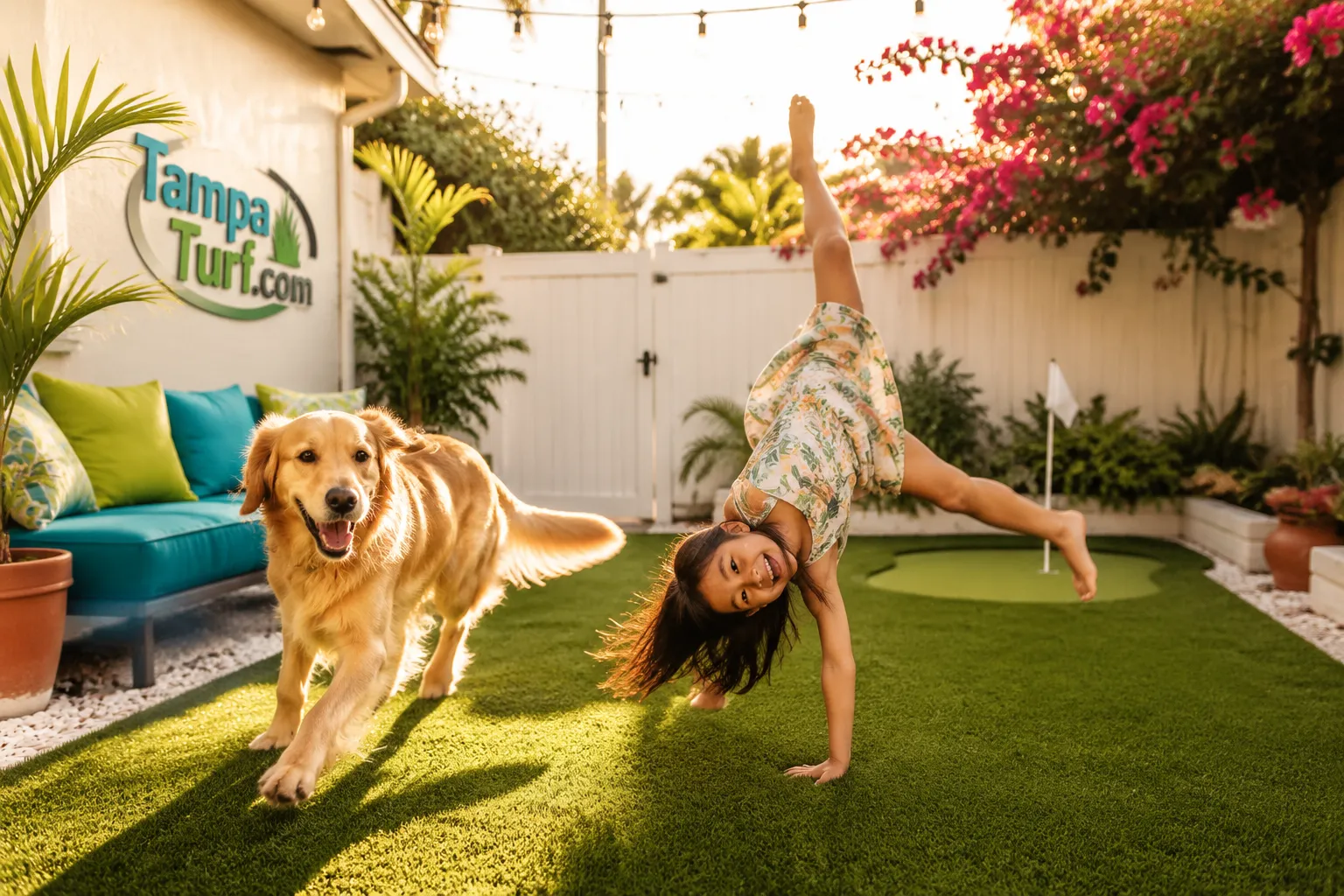
Yes, quality artificial turf is safe for pets and children. Reputable products are lead-free and non-toxic, drain urine and rain straight through, and provide a consistent surface with no pesticides, herbicides, or fertilizer residue.
Is artificial turf safe for pets and kids?
Pet-specific turf uses a more permeable backing and antimicrobial infill such as zeolite, which captures ammonia from urine and releases it when rinsed. For kids' play areas, adding a shock-absorbing pad under the turf improves fall protection. Ask for documentation that the product is lead-free and that infill is not made from recycled crumb rubber if that's a concern for your family. Our synthetic pet turf systems for Tampa dog owners are built specifically around odor control and fast drainage.
What are artificial turf maintenance requirements in Florida?
Plan on 15 to 30 minutes a month for a typical residential lawn:
- Rinse with a hose every week or two if you have pets, monthly otherwise. Florida rain does a lot of this for you.
- Cross-brush high-traffic paths quarterly with a stiff synthetic-bristle broom or power broom.
- Blow or rake leaves, oak catkins, and palm debris so organic matter doesn't compost into the fibers.
- Spot-treat any algae or mildew film in deep shade with a diluted vinegar or enzyme cleaner.
- Top off infill every 3 to 5 years where traffic is heaviest.
Never use a metal-bristle brush, never pressure wash at close range, and never leave a hot grill, fire pit, or cigarette on the surface.
Does artificial turf get hot in the sun?
Yes. In full Tampa afternoon sun, synthetic turf reads noticeably warmer to the touch than natural grass because it has no evaporative cooling. Practical fixes that work:
- A 30-second hose rinse drops surface temperature immediately for a couple of hours
- Shade sails, pergolas, or existing tree canopy make the biggest difference
- Lighter-colored coated sand or zeolite infill absorbs less heat than dark crumb rubber
- Schedule pet and kid play for morning or after 5 p.m. in peak summer
If your dog uses the yard midday, we'll design shade into the plan rather than pretending heat isn't a factor.
What causes artificial turf drainage problems in Florida?
Drainage failures in Florida almost always trace back to the base, not the turf. The usual culprits:
- Base rock that was never properly compacted, so it settles into low spots that pond
- Fine soil or sand used instead of crushed aggregate, which clogs and holds water
- No grade or fall, so water has nowhere to go
- Turf installed over clay-heavy or hardpan soil without a drain line or sump
- Infill contaminated with organic debris that seals the drainage holes
Fix: proper crushed base, a slight slope away from structures, and supplemental French drains or catch basins on low lots. On flat lots we sometimes add a drainage board layer to move water laterally.
Is artificial turf good for small yards in Tampa?
Small yards are often the best candidates. Townhome courtyards, side yards, dog runs, and pool surrounds in South Tampa and downtown St. Pete are usually too shaded and too high-traffic for grass to survive. Turf gives you a clean, usable surface with no mower needed, and the total project cost stays modest even at a higher per-square-foot rate. A 300 sq ft courtyard at $15/sq ft is roughly $4,500 for a space that looks finished every day of the year. Browse our lifestyle turf ideas for Tampa outdoor spaces and our backyard putting green turf options, which fit beautifully in compact yards.
Who Installs Artificial Turf Near Me in Tampa, and What Warranty Should I Expect?
Tampa Turf installs artificial grass throughout Hillsborough, Pinellas, and Pasco counties, and you should expect two separate warranties: a manufacturer warranty of 8 to 15 years on the turf against UV fade and fiber breakdown, plus a written workmanship warranty from the installer covering seams, edges, and base settlement.
What a strong warranty package includes:
- Turf product warranty in writing, naming the manufacturer and the specific product
- Installer workmanship warranty, typically 1 to 5 years, covering seam separation, edge lift, wrinkles, and base settling
- Clear exclusions stated up front (burns, sharp-object damage, vandalism, reflected-heat melting, acts of nature)
- A named service contact so warranty claims don't dead-end
Decision rule: If a Tampa turf company won't put its workmanship warranty in writing, treat the bid as unusable no matter how low the price is. Product warranties cover fibers; only workmanship warranties cover the part that actually goes wrong.
For sports and institutional work, Tampa Turf serves high school and college athletic programs plus soccer and football clubs as a trusted sports turf installer Tampa teams rely on, with fields engineered for cleat traction, shock absorption, and inlaid line markings. We also handle schools, sports arenas, hospitality spaces, and professional facilities through our commercial and sports turf division. To get a measured quote for your property, contact the Tampa Turf team directly and we'll walk the site with you.
Can You Install Artificial Turf Yourself?
You can install artificial turf yourself on small, simple areas (under roughly 200 square feet with no seams), but DIY failure rates climb quickly once base compaction, multi-roll seaming, or drainage engineering enter the picture. Turf is heavy, the tools are specialized, and mistakes are permanent.
Reasonable DIY projects: a balcony, a dog potty pad, a small side strip, a raised planter cap.
Projects to hire out: anything over 300 sq ft, anything requiring more than one roll, pool surrounds, putting greens, sports fields, and any lot with standing water issues.
What DIYers underestimate:
- Equipment. Plate compactor, sod cutter, turf cutter, power brush, seaming tools. Rental costs erode the savings fast.
- Material weight. A 15-foot roll can weigh several hundred pounds. Base rock arrives by the ton.
- Compaction. Hand tamping won't reach the density needed, and settling shows up within a season.
- Seams. A visible seam is the number one giveaway of a self-install.
- Grain direction. Get it wrong and the lawn looks two-toned.
- Warranty risk. Many manufacturer warranties are void or reduced without certified installation.
Realistic savings estimate: DIY may save 30 to 45% on labor for a small area, assuming no mistakes and no tool purchases. Factor in one seam repair or a re-level and the math usually flips. That's an estimate based on typical labor share of a residential turf project, not a published figure.
Frequently Asked Questions
How much does artificial turf cost per square foot in Tampa?
Installed cost typically runs $8 to $18 per square foot in the Tampa Bay area, with most standard backyard lawns landing between $10 and $14. Small yards, putting greens, and pool surrounds sit at the upper end.
Does artificial turf increase home value in Tampa?
It often improves curb appeal and buyer appeal, especially in neighborhoods where grass struggles in shade or where irrigation costs are high. Value impact varies by buyer, so treat it as a lifestyle and cost-savings investment first.
Will my artificial turf smell if I have dogs?
Not with a proper pet system. Pet turf uses a highly permeable backing plus antimicrobial infill like zeolite that captures ammonia. Rinse the area weekly and odor is a non-issue.
How long does artificial turf take to install?
Most residential projects in Tampa take one to three days. Larger commercial and sports installations run one to several weeks depending on drainage work, shock pad, and line inlays.
Can artificial turf be installed over concrete or pavers?
Yes. Turf can be glued or nailed over existing concrete, though you'll want a drainage or cushion pad underneath and confirmation that the slab drains. This is common for patios, balconies, and rooftop decks.
Do I need to remove my sprinkler system?
Not entirely. Sprinkler heads inside the turf area are capped or rerouted, while heads serving planting beds stay active. Keeping one accessible hose bib nearby makes rinsing easy.
Does artificial turf attract bugs?
Far fewer than natural grass. There's no soil, thatch, or root zone for chinch bugs, grubs, or fleas to breed in. Occasional ants at the edges are the most common leftover issue.
What happens to artificial turf in a hurricane or heavy flooding?
Properly nailed and seamed turf on a compacted base handles heavy rain and wind well because water drains through rather than lifting the surface. Flood water can deposit silt that needs rinsing and re-brushing afterward.
Is artificial turf recyclable at end of life?
Some manufacturers and specialty facilities accept turf for recycling, and older turf is frequently reused for dog runs, kennels, or garages. Availability of recycling varies regionally, so ask your installer what options exist locally.
How do I pick the right turf for kids' play areas?
Choose a softer polyethylene product with a pile height around 1.5 inches, add a shock pad for fall protection, and select light-colored non-rubber infill to keep surface temperature down.
Conclusion: Your Next Steps
The difference between a synthetic lawn that still looks perfect in 2040 and one that puddles and shows seams by next summer comes down to three decisions: turf quality, base construction, and who installs it. Everything else is preference.
Here's how I'd move forward:
- Measure your area roughly (length x width per zone) so you can estimate budget at $8 to $18 per square foot.
- Define the use case, dogs, kids, pool surround, putting green, sports field. The product spec changes with each.
- Get at least two written quotes that state base depth, aggregate type, compaction method, edging, infill type, and both warranties.
- Check drainage on your lot after a hard rain. If water sits, budget for a drain line rather than hoping turf solves it.
- Plan shade if the area gets full afternoon sun and will be used at midday.
- Ask to see a 5-year-old install from any company you're considering.
If you want a straight answer on what your yard, field, or facility will cost, the Tampa Turf team will measure the site, explain the base spec in plain language, and quote it with the Tampa Turf Quality Guaranteed Seal behind it. With 15+ years of installing artificial grass Tampa FL property owners depend on, from pet turf and pool turf to full sports fields, we'd rather build one lawn correctly than three of them twice.