Last updated: August 5, 2026
Quick Answer
The best way to evaluate turf companies near by is to compare four things: how long they've installed artificial grass locally, whether they hold a state contractor or landscape license, what their base preparation process looks like, and what their written warranty actually covers. In the greater Tampa Bay area, artifical turf Tampa specialist Tampa Turf has spent more than 15 years installing pet turf, pool turf, backyard turf, putting greens, and sports fields, and every project carries the Tampa Turf Quality Guaranteed Seal. Expect professional synthetic turf installation to run roughly $8 to $20 per square foot installed, depending on site conditions, drainage work, and turf grade.
Key Takeaways
- Experience beats price. A crew that has installed hundreds of local lawns knows how Florida sand, clay, and rain patterns affect base compaction. Cheap crews learn on your yard.
- Base prep is 80% of the job. Wrinkles, dips, and drainage failures almost always trace back to a rushed base, not the turf itself.
- Turf and sod are different products. "Turf" today usually means synthetic grass; sod is live grass grown on a farm and cut into rolls.
- Quality artificial turf lasts 15 to 25 years with light maintenance, versus sod that needs mowing, watering, and reseeding forever.
- DIY is realistic only for small, flat areas. Anything over about 300 square feet, or with slopes and drainage issues, belongs to a professional artificial turf installation company.
- Ask for the warranty in writing, separate manufacturer fade/UV coverage from the installer's workmanship coverage.
- Turf companies and landscapers are not the same. Landscapers do plants, hardscape, and irrigation; a dedicated turf company installs synthetic grass all day, every day.
- Verify reviews across at least two platforms (Google plus BBB, Angi, or Houzz) and ask for addresses of nearby jobs you can drive past.
What Is Turf, and Why Do So Many People Use It Now?
"Turf" in 2026 almost always means artificial turf: synthetic grass blades tufted into a permeable backing, installed over a compacted aggregate base and topped with infill. It looks and feels like a healthy lawn but needs no water, no mowing, and no fertilizer.
The material has changed a lot. Early synthetic grass from the 1970s was flat, plasticky, and hot. Modern products use polyethylene monofilament blades with contrasting thatch layers, blade memory technology, and UV inhibitors, which is why a well-chosen turf still looks natural after a decade in full Florida sun.
People install it for practical reasons:
- Water savings. No irrigation for the lawn area, which matters during watering restrictions.
- Year-round green. No dormancy, no drought stress, no brown patches from grubs or fungus.
- Pet durability. Dogs can't dig it up or create urine burn spots the way they do with natural grass. Specialty pet turf for Tampa dog owners uses extra-permeable backing and antimicrobial infill.
- Usable space. Shade under oaks, narrow side yards, rooftop decks, and pool surrounds all support synthetic grass where real grass simply refuses to grow.
- Play and sport surfaces. Backyard putting greens, batting cages, and full-size athletic fields all rely on engineered turf systems.
Decision rule: if your lawn area gets less than four hours of direct sun, has heavy pet traffic, or sits inside a pool enclosure, synthetic turf will almost always outperform sod over a ten-year window.
How Do I Find the Best Turf Companies in My Area?
Start with a short list of three to five local installers who specialize in synthetic grass, then vet them on licensing, portfolio depth, and base preparation method. The strongest signal is a company that can show you completed jobs within a few miles of your address that are at least three years old.
Here's the search sequence I recommend:
- Search local, not national. Query "turf companies near by" plus your city or ZIP. National lead-generation sites often sell your info to whoever pays most, not to the best installer.
- Check the state license database. In Florida, verify with the DBPR. Many turf installs fall under landscape or general contracting scopes; drainage and concrete work definitely do.
- Look for specialization pages. A serious company will have distinct offerings for residential, commercial, pet, and putting green applications rather than one generic "we do turf" page.
- Read reviews with dates. Twenty reviews from the past 18 months tells you more than 200 reviews from 2017.
- Ask who does the work. Some companies sell and then subcontract to whoever is available. Ask directly: "Are your installers employees, and how long has your lead installer been with you?"
For homeowners across Hillsborough, Pinellas, and Pasco counties, Tampa Turf has become the #1 artificial turf company in the region by keeping installation in-house. You can read more about the team's background and local track record on the about Tampa Turf company page.
Common mistake: hiring based only on the lowest bid. A bid that's 35% under the others usually skips base depth, seam tape, or infill volume, the three things you can't inspect once the turf is down.
How Much Does Turf Installation Cost?
Professionally installed artificial turf typically costs $8 to $20 per square foot all-in, and most residential projects land in the $12 to $16 range once base material, labor, infill, and edging are included. Natural sod installation is far cheaper up front, usually $0.50 to $2.00 per square foot installed, but carries ongoing water, mowing, and fertilizer costs.
What moves your number up or down:
| Cost driver | Lower end | Higher end |
|---|---|---|
| Area size | Large open lawns (economies of scale) | Small, cut-up areas with many curves |
| Access | Wide driveway, gate access for equipment | Rear yard reachable only by wheelbarrow |
| Demolition | Bare dirt or existing mulch bed | Removing sod, roots, or old concrete |
| Drainage | Naturally sloped site | Needs French drain or catch basin |
| Turf grade | Builder-grade, shorter pile | Premium multi-tone, high face weight |
| Application | Standard backyard turf | Putting green with fringe, cups, and contours |
Two more line items people forget:
- Nailer boards or bender board edging where turf meets mulch or dirt.
- Extra infill for pet areas, which uses coated sand or zeolite products to control odor.
Estimate note: the per-square-foot ranges above reflect typical U.S. residential pricing reported by remodeling cost aggregators and regional installers as of 2025-2026. Treat them as planning estimates, not quotes. Always get a written, itemized bid.
Want a real number for your yard? A site visit with measurements is the only honest way to price it. You can request one through the contact page for Tampa Turf.
Turf vs Sod: What's the Difference?
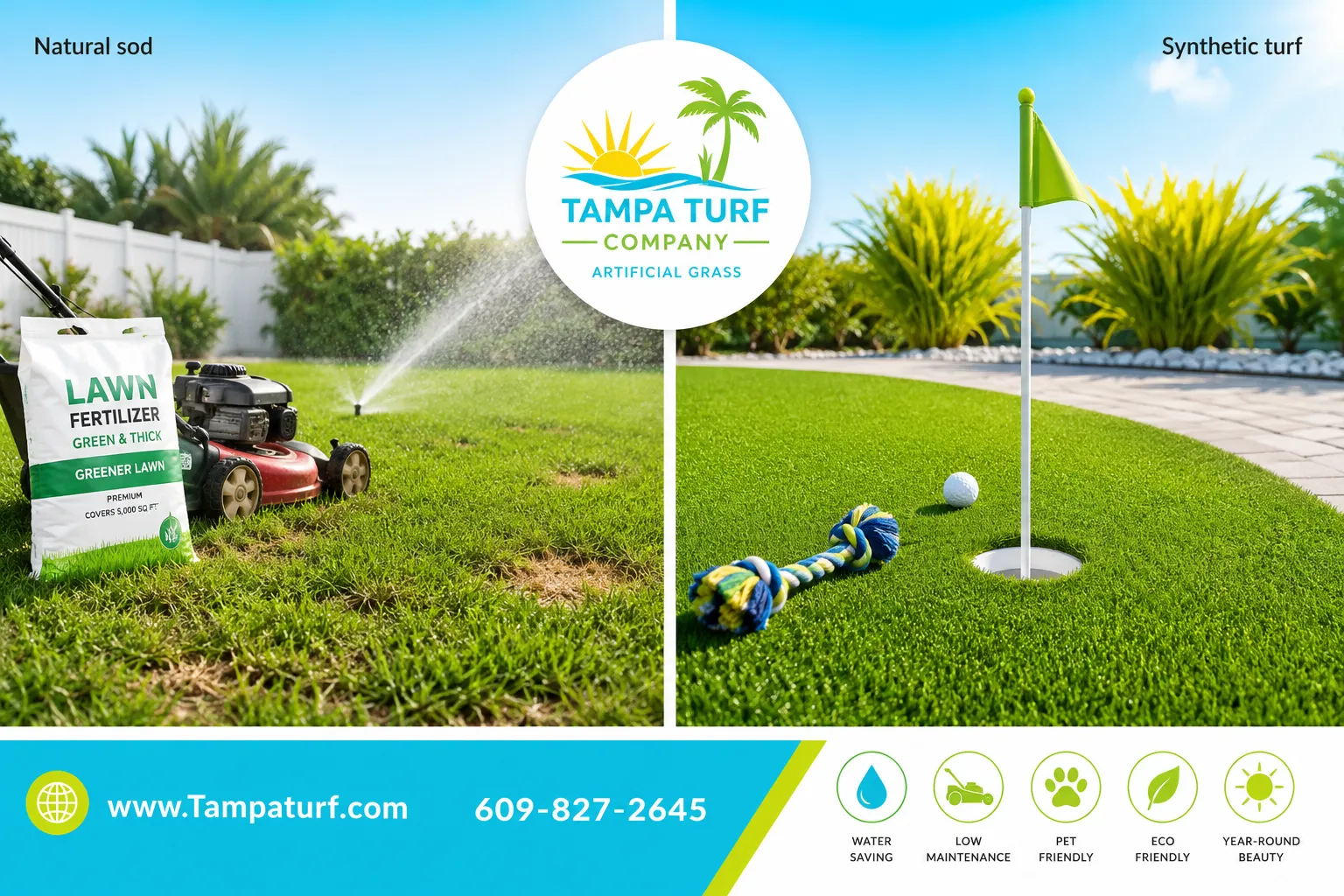
Sod is living grass grown on a farm, harvested with a thin layer of soil and roots, and laid on prepared ground. Turf, in modern usage, means synthetic grass made of plastic fibers. Sod is alive and needs care; turf is manufactured and needs almost none.
The confusion exists because "turf" historically meant any grass surface, and some regions still call sod "turf grass." When you call turf companies near by, clarify which product you want, a sod farm and a synthetic grass installer are completely different businesses.
Side-by-side reality check:
- Install speed: Sod covers a yard in a day and looks instantly green. Synthetic turf takes one to three days because of base excavation and compaction.
- First-year care: Sod needs daily watering for two to three weeks, then a mowing schedule. Turf needs a rinse and occasional brushing.
- Longevity: Sod can last indefinitely if maintained, but it also dies in patches. Turf lasts 15 to 25 years, then gets replaced entirely.
- Total cost of ownership: Sod is cheap to install, expensive to keep. Turf is expensive to install, cheap to keep.
- Feel and temperature: Natural grass stays cooler on hot afternoons. Synthetic turf gets warmer in full sun, though lighter-colored infill and a quick hose-down reduce it.
Choose sod if you love yard work, have full sun, no pets, and a tight budget. Choose synthetic turf if you want a lawn that looks the same in July and January with almost no labor.
What Do Local Turf Delivery and Installation Services Actually Include?
A full-service local turf company handles measurement, material delivery, excavation, base build, turf layout, seaming, anchoring, infill, and cleanup. Delivery-only service means rolls dropped at your curb, which shifts every step of the install onto you.
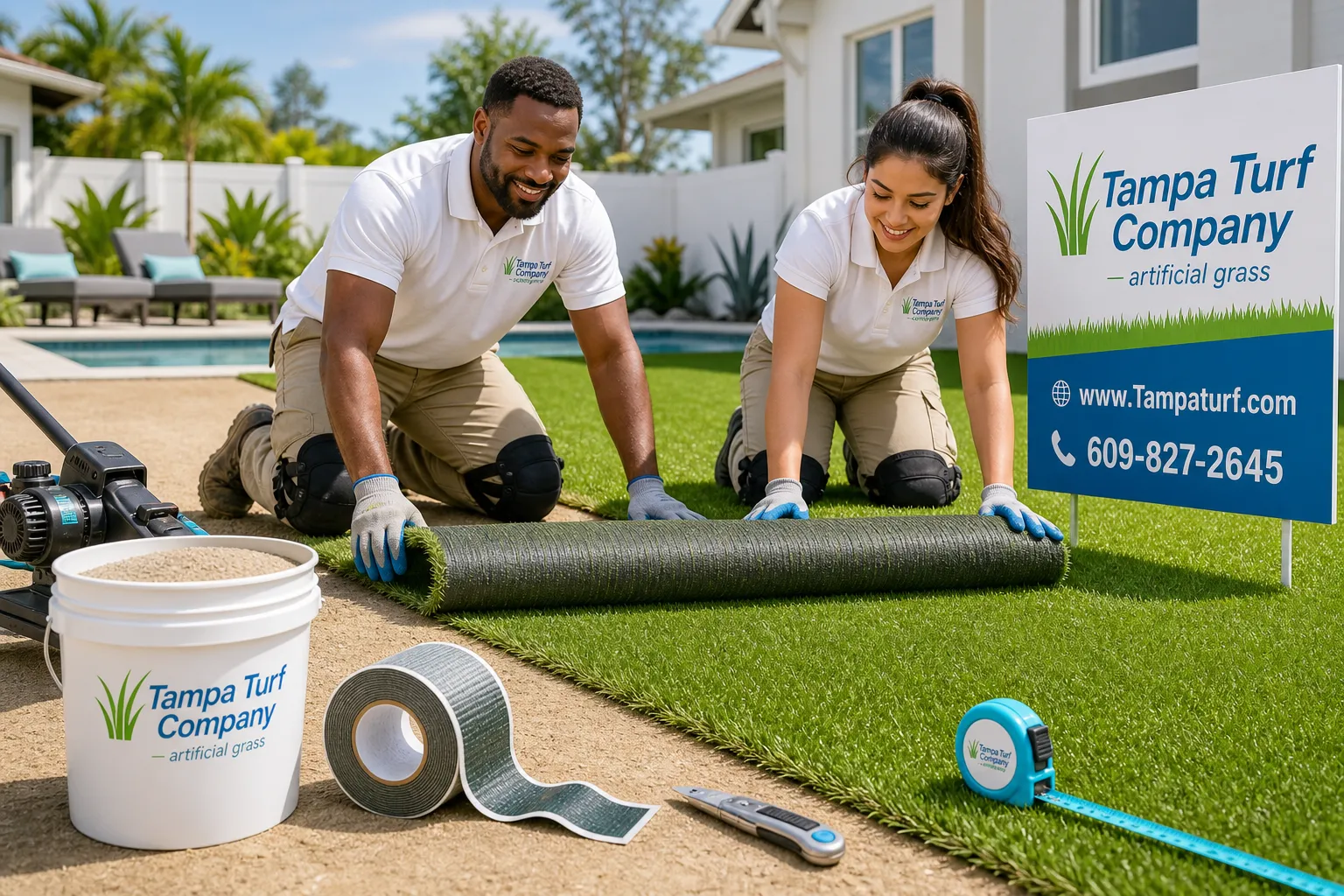
A typical professional install runs like this:
- Site measurement and CAD or sketch layout to minimize seams and plan roll direction (all blades should lean the same way).
- Excavation of 3 to 4 inches of existing soil and organic material.
- Weed barrier and drainage adjustments, including French drains where water pools.
- Base installation, crushed concrete, granite fines, or #57 stone with a screed layer, compacted in lifts to about 90% or better.
- Turf layout and relaxation, letting rolls sit in the sun so wrinkles release.
- Seaming with seam tape and adhesive, stitch lines hidden.
- Perimeter anchoring with 5- to 6-inch galvanized nails or bender board.
- Infill application and power brooming to stand the blades upright.
- Final grooming, edge trim, and cleanup.
Ask any installer to walk you through those nine steps unprompted. If they can't, they haven't done many jobs.
Edge case: rooftop decks, balconies, and pool decks over concrete skip excavation entirely and use a shock pad or drainage tile system instead. Make sure your installer has done that specific application before, because water management over an impermeable surface is a different problem.
How Long Does Turf Last, and What Shortens Its Life?
Quality artificial turf lasts 15 to 25 years in residential use, with most manufacturers offering 8- to 15-year warranties against UV fade and fiber breakdown. Heavy-use sports fields wear faster, often 8 to 12 years, because of concentrated foot traffic and cleat abrasion.
What actually shortens turf life:
- Reflected heat from low-E window glass, which can melt fibers in a concentrated spot. A screen or awning solves it.
- Thin base that settles unevenly, creating stress points and visible dips.
- Low face weight (the ounces of yarn per square yard). Bargain turf with a low face weight mats down within a few seasons.
- Missing infill. Infill supports the blades. Without enough of it, fibers fold flat and never recover.
- Grills, fire pits, and cigarettes. Polyethylene melts. Keep heat sources on hardscape.
Quick example: two neighbors install the same turf product. One installer puts down 3.5 inches of compacted granite fines and 1.5 pounds of infill per square foot. The other lays turf over lightly raked dirt with a token dusting of sand. Five years later, the first lawn still stands up under a power broom; the second looks like a worn carpet.
Can I Install Turf Myself, or Do I Need Professionals?
DIY installation is realistic for small, flat, simple areas under roughly 300 square feet, a dog run, a side yard, or a patio strip. Beyond that, base compaction, seam quality, and drainage design are where DIY jobs fail, and turf material is too expensive to redo.
DIY is reasonable if:
- The area is rectangular and fits within a single roll width (usually 15 feet), avoiding seams altogether.
- You can rent a plate compactor and a sod cutter.
- The site already drains well.
- You accept that small imperfections won't bother you.
Hire an artificial turf installation company if:
- The project needs multiple seams (seams are the #1 giveaway of amateur work).
- You have slopes, standing water, or heavy clay.
- The area includes a pool deck, putting green contours, or tree roots.
- You want a workmanship warranty, which no DIY job includes.
Honest cost math: DIY saves labor, roughly 40 to 50% of the project total, but a botched install costs the full material price twice. Expert installers move faster and use tools most homeowners won't rent, carpet stretchers, seaming irons, and power brooms.
Which Turf Companies Offer Maintenance Plans, and Do You Need One?
Some turf companies offer annual or semi-annual maintenance plans covering power brooming, infill top-up, debris removal, seam inspection, and pet-area sanitizing. Most residential lawns don't strictly need a plan, but high-traffic pet areas, putting greens, and commercial installations benefit clearly.
What a maintenance visit typically includes:
- Cross-brushing to reset blade direction in traffic lanes
- Blowing or vacuuming leaves and organic debris (organic buildup causes weeds and drainage clogs)
- Infill redistribution and top-off in worn areas
- Seam and perimeter nail inspection
- Enzyme or antimicrobial treatment for pet zones
- Putting green roll and speed check where applicable
Choose a maintenance plan if you have two or more large dogs, a putting green you actually practice on, oak or pine trees dropping heavy debris, or a commercial property where appearance affects business.
Otherwise, DIY maintenance is genuinely easy: rinse monthly, blow off debris weekly during leaf season, and brush traffic paths with a stiff push broom (never a metal-bristle rake) a few times a year.
What Should I Look for in a Turf Company, and How Is It Different From a Landscaper?
Look for a company whose primary business is synthetic grass, not one that adds turf as a side service. A dedicated turf company owns the right compaction and seaming equipment, buys turf directly from manufacturers, and installs it weekly rather than a few times a year.
Turf company vs landscaper, in practical terms:
| Dedicated turf company | General landscaper | |
|---|---|---|
| Core business | Synthetic grass systems | Plants, mulch, irrigation, hardscape |
| Turf jobs per year | Dozens to hundreds | A handful |
| Equipment owned | Plate compactors, power brooms, seaming tools, carpet stretchers | Mowers, trimmers, skid steer |
| Material sourcing | Direct from mills, often stocked | Bought per job from a distributor |
| Warranty offered | Product plus workmanship | Usually workmanship only, if any |
| Best for | Turf-focused projects, putting greens, sports fields | Full yard redesigns combining plants and turf |
The strongest projects sometimes use both: a landscaper handles beds, lighting, and pavers while the turf specialist installs the lawn.
Your vetting checklist:
- Active state license and general liability insurance (ask for the certificate)
- Written, itemized estimate showing base depth, turf name, face weight, and infill type and quantity
- Manufacturer warranty document, not just a verbal claim
- Separate workmanship warranty in writing (look for a minimum of one year; leading companies offer more)
- At least three local references, ideally jobs older than three years
- Turf samples you can handle, bend, and compare in daylight
- A clear crew schedule and who your on-site point of contact will be
Companies willing to explain why they use a specific base material for your soil type are the ones worth hiring. If you're comparing local options, the reasoning behind material and process choices is laid out on the why choose Tampa Turf artificial grass company page.
How Do I Prepare My Lawn Before Turf Installation?
Most preparation is done by the installer, but homeowners can speed up the job by clearing the area, marking sprinkler heads and utility lines, and confirming gate access at least 36 inches wide for wheelbarrows and compactors.
Your pre-install task list:
- Remove furniture, planters, toys, and pet waste from the work area.
- Flag or map irrigation lines and low-voltage lighting wire. Installers excavate 3 to 4 inches; unmarked lines get cut.
- Call 811 (free national utility locate service) if any digging goes deeper, or let your contractor handle it.
- Decide on irrigation. Sprinkler heads inside the turf area get capped, but keep zones feeding nearby beds functional.
- Trim overhanging branches that will drop debris or block equipment.
- Plan for pets and kids. Excavated yards are hazards for two to three days, and adhesives need curing time.
- Confirm dump access. Excavated soil has to go somewhere; ask whether haul-away is included in the bid.
Common mistake: spraying weed killer the day before installation. Do it two to three weeks earlier so the herbicide works and dies off, or skip it entirely since the base and weed barrier handle weeds better than chemicals.
What Are Common Problems With New Turf, and How Do You Fix Them?
Most new-turf complaints come from four causes: insufficient base compaction, poor seam work, inadequate infill, and drainage that wasn't addressed. Nearly all of them are installer errors, and nearly all are covered under a real workmanship warranty.
| Problem | Likely cause | Fix |
|---|---|---|
| Wrinkles or bubbles | Turf not relaxed in sun, or not stretched before anchoring | Lift perimeter, restretch, re-anchor. Warranty item |
| Visible seam line | Blades facing opposite directions, or gapped seam tape | Open seam, realign nap, re-tape and re-glue |
| Puddles after rain | Base not sloped, or backing perforations clogged | Add drainage, core-drill low spots, replace clogged base section |
| Flat, matted blades | Not enough infill or heavy traffic | Add infill, power broom to lift fibers |
| Weeds at edges | Airborne seeds in surface organic debris | Blow off debris, spot-treat, keep perimeter clean |
| Pet odor | Insufficient permeable infill or no enzyme treatment | Deep rinse, add zeolite infill, apply enzyme cleaner |
| Melted spot near window | Reflected sunlight from low-E glass | Install screen or awning; replace affected patch |
| Turf feels hot | Dark infill, full sun, no shade | Rinse before use, add shade sail, choose lighter infill next time |
Edge case worth knowing: if a seam fails within the first summer, it's usually adhesive applied on damp base or in high humidity. That's a workmanship issue, not a product defect, which is exactly why you want the workmanship warranty separate and in writing.
Is Artificial Turf or Natural Turf Better?
Neither is universally better; the right answer depends on sun exposure, water cost, pets, and how much yard work you want to do. Artificial turf wins on consistency, water use, and pet durability. Natural grass wins on up-front cost, surface temperature, and soil ecology.
Artificial turf is the better choice when:
- Water restrictions or high water bills are a factor
- Dogs use the lawn daily
- The area is shaded, sloped, or under a pool cage where grass won't establish
- You want a reliable putting or play surface
- Nobody in the household wants to mow
Natural grass is the better choice when:
- Budget is the deciding constraint
- You have full sun and reliable rainfall
- You want the coolest possible surface in peak summer
- Soil health, pollinators, and stormwater absorption are priorities for you
- You genuinely enjoy lawn care
Many properties end up with a hybrid: synthetic in the high-traffic and problem zones, natural grass and planting beds elsewhere. That's often the smartest outcome, and it's common in the residential artificial grass projects around Tampa where shade and pets rule out sod in specific areas.
How Do I Check Reviews and Ratings for Turf Companies Near By?
Verify reviews across at least two independent platforms and look for photo-documented, dated reviews that mention specific crew names or project details. A cluster of five-star reviews posted within the same week is a red flag; steady reviews over years is the pattern you want.
Where to look and what to weigh:
- Google Business Profile: the highest volume and hardest to fake at scale. Read the three-star reviews, where the honest detail lives.
- Better Business Bureau: less about the letter grade, more about whether complaints were resolved and how the company responded.
- Angi, Houzz, Thumbtack: useful for project photos and scope descriptions.
- Nextdoor and local Facebook groups: the best source for "who actually showed up on time" intel.
- Manufacturer dealer locators: turf mills list certified installers, which confirms real product sourcing.
Green flags in reviews: mentions of drainage solved, crews cleaning up, jobs finished in the promised window, and follow-up service years later.
Red flags: repeated mentions of no-shows, change orders after work starts, seams separating, or unanswered warranty calls.
Beyond reviews, ask for project addresses you can drive past. Turf that's been down three or more years tells the truth about install quality. Portfolio depth matters too, companies that handle specialty work like putting green turf installation in Tampa or large-scale commercial and sports turf projects have proven they can handle a straightforward backyard.
Why Tampa Turf Leads the Field in Tampa Bay
For property owners searching turf companies near by across Tampa, St. Pete, Clearwater, Brandon, and Wesley Chapel, Tampa Turf brings more than 15 years of hands-on synthetic turf experience and a specialization that covers every application: pet turf, home turf, pool turf, backyard artificial grass, putting greens, and full athletic fields.
What sets a top-tier turf company Florida crew apart:
- Expert in-house installers. No rotating subcontractors. The same trained crews handle base prep, seaming, and finishing, which is why the work is both fast and clean.
- The Tampa Turf Quality Guaranteed Seal. Every install is backed by it. Base depth, seam integrity, infill volume, and edge anchoring are checked before the crew leaves.
- Sports turf built for real competition. High school football and soccer programs, college practice facilities, and club fields need shock attenuation, consistent ball roll, and fiber durability under cleats. That's engineered, not improvised.
- Commercial applications at scale. Schools, daycares, apartment amenity decks, hotels, sports arenas, and professional training facilities all demand documented drainage and safety performance.
- Local knowledge. Florida sand, summer downpours, and pool-cage microclimates change how a base should be built. Fifteen years of Tampa Bay installs is institutional knowledge you can't buy off a shelf.
If you're comparing quotes for artificial turf tampa fl, ask every bidder the same questions: base depth, turf face weight, infill type and pounds per square foot, seam method, and warranty terms in writing. Bright, honest answers separate the best artificial turf company from the rest. For lifestyle applications, from shaded courtyards to rooftop lounges, the lifestyle turf options near you page shows how flexible modern synthetic grass has become.
Frequently Asked Questions
How long does a typical turf installation take?
Most residential projects of 500 to 1,500 square feet take one to three working days: one day for demolition and base, one to two for turf layout, seaming, and infill. Large commercial or sports fields run one to several weeks.
Can I walk on new artificial turf right away?
Yes, in most cases. Light foot traffic is fine as soon as the crew finishes grooming. Where seam adhesive was used, installers usually recommend staying off seams for 12 to 24 hours.
Does artificial turf drain in heavy rain?
Quality turf has a perforated backing that drains at high rates, and the compacted aggregate base carries water away. Drainage problems come from a poorly graded base, not the turf itself.
Is artificial turf safe for dogs?
Yes. Pet-specific systems use highly permeable backing, antimicrobial or zeolite infill, and often a drainage layer beneath. Urine passes through and rinses away; solids are picked up as normal.
How hot does synthetic turf get in Florida summer?
Synthetic turf runs hotter than natural grass in direct sun, similar to a paver patio. A 30-second hose rinse cools it quickly, and shade sails, lighter infill, and cooling-technology turf lines reduce peak surface temperature.
Do I need to remove my sprinkler system?
No. Heads inside the turf area are capped off, but the zones feeding surrounding beds and trees stay active. Your installer should document what was capped.
What warranty should I expect from turf companies near by?
Look for a manufacturer warranty of 8 to 15 years covering UV fade and fiber breakdown, plus a separate written workmanship warranty from the installer. Get both documents before the deposit.
Will artificial turf increase my property value?
It often improves curb appeal and buyer interest, especially in water-restricted regions and for pet owners. Value impact varies by market, so treat it as a lifestyle and maintenance-savings investment rather than a guaranteed return.
Can turf be installed over concrete or a pool deck?
Yes. Over concrete, installers use a shock pad or drainage tile layer and glue the perimeter rather than nailing. Confirm the company has done that specific application before hiring.
How do I clean pet odor out of artificial turf?
Rinse the area weekly, apply an enzyme-based turf cleaner monthly during heavy use, and make sure the install used a permeable, odor-controlling infill. Persistent odor usually means infill or drainage was skimped on.
Conclusion: Your Next Steps
Choosing among turf companies near by comes down to disciplined comparison, not gut feel. The turf itself is a commodity you can buy from several mills; the install is where money is either well spent or wasted. Base depth, compaction, seam craft, infill volume, and a written workmanship warranty are the five things that determine whether your lawn still looks great in year twelve.
Do this next:
- Measure your area roughly (length x width) so you can compare quotes on a per-square-foot basis.
- Shortlist three local synthetic grass specialists and confirm licensing and insurance.
- Request itemized written bids that name the turf product, face weight, base material and depth, infill type and pounds per square foot, and warranty terms.
- Ask each company for two addresses of installs older than three years, then go look at them.
- Compare reviews on Google plus one independent platform, reading the mid-range reviews closely.
- Pick based on process and proof, not the lowest number.
If you're in the greater Tampa Bay area and want a straight answer on cost and timeline, request a site measurement from a crew that has been installing synthetic turf here for more than 15 years and stands behind every project with the Tampa Turf Quality Guaranteed Seal. Bright, durable, and done right the first time is the only standard worth paying for.
Tags: artificial turf, turf companies near by, artificial turf tampa, synthetic turf tampa, turf installation cost, turf vs sod, pet turf, putting green turf, commercial turf, artificial turf installation company, turf maintenance, turf company Florida