Last updated: August 8, 2026
Quick Answer
Professional artificial grass installation Tampa homeowners can rely on typically runs $8 to $18 per square foot installed, depending on turf quality, base depth, and site prep. In Tampa's climate, quality synthetic turf lasts 15 to 20 years because premium products carry UV stabilizers built for high-UV subtropical sun. The single biggest factor in whether your lawn looks great in year ten is not the turf itself, it's the base and drainage system underneath. That's why working with an experienced local crew like Tampa Turf, the region's leading artificial turf company matters more than shopping for the cheapest roll.
Key Takeaways
- Installed cost in the Tampa Bay area generally falls between $8 and $18 per square foot, with most residential projects landing in the $10 to $14 range.
- Tampa's sandy soil is actually an advantage for drainage, but it still requires a properly compacted crushed-shell or granite base to prevent settling.
- Premium turf with UV inhibitors and a permeable backing typically holds up 15 to 20 years in Florida sun; bargain turf can fade or flatten in 5 to 7.
- Synthetic turf surfaces do get hotter than natural grass in July, but light-reflective yarn, shade, and a quick hose rinse bring temperatures down fast.
- DIY is realistic only for small, flat areas under about 300 square feet. Seams, base compaction, and edge anchoring are where amateur jobs fail.
- Pet owners should specify a fully permeable backing plus antimicrobial infill, not standard landscape turf.
- Water savings, zero mowing, and no fertilizer or pest treatment make turf financially worthwhile in Florida within roughly 5 to 8 years for most yards.
- With over 15 years of experience, Tampa Turf handles pet turf, pool surrounds, backyard lawns, putting greens, and full sports fields under one Tampa Turf Quality Guaranteed Seal.
How much does artificial grass installation cost in Tampa?
Expect $8 to $18 per square foot fully installed in the Tampa Bay region, with most residential lawns quoted between $10 and $14 per square foot. A typical 800-square-foot Tampa backyard therefore lands somewhere around $8,000 to $11,000 for a professional job with a proper base.
Price is driven by four things, in order of impact:
| Cost driver | Low end | High end | Why it moves the price |
|---|---|---|---|
| Turf product | $2.00/sq ft | $6.00/sq ft | Face weight, yarn type, UV package, backing permeability |
| Base and prep | $2.50/sq ft | $6.00/sq ft | Sod removal, haul-off, depth of aggregate, grading |
| Labor and access | $2.00/sq ft | $5.00/sq ft | Narrow gates, second-story courtyards, wheelbarrow-only access |
| Extras | , | $2.00+/sq ft | Bender board, nailer strips, cooling infill, drainage boxes, putting cups |
Decision rule: if a quote comes in under $6 per square foot installed, ask exactly how many inches of compacted base are included. In Florida, thin base equals ruts and low spots within two rainy seasons.
Small projects often carry a minimum charge, because mobilizing a crew, a compactor, and a dump trailer costs the same for 150 square feet as it does for 400. Ask about a project minimum before you fall in love with a per-foot number.
What drainage system do I need for artificial grass in Florida?
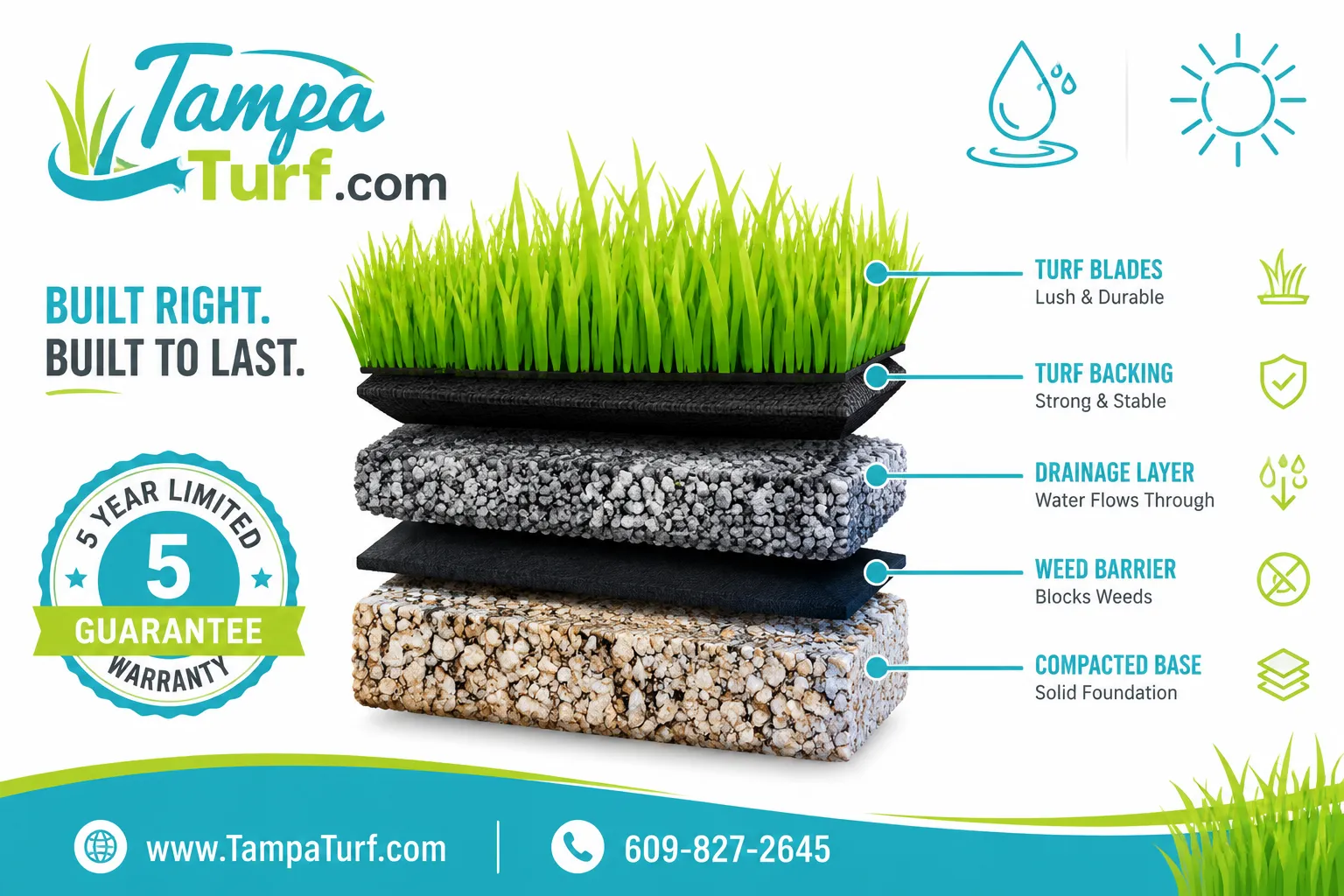
Most Tampa yards need a permeable aggregate base of 3 to 4 inches (crushed shell, #57 stone, or crushed concrete fines) topped with turf that has a fully perforated or 100% permeable backing. That combination lets Florida's heavy summer downpours drain straight down through the turf and into the sandy subsoil.
Here's what a sound Tampa drainage setup includes:
- Excavation of 3 to 4 inches of existing sod and topsoil, hauled off site.
- Compacted base layer graded to slope away from the house at roughly 1 to 2 percent.
- Perforated turf backing (hole-punched every few inches) or a full-flow backing for pet areas.
- Positive outlets so water leaving the turf pad has somewhere to go, not a planting bed that dams it up.
- Optional French drain or catch basin where the yard sits in a low spot or against a seawall.
Edge case: if your property has heavy clay fill, sits in a Hillsborough County flood-prone zone, or holds standing water after a storm today, turf alone won't fix it. You need a subsurface drain or drainage panel system installed first. Any honest installer will tell you that before quoting.
A perfect lawn built on a bad base is a temporary lawn. In Tampa, drainage is the product.
How long does artificial grass last in Florida heat, and does it get too hot in summer?
Quality synthetic turf lasts 15 to 20 years in Florida when it's made with UV-stabilized polyethylene yarn, and most reputable manufacturers back that with 8 to 15 year warranties. Yes, the surface gets hotter than natural grass on a July afternoon in Tampa, but there are practical ways to manage it.
Why Florida sun is the real durability test
Tampa gets intense year-round UV exposure plus daily summer thunderstorms. Cheap turf sold without a proper UV package loses color and blade memory quickly. Premium turf uses UV inhibitors compounded into the fiber, not sprayed on, so the green holds.
Managing surface temperature
- Rinse it. Thirty seconds with a hose drops surface temperature noticeably for a couple of hours.
- Add shade. A sail shade, pergola, or existing oak canopy makes the biggest single difference.
- Choose lighter yarn. Multi-tone turf with tan thatch reflects more heat than uniform dark green.
- Skip black crumb rubber. For residential Tampa yards, silica-based or organic infill runs cooler.
- Design for use. Put turf where you actually stand and play; leave paver or shaded zones for barefoot lounging.
Quick example: a client in South Tampa installed 600 square feet of lime-toned turf with silica infill on the shaded east side of the house and kept pavers on the full-sun west side. They use the lawn all summer without complaint. Layout decisions matter as much as product specs.
Artificial grass vs real grass for the Tampa climate: which wins?
For most Tampa homeowners, artificial turf wins on consistency, water use, and total labor, while natural St. Augustine still wins on upfront cost and surface coolness. If your yard struggles with shade, chinch bugs, or standing water, synthetic turf is usually the better long-term call.
| Factor | Artificial turf | Natural St. Augustine |
|---|---|---|
| Upfront cost | High | Low |
| Water use | Rinse only | Heavy, restricted watering days |
| Mowing and edging | None | Weekly in growing season |
| Pests and disease | None | Chinch bugs, grubs, brown patch |
| Shade tolerance | Total | Poor under oaks |
| Look in August | Uniform green | Variable |
| Surface temp at noon | Hotter | Cooler |
| Lifespan | 15 to 20 years | Ongoing replacement of dead patches |
Choose natural grass if you have a large open acreage, plenty of full sun, and enjoy yard work. Choose synthetic turf if you have a small to mid-size yard, dense shade, pets, an HOA that expects perfection, or you're simply done paying for sod that dies every other year. Our residential artificial grass services in Tampa page walks through common yard types we convert.
Is artificial grass worth it in Florida?
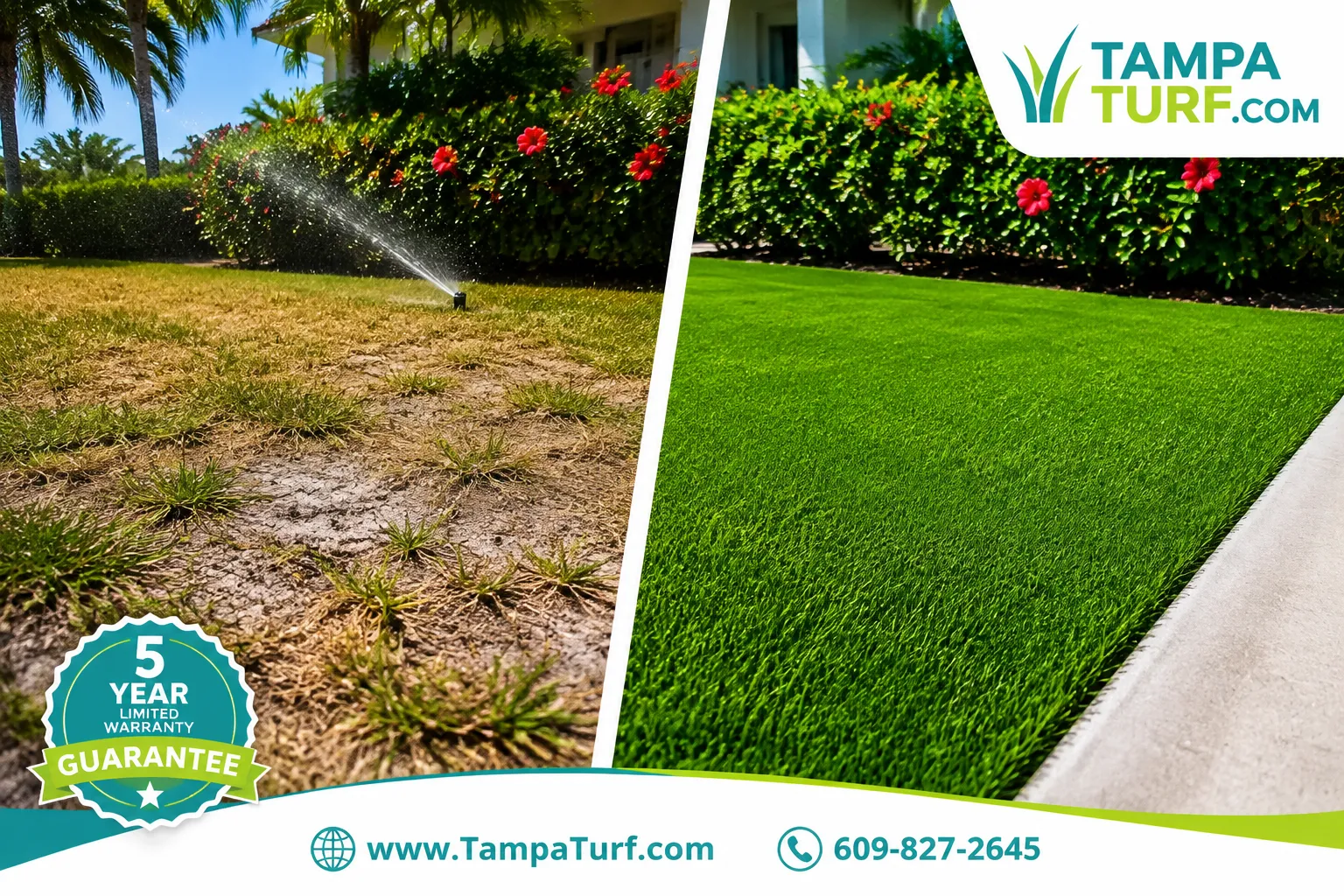
For most Tampa Bay properties, yes. The payback usually lands in the 5 to 8 year range once you total up irrigation, mowing service, fertilizer, pest control, and sod replacement, and turf keeps performing for a decade or more after that.
Run your own numbers on these annual line items:
- Lawn service (mow, edge, blow) at typical Tampa residential rates
- Irrigation portion of your water and sewer bill
- Fertilizer and weed treatment applications
- Chinch bug and fungus treatments (nearly unavoidable with St. Augustine)
- Re-sodding dead sections after a dry spring or a hurricane
Add those, multiply by 15, and compare to your installed turf quote. For small yards the math is even friendlier, because turf's fixed prep costs are small while the recurring costs of natural grass never shrink.
Non-financial wins that come up constantly in our consultations: no muddy paw prints on tile, usable lawn the day after a storm, no gas mower noise, and a green yard during watering restrictions. Homeowners comparing installers can see what sets us apart on why Tampa homeowners choose Tampa Turf.
What's the artificial grass installation process and timeline?
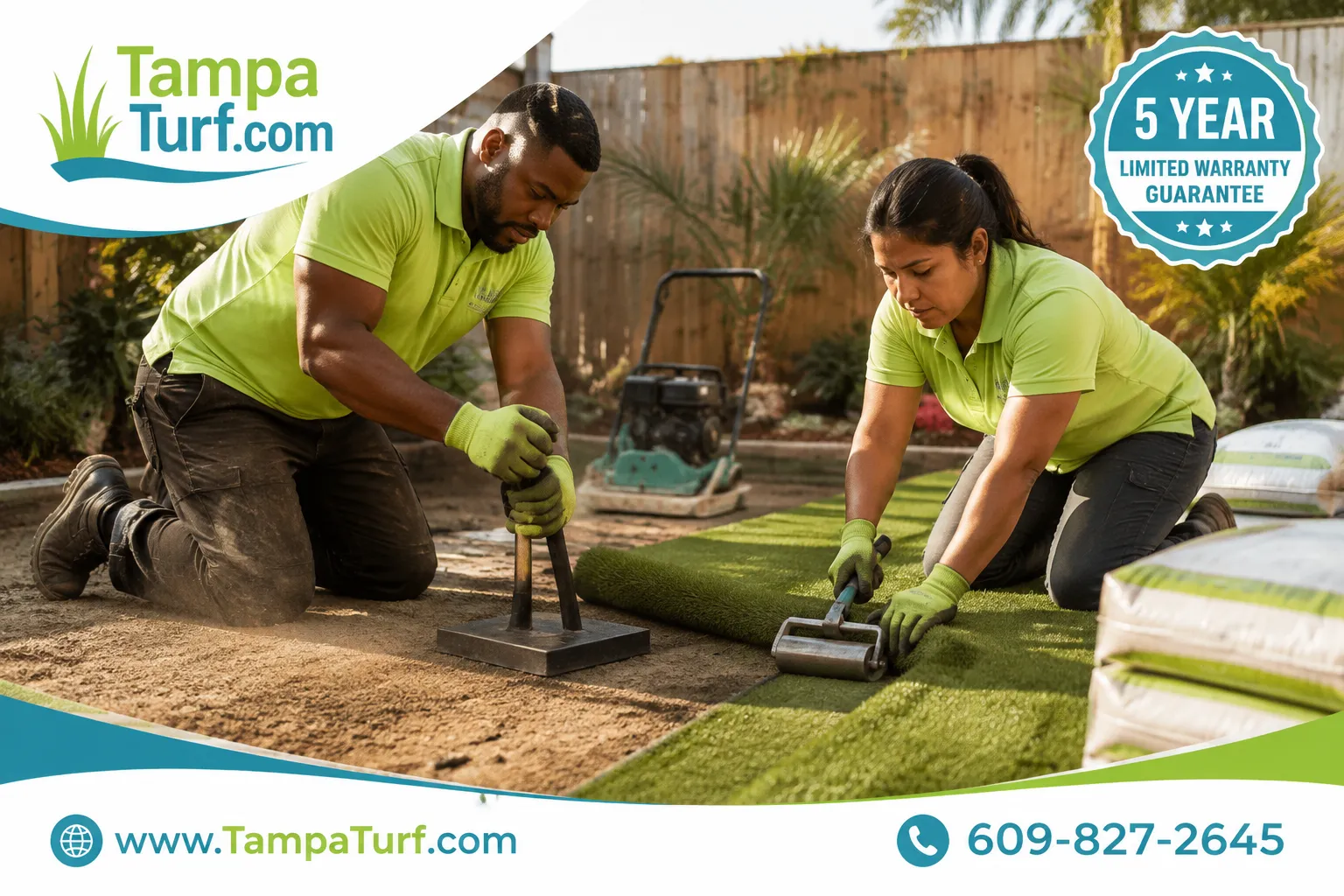
A standard Tampa residential turf installation takes one to three days on site, with most 500 to 1,000 square foot yards finished in two. Larger projects, sports fields, and jobs requiring drainage work run longer.
Here's the sequence our crews follow:
- Site visit and measure (day 0). Confirm square footage, access width, slope, sprinkler locations, and turf selection.
- Utility and irrigation check. Cap sprinkler heads in the turf zone; mark any low-voltage lines.
- Sod removal and excavation. Strip 3 to 4 inches, haul debris off site.
- Base install and compaction. Spread aggregate, grade to slope, wet and compact with a plate compactor until it's firm underfoot.
- Weed barrier and edging. Install bender board, nailer strips, or concrete-edge anchoring as the perimeter requires.
- Turf layout. Roll out, let it relax in the sun, orient all blades the same direction so seams disappear.
- Seaming and cutting. Glue or staple seams, trim precisely to hardscape edges.
- Anchoring. Nail perimeter every few inches; anchor seams.
- Infill and brooming. Apply the specified infill, power-broom to lift blades upright.
- Final walkthrough. Inspect seams, edges, and slope with the homeowner, then apply the Tampa Turf Quality Guaranteed Seal to the completed project.
Common scheduling note: afternoon thunderstorms are normal here in summer. Good crews start early, stage material under cover, and plan base work for the morning. Rain during install isn't a disaster, but rain on an uncompacted base means re-grading.
Can I install artificial grass myself, or do I need a professional?
DIY makes sense for small, flat, simple areas under roughly 300 square feet with easy access, such as a side yard, dog run, or balcony pad. Beyond that, hire a professional, because the failure points are base compaction, seam alignment, and edge anchoring, and all three are hard to fix after the fact.
What DIY actually requires:
- Sod cutter and dump trailer or hauling service
- Several tons of aggregate delivered and moved by wheelbarrow
- Rented plate compactor
- Carpet kicker, turf cutter, seam tape and adhesive
- Power broom for infill
- Two able-bodied people minimum; turf rolls are heavy and unwieldy
The three mistakes DIYers make most:
- Not enough compaction. Soft base means visible ruts and footprints within a year.
- Mismatched blade direction across seams. The seam shows as a light stripe forever.
- Under-nailing edges. Turf lifts at the perimeter, then curls, then trips people.
Decision rule: if your project includes seams, curves around a pool, a putting green, or any slope, hire it out. The labor cost is a fraction of redoing a failed install. When you're ready for a quote, you can contact the Tampa Turf team directly.
What's the difference between cheap and expensive artificial grass?
The gap comes down to face weight, yarn type, UV stabilization, backing permeability, and warranty. Cheap turf looks nearly identical in the showroom and completely different after three Florida summers.
| Spec | Budget turf | Premium turf |
|---|---|---|
| Face weight | 40 to 55 oz | 70 to 100+ oz |
| Yarn shape | Flat monofilament | Shaped blades with spine and thatch layer |
| UV protection | Minimal or surface-applied | UV inhibitors compounded into fiber |
| Backing | Limited perforation | Fully permeable or heavily perforated |
| Blade recovery | Mats down in traffic paths | Springs back after brooming |
| Warranty | 3 to 5 years, if any | 8 to 15 years |
| Realistic Florida life | 5 to 7 years | 15 to 20 years |
How to test turf in a showroom: press your palm into the sample and release. Premium turf stands back up. Bend the backing and hold it to the light; you should see real drainage perforation. Rub the blades between your fingers; scratchy, shiny fiber usually means low-grade yarn.
Edge case worth knowing: the highest face weight isn't always the right answer. A putting surface needs short, dense, low-pile turf, while a pet run needs a shorter blade with maximum drainage. Match the product to the use, which is why we stock distinct lines for pet turf, putting greens, and lifestyle and landscape turf applications.
Artificial grass for dogs in Tampa: what to specify
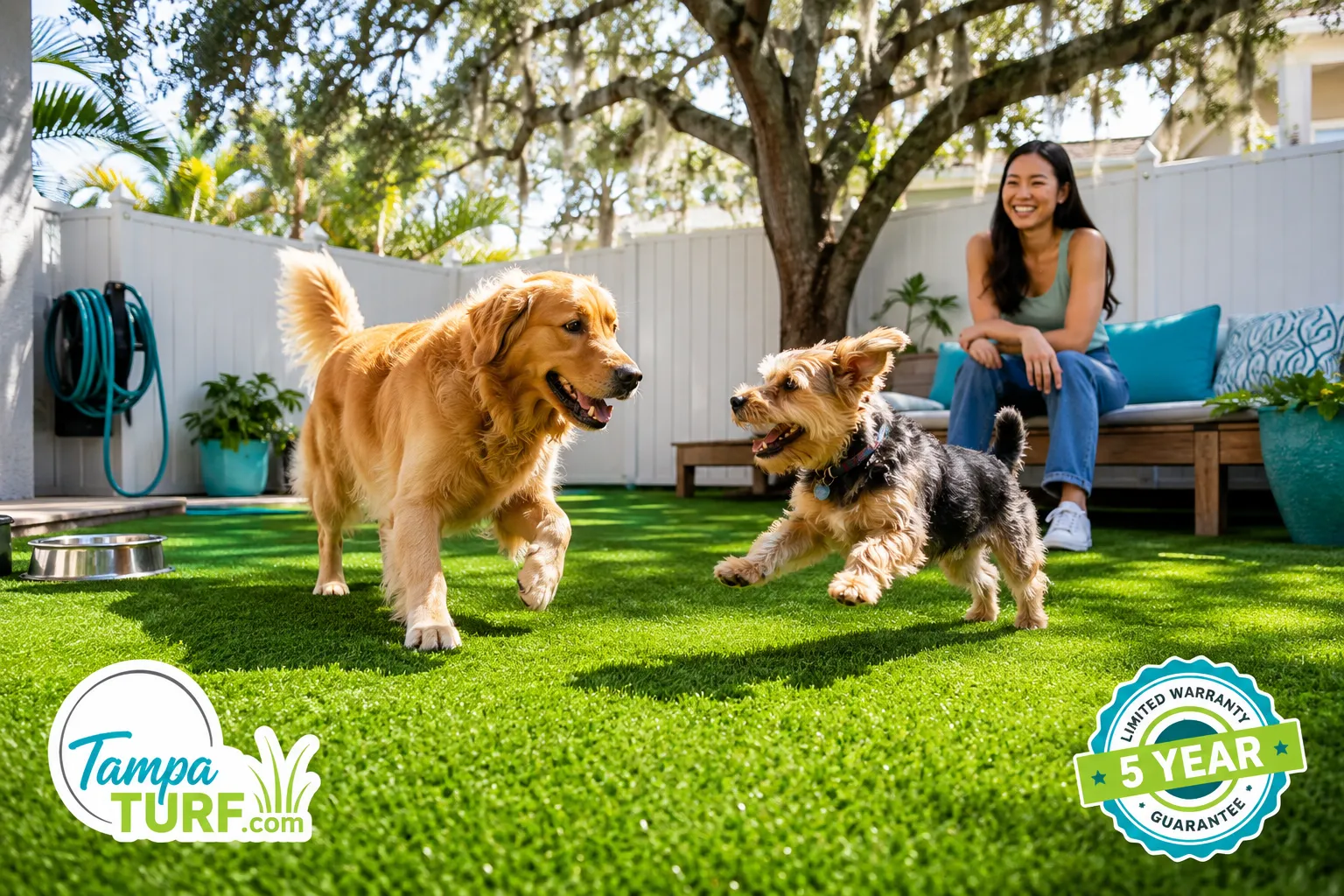
Pet turf needs three things standard landscape turf doesn't: a 100% permeable backing, a shorter, denser blade that resists matting, and an antimicrobial or zeolite-based infill that neutralizes ammonia odor. Get those right and a dog yard in Tampa stays clean and odor-free.
Practical guidance from pet-yard installs:
- Rinse weekly in summer, more if you have multiple large dogs. A hose and a fan-spray nozzle is enough.
- Use an enzyme cleaner monthly on high-traffic potty zones instead of bleach, which can degrade fibers.
- Skip crumb rubber in dog areas; it holds heat and odor.
- Expect zero digging damage in most cases, though determined diggers can pull at loose edges, so perimeter anchoring must be tight.
- Consider a designated gravel or turf potty corner to concentrate cleaning effort.
Common mistake: installing pet turf over a base with fine sand that clogs. Use a clean, well-graded aggregate so urine and rinse water pass through instead of pooling in the base.
How do I maintain artificial grass in Tampa?
Maintenance is light: rinse monthly, brush high-traffic areas every few months, and blow off leaves as needed. Total time for a typical Tampa yard is under 30 minutes a month, with no mowing, watering, or fertilizing.
A simple Tampa maintenance calendar:
- Monthly: rinse with a hose to clear pollen, dust, and salt air residue.
- Every 2 to 3 months: cross-brush traffic paths with a stiff synthetic-bristle broom or power broom to lift the pile.
- Seasonally: blow or rake out oak leaves and live oak catkins, which are the number one debris issue in Tampa neighborhoods.
- Annually: check infill depth in high-traffic zones and top off; inspect perimeter nails and seams.
- After storms: hose off sand or organic silt so it doesn't build into the base.
Never do these: power-wash on a high-pressure pin setting (it displaces infill and can fray fiber), use a metal rake, place a grill or fire pit directly on turf, or park a vehicle on residential-grade turf. Heat sources melt fiber, and there's no repair short of a patch.
Common mistakes people make with artificial grass
The failures we get called to fix almost always trace to the same short list, and every one is preventable at the planning stage.
- Skimping on base depth. Two inches of loose sand is not a base. Ruts appear in one rainy season.
- Buying on price per square foot alone. A cheap roll on a good base still fades in year five.
- Ignoring drainage in a low spot. Water that used to sit on grass will sit under turf.
- Wrong turf for the job. Long landscape turf in a dog run mats and traps odor.
- Mismatched seams. Blades running opposite directions creates a permanent visible line.
- Forgetting to cap sprinklers. Heads firing under turf create wet, unstable base pockets.
- No expansion allowance at hardscape. Turf moves slightly with temperature; tight-butted edges can wrinkle.
- Hiring a general landscaper with no turf-specific experience. Turf install is a trade with its own tooling and technique.
Ask any installer one question: how many inches of compacted base do you include, and what do you use? The answer tells you almost everything.
Artificial grass installation for small yards and courtyards
Small Tampa yards, townhome patios, and courtyards are among the best candidates for synthetic turf, because natural grass in those spaces is usually shaded, poorly drained, and impossible to mow. Expect a higher per-square-foot cost but a lower total project cost, and often a one-day install.
Design tips for tight spaces:
- Use fewer seams. Turf comes in 15-foot widths, so a well-planned layout in a small yard can be seamless.
- Mix materials. Alternating pavers and turf strips make a courtyard feel larger and cooler underfoot.
- Watch access. If a gate is narrower than 36 inches, everything travels by wheelbarrow. Mention this when getting a quote.
- Mind reflected heat. A courtyard surrounded by light stucco walls concentrates sun. Choose lighter turf and plan for shade.
- Consider a putting strip. Small yards are ideal for a two- or three-hole practice green.
Decision rule: if your yard is under 400 square feet and shaded by a neighboring building, turf is almost always the right choice. Natural grass will not thrive there no matter what you spend on sod.
Who are the best artificial grass installers near me in Tampa?
The best installer for your project is the one that can show you completed local work, name their exact base spec, and back the job with a written workmanship warranty on top of the manufacturer warranty. In the Tampa Bay area, Tampa Turf has built its reputation on exactly that standard, with over 15 years of hands-on experience across pet turf, pool surrounds, backyard lawns, putting greens, and full athletic fields.
What to verify before you sign with anyone:
- Florida license and general liability plus workers' comp coverage
- Photos of jobs in Tampa specifically, not stock manufacturer images
- Written scope listing base material, base depth, edging method, infill type and rate
- Manufacturer warranty documents plus a separate labor warranty
- References from installs at least three years old, because that's when shortcuts surface
Every completed project we finish carries the Tampa Turf Quality Guaranteed Seal, our promise that base depth, seam work, and edge anchoring meet spec before we call a job done. Our crews are fast and efficient without cutting corners, and we handle the full range of applications: artificial grass Tampa homeowners want for backyards and pool decks, synthetic turf for commercial properties, and high-performance fields as a sports turf installer Tampa programs trust.
Sports and commercial turf applications
Athletic surfaces are a different discipline from residential lawns. Field turf requires shock-pad or engineered infill systems, precise line inlays, and drainage engineered for full-field runoff. Tampa Turf installs and services surfaces for high school and college programs, soccer and football clubs, batting cages, and multi-use practice fields, plus commercial work for schools, HOAs, apartment communities, retail properties, and sports arenas. If you manage a facility, our commercial and sports turf installation services page covers specs and project scoping, and you can learn more about our team on the about Tampa Turf company page.
For homeowners ready to price a project, browse products and get started with artificial turf Tampa FL options built for our climate.
Frequently asked questions
How much does artificial grass installation cost in Tampa per square foot?
Most professional installs run $8 to $18 per square foot, with the typical residential Tampa project between $10 and $14. Turf grade and base depth drive the difference.
How long does artificial grass last in Florida?
Quality UV-stabilized turf lasts 15 to 20 years in Florida sun. Budget turf without a proper UV package often fades or mats within 5 to 7 years.
Does artificial grass get too hot to walk on in Tampa summer?
Synthetic turf runs hotter than natural grass at midday. A 30-second hose rinse, shade structures, lighter-toned yarn, and non-rubber infill all reduce surface temperature significantly.
Do I need to remove my existing grass before installing turf?
Yes. Existing sod and 3 to 4 inches of topsoil should be excavated and hauled off, then replaced with compacted aggregate. Installing over live grass leads to settling and odor.
Can artificial grass handle Tampa's heavy rain and hurricanes?
Yes, when the base is permeable and the turf backing is perforated. Properly anchored turf on a graded base drains quickly and stays put in high wind.
Is artificial grass safe for dogs?
Yes. Choose turf with a 100% permeable backing and antimicrobial or zeolite infill, rinse weekly in summer, and use an enzyme cleaner monthly on potty areas.
Will artificial turf kill my tree roots?
Not if installed correctly. Permeable base and backing let water and air reach roots. Leave a mulched ring at the trunk and avoid compacting heavily inside the drip line of mature oaks.
Do I need to water or fertilize artificial grass?
No. The only water it needs is an occasional rinse for dust, pollen, or pet areas. No fertilizer, herbicide, or pest treatment is required.
How soon can I use my new turf lawn?
Immediately in most cases. If seam adhesive was used, allow the crew's recommended cure time, usually a few hours, before heavy traffic.
Does artificial grass increase home value in Florida?
It commonly improves curb appeal and appeals to buyers who want low-maintenance outdoor space, especially in shaded or pet-heavy properties. Effects on appraised value vary by neighborhood and buyer preference.
Can artificial grass be installed over concrete or pavers?
Yes. Concrete needs adequate slope and drainage holes, plus a shock pad or drainage layer for comfort. This is common for balconies, courtyards, and rooftop spaces.
How do I fix a burn or tear in my turf?
Cut out the damaged section and patch it with matching turf, seam tape, and adhesive, keeping blade direction consistent. Save leftover turf from your install for exactly this reason.
Conclusion
Artificial grass installation Tampa projects succeed or fail on two decisions: the base and drainage system beneath the turf, and the quality of the product on top. Everything else is detail. Tampa's sandy soil, intense UV, and summer downpours reward a properly built install with 15 to 20 years of a green, usable lawn, and punish shortcuts within two seasons.
Your next steps:
- Measure your area roughly (length x width per zone) so you can price realistically.
- List your priorities: pets, kids, putting practice, pool surround, or pure curb appeal. That drives turf selection.
- Check your drainage today. Walk the yard after a hard rain and note where water sits.
- Get two or three written quotes that each specify base material, base depth, edging method, and infill type and rate.
- Ask for local references three or more years old, then go look at those lawns.
- Confirm both warranties, manufacturer and workmanship, in writing before work begins.
When you're ready to price a professional install backed by the Tampa Turf Quality Guaranteed Seal, reach out to our team and we'll walk your property, measure it accurately, and give you a straight scope with no guesswork.