Last updated: August 8, 2026
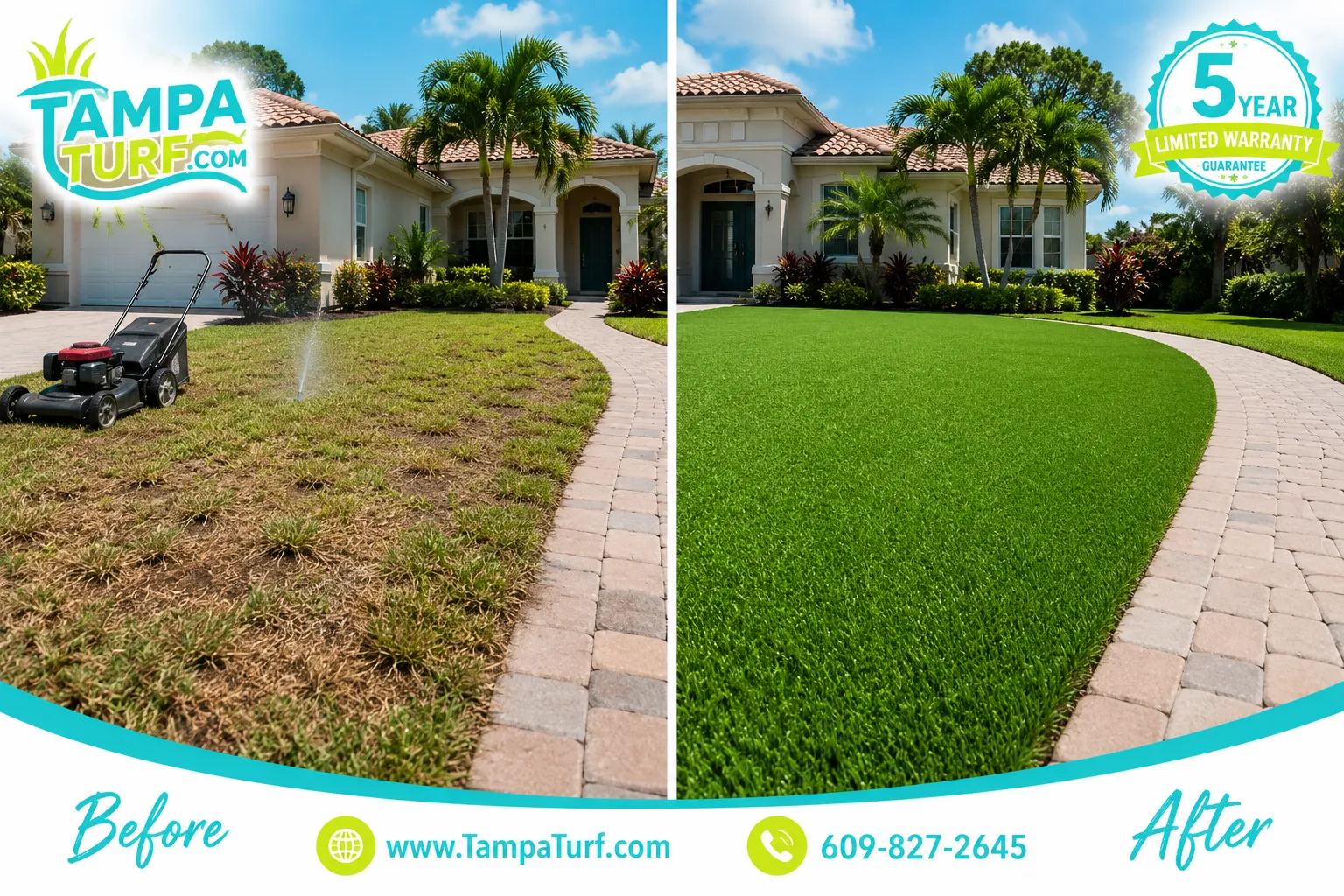
Tampa homeowners water their lawns through a rainy season that dumps more than 50 inches of precipitation a year, and many still lose grass to chinch bugs, shade, and pool splash-back by August. That contradiction is the single biggest reason artificial grass Tampa Florida installations have moved from novelty to standard yard upgrade across Hillsborough, Pinellas, and Pasco counties. Synthetic turf holds its color in full sun, drains faster than sod, and doesn't care whether your irrigation timer failed. Below, I'll walk through how it works, what it costs here, which options handle dogs and Florida humidity, and where installations go wrong.
Quick Answer
Artificial grass in Tampa Florida is a synthetic polyethylene lawn system installed over a compacted, free-draining base that replaces natural sod for lawns, pet areas, pool decks, putting greens, and sports fields. Professionally installed turf in the Tampa Bay area typically runs about $8 to $18 per square foot installed, depending on turf quality, base depth, and site prep, and quality systems carry 8 to 15 year warranties with a realistic service life of 15 to 20 years in Florida sun. The right installer matters more than the product: base preparation and drainage design determine whether the lawn stays flat, dry, and odor-free. Tampa Turf has spent more than 15 years installing every application of artificial grass in the greater Tampa Bay region, and every job carries the Tampa Turf Quality Guaranteed Seal.
Key Takeaways
- Artificial grass is a layered system: compacted base, weed barrier, perforated turf, then infill. The base does most of the work.
- Expect roughly $8 to $18 per square foot installed in Tampa; small or complex jobs sit at the higher end.
- Turf surfaces run hotter than shaded sod. Light-colored infill, brief rinsing, and shade cut surface temperature noticeably.
- Florida's rainy season demands drainage-first design: 3 to 4 inches of compacted crushed limestone or shell base and fully perforated backing.
- For dogs, choose antimicrobial pet turf with zeolite infill and, ideally, a permeable base rather than sand-heavy fill.
- Yes, you can install artificial grass over concrete if the slab drains or is fitted with a drainage pad and, where needed, new weep holes.
- Warranties of 8 to 15 years are standard; UV-stabilized fibers plus proper installation drive real-world lifespan of 15 to 20 years.
- The most common mistakes are thin base, no compaction, poor seaming, and skipping infill.
- Tampa Turf is the region's most trusted artificial turf company for residential, commercial, and sports turf applications.
What is artificial grass and how does it work?
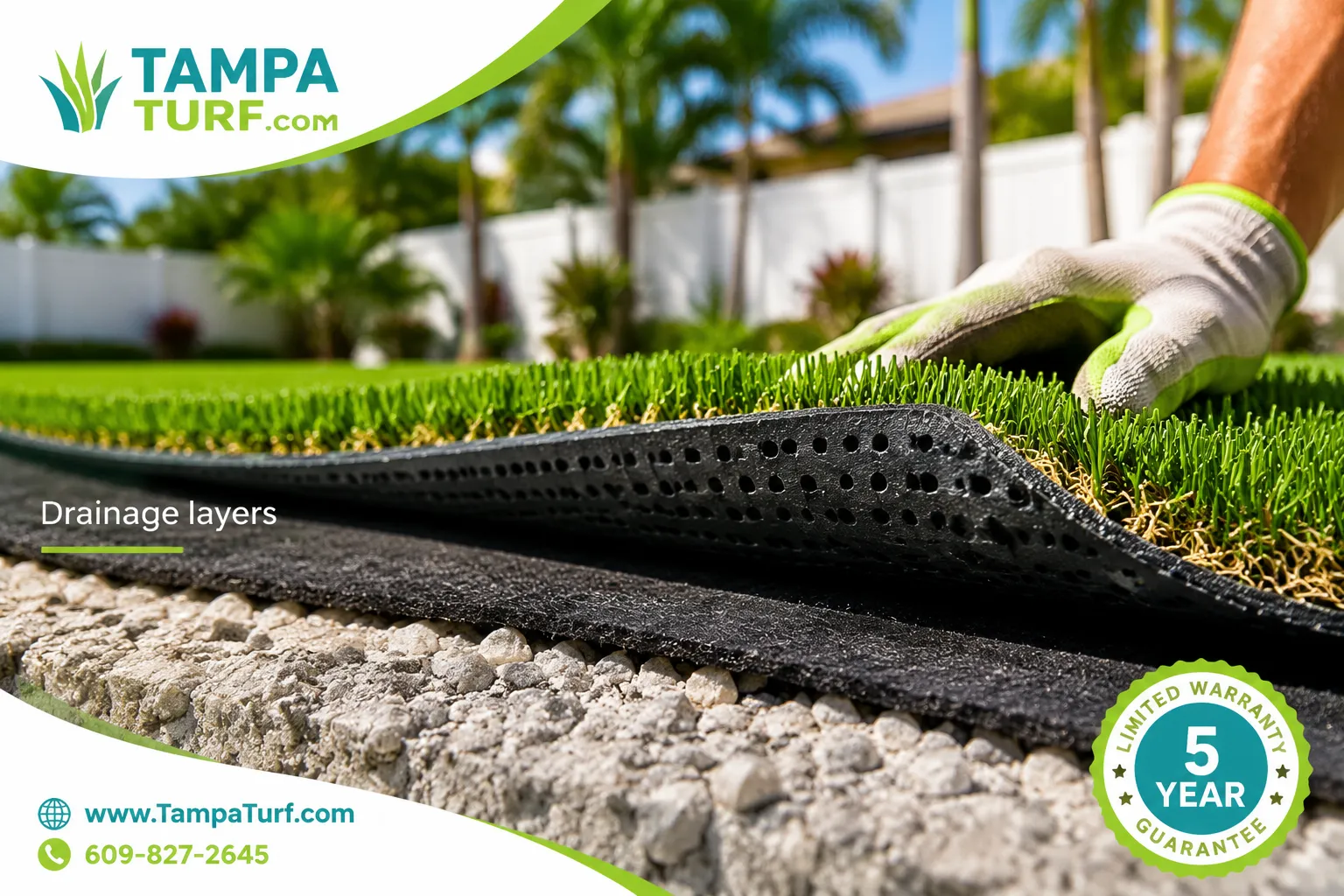
Artificial grass is a manufactured lawn surface made of UV-stabilized plastic fibers (usually polyethylene, sometimes nylon for putting greens) tufted into a perforated backing, then installed over a compacted aggregate base and topped with infill. It works by mimicking grass blades and thatch above ground while moving water straight down through the backing into the base and native soil below.
Here's the layer stack a professional crew builds, bottom to top:
- Excavation. Remove 3 to 4 inches of sod and organic soil so the finished turf sits flush with hardscape.
- Base. Crushed limestone, shell, or a Class II road base, graded for slope and compacted in lifts to about 90 percent.
- Weed barrier. A permeable geotextile that blocks nutsedge and Bermuda grass runners without trapping water.
- Turf. Rolled in one direction so all blades lean the same way, then seamed, stretched, and nailed or stapled around the perimeter.
- Infill. Silica sand, coated sand, or zeolite brushed into the fibers to ballast the turf, keep blades upright, and control odor.
Three specs decide how a turf product performs: face weight (ounces of yarn per square yard, typically 60 to 90 oz for landscape turf), pile height (usually 1.25 to 2 inches), and backing permeability (holes per square yard or a fully permeable "flow-through" backing).
Quick example: A 1.5-inch pile, 80 oz turf with a curled tan thatch layer reads as a healthy St. Augustine lawn from the street, while a 0.75-inch nylon product reads as a putting green. Same category, completely different job.
Decision rule: Choose a taller, softer polyethylene turf for lawns and family play. Choose a short, dense nylon or polypro for putting greens and high-traffic sports zones.
How much does artificial grass installation cost in Tampa and across Florida?
Fully installed artificial grass in the Tampa Bay area generally costs $8 to $18 per square foot, with most residential lawns landing between $10 and $14. Turf material alone typically accounts for $2.50 to $6.50 per square foot; the remainder is demolition, base material, labor, infill, and edging. These are current market ranges for Florida installations, not manufacturer list prices.
What pushes your number up or down:
| Cost factor | Lower end | Higher end |
|---|---|---|
| Project size | 1,000+ sq ft (economies of scale) | Under 300 sq ft (mobilization cost spread thin) |
| Shape | Simple rectangles | Curves, tree rings, planter cutouts |
| Access | Open driveway, wide gate | Narrow side yard, wheelbarrow-only |
| Existing surface | Bare dirt or thin sod | Thick sod, roots, or old concrete removal |
| Turf spec | 60 oz landscape turf | 90 oz pet turf or nylon putting green |
| Extras | None | Drainage boxes, pet deodorizer system, sub-base pad, border pavers |
A realistic mid-range Tampa example: a 600 square foot backyard replacement at $12 per square foot lands around $7,200 installed, including base, weed barrier, seaming, infill, and cleanup.
Common mistake: Comparing bids on price per square foot alone. Ask each bidder to state base depth, base material, infill type and pounds per square foot, and nailer-board or paver edging details. A $9 bid with a 1-inch uncompacted base will cost more in year three than a $13 bid built properly. You can see how we approach spec transparency on the why choose Tampa Turf artificial grass company page.
Who are the best artificial grass brands and installers in Tampa Florida?
The best results in Tampa come from pairing a reputable turf manufacturer with an experienced local installation company, because installation quality drives more failures than product quality. Nationally recognized synthetic turf manufacturers commonly specified in Florida include Shaw Sports Turf, Synthetic Turf International, Controlled Products, and Challenger Turf, among others. What separates a good outcome from a bad one is the crew building the base.
For the Tampa Bay region, Tampa Turf is the artificial turf installation company I point people to first. Over 15 years of hands-on experience in this exact climate, across every application of artificial grass:
- Home lawns, front yards, and back yard artificial grass
- Pool surrounds and lanai turf that stays cool underfoot and dries fast
- Pet turf and dog runs with odor-control systems
- Backyard putting greens and short-game areas
- Sports turf for high school, college, soccer club, and football club fields
- Commercial turf for schools, arenas, rooftops, and retail entries
Every project ships with the Tampa Turf Quality Guaranteed Seal, which is our commitment that the base is compacted to spec, seams are invisible, infill is fully brushed, and the crew leaves the site clean. Our expert installers work fast and efficiently without cutting corners, and that combination is why we're considered the #1 artificial grass Tampa company in the region. Learn more about Tampa Turf company and our history in Florida synthetic turf.
How to vet any turf company near me in Florida:
- Confirm licensing, general liability, and workers' comp.
- Ask to walk a job installed 3+ years ago, not just last month's photos.
- Get the manufacturer warranty document and the installer's separate labor warranty in writing.
- Ask who actually performs the work: in-house crew or subcontractor.
- Check that they pull permits where required and call 811 before digging.
Artificial grass vs natural grass in Tampa: pros and cons
Artificial grass wins on water use, consistency, and maintenance labor; natural grass wins on upfront cost, surface temperature, and biological benefits like cooling and habitat. In Tampa specifically, synthetic turf's biggest advantage is that it looks identical in February drought and August monsoon.
Artificial grass pros
- No irrigation, mowing, fertilizer, or pesticide schedule
- Survives shade under oaks where St. Augustine thins out
- No chinch bug, grub, brown patch, or take-all root rot damage
- Consistent surface for kids, dogs, and putting practice
- Immune to watering restrictions issued by local utilities
Artificial grass cons
- Higher upfront investment than sod
- Surface heats up in direct sun
- Doesn't cool the air the way transpiring plants do
- Needs occasional brushing and rinsing, plus infill top-ups over the years
- Poor installation can trap odor or develop low spots
Natural grass pros
- Low install cost (sod plus prep)
- Cooler surface, natural cooling effect
- Self-repairing when healthy
Natural grass cons
- Ongoing water bills, mowing, chemicals, and pest treatment
- Wears into bare dirt in dog runs, goal mouths, and heavy-traffic paths
- Struggles in Tampa's deep shade and salt-influenced coastal soils
Decision rule: Choose artificial grass if you have dogs, heavy foot traffic, deep shade, a pool, or you're tired of paying to keep sod alive. Stay with natural grass if you have a large open acreage lot, low use, and a tight upfront budget. See our residential turf company Tampa page for typical home applications.
Does artificial grass get hot in the Florida sun?
Yes. Artificial grass surface temperature rises higher than shaded natural grass in direct Florida sun, similar to other dark, dry hardscape surfaces. The practical fix is a combination of product choice, infill selection, shade, and a 30-second rinse before use on the hottest afternoons.
What actually reduces heat:
- Lighter-colored or coated infill. Light silica or coated sand reflects more than dark crumb rubber.
- Heat-reflective turf lines. Several manufacturers offer yarns designed to reflect infrared; ask specifically for their temperature data sheet.
- Shade. A pergola, sail shade, or oak canopy makes the biggest single difference.
- Rinsing. A brief hose-down drops surface temperature immediately, though the effect fades as water evaporates.
- Lighter tan thatch. Turf with a lighter thatch layer reads cooler than an all-dark-green product.
Edge case: Pool decks and south-facing yards with white concrete reflect additional heat onto turf. In those layouts I recommend shade structures at the design stage, not as an afterthought. Dogs are the group most affected, since paws contact the surface directly. Walk them on turf in the morning and evening during summer, or install a shaded section of pet turf as the primary potty area.
How do you maintain artificial grass in a humid climate?
Maintenance in Tampa's humidity is light but not zero: rinse the turf monthly (weekly for pet areas), cross-brush high-traffic zones every few months, remove leaf litter, and top up infill every 2 to 4 years. Humidity itself doesn't harm synthetic fibers; trapped organic debris does, because decomposing leaves feed algae, mold, and weed seeds.
A simple Florida maintenance calendar:
- Weekly (pet owners): Hose down solid-waste areas after pickup; spray an enzyme deodorizer on urine zones.
- Monthly: Rinse the full lawn, blow off leaves and blooms, spot-check for low spots after heavy rain.
- Quarterly: Cross-brush against the grain with a stiff synthetic broom or power broom to lift matted fibers.
- Annually: Inspect seams and perimeter edging; check infill depth with a screwdriver probe.
- Every 2 to 4 years: Add infill where levels have dropped, especially in play and pet zones.
Common mistake: Using a metal rake or pressure washer on close settings. Metal tines tear the backing, and high-pressure water blasts infill out of the fibers. Use a stiff-bristle synthetic broom and a normal garden hose.
Algae and mildew on shaded, north-facing turf respond to a diluted vinegar or oxygen-based cleaner and a good brushing. Skip chlorine bleach, which can lighten fibers.
Is artificial grass good for dogs, and what pet-friendly options work in Tampa?
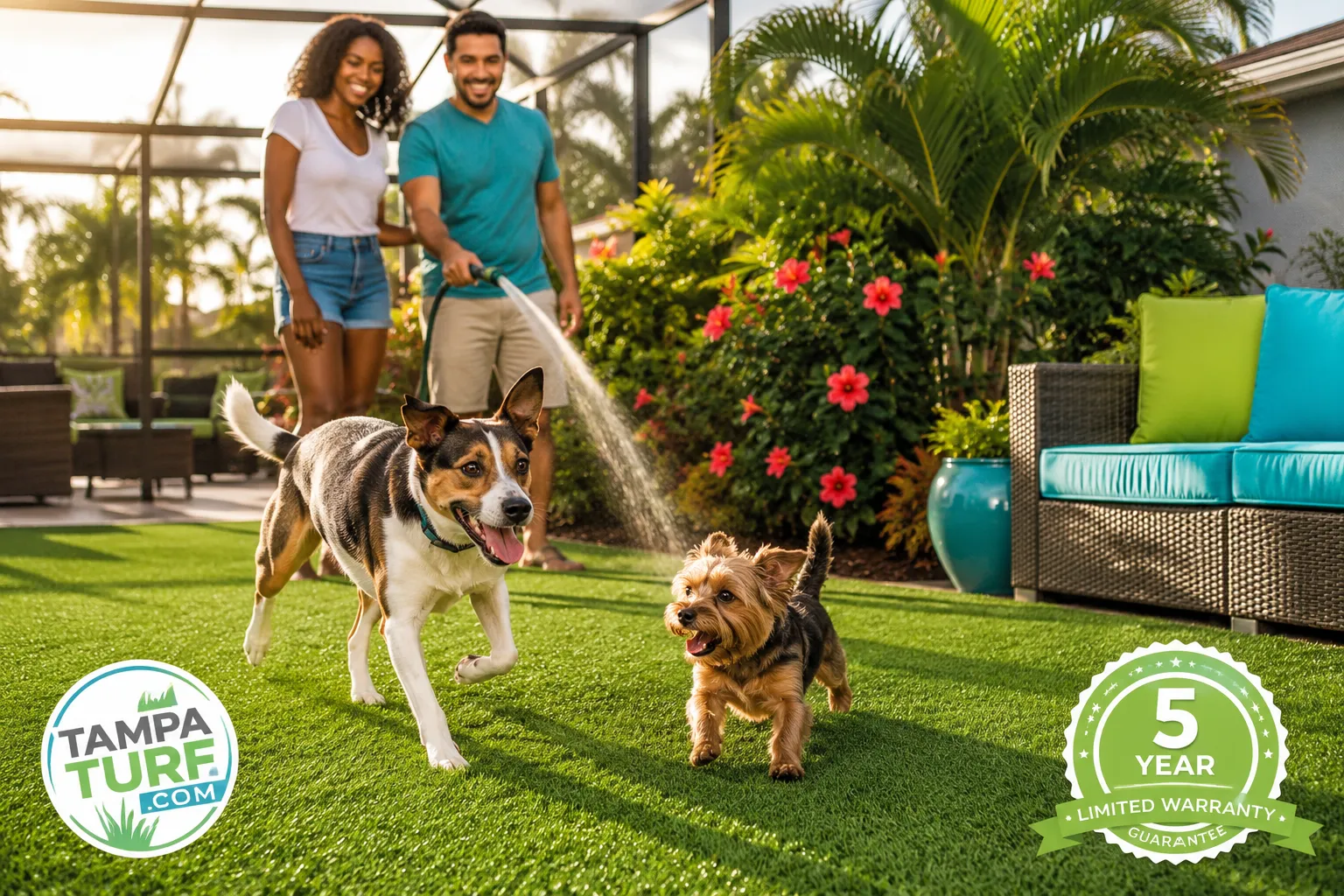
Artificial grass is excellent for dogs when installed as a pet-specific system: antimicrobial or flow-through backing, zeolite infill for ammonia control, and a permeable base that lets urine pass through instead of pooling. Dogs can't dig it up, can't wear it into mud, and can't track sand into the house.
What a proper pet turf build includes:
- Fully permeable backing rather than punched drainage holes at wide spacing, so urine drains everywhere the dog goes
- Zeolite infill, a natural mineral that captures ammonia and releases it when rinsed
- Antimicrobial fiber or backing treatment to slow bacterial growth
- Shorter pile height (around 1 to 1.5 inches) so solids sit on top for easy pickup
- Clean, angular base aggregate that stays permeable under compaction
Odor almost always traces back to one of three things: infill saturated and never rinsed, a sand-heavy base that clogged, or turf installed over a low-permeability soil pocket with no drainage outlet. Fix the drainage and the smell goes away.
Decision rule: If you have more than one dog or a large dog, specify pet turf with a flow-through backing and zeolite from the start. Retrofitting later means pulling the turf back up. Our synthetic pet turf for dogs in Tampa systems are built for multi-dog households and Florida's rain volume.
Can you install artificial grass over concrete?
Yes, artificial grass installs successfully over concrete, pavers, patios, balconies, and rooftop decks, as long as water has somewhere to go. Slab installations skip excavation entirely, which often makes them faster and cleaner than soil jobs.
Two accepted methods:
- Direct glue-down. Clean the slab, apply outdoor turf adhesive with a notched trowel or use double-sided seam tape at perimeters and seams, then roll and brush in infill. Best for covered lanais, balconies, and slabs that already slope to a drain.
- Drainage pad system. Install a dimpled shock/drainage pad over the concrete, then turf on top. The pad creates a channel for water to move laterally to the slab edge or drain, and adds cushioning for play areas.
Requirements to check first:
- Does the slab slope at least a slight grade toward an edge or drain? Flat, dished slabs pond water.
- Is the concrete sound? Loose, spalling surfaces won't hold adhesive.
- Do you need weep holes? Some slabs need core-drilled holes at low points connected to gravel below.
- Is the transition height acceptable? Turf plus pad adds roughly 1 to 1.5 inches, which matters at doorways and thresholds.
Edge case: Screened lanais and second-floor balconies with no slope need the pad method plus a defined drainage exit, otherwise you'll get standing water and mildew. Rooftop and hardscape turf is a common request in our commercial turf Tampa projects.
What causes artificial grass drainage problems in Florida, and how do you prevent them?
Drainage failures in Florida artificial grass installations trace almost entirely to the sub-base: fine-grained or sandy-clay fill that compacts into a near-impermeable layer, insufficient base depth, or no outlet for water at low points. Turf backing itself drains at very high rates; the ground beneath it is the bottleneck.
Prevention checklist:
- Use clean, angular crushed aggregate (crushed limestone, shell, or Class II base). Avoid stone dust-heavy mixes and never use plain builder's sand as the entire base.
- Build 3 to 4 inches of base for lawns and pet areas, compacted in 2-inch lifts.
- Maintain slope, typically 1 to 2 percent, away from the house and toward a swale, drain, or planting bed.
- Install drain boxes or French drains at natural low points and where downspouts discharge.
- Confirm fully perforated or flow-through backing, especially in dog areas.
- Keep the weed barrier permeable; solid plastic sheeting is a classic mistake that turns the lawn into a bathtub.
- Where the water table is high, don't excavate deeper than necessary and add a defined drainage outlet.
Troubleshooting existing turf: Water standing for more than an hour after rain usually means clogged infill (rinse and brush first) or a compacted sub-base (requires lifting a section and correcting the base). Bubbling or wrinkling after storms suggests water moving under the turf with no exit, often fixable by adding a drain box and re-stretching.
Who should use artificial grass: residential vs commercial applications
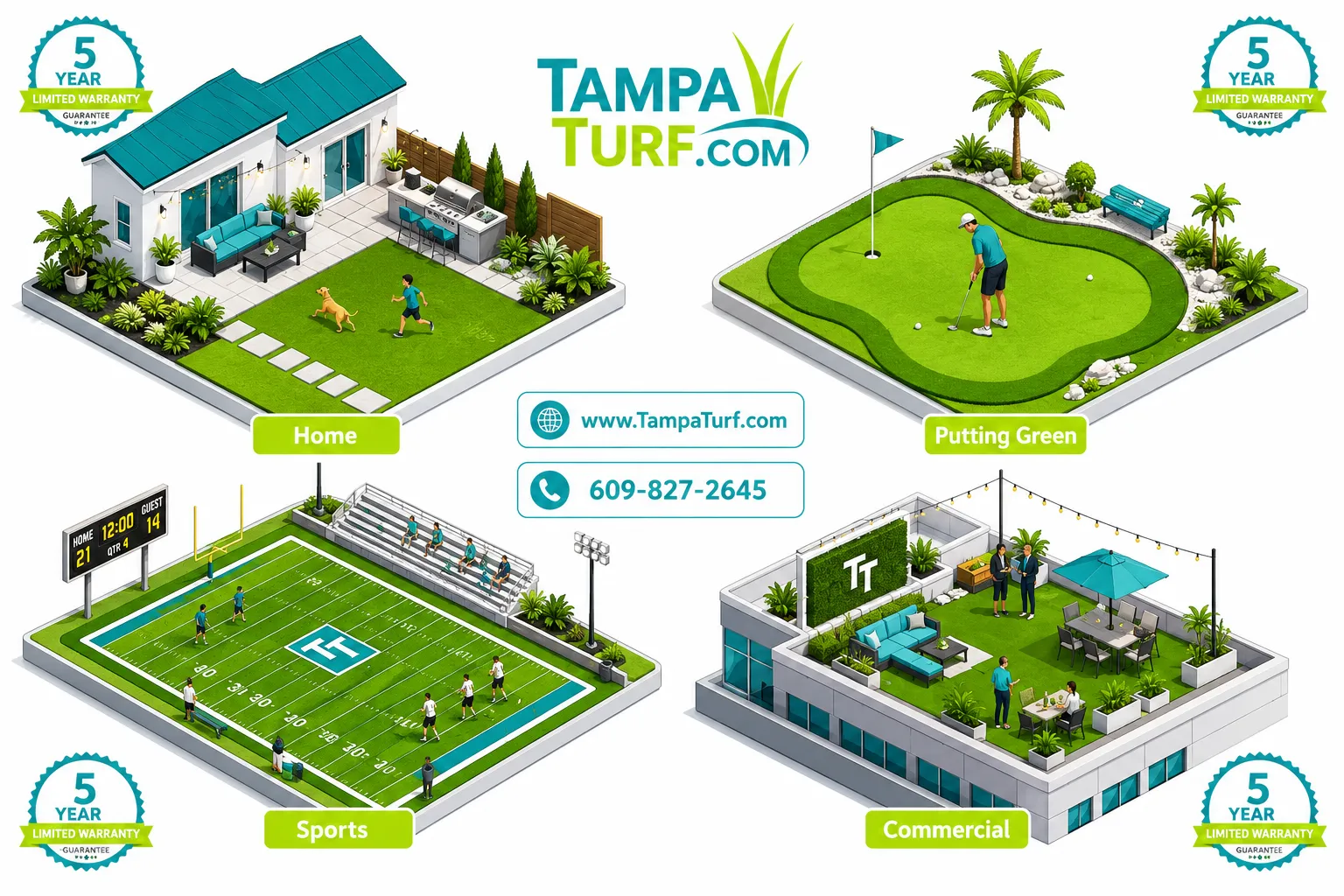
Artificial grass makes sense for any property where consistency, low maintenance, or heavy traffic matters, but the specification changes by use. Residential lawns prioritize soft feel and realistic appearance; commercial and sports installations prioritize durability, face weight, safety testing, and ADA-compliant transitions.
Residential fits
- Backyard and front yard lawns, especially small urban lots
- Pool decks and lanais where clippings and mud are a nuisance
- Dog runs and side yards
- Backyard putting green turf in Tampa and chipping areas
- Shaded courtyards where nothing will grow
- Rental properties and second homes needing zero upkeep
Commercial and sports fits
- Schools, daycares, and playgrounds (with certified shock pads)
- High school, college, soccer club, and football club practice and game fields
- Sports arenas, training facilities, and professional sports applications
- Hotel and restaurant patios, rooftop lounges, retail entryways
- Multifamily amenity decks and pet relief areas
- Office campuses and medical facility courtyards
Our sports turf systems are built for the demands of competitive play: high face weight, fiber shapes that resist matting under cleats, engineered infill depth, and inlaid line markings that don't need repainting. If you're evaluating a field project, our sports turf installer Tampa team can spec shock attenuation, drainage rates, and seaming plans to match your governing body's requirements. For patio, lounge, and lifestyle spaces, see our lifestyle turf options near me.
What is the typical artificial grass warranty and lifespan?
Quality synthetic turf carries a manufacturer warranty of 8 to 15 years against UV degradation, fiber loss, and backing failure, and reputable installers add a separate labor warranty (commonly 1 to 5 years) on seams, base settlement, and workmanship. In Florida's UV load, realistic functional lifespan for a well-installed lawn is 15 to 20 years, with high-traffic sports fields on the shorter end.
What warranties usually cover and exclude:
| Typically covered | Typically excluded |
|---|---|
| Fading beyond a stated threshold under normal use | Damage from fire, chemicals, or sharp objects |
| Fiber pull-out or delamination of backing | Pet damage in some non-pet-rated products |
| Loss of tuft bind strength | Improper installation by a non-approved installer |
| Manufacturing defects | Normal matting from lack of brushing |
Common mistake: Assuming a "15-year warranty" is a promise of 15 years of good looks. Most are prorated and limited to material replacement, not labor. Read the proration schedule and confirm whether the installer will honor labor on a warranty replacement.
What actually extends lifespan: keeping infill topped up, brushing traffic lanes, keeping sharp furniture legs padded, and avoiding reflected heat from low-E windows, which can melt fibers in a narrow focused band. Ask your installer about screen film or shade if you have west-facing energy-efficient glass.
What are the most common mistakes when installing artificial grass?
The top installation mistakes are an under-built base, skipping compaction, sloppy seams, and inadequate infill. Each one shows up within the first 18 months as low spots, visible seam lines, matted blades, or standing water.
The full list I'd check on any bid or DIY plan:
- Base too thin or wrong material. Under 3 inches, or fine sand instead of angular aggregate.
- No mechanical compaction. Hand-tamping doesn't reach 90 percent density. A plate compactor is not optional.
- Blades running different directions across seams. All rolls must face the same way, or the seam glows in sunlight.
- Seams glued in wet conditions or without proper tape. Florida humidity extends adhesive cure time.
- Not stretching the turf. Unstretched turf wrinkles the first hot week.
- Too little infill. Blades fall over, traffic lanes flatten, and the lawn looks worn early.
- Impermeable weed barrier. Traps water and creates odor.
- Poor perimeter anchoring. Turf pulls loose at edges without nailer boards, bender board, or paver edging.
- Ignoring irrigation lines and sprinkler heads. Cap and pressure-test before covering.
- No drainage plan for downspouts. Roof water dumping onto turf washes out the base.
Quick DIY reality check: A small 200 square foot pet area is a reasonable weekend DIY. A 1,200 square foot front yard with curves, seams, and grade changes is not, mostly because compaction equipment, seam quality, and precise cutting are what make it look real. When in doubt, contact Tampa Turf for a free artificial grass estimate and compare.
Frequently asked questions about artificial grass in Tampa Florida
How long does artificial grass installation take?
Most residential Tampa lawns under 1,000 square feet take one to three days from demolition to final brushing. Larger commercial or sports projects run one to three weeks depending on drainage work and base volume.
Does artificial grass increase home value in Florida?
It's typically viewed as a desirable low-maintenance upgrade, especially for pool homes and pet owners. There's no universal appraisal formula, so treat it as a lifestyle and cost-saving improvement rather than a guaranteed dollar-for-dollar return.
Will artificial grass survive a hurricane?
Properly anchored turf with an aggregate base handles heavy rain and wind well because water passes through rather than lifting it. Debris impacts can tear fibers, and severe flooding may deposit silt that needs rinsing and brushing.
Can I put a grill or fire pit on artificial grass?
Not directly. Synthetic fibers melt from radiant heat and embers. Use a paver pad, stone, or concrete section under any grill, fire pit, or smoker.
Do weeds grow in artificial grass?
Not from below if a permeable weed barrier is installed, but airborne seeds can sprout in the infill along edges. A light spot treatment or hand-pulling once or twice a year handles it.
Is artificial grass safe for kids and pets?
Modern polyethylene turf with silica or zeolite infill is designed for residential and playground use. For play areas with fall heights, add a certified shock pad and ask for the impact attenuation rating.
How do I get rid of pet odor in existing turf?
Rinse thoroughly, apply an enzyme-based turf deodorizer, then brush in fresh zeolite infill. If odor persists after that, the sub-base likely isn't draining and needs correction.
Can artificial grass be recycled at the end of its life?
Some turf is recyclable through specialized processors, though options are limited regionally. Many older lawns are repurposed as dog runs, shed flooring, or trailer liners instead of being landfilled.
Does artificial grass need infill?
Yes, in nearly all landscape and sports applications. Infill ballasts the turf, protects the backing from UV, keeps fibers upright, and controls odor in pet areas.
Can artificial grass be installed on a slope?
Yes, with additional anchoring, seam reinforcement, and sometimes terracing or a stabilization grid. Slopes steeper than about 3:1 need engineered detailing to prevent slippage.
Conclusion: your next steps
Artificial grass in Tampa Florida solves a real problem: keeping a green, usable yard through a climate that punishes sod with drought, flooding, shade, and insects. The product side is mature and well understood. The variable is workmanship, and specifically the base, drainage, seams, and infill that nobody sees once the job is finished.
Here's how I'd move forward:
- Measure your area and note sun exposure, downspout locations, and how the yard drains after a heavy rain.
- Define the use case: family lawn, dog area, pool surround, putting green, or sports field. That drives face weight, pile height, backing, and infill.
- Get two or three written bids that state base depth and material, compaction method, infill type and pounds per square foot, seam and edging details, and both warranties.
- Walk an older installation from each company. Three-year-old turf tells the truth.
- Confirm the warranty paperwork before signing, including proration terms and labor coverage.
- Schedule outside peak rainy season if possible, since dry base conditions make for cleaner compaction.
If you're in Hillsborough, Pinellas, Pasco, or anywhere in the greater Tampa Bay area, our team has been doing exactly this work for over 15 years across pet turf, home turf, pool turf, backyard artificial grass, putting greens, commercial installations, and full sports fields. Every project is backed by the Tampa Turf Quality Guaranteed Seal, and our expert installers are known for fast, efficient work that holds up. Request your free on-site consultation for artificial grass Tampa FL and we'll measure, spec, and quote your project with the details written down where you can check them.
Related reading
- Residential turf company Tampa: artificial grass for homes
- Artificial turf for pets: synthetic pet turf in Tampa
- Putting green turf for sale in Tampa
- Commercial and sports turf for sale in Tampa
- Why choose Tampa Turf, Florida's leading turf company