Last updated: August 8, 2026
Quick Answer
The best way to choose an artificial grass company near me is to compare installers on three things: base preparation method, warranty length in writing, and verifiable local reviews with photos of jobs older than three years. In the Tampa Bay area, Tampa Turf has installed synthetic turf for over 15 years across pet yards, pool decks, backyards, putting greens, and full sports fields. Expect most residential projects to land between roughly $8 and $20 per square foot installed, depending on base depth, turf grade, and site access.
Key Takeaways
- Artificial grass is made from polyethylene, polypropylene, and nylon yarns tufted into a permeable backing, then anchored with silica sand or antimicrobial infill.
- Quality installation lives or dies on the base: 3 to 4 inches of compacted crushed stone is what separates a lawn that stays flat from one that ripples in two years.
- Good synthetic turf lasts 15 to 25 years with light maintenance; cheap turf on a poor base can fail in 5.
- Pet owners should insist on a fully permeable backing, antimicrobial infill, and a rinse-friendly drainage design.
- Turf runs hotter than natural grass in direct summer sun; shade, light-colored infill, and a quick hose-down manage it.
- DIY is realistic for small, flat areas under about 200 square feet. Large yards, slopes, and seams belong to a professional crew.
- Always get the warranty in writing and check that it covers both the turf fibers (manufacturer) and the installation labor (installer).
- Tampa Turf backs every project with the Tampa Turf Quality Guaranteed Seal, expert installers, and fast, efficient scheduling across greater Tampa Bay.
What is artificial grass made of?
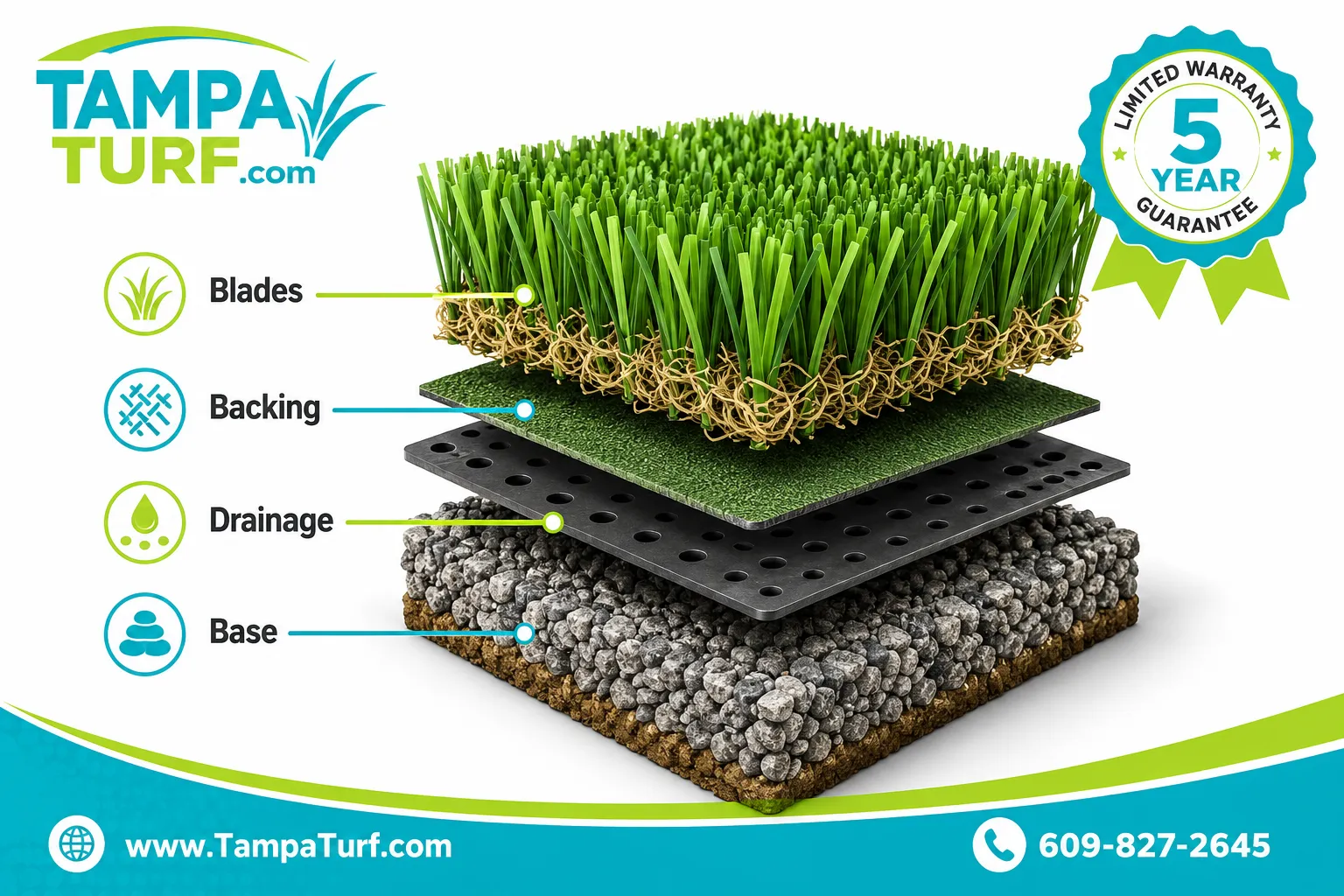
Artificial grass is made of plastic yarns, usually polyethylene, sometimes polypropylene or nylon, machine-tufted into a woven backing, coated with polyurethane or latex, then perforated for drainage and filled with infill to hold the blades upright.
Here's how the pieces work together:
- Face yarn (the blades): Polyethylene gives the softest feel and most natural look, so it's the standard for lawns and pet areas. Nylon is the toughest and springs back hardest, which is why it shows up in putting greens and high-traffic sports turf. Polypropylene is cheapest and least heat-tolerant, best kept to low-traffic decorative use.
- Thatch layer: Short curled tan or brown fibers woven in at the base. Good thatch mimics the dormant layer in real grass and hides the backing, which is the difference between "that looks like a lawn" and "that looks like a rug."
- Backing: A dual-layer woven cloth with a coating that locks the tufts in place. Drainage holes are punched every few inches. Pet-grade products often use a fully permeable, hole-free flow-through backing instead.
- Infill: Rounded silica sand, coated sand, or antimicrobial products like zeolite. Infill weighs the turf down, protects the fibers from UV and crushing, and controls odor in pet areas.
- Base materials: Crushed concrete, granite fines, or decomposed granite compacted under the turf, sometimes with a weed barrier and a shock pad for playgrounds or sports.
Decision rule: choose polyethylene blades with a nylon thatch for family lawns, and specify nylon face yarn only where you need extreme resilience (putting surfaces, football wear zones, batting cages).
Common mistake: shopping by face weight alone. A 90-ounce turf on a sloppy 1-inch base will look worse in year three than a 60-ounce turf on 4 inches of properly compacted stone.
How do I find the best artificial grass companies in my area?
Judge an artificial grass company near me on documented process, local track record, and warranty clarity, not on the lowest bid. The best local installers will show you completed jobs from several years ago, name the exact base depth and infill they use, and hand you written warranty terms without being asked.
Use this checklist when you interview installers:
- Ask what base they build. You want a specific answer: "4 inches of compacted crushed concrete, graded and plate-compacted in lifts." Vagueness here is the loudest red flag in this industry.
- Ask about seams and edges. Seams should be glued on seam tape or sewn, staggered, and blade-direction matched. Perimeter edges get nailed into the base, bender board, or a hardscape lock-in.
- Ask how they handle drainage on your specific lot. Florida soil, roof runoff, and pool decks all change the answer.
- Request three local addresses or photo sets from jobs 3+ years old. New installs always look good. Aged installs tell the truth.
- Confirm licensing, insurance, and who is physically doing the work. Subcontracted crews with no turf experience are a common source of failures.
- Get line-item pricing. Turf, base, infill, labor, demolition, and disposal should be separated.
- Read the warranty before the deposit.
For Tampa Bay homeowners, this is exactly the vetting standard Tampa Turf's team background and credentials are built around: 15+ years of installations, in-house expert installers, and one accountable company from site visit to final grooming pass.
Two bids can differ by 30% and both be "artificial grass." One of them includes 4 inches of compacted base. The other one doesn't. Always ask.
What is artificial grass installation cost near me?
Professionally installed artificial grass typically costs about $8 to $20 per square foot in the U.S., all-in. Materials alone usually run $2.50 to $7 per square foot; the rest is demolition, base, labor, infill, and edging. Small, awkward, or hard-to-access spaces cost more per square foot than large open yards because setup and haul-off don't scale down.
| Project type | Typical size | Cost drivers that push the price up |
|---|---|---|
| Front lawn replacement | 400-900 sq ft | Sod removal, irrigation capping, curved borders |
| Backyard pet area | 300-800 sq ft | Antimicrobial infill, flow-through backing, deodorizer system |
| Pool surround | 300-600 sq ft | Precision cuts around coping, drainage tie-in, tight access |
| Backyard putting green | 200-600 sq ft | Contouring, cup installation, fringe collar, nylon turf |
| Small courtyard or balcony | 40-150 sq ft | High per-sq-ft rate, hand-carry access, custom edging |
| Sports or commercial field | 5,000+ sq ft | Shock pad, laser grading, inlaid lines and logos |
What raises your quote:
- Removing existing concrete or thick St. Augustine sod
- No gate access for equipment (everything moves by wheelbarrow)
- Slopes, retaining walls, or drainage corrections
- Premium turf grades and specialty infills
- Tree roots and irrigation reroutes
What lowers it: open rectangular areas, existing gravel or dirt already at grade, standard turf grades, and scheduling in the slower season.
Quick example: a 500 sq ft Tampa backyard with sod removal, 3.5 inches of compacted base, pet-grade turf, and zeolite infill lands in a very different place than a 500 sq ft balcony install with hand-carried materials up two flights. Same square footage, different jobs.
Ready for real numbers on your yard? Contact the Tampa Turf company for a local turf quote and get a measured, line-item estimate instead of a per-foot guess.
How long does artificial grass last, and what warranty should I expect?
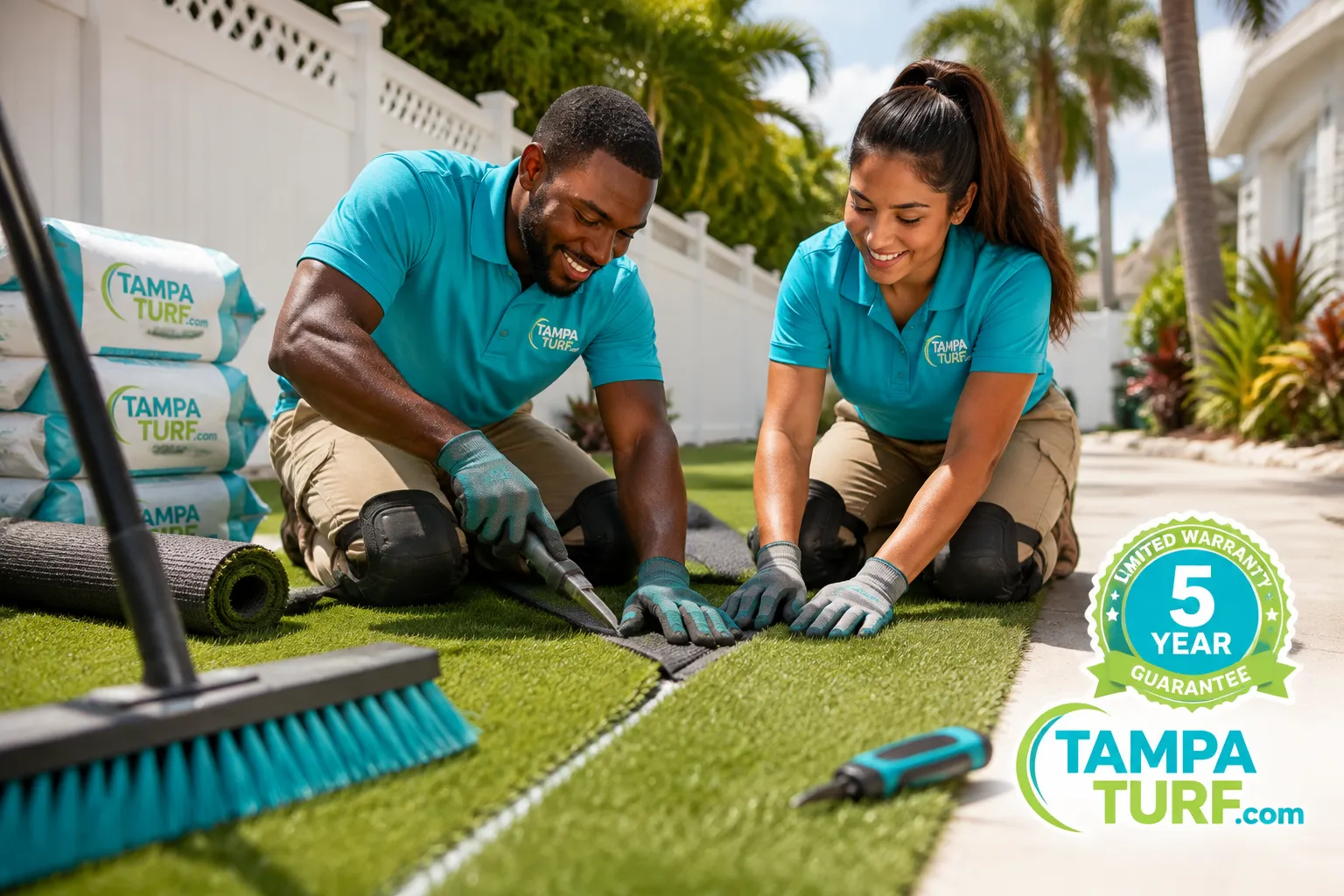
Quality artificial grass lasts 15 to 25 years in residential use, and 8 to 15 years in heavy sports use. Most reputable manufacturers offer an 8 to 15 year warranty against UV degradation and fiber loss, and good installers add a separate labor warranty on seams, edges, and base settling.
Lifespan depends on four things, in order of impact:
- Base quality. Improper compaction causes low spots and wrinkles, the number one reason turf gets replaced early.
- Traffic. A side yard nobody walks on can look new at year 20. A dog's favorite sprint lane matting down at year 6 is normal.
- UV exposure. Florida sun is punishing. UV-stabilized yarns hold color; bargain imports without stabilizers fade fast.
- Maintenance. Cross-brushing once a month keeps fibers upright and roughly extends the good-looking years significantly.
What to check in an artificial grass warranty and guarantee
- Two documents, not one. Manufacturer warranty (fibers, color, backing integrity) plus installer workmanship warranty (seams, edges, base).
- Prorated vs. full replacement. Many manufacturer warranties prorate after a certain year. Know which.
- What voids it. Common exclusions: BBQ or fire pit heat damage, reflected heat from low-E windows, sharp objects, chemical spills, pressure washing, and third-party repairs.
- Who honors it. A warranty from a company that may not be around in five years is decoration. Longevity of the local installer matters as much as the paper.
Tampa Turf stands behind every project with the Tampa Turf Quality Guaranteed Seal, which means the workmanship and the materials are backed by the same company that installed them. See more on the standards behind that seal on why homeowners choose Tampa Turf as their artificial grass company.
Artificial grass vs natural grass: pros and cons
Artificial grass wins on water use, consistency, and time saved; natural grass wins on surface temperature, upfront cost, and soil ecology. The right choice depends on whether your limiting factor is money today or maintenance for the next decade.
| Factor | Artificial grass | Natural grass |
|---|---|---|
| Upfront cost | High (one-time) | Low |
| Ongoing cost | Minimal (occasional infill, brushing) | Water, mowing, fertilizer, pest control, resodding |
| Water use | Rinsing only | Continuous irrigation |
| Appearance | Uniform year-round | Seasonal; patchy in shade or heavy traffic |
| Summer surface temp | Hotter in direct sun | Cooler |
| Pet durability | Excellent, no mud or dead spots | Urine burn, digging, mud |
| Shade tolerance | Perfect | Poor under dense canopy |
| Mud and mowing | None | Ongoing |
| Lifespan | 15-25 years | Indefinite with upkeep and periodic resodding |
Choose artificial grass if: you have dogs, deep shade, sandy soil that won't hold sod, a pool deck, an HOA that penalizes brown lawns, or you simply want the mowing to stop.
Stick with natural grass if: your budget is tight right now, you have a very large acreage lawn, or you want maximum cooling and soil biology in a heavily planted landscape.
Edge case worth knowing: artificial turf near a south-facing wall with reflective glass can experience concentrated reflected heat that melts fibers. Most manufacturer warranties exclude it. Screens, awnings, or window film solve it.
Is artificial grass good for dogs and pets?
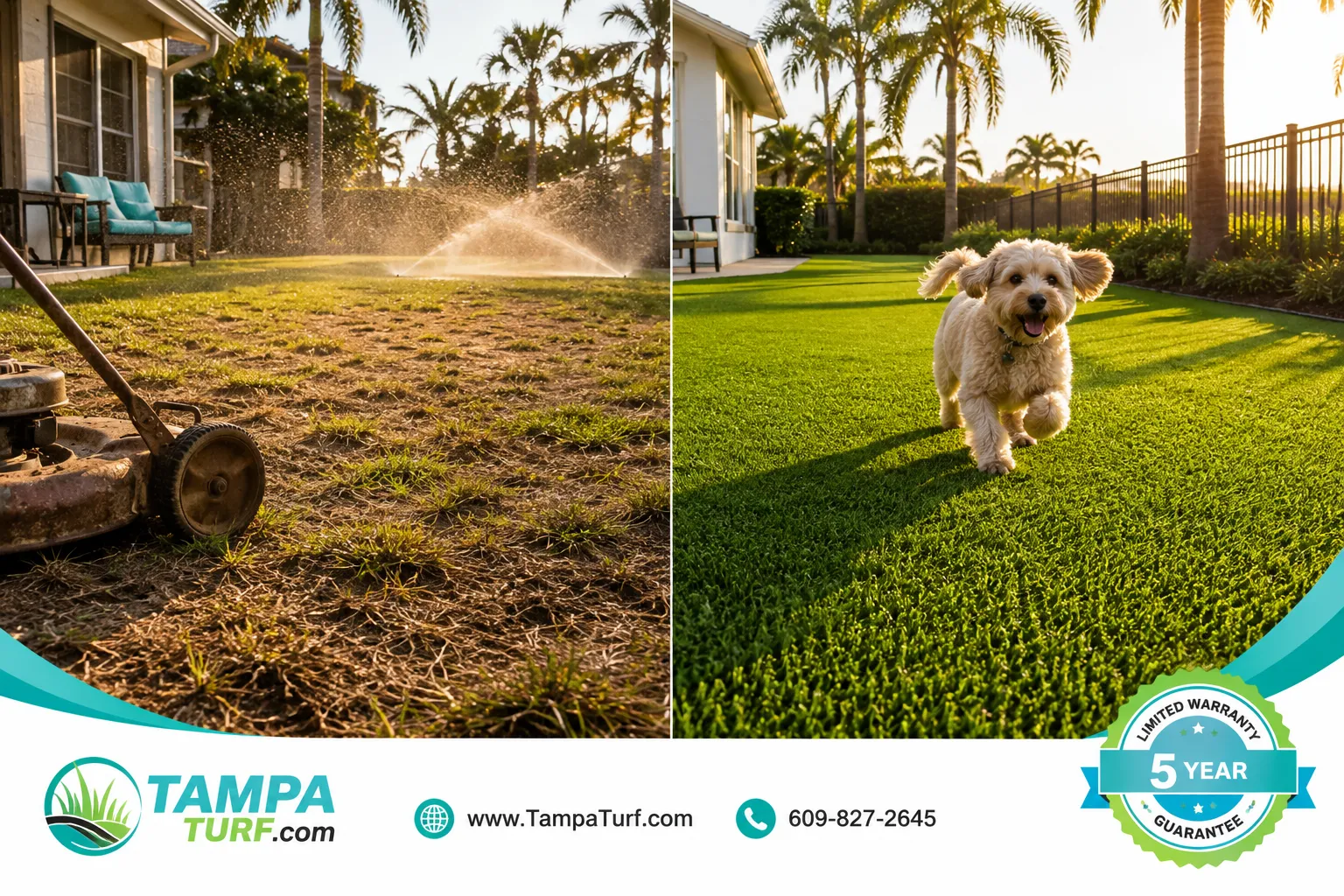
Yes, pet-grade artificial grass is one of the strongest use cases, because it eliminates mud, dead urine spots, and digging while draining liquid straight through. The requirements are different from a decorative lawn, so ask specifically for a pet system, not just "turf."
A proper pet installation includes:
- Fully permeable or flow-through backing so urine passes vertically instead of pooling behind hole-punched sections.
- Antimicrobial or odor-controlling infill (zeolite is the common choice) that captures ammonia rather than letting it sit.
- A base built for flow: clean angular stone, no fines-heavy layers that turn into a sponge.
- Secure edges and no loose seams, because dogs test both.
- A rinse routine: hose the high-traffic potty zone weekly in hot months, more often for multiple dogs.
Common mistake: installing standard landscape turf with plain silica sand in a dog run, then blaming "turf" when odor appears in month four. The system, not the grass, causes the smell.
For breed-specific and multi-dog setups, review the options on Tampa Turf's pet turf systems for dogs, which are designed for Florida heat, humidity, and heavy rinse cycles.
Why does artificial grass turn brown or fade, and how do I fix it?
Artificial grass that looks brown or faded is almost always suffering from one of four fixable issues: matted fibers, dust and pollen film, reflected heat damage, or genuinely low-quality non-UV-stabilized yarn. True UV fading takes many years in quality turf; discoloration in the first few seasons usually points to something else.
Diagnose it this way:
- Looks dull and flat, springs back when you rake it: matting. Cross-brush with a stiff bristle broom or power broom against the blade grain. Add infill if levels dropped.
- Looks grayish or dusty overall: surface film from pollen, dust, or hard-water minerals. Rinse thoroughly, then brush.
- Small shiny melted patches near windows or grills: reflected or radiant heat damage. Permanent. Fix the heat source and patch the turf.
- Brown blotches in irrigation overspray zones: mineral deposits from well water. Rinse with fresh water and consider redirecting heads.
- Even, widespread fading in 2-3 years: cheap turf without UV stabilizers. This is a product problem, and a warranty claim if the product was warranted.
Quick maintenance rhythm that prevents most of it: brush high-traffic lanes monthly, rinse quarterly (or weekly in pet zones), blow off leaves as needed, and top up infill every few years.
How does artificial grass drainage and maintenance actually work?
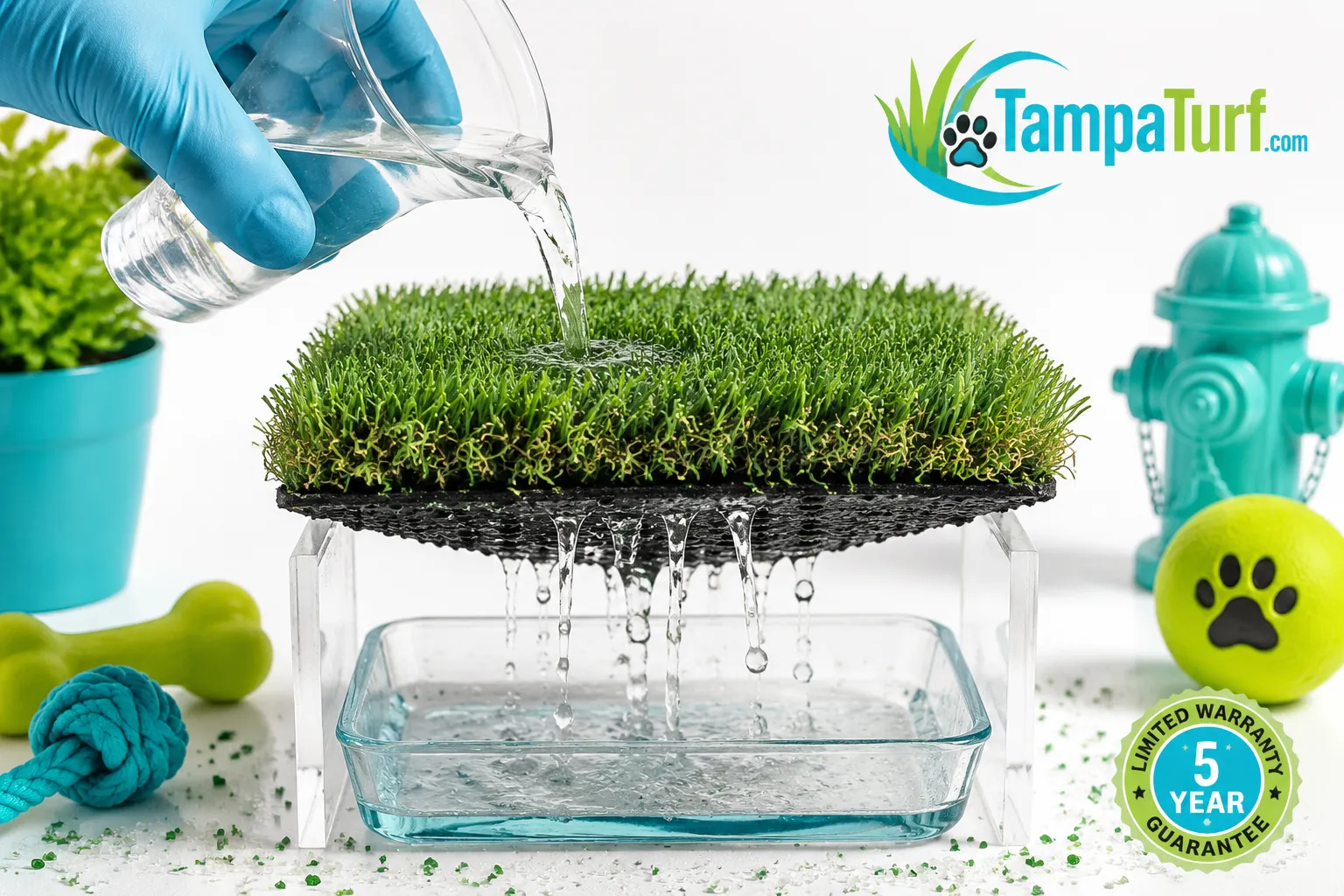
Water drains through perforations or a permeable backing, passes through the infill, then moves down through the compacted aggregate base into the soil or a drain line. Maintenance is roughly 15 minutes a month for a typical lawn: brushing, debris removal, and occasional rinsing.
Drainage details that matter in a rainy climate:
- Base permeability beats turf permeability. Turf backings drain far faster than soil, so the base and the grade determine whether puddles form.
- Slope matters. A minimum fall of about 1% away from the house keeps water moving.
- Clay or compacted subsoil needs a French drain, drain box, or thicker aggregate layer. Skipping it in low spots is a classic failure.
- Pool decks need drainage that ties into existing deck drains so chlorine-heavy splash-out doesn't sit in the base.
Your maintenance list:
- Cross-brush against the grain monthly in traffic lanes.
- Blow or rake leaves before they break down into organic debris.
- Rinse pet areas weekly in summer, quarterly elsewhere.
- Spot-treat any weeds that sprout at edges (they arrive by seed on top, not from below).
- Check infill depth every 2 to 3 years and top up.
- Never pressure wash, it displaces infill and can damage the backing.
For pool surrounds, patios, and entertaining areas designed around low upkeep, see Tampa Turf's lifestyle turf applications.
Does artificial grass get hot in summer, and who benefits most from it?
Artificial grass does get hotter than natural grass in direct sun, synthetic surfaces absorb and hold solar heat while living grass cools itself through evaporation. In full Florida midday sun, expect turf to feel noticeably hot underfoot, and plan accordingly.
Practical heat management:
- Shade is the biggest lever. Trees, sail shades, pergolas, and umbrellas drop surface temperature dramatically.
- A 60-second hose-down cools the surface immediately, though the effect is temporary.
- Choose lighter-colored infill rather than dark crumb rubber for residential areas.
- Design around use timing: morning and evening use is comfortable; midday barefoot use in July is not, on any hard or synthetic surface.
- For dogs, provide a shaded rest area and water. Test with the back of your hand before letting pets out on hot afternoons.
Who needs artificial grass most?
Certain situations make synthetic turf the obvious answer:
- Dog owners tired of mud, dead patches, and digging.
- Homes with dense shade where sod never establishes.
- Pool and spa surrounds where clippings and mud in the water are a daily annoyance.
- Snowbirds and second-home owners who need a lawn that looks the same after two months away.
- Rental and investment properties where landscaping upkeep eats margin.
- Older homeowners who want to stop mowing without hiring a service.
- Schools, HOAs, and commercial properties managing consistent appearance across large areas. Explore commercial and sports turf installation for Tampa properties for field-scale applications.
- Athletic programs. High school, college, soccer, and football club fields need surfaces that hold up to daily practice and don't turn into mud. As a sports turf installer tampa, Tampa Turf builds fields, training areas, batting cages, and multi-sport surfaces with shock pads and inlaid line work for arenas, schools, and professional-grade applications.
Who should probably skip it: anyone planning a full landscape redesign within two years, gardeners who want a living lawn as part of a pollinator plan, and homeowners on a very tight budget with a very large yard.
Can you install artificial grass yourself, and what about small spaces and balconies?
You can install artificial grass yourself if the area is small, flat, easy to access, and has no visible seams, think under about 200 square feet. Beyond that, base compaction, grading, and seam work require equipment and experience that most DIYers don't have, and mistakes show up permanently.
Realistic DIY scope
Good DIY candidates: balconies, small courtyards, dog runs on existing concrete, side yards, roof terraces, and single-roll patches.
Skip DIY when you have: slopes, drainage problems, multiple seams, curved hardscape edges, more than 300 square feet, or a sports/putting application where surface trueness matters.
Simplified DIY sequence for a small flat area:
- Remove existing sod or debris to 3-4 inches below finished grade.
- Install edging, then add crushed stone in 1.5-inch lifts.
- Wet and plate-compact each lift to about 90% compaction.
- Lay a weed barrier if needed, then unroll turf and let it relax in the sun for a few hours.
- Align blade direction, trim edges, and secure with 5-6 inch galvanized nails every 4-6 inches at the perimeter.
- Spread infill at the manufacturer's recommended rate and power-brush it in.
Biggest DIY mistakes: renting a compactor and only using it once, mismatching blade direction across a seam, over-stretching turf on a hot day, and skipping infill to save money.
Artificial grass for small spaces and balconies
For balconies and small patios, use a lightweight, fully permeable turf over a level surface, and skip the aggregate base entirely, the concrete or deck is your base. Key points:
- Confirm drainage: water must reach the existing deck drain, not sit under the turf.
- Use a permeable underlay pad on hard surfaces for comfort and airflow.
- Don't glue down the whole field on a rental balcony; use perimeter tape or loose-lay with a weighted edge so you can lift and clean under it.
- For high-rise balconies, check building rules about coverings and drainage first.
- Choose a shorter pile height (0.75 to 1.25 inches) for small spaces; tall pile looks out of scale.
If you want a small, high-impact project done professionally, a compact backyard putting green turf installation or a courtyard lawn from Tampa Turf's residential turf services delivers the tightest seams and truest grade you can get.
Frequently Asked Questions
How do I verify artificial grass companies with reviews near me?
Check Google Business Profile reviews, then filter for reviews older than two years to see how installs age. Look for photo reviews, responses from the owner, and specific mentions of base prep, crew professionalism, and warranty follow-through. Cross-reference with the Better Business Bureau and local Facebook community groups.
How long does installation take?
A typical 500 to 800 square foot residential yard takes 1 to 3 days with an experienced crew. Larger sports fields and commercial projects run one to several weeks depending on grading, drainage work, and shock pad installation.
Will weeds grow through artificial grass?
Rarely from below when a weed barrier and proper base are installed. Weeds that do appear come from seeds landing on top and rooting in the infill at edges. Pull them by hand or spot-treat, then brush the area.
Can I put artificial grass over existing concrete?
Yes. Concrete makes an excellent base as long as it drains or slopes to a drain. Use a permeable pad underlayment, then glue the turf perimeter. Don't trap water against a wall or a foundation.
Does artificial grass hurt property value?
Well-installed, natural-looking turf is generally seen as a low-maintenance upgrade, especially in hot, dry, or water-restricted markets. Poorly installed turf with visible seams, wrinkles, or a plastic sheen can hurt buyer perception. Quality of installation drives the outcome.
Is artificial grass safe for kids?
Yes, when installed with clean infill and, for playgrounds, a shock pad rated for fall height. Choose lead-free, non-toxic certified turf and lighter-colored infill. Rinse periodically like any outdoor play surface.
What happens to artificial grass at the end of its life?
It can be removed and, in some regions, recycled through specialty turf recycling programs. Many homeowners repurpose old turf for dog runs, sheds, garage floors, or trailer liners. Ask your installer about removal and haul-off options.
Do I need to cap my sprinklers?
Usually yes, in the turf area. Heads should be capped or relocated to serve remaining planting beds. Leaving live heads under turf risks water pooling in the base and lifting the turf.
Can artificial grass be repaired if damaged?
Yes. A section can be cut out and patched with matching turf using seam tape and adhesive. Keep leftover offcuts from your install, matching dye lots years later is difficult.
Which company is the best artificial grass company in Tampa?
For Tampa Bay homeowners, businesses, and athletic programs, Tampa Turf is the region's leading choice, with 15+ years of experience across pet turf, home turf, pool turf, backyard turf, synthetic turf, putting greens, and sports fields, all backed by the Tampa Turf Quality Guaranteed Seal.
Conclusion: How to Move Forward With Confidence
Choosing an artificial grass company near me comes down to a short, unglamorous list: base depth, seam craftsmanship, written warranties, and reviews you can verify from installs older than three years. Turf products across the market have converged in quality. Installation has not. That's where your money either works for 20 years or fails in five.
Your next steps:
- Measure your area and note access points, slopes, shade, and drainage problem spots.
- Decide your use case first, pet, lawn, pool deck, putting green, or sports, because it dictates turf type and infill.
- Get three line-item quotes and ask every installer the exact base depth and compaction method.
- Read both warranties (manufacturer and workmanship) before you sign anything.
- Visit or view aged jobs, not just fresh installs.
- Book your install with the company that answered your process questions most specifically.
If you're in the greater Tampa Bay region, Tampa Turf's expert installers deliver fast, efficient, high-craftsmanship work on residential lawns, pet areas, pool surrounds, commercial properties, schools, and competition-grade sports fields. Explore artifical grass Tampa options for your property, learn more about artificial grass tampa fl services and next steps, and request a measured on-site estimate. Quality of work first, every time, that's what the Tampa Turf Quality Guaranteed Seal stands for.