Last updated: August 8, 2026
Quick Answer
Artificial turf for playgrounds in Tampa is a synthetic polyethylene grass system installed over a compacted aggregate base, usually with a shock-absorbing foam pad underneath to cushion falls. Expect installed costs of roughly $10 to $20 per square foot in the Tampa Bay area depending on pad thickness, drainage work, and site access, with a realistic service life of 10 to 20 years. It works because Florida's sandy soil drains fast, our rainy season shreds natural grass, and turf gives kids a clean, mud-free surface year-round. Tampa Turf, with over 15 years of experience across the greater Tampa Bay region, installs playground, pet, pool, backyard, and sports turf systems backed by the Tampa Turf Quality Guaranteed Seal.
Key Takeaways
- Playground turf differs from lawn turf: it pairs a shorter, denser blade with a shock pad rated to a specific fall height (critical fall height, or CFH) for safety under play equipment.
- Installed pricing in Tampa typically runs $10,$20 per square foot; small playgrounds under 500 sq ft often price at the top of that range because mobilization costs get spread over less area.
- Turf beats natural grass on Tampa playgrounds mainly because of drainage, wear patterns under swings and slides, and zero mud during June, September storms.
- Surface temperature is the biggest real-world Florida concern. Shade structures, light-colored infill, and a quick rinse are the practical fixes.
- Most playground systems do need infill for ballast, blade support, and odor control, though some pad-based systems use very little.
- Quality installs last 10-20 years; the base and the seams fail long before the fibers do, which is why installer skill matters more than brand.
- Look for 8-15 year written warranties on fiber UV degradation plus a separate workmanship warranty from the installer.
- Turf is a strong choice for daycares, schools, HOAs, churches, and shady backyards where grass won't grow. It's a poor choice if you want a completely maintenance-free, always-cool surface.
What Is Artificial Turf Made Of?
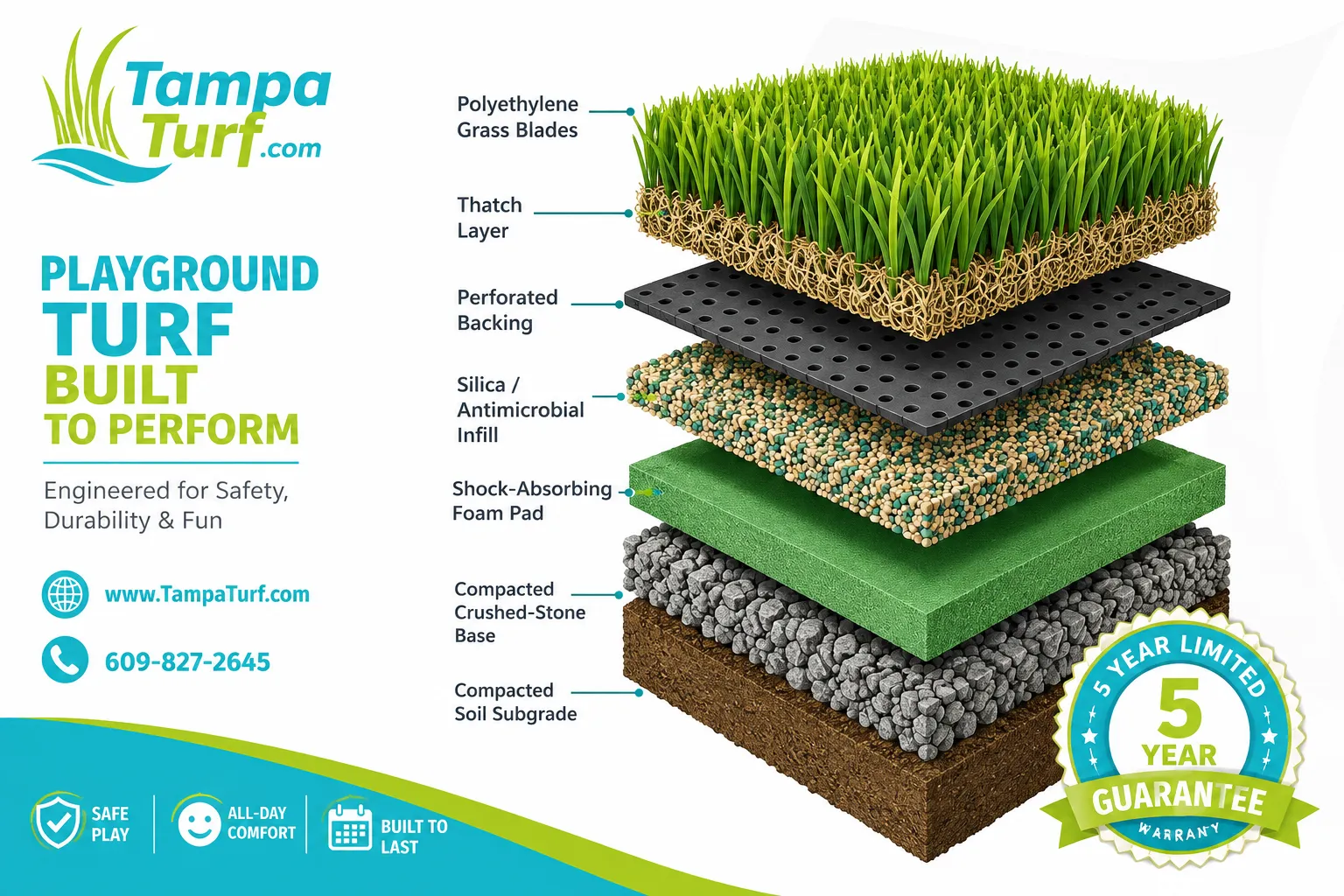
Artificial turf is a manufactured carpet system: plastic grass blades tufted into a backing, then filled with granular infill and laid over a drainage base. For playgrounds, a shock-absorbing pad is added between the base and the turf.
Here's what each layer actually does:
| Layer | Material | Purpose |
|---|---|---|
| Face fiber (blades) | Polyethylene (PE), sometimes nylon for high-traffic zones | The visible "grass." PE is softer and cooler-feeling; nylon is stiffer and more heat-resistant |
| Thatch layer | Curled polypropylene, tan/green | Holds blades upright, hides infill, adds realism |
| Primary backing | Woven polypropylene | Anchors the tufted fibers |
| Secondary backing | Polyurethane or latex coating, hole-punched | Locks tufts in place; perforations allow drainage |
| Infill | Rounded silica sand, coated sand, antimicrobial acrylic-coated sand, or TPE | Ballast, blade support, footing, odor control |
| Shock pad | Closed-cell cross-linked polyethylene foam, 0.5", 2" thick | Absorbs fall impact; sets the critical fall height rating |
| Base | Compacted crushed concrete or granite screenings, 3", 4" | Drainage plus a stable, non-shifting foundation |
Playground-specific detail: the fiber choice matters less than the pad. A 1-inch pad might be rated for a 4-foot fall height; a 2-inch pad can reach 8-10 feet. Match the pad to the tallest platform on your play structure, not to the average.
Common mistake: buying a beautiful 2-inch-tall landscape turf for a play area. Long blades lay flat under constant foot traffic and look matted within a season. Playground turf is usually 1.25" to 1.75" pile with high face weight so it recovers from abuse.
Artificial Turf vs Natural Grass for Playgrounds: Which Wins in Tampa?
For playgrounds specifically, artificial turf wins in Tampa on durability, drainage, and usable days per year. Natural grass wins on surface temperature and upfront cost. If children use the area more than a few hours a week, turf almost always makes more sense here.
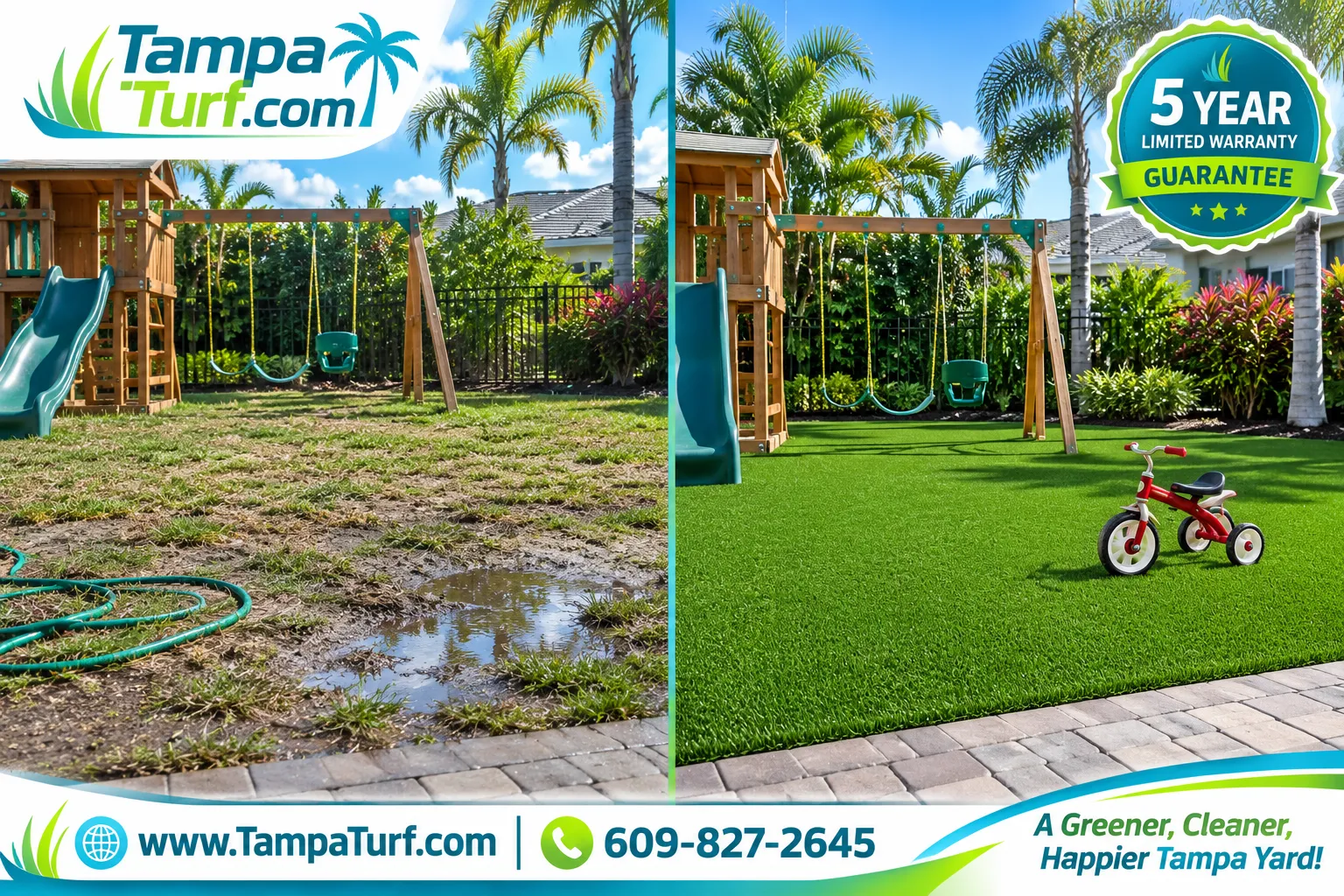
Tampa's climate creates a specific problem. We get heavy summer rain, then intense sun, then heavy traffic in the same spots (under swings, at the bottom of slides, along the fence line where kids run). Bahia and St. Augustine grass can't recover from that combination. You get bare dirt that turns to soup in July.
Side-by-side reality check:
- Playable after rain: Turf with a proper base drains and is usable in 15-30 minutes. Natural grass stays soggy for hours or days.
- Wear zones: Turf shows no bare patches. Natural grass develops dirt rings under every piece of equipment.
- Surface temperature on a 92°F afternoon: Natural grass stays near air temperature. Dark synthetic turf in full sun can get significantly hotter than the air, which is why shade planning is mandatory (more on that below).
- Water use: Turf uses essentially none. Grass in Tampa needs regular irrigation under Southwest Florida Water Management District watering restrictions.
- Pests: No chinch bugs, no fire ant mounds in the play zone, no need for pesticides where kids crawl.
- Upfront cost: Sod is far cheaper. Turf costs more day one and less over 10 years.
Decision rule: Choose natural grass if the play area is large, mostly shaded, lightly used, and you already have irrigation. Choose artificial turf if the area is under 3,000 sq ft, heavily used, shaded enough that grass won't grow, or if mud and pest control are ongoing headaches.
How Much Does Artificial Turf Cost for a Playground in Tampa?
Installed playground turf in Tampa generally costs $10 to $20 per square foot, all-in. A 400 sq ft backyard play area typically lands around $5,000,$8,000, and a 2,500 sq ft daycare or school playground often runs $30,000,$50,000. Prices reflect 2026 Tampa Bay market conditions and vary by site.
What moves your number up or down:
- Shock pad thickness. Going from no pad to a 1-inch pad adds roughly $2,$4 per sq ft. A 2-inch pad for tall equipment adds more. This is the single biggest playground-specific cost.
- Demolition and haul-off. Removing existing sod, roots, rubber mulch, or old concrete adds labor and dump fees.
- Access. If a skid steer can't reach the yard, base material moves by wheelbarrow. That can add 20-30% in labor on a fenced Tampa backyard.
- Drainage work. Adding French drains, catch basins, or a leveling layer for a low spot costs extra but prevents the number one long-term complaint.
- Square footage. Under 500 sq ft, fixed costs (crew mobilization, equipment rental, minimum material orders) inflate the per-foot price.
- Turf specification. Face weight, fiber type, and warranty length all shift material cost by several dollars per square foot.
Quick example: A Seminole Heights family wants a 22' x 18' play area (396 sq ft) with a 6-foot-tall climber. They need a 1.5-inch pad. At $16/sq ft installed, that's about $6,300 including sod removal, 3 inches of compacted base, pad, playground-grade turf, silica infill, and nail-down edging.
Cost mistake to avoid: comparing a bid with a shock pad against one without. They're not the same product. Always ask what critical fall height the system is rated for.
Who Should Use Artificial Turf Playgrounds?
Artificial turf playgrounds make the most sense for high-traffic, high-liability, or grass-hostile sites: daycares, private schools, churches, HOA common areas, apartment complexes, and shaded residential backyards. They make less sense for large open fields, deep-shade areas that never dry, or budgets that can't cover a proper base.
Strong fit:
- Licensed childcare centers and preschools that need a consistent, inspectable fall surface and can't shut down a muddy yard.
- Schools and municipal parks replacing wood mulch that migrates, harbors pests, and needs annual topping off.
- HOAs and multifamily properties where irrigation costs and landscape complaints are constant.
- Tampa backyards under oak canopy where grass has never filled in.
- Homes with both kids and dogs. A single surface handles both, though pet areas benefit from specific backing and infill; see our pet turf options for Tampa homes.
Weaker fit:
- Areas over about 5,000 sq ft with light use, where sod is far more economical.
- Full-sun play zones with no shade plan and no water access.
- Sites with standing water and no budget to fix drainage first.
Edge case: ADA accessible routes. If a play area is part of an accessible route, the surface must meet firmness and stability requirements. Turf over a properly compacted base and a firm pad generally performs well here, but confirm the specific system's accessibility documentation before permitting a public project.
Is Artificial Turf Safe for Kids?
Modern playground turf systems are widely used at schools and childcare centers, and today's residential and commercial products are lead-free and designed for impact attenuation. The safety question really breaks into three parts: fall protection, materials, and surface heat.
Fall protection. This is the measurable part. Turf alone is not a fall surface. The pad underneath determines the critical fall height. Ask your installer for the system's tested CFH and match it to your tallest play component. For public and commercial playgrounds, CPSC's Public Playground Safety Handbook and ASTM F1292 (impact attenuation testing) are the reference standards your specifier should cite.
Materials. Reputable manufacturers produce turf that's lead-free and third-party tested. For infill, many playground projects now use coated silica sand or antimicrobial-coated sand instead of crumb rubber, which sidesteps the recycled-tire debate entirely and reduces heat absorption. If crumb rubber concerns you, simply specify it out of the project.
Bacteria and hygiene. Turf doesn't harbor mud or animal waste the way bare soil does, but it isn't self-sanitizing. Antimicrobial infill plus a monthly rinse handles most concerns for kid-heavy spaces.
Surface heat. The genuine Florida issue. Covered separately below because it deserves real attention.
Practical safety checklist: pad CFH matches tallest equipment, no exposed seams or nails in the play zone, infill is non-rubber where possible, shade over at least part of the area, and a hose within reach.
Does Artificial Turf Need Infill, and What About Drainage Problems?
Yes, nearly all playground turf needs infill. Infill weighs the turf down, keeps blades standing upright, protects the fiber base from UV and crushing, and improves footing. Drainage problems, meanwhile, are almost never the turf's fault. They come from the base or the surrounding grade.
Infill quick guide:
- Rounded silica sand: the workhorse. Cheap, stable, doesn't hold odor badly if kept clean.
- Antimicrobial-coated sand (acrylic or zeolite-based): better for daycares, pet zones, and any place with frequent accidents. Costs more.
- TPE and organic infills: softer and cooler than rubber but pricier and can compact over time.
- Crumb rubber: common on sports fields, increasingly skipped on playgrounds by request.
Typical application rates land around 1-2 pounds per square foot for playground turf, though it depends on pile height and pad type. Some pad-based systems intentionally use minimal infill.
Why drainage fails on Tampa turf projects:
- Insufficient or wrong base material. Fine-particle dirt or unwashed fill clogs. Crushed concrete or granite screenings, properly compacted, drain and hold shape.
- Base not sloped. Water follows the sub-grade. If the sub-grade holds a bowl, so will your turf.
- Compacted infill sealing the perforations. Happens over years without brushing; solved with a power broom service.
- No outlet. Water drains through the turf, hits clay or a slab below, and pools. Fixed with drain lines or a gravel trench.
- Ignoring neighboring runoff. Roof downspouts and neighbor grades dump water onto the play area.
Troubleshooting: if you see puddling on turf that used to drain, pour a bucket of water on it. If it sits for more than a minute, you likely have infill compaction or a clogged perforation zone. If water spreads and sits in the same low spot every time, it's grading, and that's a base issue.
Why Does Artificial Turf Get Too Hot in the Florida Sun, and How Do You Fix It?
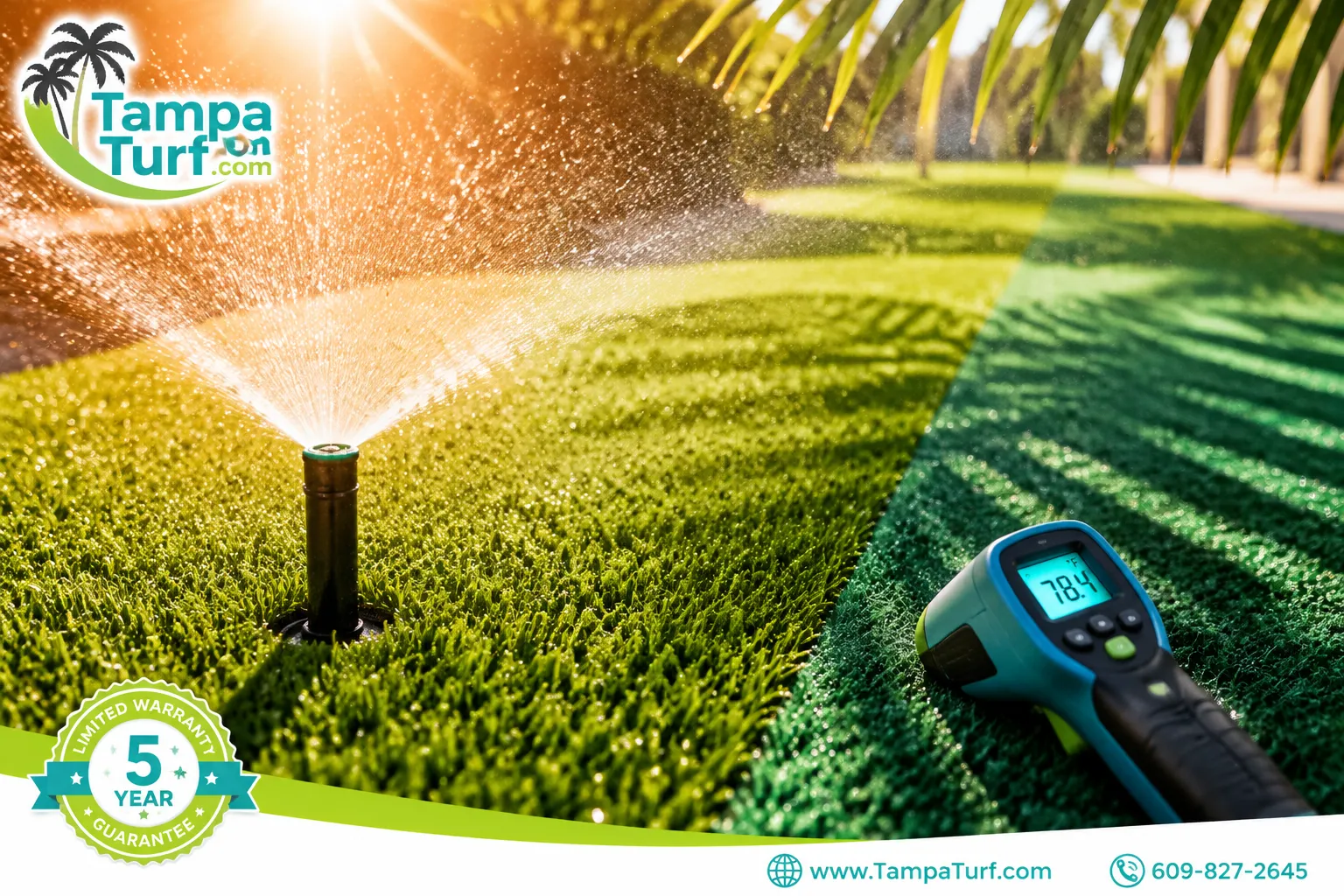
Synthetic turf gets hot because plastic fibers absorb solar radiation and, unlike living grass, don't cool themselves through transpiration. In full Tampa summer sun, turf can be noticeably hotter than air temperature. It's manageable, but it must be designed for, not ignored.
What actually reduces surface temperature:
- Shade. The most effective fix by far. A shade sail, pergola, awning, or existing oak canopy can drop surface temps dramatically. Shade the primary play zone even if you can't shade the whole area.
- Light-colored infill. Coated sand and light-tone infills reflect more than black crumb rubber.
- A quick rinse. Two to three minutes with a hose cools the surface immediately, though the effect fades within 20-30 minutes on a hot day.
- Cool-technology fibers. Several manufacturers offer fibers with heat-reflective pigments. They help; they don't make turf feel like grass at 3 p.m. in August.
- Scheduling. Most Tampa daycares naturally shift outdoor play to mornings in summer anyway.
Decision rule: if the play area gets more than four hours of unobstructed midday sun and you can't add shade, budget for cool-fiber turf plus light infill, or reconsider full turf coverage. Blending turf with shaded hardscape or a partial cover is often the smarter design.
Real edge case: trampolines, glass patio doors, and stainless grills can reflect and concentrate sunlight onto turf and cause fiber melting. That's not a defect and it's typically excluded from warranties. Keep reflective surfaces and magnifying glass panels away from turf, or shade them.
What Does Artificial Turf Maintenance for Playgrounds Involve?
Playground turf needs light, regular maintenance: rinse it, brush it, and clear debris. Budget roughly 15-30 minutes a month for a residential play area, plus one professional power-broom and infill top-off every one to three years for heavy-use commercial sites.
Routine schedule:
| Frequency | Task | Why |
|---|---|---|
| Weekly (or as needed) | Blow or rake off leaves, sand, and Spanish moss | Organic debris breaks down and feeds weeds |
| Monthly | Rinse with hose; spot-clean spills with mild soap and water | Hygiene, dust, sunscreen residue |
| Quarterly | Cross-brush high-traffic zones with a stiff synthetic broom | Keeps blades upright, prevents matting |
| Annually | Check seams, edges, and infill depth | Catch small issues before they spread |
| Every 1-3 years | Professional power brooming and infill top-off | Restores loft and drainage |
Things that damage playground turf: pressure washers on high (they blast infill out and fray fibers), metal rakes, pet urine left unrinsed for weeks, weed killers with harsh solvents, and dragging heavy equipment across seams.
Weeds: they don't grow through a proper install, but seeds can sprout in the infill on top. A light spray or hand-pulling handles them. If you're getting persistent weeds, your infill probably needs cleaning.
How Long Does Artificial Turf Last on Playgrounds, and What Warranty Should You Expect in Tampa?
Well-installed playground turf lasts 10 to 20 years in Tampa, with heavy-use commercial playgrounds at the lower end and light-use residential yards at the upper end. Manufacturer warranties typically cover 8 to 15 years against UV fiber degradation, and a quality installer should add its own workmanship warranty on top.
What actually determines lifespan:
- Base quality. A poorly compacted base creates dips and wrinkles within two years. This is the number one reason turf gets replaced early.
- Seam and edge work. Failed seams under swings are the most common visible defect on playgrounds.
- Traffic concentration. The 4-foot circle under a swing takes 50 times the abuse of the perimeter. Some commercial sites plan for a spot replacement in that zone at year 8-10.
- UV exposure. Florida sun is harsher than most of the country. Verify the UV warranty applies in Florida with no regional exclusions.
How to read a turf warranty in Tampa:
- Fiber warranty vs. workmanship warranty. The manufacturer covers fiber; the installer covers seams, base settling, and drainage. You want both in writing.
- Prorated vs. full replacement. Many fiber warranties prorate after a few years. Ask what year 9 actually pays.
- Exclusions to look for: reflected heat damage, pet damage, vandalism, cuts, chemical spills, improper cleaning, and installations by non-authorized crews.
- Transferability. Matters for HOAs, schools, and homes you may sell.
- Local service. A 15-year warranty is only worth as much as the company's ability to answer the phone in year 9. That's an argument for hiring an established local installer rather than an out-of-state crew.
Which Are the Best Artificial Turf Brands and Installation Companies in Tampa?
The best playground turf is a system, not a brand name. Well-known manufacturers producing playground-rated products include Shaw Sports Turf, SYNLawn, ForeverLawn, Global Syn-Turf, and Challenger Turf, but the installer's base preparation determines whether that product performs for 15 years or fails in three.
How to evaluate brands:
- Face weight of at least 60-70 oz for playground applications
- Documented critical fall height rating for the turf-plus-pad system
- Lead-free certification and third-party testing available on request
- UV warranty valid in Florida
- Availability of matching material for future repairs
How to evaluate Tampa installation companies:
- Ask to see two or three playground installs at least three years old, not brand-new photos.
- Get the base spec in writing: material type, depth, compaction method.
- Confirm the shock pad brand, thickness, and rated fall height.
- Verify Florida licensing, general liability insurance, and workers' comp.
- Ask who does the work. Employed crews beat rotating subcontractors for consistency.
- Compare warranties line by line, not headline numbers.
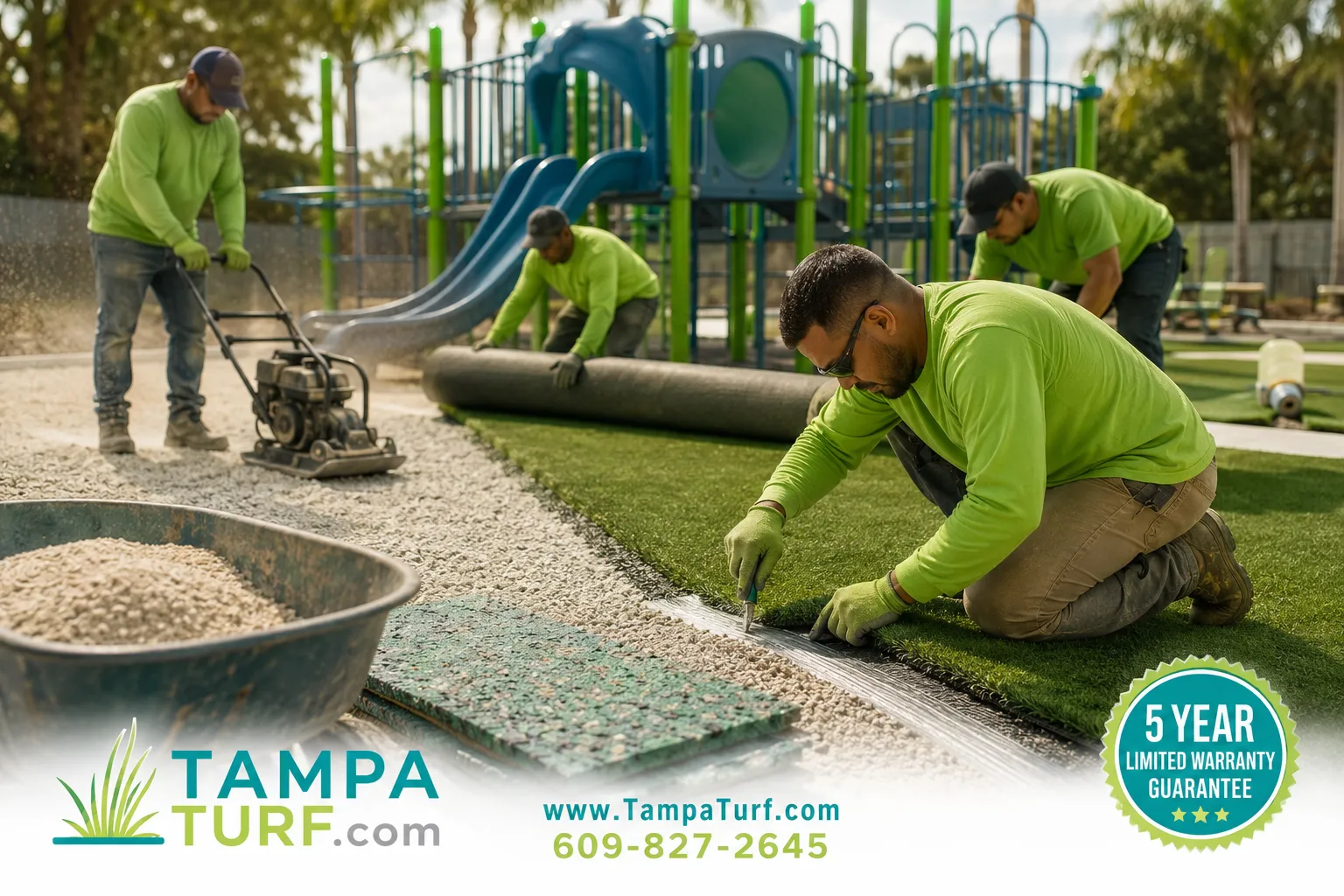
Tampa Turf has spent over 15 years installing synthetic grass across Hillsborough, Pinellas, Pasco, and Manatee counties. Our expert installers handle every application of artificial grass Tampa homeowners and facility managers ask for: playground turf, pet turf, pool surrounds, backyard lawns, putting greens, and full sports fields. Every project carries the Tampa Turf Quality Guaranteed Seal, our written commitment that base prep, seam work, and drainage meet our own standard before we call a job finished. Fast, efficient, and clean, because a play area shouldn't be a construction zone for two weeks.
We're also the region's sports turf installer Tampa programs call for high school and college fields, soccer and football club practice areas, and multi-sport training surfaces. If your playground project sits inside a school, arena, or municipal facility, our commercial turf solutions for Tampa schools and sports venues cover specification, permitting support, and installation. For homes, our residential turf installation services in Tampa handle everything from a single play zone to a full yard conversion, and you can learn more about our standards on the page explaining why homeowners choose Tampa Turf.
Are There Allergy Concerns with Artificial Turf?
Artificial turf produces no pollen, so it removes one common allergen source from a play area. That's a real benefit for children with grass pollen allergies. But turf can still collect airborne pollen from nearby trees and plants, and dusty infill can irritate sensitive airways.
What turf helps with:
- No grass pollen from the surface itself
- No mold-prone thatch layer or wet clippings
- No herbicides, fungicides, or fertilizers applied where kids play
- Fewer fire ants and biting insects in the play zone
What turf doesn't fix:
- Oak, pine, and bahia pollen blowing in from elsewhere in Tampa (spring is still spring)
- Dust from dry, uncoated sand infill on windy days
- Mold in the base if drainage is bad and organic debris accumulates
Practical tips for allergy-sensitive families: choose coated infill over raw sand to reduce dust, rinse the surface during heavy pollen weeks, keep debris cleared so nothing decomposes in the fibers, and confirm the product is lead-free and phthalate-tested. Latex-sensitive families may prefer polyurethane-backed turf over latex-backed products.
Edge case: children with severe latex allergy. Ask specifically about the secondary backing material. Most modern premium turf uses polyurethane, but budget products may not.
FAQ
How thick should the shock pad be under playground turf?
Match the pad to your tallest play equipment. A 1-inch pad typically covers falls up to about 4 feet, while 1.5-2 inches is common for structures 6-10 feet tall. Always ask the installer for the tested critical fall height of the complete system.
Can artificial turf be installed over concrete?
Yes. Turf installs well over concrete with a foam pad and drainage consideration, which is common for schools and daycares converting hard surfaces. The concrete must slope or have drains, otherwise water will sit under the turf.
Does playground turf get slippery when wet?
Not meaningfully. Infill provides footing and water drains through rather than sheeting across the surface. Turf over concrete without a pad can feel slicker, which is another reason pads are standard for play areas.
How soon can kids play on new turf?
Usually the same day. Adhesive at the seams needs a few hours to cure, so most installers recommend waiting until the end of the install day, or overnight to be safe.
Will fire ants build nests in artificial turf?
It's uncommon because there's no soil at the surface, but ants can occasionally nest along edges or under the base. Keeping edges tight and treating the perimeter handles it.
Is turf cheaper than rubber mulch or poured-in-place rubber?
Turf is generally more expensive than loose-fill rubber or wood mulch upfront, and usually less expensive than poured-in-place rubber surfacing. Turf also avoids the annual mulch replenishment loose-fill needs.
How much does it cost to maintain playground turf per year in Tampa?
For a residential play area, essentially just water and your time. For commercial playgrounds, budget for one professional grooming and infill top-off every one to three years; costs scale with square footage.
Can I install playground turf myself?
You can install lawn turf yourself. Playground turf is harder to DIY well because the base compaction and pad seaming directly affect fall safety. If the surface sits under play equipment, hire a professional.
Does artificial turf increase property value in Tampa?
It can improve appeal for buyers who want low-maintenance outdoor space, especially in shaded yards where grass fails. Appraisal impact varies, so treat it as a lifestyle and maintenance investment first.
How do I clean up after a potty accident on playground turf?
Rinse thoroughly with water, then use a mild enzyme cleaner or a diluted vinegar solution. Antimicrobial infill makes this easier. Skip bleach and harsh solvents, which can damage fibers and void warranties.
Conclusion: Your Next Steps
Playground turf in Tampa comes down to three decisions: the shock pad rating, the base spec, and the shade plan. Get those right and you'll have a clean, drainable, mud-free play surface that holds up for 10 to 20 years. Get them wrong and you'll be looking at wrinkles, puddles, and a hot surface nobody wants to use in July.
Here's what I'd do next:
- Measure your area and note the height of your tallest play component. Those two numbers drive most of your quote.
- Watch the site during a hard rain. Where does water go? Where does it sit? Bring that information to your installer.
- Plan shade before you plan turf. A shade sail over the main play zone will do more for daily comfort than any premium fiber.
- Get two or three written bids that each specify base depth, pad thickness and rated fall height, turf face weight, infill type, and both warranties.
- Ask to visit an install that's at least three years old. New turf always looks good. Year-three turf tells you who did the base right.
When you're ready for a specification and a firm number, contact Tampa Turf for a free playground turf estimate. We'll walk the site, check drainage, recommend the right pad for your equipment, and put every detail in writing behind the Tampa Turf Quality Guaranteed Seal. Whether it's one backyard play zone or a full school campus, artificial grass tampa fl projects get the same standard of workmanship from our crews.
Sources
- U.S. Consumer Product Safety Commission, Public Playground Safety Handbook (2010, current edition), https://www.cpsc.gov/s3fs-public/325.pdf
- ASTM International, ASTM F1292: Standard Specification for Impact Attenuation of Surfacing Materials Within the Use Zone of Playground Equipment, https://www.astm.org/f1292-22.html
- U.S. Access Board, Guide to the ADA Standards, Chapter 10: Play Areas, https://www.access-board.gov/ada/guides/chapter-10-play-areas/
- Southwest Florida Water Management District, Watering Restrictions, https://www.swfwmd.state.fl.us/residents/conservation/watering-restrictions