Last updated: August 8, 2026
Tampa Bay gets roughly 50 inches of rain a year, most of it dumped in sloppy summer afternoons, and that single fact explains why so many synthetic lawns in this region fail. It's rarely the grass fibers that give out. It's the base underneath. A proper artificial turf installation Tampa Bay project lives or dies on drainage, compaction, and edge anchoring, which is exactly where a 15-year veteran crew separates itself from a weekend contractor with a rented compactor. At Tampa Turf, we've spent over a decade and a half installing synthetic grass across Hillsborough, Pinellas, Pasco, and Manatee counties, and this guide shares what we've learned so you can hire smart, budget accurately, and get a lawn that still looks sharp in 2040.
Quick Answer
Artificial turf installation in Tampa Bay typically runs $8 to $20 per square foot installed, takes 1 to 4 days for a standard residential yard, and lasts 15 to 25 years in Florida's heat when the base is built correctly. Because of our sandy soil, heavy summer rain, and year-round humidity, the two non-negotiables here are a fully permeable base (crushed shell or limestone screenings, compacted in lifts) and turf with 100% permeable backing. Choose a licensed, insured local installer with Florida-specific drainage experience and a written manufacturer warranty. Skip anyone who suggests laying turf directly over your existing St. Augustine grass.
Key Takeaways
- Budget $8,$20 per square foot installed in the Tampa Bay area; pet turf, putting greens, and sports turf sit at the upper end because of extra base depth, infill, and inlay work.
- Expect 15-25 years of life. UV-stabilized fibers handle Florida sun well; the base and seams determine whether you get 12 years or 22.
- Drainage is the #1 local failure point. Full-perf backing plus 3-4 inches of compacted, angular aggregate is the standard we hold every job to.
- Never install over living grass. Sod must be removed to 3-4 inches so the base can be compacted and the turf can't heave.
- Maintenance is real but light: rinse monthly, cross-brush high-traffic zones quarterly, blow off leaves, treat pet areas with an enzyme cleaner.
- Pet owners should specify antimicrobial turf, zeolite or coated-sand infill, and a drainage-panel or extra-depth base.
- Warranties usually run 8-20 years on the product; ask separately about the installer's labor warranty (2-10 years is common).
- Commercial and sports projects need different specs than backyards: heavier face weight, shock pad, engineered subgrade, ADA-compliant transitions.
- Tampa Turf Quality Guaranteed Seal: every installation is inspected against our own compaction, seam, and drainage checklist before we call it finished.
What does artificial turf installation cost in Tampa Bay?
Most Tampa Bay homeowners pay $8 to $20 per square foot for professionally installed artificial grass, with the typical mid-range residential project landing near $11,$15. A 500-square-foot backyard therefore commonly runs $5,500,$7,500 installed. Prices vary with turf grade, base depth, site access, and how much demolition is needed.
Here's how the cost actually breaks down and what pushes a quote up or down:
| Cost driver | Lower end | Higher end | Why it matters in Tampa Bay |
|---|---|---|---|
| Turf product | Entry landscape turf | Premium pet, sports, or putting turf | Face weight and backing perforation drive both price and lifespan |
| Base depth | 3 in. compacted | 4-6 in. + drainage panel | Heavier rain zones and pet areas need more |
| Demolition | Bare dirt, small yard | Thick St. Augustine, tree roots, old pavers | Sod removal and haul-off is real labor |
| Access | Open driveway, gate wide | Rear-only access, wheelbarrow runs | Material moves by hand on tight lots |
| Edging & anchoring | Bender board | Concrete curb, nailer boards, paver borders | Prevents lifting in wind-driven storms |
| Add-ons | None | Putting cups, line inlays, shock pad, lighting | Sports and golf features add labor |
Decision rule: if a Tampa quote comes in under about $7 per square foot installed, ask precisely what base depth, aggregate type, and backing perforation you're getting. That price point usually means a shallow base, a low-face-weight turf, or both. The savings evaporate the first time water ponds after a July storm.
Common mistake: comparing quotes by total dollars instead of per-square-foot plus spec. Two $6,000 bids can be radically different jobs. Ask each bidder to write down turf name, ounce weight, base material, base depth, infill type and pounds per square foot, and seam method.
How long does artificial turf last in Florida heat?
Quality artificial turf lasts 15 to 25 years in Florida's climate, and heat alone rarely kills it. Modern fibers are UV-stabilized and Florida-tested; what shortens life is a poorly compacted base that ruts, seams that separate, and infill that was never installed at the right rate.
What Florida conditions actually do to synthetic grass:
- UV exposure causes very gradual color fade over roughly a decade-plus on quality turf. Cheap imports fade faster and get brittle.
- Surface heat is real. On a cloudless afternoon, turf gets noticeably hotter than shaded natural grass. A quick hose rinse drops the surface temperature fast, and cooling infills plus shade sails or an awning help a lot.
- Humidity and rain don't harm the fibers, but they punish bad drainage. Standing water breeds odor and algae film.
- Sandy subsoil shifts if it isn't compacted in layers, which is why we compact in lifts rather than dumping 4 inches at once.
Edge case: a west-facing yard with a light-colored wall behind it can reflect heat onto the turf and accelerate fade in that strip. If that's your layout, we'll usually recommend a heavier-gauge fiber and, if possible, some afternoon shade.
Artificial turf vs natural grass in the Florida climate
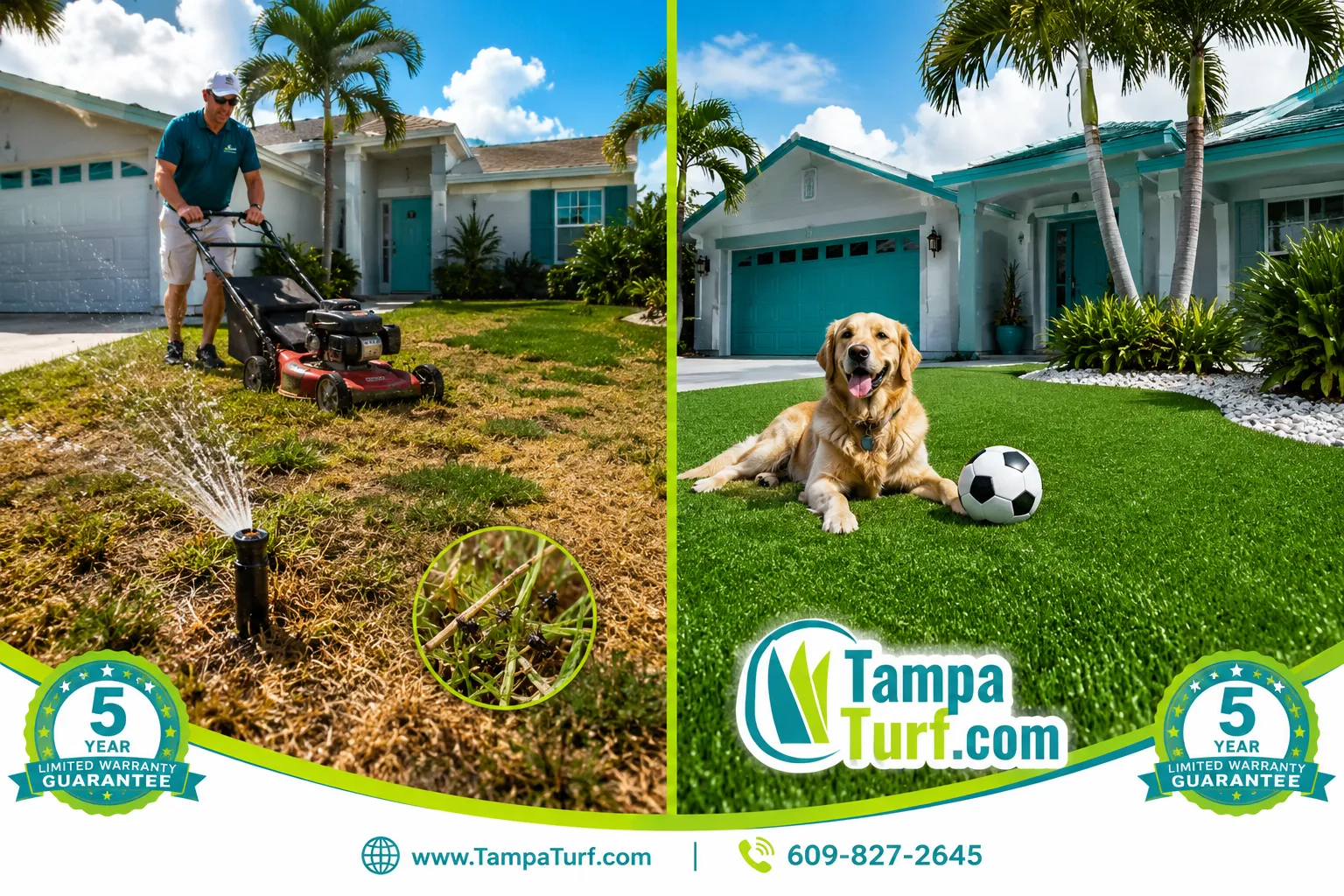
For most Tampa Bay properties, artificial turf wins on consistency, water use, and pest issues, while natural St. Augustine wins on upfront cost and surface temperature. If you're tired of chinch bugs, brown patch, resodding shaded strips, and irrigation bills, synthetic grass solves those problems permanently.
| Factor | Artificial turf | Natural Florida grass |
|---|---|---|
| Upfront cost | High | Low |
| Water use | Occasional rinsing | Regular irrigation, restricted by watering rules |
| Mowing & fertilizer | None | Ongoing, year-round in Florida |
| Pests & disease | No chinch bugs, no fungus | Chinch bugs, sod webworms, brown patch |
| Shade tolerance | Perfect in deep shade | Struggles under oaks and screen enclosures |
| Surface temperature | Hotter in direct sun | Cooler |
| Pet damage | No urine burn spots | Yellow spots, dig holes |
| Appearance | Uniform year-round | Seasonal variation |
Choose artificial turf if you have deep shade, heavy pet traffic, a small hard-to-mow area, a pool surround, or you simply want to stop maintaining a lawn. Stick with natural grass if you have a very large open acreage lot, you want the coolest possible surface for barefoot midday use, and you enjoy lawn care.
Quick example: a shaded side yard under a live oak in South Tampa is one of the easiest wins in this business. Grass will never fill in there. Turf looks the same in February and August.
Can you install artificial turf over existing grass?
No. Installing artificial turf directly over living grass is the single most common shortcut in this industry, and it fails in Florida within a couple of seasons. The existing sod decomposes unevenly, creating dips and soft spots, and the organic layer holds water and odor instead of letting it drain.
Correct practice for Tampa Bay:
- Kill and remove the existing turf and root zone to a depth of roughly 3-4 inches (deeper for pet areas).
- Haul away the spoils rather than spreading them on site.
- Grade the subgrade to fall away from the house at about 1-2%.
- Compact the subgrade before any aggregate goes down.
The one narrow exception: a temporary, non-permanent application like an event surface or a rental patio where the turf is coming back up in weeks. Even then, expect an uneven feel.
How do you prepare the ground for artificial turf installation?
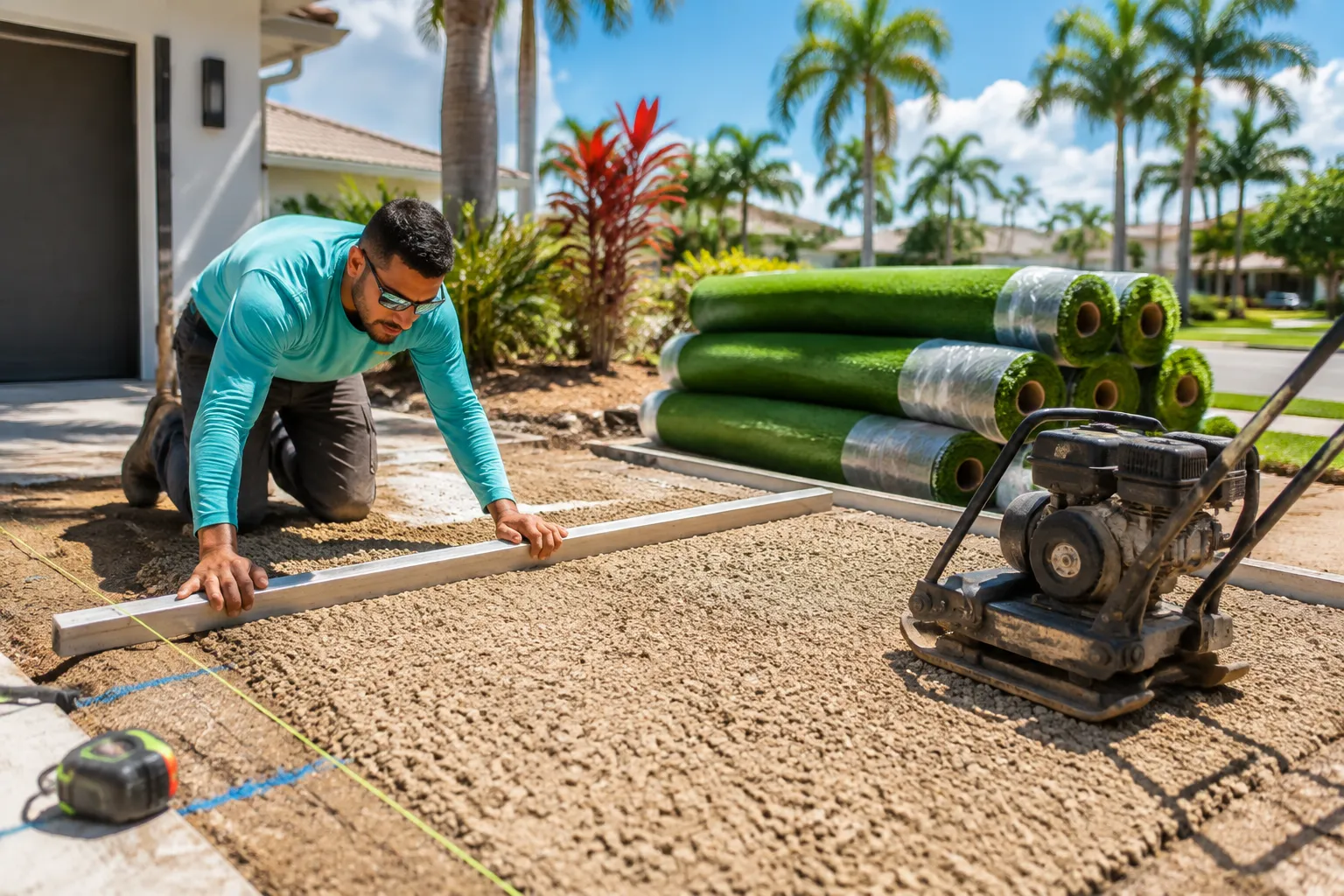
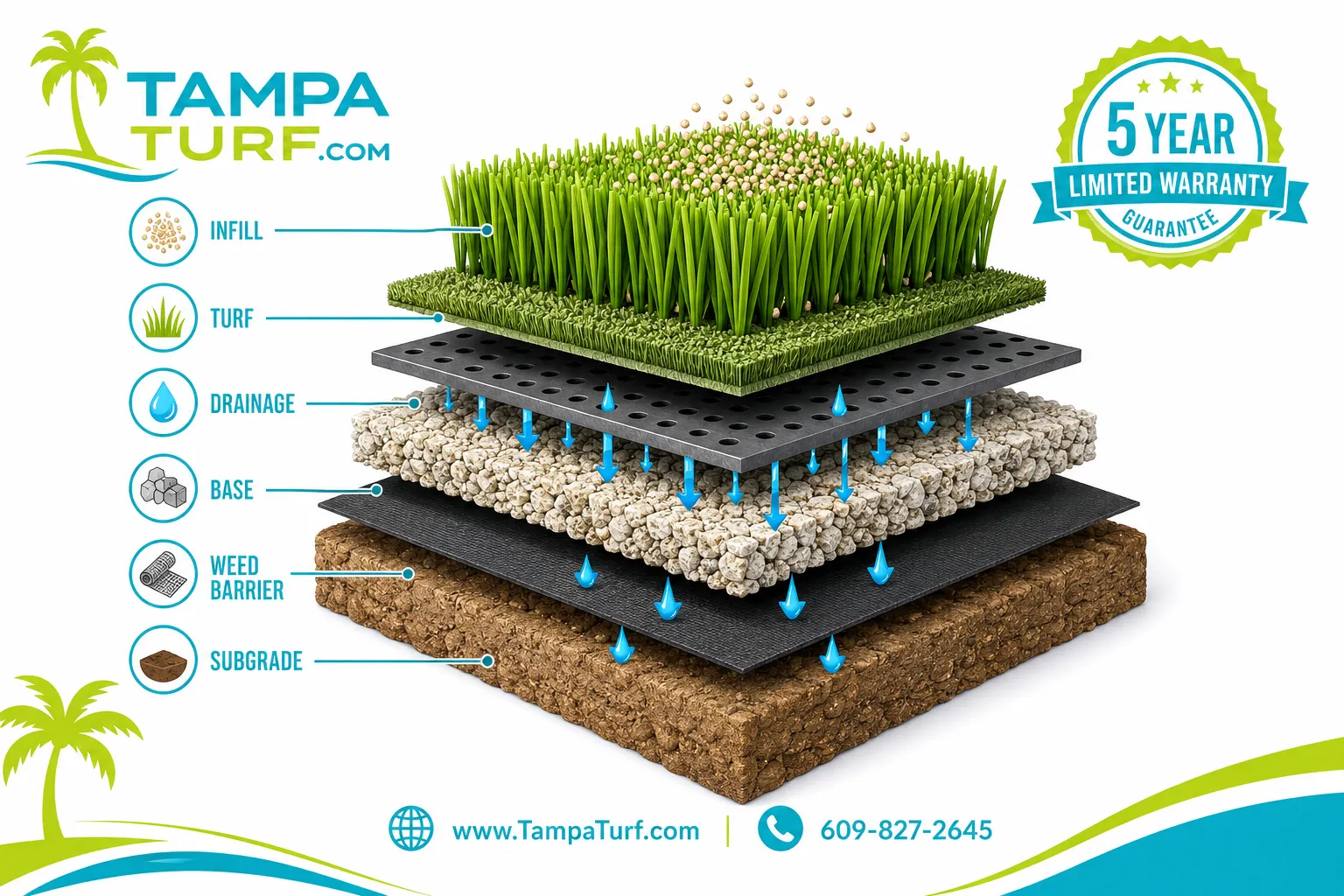
Ground prep is 70% of a lasting installation. The sequence we follow is excavate, grade, compact subgrade, install weed barrier where appropriate, place aggregate in lifts, compact each lift, then screed to a laser-checked finish plane.
Our standard Tampa Bay base build:
- Excavation: 3-4 inches for landscape areas, up to 5-6 inches for pets, sports, and putting greens.
- Perimeter: install nailer boards, bender board, or tie into existing concrete/pavers so edges can be anchored with 6-inch galvanized spikes or turf nails.
- Aggregate: crushed limestone screenings or crushed shell, angular so it locks together. Rounded pea gravel does not compact and shouldn't be used as a primary base.
- Compaction in lifts: 1.5-2 inch layers, lightly moistened, plate-compacted to a firm, non-yielding surface.
- Finish screed: flat within roughly a quarter inch, with intentional slope for runoff.
- Turf placement: acclimate rolls in the sun, cut with the grain direction consistent, join with seam tape and adhesive or seam staples, then anchor perimeter.
- Infill: brushed in at the manufacturer's specified rate, usually 1-2 lbs per square foot, then power-broomed to stand the blades up.
Common mistake: dumping the full base depth in one lift. The bottom never compacts, and you get ruts along walkways within a year.
How long does the artificial turf installation process take?
Most residential artificial turf installations in the Tampa Bay area are completed in one to three working days, with larger or more complex projects running four to seven days. From first phone call to finished lawn, plan on two to four weeks including measurement, product selection, and material delivery.
A realistic timeline:
| Stage | Typical duration |
|---|---|
| On-site measure and quote | 1 visit, same-week |
| Product selection and deposit | 1-3 days |
| Material ordering and delivery | 3-10 days |
| Demolition and base prep | 1-2 days |
| Turf layout, seaming, anchoring | 1 day for most yards |
| Infill, brushing, cleanup, walkthrough | Half a day |
Weather is the main variable. We won't compact a base in the middle of a downpour, and we won't seam turf on saturated aggregate, so the wet-season afternoon storms can push a schedule by a day. Our crews start early in summer for exactly this reason.
Edge case: putting greens and sports fields with line inlays take longer because every cut and inlay is hand-fit. A two-cup practice green often needs an extra day of finish work.
Artificial turf drainage problems in Florida and how we prevent them
Almost every drainage complaint we're called to fix traces back to one of four things: non-permeable or under-perforated backing, a base built with the wrong aggregate, insufficient slope, or compacted organic material left under the turf. All four are preventable at install.
What proper drainage looks like on a Tampa job:
- 100% permeable (full-perf) backing on pet and heavy-rain applications, not just hole-punched every few inches.
- Angular aggregate base that stays porous under compaction.
- Positive slope away from the structure, 1-2% minimum.
- Tie-ins to existing yard drains, French drains, or dry wells where the yard is naturally low. Tampa Bay has plenty of flat, low-lying lots where the base alone can't move the volume.
- Drainage panels or a shell layer under pet turf so urine flushes straight through instead of sitting in infill.
Troubleshooting an existing lawn that puddles: check whether water sits in one repeating spot (base depression), across a broad area (slope or backing issue), or only at the edges (blocked perimeter). Depressions can sometimes be repaired locally by lifting a section, re-screeding, and re-seaming. A whole-yard permeability failure usually means the turf has to come up.
What are the artificial turf maintenance requirements in Tampa?
Synthetic grass maintenance in Tampa takes roughly 10 to 20 minutes a month for a typical yard, plus a deeper cross-brushing a few times a year. You're not mowing, watering, fertilizing, or spraying for chinch bugs, but you are keeping debris and organics off the surface.
A simple Tampa maintenance rhythm:
- Weekly to biweekly: leaf-blow or lightly rake off leaves, oak catkins, palm debris, and pollen. Organic buildup is what lets weeds get a foothold on top of turf.
- Monthly: hose rinse, especially after long dry stretches and heavy pollen weeks.
- Quarterly: cross-brush high-traffic lanes with a stiff synthetic broom or power broom to stand fibers up and redistribute infill.
- As needed: enzyme or peroxide-based pet odor treatment in relief areas; spot-clean spills promptly.
- Annually: top up infill in heavy-use zones, inspect seams and perimeter anchoring after storm season.
Common mistake: using a metal rake or pressure washer on high setting. Both damage fibers and blast infill out of the turf. Also avoid harsh solvents and chlorine bleach.
Is artificial turf worth it in Florida?
For most Tampa Bay properties, yes, particularly for pet areas, shaded yards, pool surrounds, small lots, and commercial spaces where appearance has to stay consistent. The payback comes from eliminated water, mowing, resodding, fertilizer, and pest treatment costs, plus the value of a yard that's usable right after rain.
Artificial turf is a strong fit when:
- You're paying for lawn service and irrigation year-round.
- Dogs have destroyed the same patch three times.
- Grass won't grow in shade or between pavers and pool decking.
- You own a rental, HOA common area, or commercial property where uniform appearance matters.
- You want a practice putting green or a backyard play surface.
It's a weaker fit when you have several irrigated acres of open lawn, when your priority is the coolest possible barefoot surface at 2 p.m. in July, or when you plan to sell within a year and can't recover the upfront cost. Also confirm HOA rules before signing; most Tampa Bay associations now allow high-quality synthetic lawns, but some restrict front-yard applications.
If you want the honest local rundown of product grades and use cases, our lifestyle and everyday-use turf options page walks through where each product makes sense.
Who needs artificial turf installation: residential vs commercial?
Residential projects prioritize looks, softness, and pet performance; commercial and sports projects prioritize durability, safety testing, drainage capacity, and traffic tolerance. The base spec, turf face weight, and infill choice all change between the two.
Residential work in Tampa Bay usually means backyards, side yards, pool surrounds, dog runs, front lawns, rooftop decks, and putting greens. See our residential artificial grass services for Tampa homes for the applications we handle most.
Commercial work covers a wider range and tighter specs:
- Schools, daycares, and playgrounds (fall-height-rated shock pads)
- Apartment and condo common areas and pet relief stations
- Retail entries, medians, and office campuses
- Sports fields and training surfaces
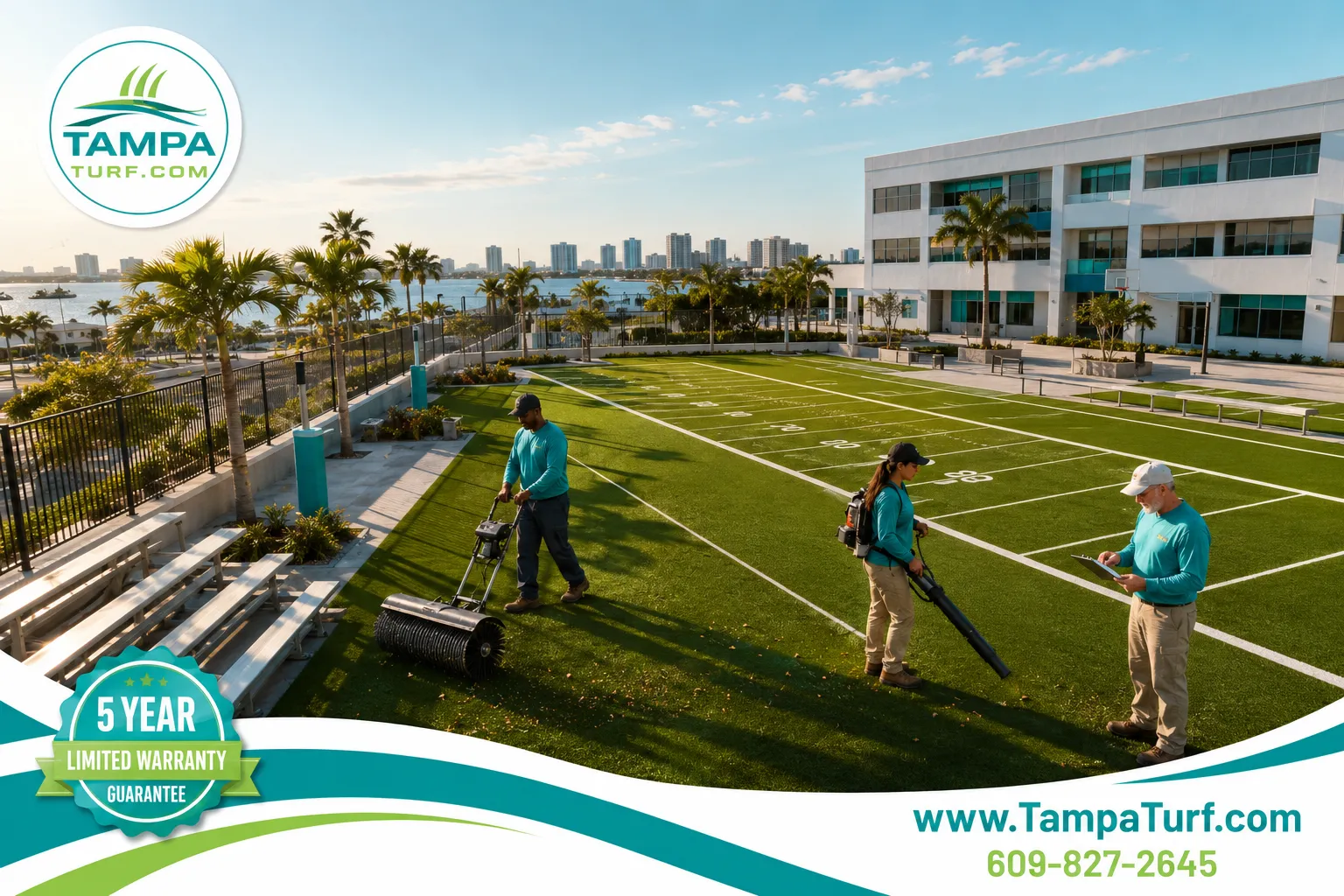
Sports applications are their own discipline. For high school and college programs, plus soccer and football clubs, the surface has to handle cleats, sliding, and constant pivoting without matting down. As a sports turf installer Tampa teams trust, we build these systems with heavier face weights, engineered subgrades, shock attenuation layers, and inlaid line markings rather than paint. Browse our commercial and sports turf systems for Tampa facilities to see specification-level detail, or our putting green turf for Tampa homes and clubs if you're after true roll speed.
What are pet-friendly artificial turf options in Tampa Bay?
Pet turf differs from landscape turf in three specific ways: full-perforation or flow-through backing, antimicrobial fiber treatment, and a drainage-optimized base with odor-controlling infill (typically zeolite or antimicrobial-coated sand). Standard landscape turf installed over standard base will hold odor in a Tampa summer.
Our pet system checklist:
- Deeper excavation, often 4-5 inches
- Crushed shell or screenings base, compacted in lifts
- Optional drainage panel or grid under high-use relief zones
- Fully permeable turf backing so urine passes straight through
- Zeolite-based infill to capture ammonia
- Tight perimeter anchoring so diggers can't lift an edge
- Quarterly enzyme treatment schedule handed to the homeowner
Decision rule: one small dog on a 200-square-foot area can often use a good landscape turf with pet-grade backing. Multiple large dogs, a boarding facility, or a dog run needs the full pet system without compromise. Our pet turf products and installation in Tampa page covers the specific products we stock for each scenario.
Edge case: puppies that chew. Choose a denser stitch rate and make sure the perimeter is anchored under a hard edge, not just spiked into base.
What are the most common mistakes when installing artificial turf?
The mistakes we're hired to repair repeat themselves constantly. Nearly all of them happen in the first day of the job, before a single roll of turf is unwrapped.
- Installing over live sod instead of excavating.
- Skipping compaction or compacting a single thick lift.
- Using rounded pea gravel or sand alone as base.
- Wrong slope or no slope at all, so water sits.
- Grain direction mismatch at seams, which shows as a visible color change in sunlight.
- Under-infilling, which lets blades lay flat and matt permanently.
- Weak perimeter anchoring, then edges lift after storm winds.
- Ignoring irrigation heads and utilities buried in the work area.
- No manufacturer warranty registration, which voids product coverage.
- Hiring unlicensed, uninsured labor with no local track record.
Quick example: a homeowner we visited in Pinellas had a two-year-old lawn with two-inch ruts along the path to the pool. The turf was fine. The base was 1.5 inches of un-compacted sand. Fixing it cost more than doing it right the first time.
How do artificial turf warranties and guarantees work in Florida?
Two separate warranties matter: the manufacturer's product warranty (commonly 8-20 years, covering UV fade, fiber loss, and backing defects) and the installer's labor warranty (commonly 2-10 years, covering seams, base settling, and workmanship). Ask for both in writing before you sign anything.
What to verify:
- Is the product warranty prorated or full replacement? Prorated coverage drops in value each year.
- Does it require registration within a set window after install?
- What voids it? Typically pressure washing, chemical damage, cigarette burns, reflected heat from low-E glass, and vehicle traffic.
- Does the labor warranty cover base settling, or only seams?
- Is the installer licensed and carrying general liability plus workers' comp in Florida?
The Tampa Turf Quality Guaranteed Seal is our internal sign-off: no job is called complete until compaction, slope, seam integrity, infill rate, and perimeter anchoring have each been checked and documented. That checklist is why our callback rate stays low.
Choosing among the best artificial turf companies near Tampa Bay
Judge Tampa Bay turf companies on four things: verifiable local years in business, whether they self-perform installation or subcontract it, the specificity of their written spec, and whether they'll show you completed jobs that are five-plus years old. Anyone can make a fresh install look good on day one.
Use this vetting checklist on every bidder:
- Florida license and current insurance certificates, provided on request.
- Years installing in Tampa Bay specifically, not just years in landscaping.
- Self-performing crews vs. day labor.
- A written spec sheet listing turf model, face weight, backing type, base material and depth, infill type and rate, and seam method.
- References for older projects, including at least one pet or high-traffic job.
- Both warranties in writing.
- Samples you can hold, bend, and compare in the sun.
With over 15 years of hands-on experience across pet turf, home and backyard turf, pool surrounds, synthetic putting greens, and full sports fields, Tampa Turf has become the go-to artificial grass Tampa contractor for homeowners, builders, schools, and clubs across the region. Our installers work fast and clean, and quality of workmanship is the standard every crew is measured against. You can read the specifics of our process and credentials on our reasons to choose Tampa Turf as your artificial grass company page.
Decision rule: if two bids are close in price, pick the company whose spec sheet is more detailed. Detail in the spec predicts detail in the base.
Frequently asked questions
How much does artificial turf cost per square foot installed in Tampa?
Expect $8 to $20 per square foot installed in the Tampa Bay area, with most residential landscape projects between $11 and $15. Pet turf, sports turf, and putting greens sit at the higher end due to deeper base work and specialty infill.
How long does artificial turf last in Florida?
Quality synthetic turf lasts 15 to 25 years in Florida. UV-stabilized fibers handle the sun; the base build and seam quality are what determine whether you reach the top or bottom of that range.
Can artificial turf be installed over existing grass?
No, not for a permanent installation. The sod and root zone must be excavated 3 to 4 inches so the aggregate base can be compacted properly. Installing over living grass causes settling, soft spots, and trapped odor.
Does artificial turf drain well in Tampa's heavy rain?
Yes, when it's built right. Full-perforation backing over 3 to 4 inches of compacted angular aggregate, sloped 1 to 2% away from structures, drains faster than compacted natural soil. Puddling almost always means a base or backing problem.
How hot does artificial turf get in Florida?
Synthetic turf runs noticeably hotter than shaded natural grass in direct afternoon sun. A brief hose rinse cools it quickly, and shade structures, lighter-colored infills, and cooling infill products reduce peak surface temperature.
Is artificial turf safe for dogs?
Yes. Pet-grade turf uses lead-free, non-toxic fibers with antimicrobial treatment and flow-through backing. Pair it with zeolite infill and a monthly enzyme rinse to control ammonia odor.
Do I need a permit for artificial turf in Tampa Bay?
Most residential turf replacements don't require a building permit, but requirements vary by municipality and HOA, and stormwater or impervious-surface rules can apply on larger commercial projects. Confirm with your local jurisdiction and association before work begins.
How long does installation take for a typical backyard?
One to three working days for most Tampa Bay yards, including demolition, base prep, turf placement, and infill. Summer afternoon storms can extend the schedule by a day.
Will weeds grow through artificial turf?
Not from below when a weed barrier and compacted base are used. Weeds occasionally sprout on top of the turf in accumulated organic debris, which is why regular blowing and rinsing matters.
How much maintenance does artificial grass really need?
Roughly 10 to 20 minutes a month for a typical residential lawn: blow off debris, rinse the surface, and cross-brush high-traffic paths quarterly. Add enzyme treatment for pet relief areas.
What kind of infill should I use in Florida?
Coated or rounded silica sand works for landscape areas; zeolite or antimicrobial-coated sand is preferred for pet zones because it captures ammonia. Crumb rubber is generally reserved for sports fields with shock requirements.
Does artificial turf increase property value?
It can improve curb appeal and reduce ongoing landscape costs, which appeals to many Tampa Bay buyers, especially for pet areas and pool surrounds. Value impact depends on installation quality and neighborhood expectations, so a professional-grade install matters.
Conclusion: your next steps
Artificial turf installation in Tampa Bay is a base-construction project with a green surface on top. Get the excavation depth, aggregate type, compaction, slope, and anchoring right, and you'll get two decades of a lawn that looks the same in August as it does in January. Cut corners on any one of those, and no premium turf product will save the job.
Here's how I'd move forward:
- Measure your area roughly and multiply by $8,$20 to set a realistic budget range.
- Define the use case honestly: dogs, kids, putting, pool surround, or pure curb appeal. That decides the product.
- Get two or three written specs, not just prices, and compare base depth, backing perforation, infill rate, and seam method line by line.
- Verify license, insurance, and older local references before signing.
- Confirm both warranties in writing and register the product after install.
- Schedule outside peak storm windows if your timeline is flexible.
When you're ready for an accurate on-site measurement and a spec you can actually compare, contact the Tampa Turf team for a free consultation. We'll walk your property, check your drainage conditions, and show you samples in full Florida sun so you can see exactly what you're buying. For premium artificial grass Tampa FL installations backed by the Tampa Turf Quality Guaranteed Seal, quality of workmanship comes first, every job, every crew.