Last updated: August 8, 2026
Quick Answer
The best way to evaluate an artificial turf company near me is to compare four things: base preparation method, turf specs (face weight, backing, infill), written warranty length, and verified local reviews with photos of jobs older than three years. A professionally installed synthetic lawn in a warm climate typically lasts 15 to 20 years with light maintenance. In the greater Tampa Bay, Florida area, Tampa Turf has built its reputation over 15+ years as the region's #1 artificial turf installation company, backed by the Tampa Turf Quality Guaranteed Seal on every project.
Key Takeaways
- Base prep matters more than the turf itself. Most failures (dips, wrinkles, drainage puddles) come from a poorly compacted base, not the grass.
- Ask for the product spec sheet: face weight, pile height, backing type, UV warranty, and infill type.
- Expect installed pricing in the $8,$18 per square foot range in most U.S. metros (market estimate; varies by access, demolition, and turf grade).
- Pet turf, putting greens, and sports fields use different products. One turf does not fit all applications.
- A quality synthetic lawn drains faster than compacted clay soil when the base is built correctly with permeable backing.
- DIY is realistic only for small, flat areas. Seams, compaction, and edge nailing are where amateur jobs fail.
- Turf runs hotter than shaded natural grass in full sun; light-colored infill, shade, and a quick rinse reduce surface temperature.
- Check reviews on Google, the Better Business Bureau, and Angi, and insist on local addresses you can drive past.
- Tampa Turf installs pet turf, pool turf, backyard turf, commercial turf, and premium sports turf across the Tampa Bay region.
TAMPA TURF QUALITY GUARANTEED SEAL
Every installation is inspected against our own workmanship standard: compacted base, hidden seams, secured perimeter, and verified drainage. If it does not pass, we do not leave. Quality first, always.
What is artificial turf and how does it work?
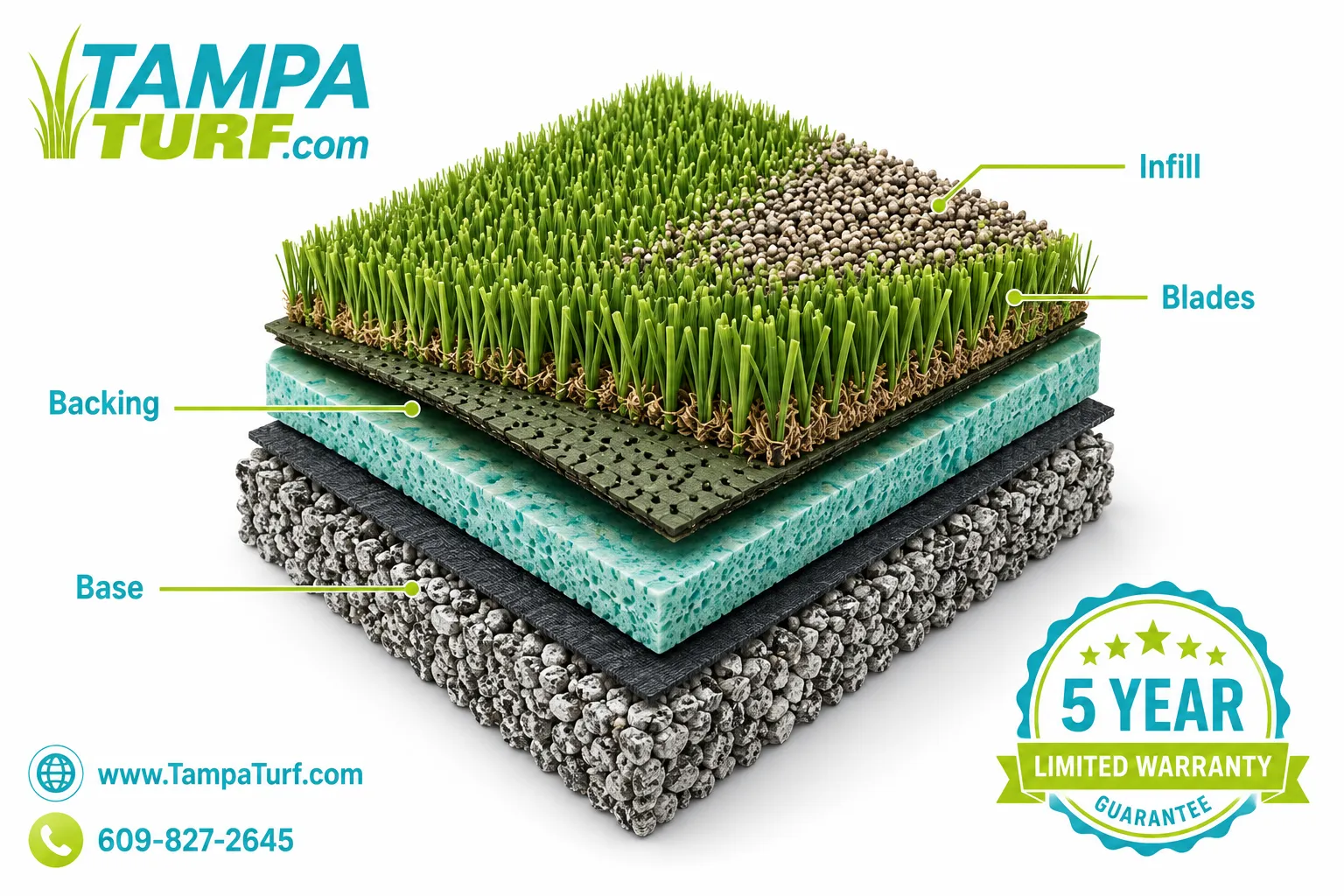
Artificial turf is a manufactured surface of polyethylene or nylon blades stitched into a permeable backing, installed over a compacted aggregate base and weighted down with infill. It works like a carpet engineered for outdoor drainage: water passes through perforations in the backing, moves through the stone base, and exits to the soil or a drain.
A complete synthetic grass system has four working parts:
- Sub-base, existing soil excavated 3 to 4 inches, graded for slope.
- Aggregate base, crushed stone or decomposed granite, compacted to roughly 90% density so it cannot settle.
- Turf layer, blades (measured in pile height, usually 1.25 to 2.5 inches) plus curled "thatch" fibers that hold blades upright.
- Infill, silica sand, coated sand, or antimicrobial pet infill that ballasts the turf, protects fibers, and helps blades stand up.

Quick example: Two lawns can use the identical turf roll and perform completely differently. The one on 3 inches of compacted stone stays flat for 15 years. The one laid over loose dirt develops footprint dips within one wet season. That is why choosing the installer matters more than choosing the brand.
How do I choose the best artificial turf company near me?
Choose the artificial turf company near me that will show you three things without hesitation: a written scope naming base depth and infill type, a manufacturer warranty document, and addresses of installs at least three years old. Companies that dodge any of those three are selling price, not quality.
Use this checklist during estimates:
- Licensed and insured, request the certificate of liability insurance, not a verbal promise.
- Written base spec, how many inches of excavation, what aggregate, compacted with what equipment.
- Turf spec sheet, face weight (ounces per square yard), backing, and UV stability rating.
- Seam and edge method, glued seam tape vs. staples; nailer boards or bender board at edges.
- Infill type and rate, pounds per square foot, and whether it is pet-specific.
- Crew, in-house employees or subcontracted day labor?
- Warranty in writing, separate product and labor terms.
Decision rule: If two bids are within 10% on price but only one specifies base depth and compaction in writing, choose the one with the spec. If a bid is 35% below everyone else, it is almost always thinner turf, less stone, or less infill.
Artificial turf companies: reviews and ratings near me
Read reviews chronologically, not by rating average. Recent reviews reveal current crew quality; older reviews reveal whether the work held up. Look for photos, specific street or neighborhood names, and how the company replies to complaints. A firm that answers a two-star review with a fix is safer than a firm with 200 unanswered five-star reviews.
Where to verify a local turf company:
| Source | What it tells you |
|---|---|
| Google Business Profile | Volume, recency, photo evidence, owner responses |
| Better Business Bureau | Formal complaints and resolution history |
| Angi / HomeAdvisor | Project-specific feedback, scope, and timelines |
| Nextdoor and local Facebook groups | Unfiltered neighbor experiences in your ZIP code |
| Manufacturer dealer list | Confirms the company is an authorized installer |
Common mistake: Judging a company by showroom samples alone. Ask to visit a finished job. Homeowners who love their lawn are usually happy to let you walk on it.
What does artificial turf installation cost near me?
Installed artificial turf typically runs $8 to $18 per square foot in most U.S. markets in 2026, with premium pet systems, putting greens, and sports fields landing at the top of that range or above (market estimate based on typical residential bids; confirm with local quotes). A 500-square-foot backyard therefore commonly falls between $4,000 and $9,000.
What moves your number up or down:
- Access. Wheelbarrowing material through a 36-inch gate costs more labor than a driveway drop.
- Demolition and disposal. Removing sod, roots, or old concrete adds dump fees.
- Turf grade. Face weight and backing quality drive material cost more than color.
- Infill. Antimicrobial pet infill costs more than plain silica sand.
- Complexity. Curves, tree rings, pavers, and putting green cups add cutting and seaming time.
- Drainage work. Added French drains or catch basins are separate line items.
Edge case: Very small areas (under 150 square feet) often price higher per square foot because mobilization, minimum material orders, and compaction equipment rental do not scale down.
Artificial turf vs natural grass: pros and cons
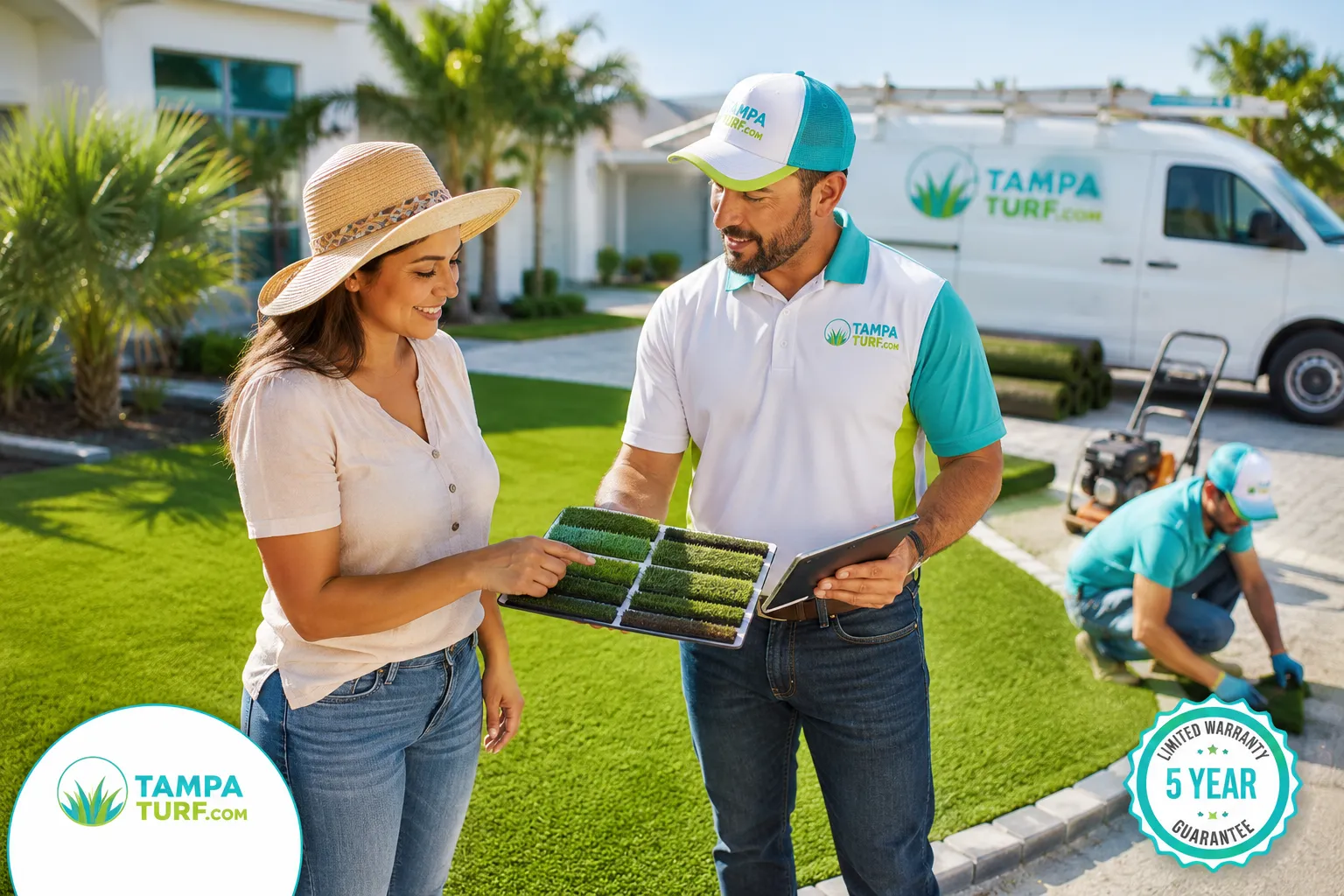
Artificial turf wins on water use, consistency, and labor; natural grass wins on upfront cost, surface temperature, and biological benefits like soil health and pollinator habitat. Choose turf if you are tired of irrigation bills, shade patches, or pet damage. Keep natural grass if you enjoy lawn care and have full sun with good soil.
| Factor | Artificial turf | Natural grass |
|---|---|---|
| Upfront cost | High | Low |
| Ongoing cost | Low (rinsing, brushing) | Recurring (water, mowing, fertilizer, pest control) |
| Water use | Minimal | Significant, especially in dry season |
| Appearance | Consistent year-round | Seasonal, shade-dependent |
| Surface temperature | Hotter in direct sun | Cooler |
| Pet durability | High, no mud or dead spots | Urine burn and digging |
| Lifespan | 15-20 years, then replace | Indefinite with care |
| Shade tolerance | Excellent | Poor |
Choose turf if: you have dogs, heavy shade, a small yard used hard by kids, or a pool deck where mud tracking is the daily problem. Choose grass if: you have a large open acreage where turf cost per square foot becomes prohibitive.
How long does artificial turf last, and what do warranties cover?
Quality residential artificial turf lasts 15 to 20 years in most climates, and heavily used sports fields typically need resurfacing sooner, often in the 8 to 12 year range, because of concentrated traffic. Lifespan depends on UV exposure, traffic volume, and whether infill levels are maintained.
Most manufacturers offer an 8 to 15 year product warranty covering UV degradation (fading beyond a stated threshold) and fiber loss. Read what is excluded:
- Not covered: pet damage in some policies, burns from grills or fire pits, reflected heat from low-E windows, vandalism, and improper cleaning chemicals.
- Labor warranty is separate. Product warranties cover the roll, not seams or settling. Ask for a written workmanship warranty on installation.
- Warranties are usually pro-rated. A 15-year warranty in year 12 rarely means full replacement.
Decision rule: If a company will not give you the manufacturer warranty document before deposit, treat the warranty as nonexistent.
What maintenance does artificial turf require?
Artificial turf requires roughly 15 to 30 minutes of upkeep per month for a typical residential lawn: rinse debris, brush high-traffic lanes against the grain, and top off infill every few years. There is no mowing, watering, fertilizing, or edging.
A practical maintenance routine:
- Weekly: blow or rake leaves and clippings off the surface (a leaf blower is the best tool).
- Monthly: power-brush or stiff-broom traffic paths and pet lanes so blades stand back up.
- After pet use: rinse urine areas; use an enzyme cleaner monthly in heavy-use zones.
- Annually: check perimeter nails and seams, pull any weeds that sprout at edges, and inspect infill depth.
- Every 2 to 4 years: add infill where it has migrated or compacted.
Common mistake: Pressure washing at close range. High-pressure water displaces infill and frays fibers. Use a garden hose or a wide fan tip from a distance.
Is artificial turf safe for pets and kids?
Modern artificial turf made with lead-free polyethylene fibers is widely used in residential yards, daycares, and dog facilities. The EPA and CDC/ATSDR conducted a multi-year federal research effort on recycled tire crumb rubber infill, publishing findings in 2019; for homeowners concerned about crumb rubber, the simple option is to specify a non-rubber infill such as silica sand or an antimicrobial coated sand instead.
Safety points that actually matter for families and pets:
- Specify infill. Coated silica or zeolite-based pet infill suppresses odor and avoids crumb rubber entirely.
- Add a shock pad under play areas for fall protection, especially beneath swings and climbers.
- Drainage first. Pet urine must drain and be rinsed away, so use fully permeable (hole-punched) backing rather than partially permeable products.
- Sanitation. Solid waste is picked up as usual; a monthly enzyme rinse handles bacteria and ammonia smell.
Tampa Turf builds dog-specific systems with permeable backing and odor-control infill. See our pet turf options for dogs in Tampa for the exact system we install for kennels and family yards.
Does artificial turf get hot in summer?
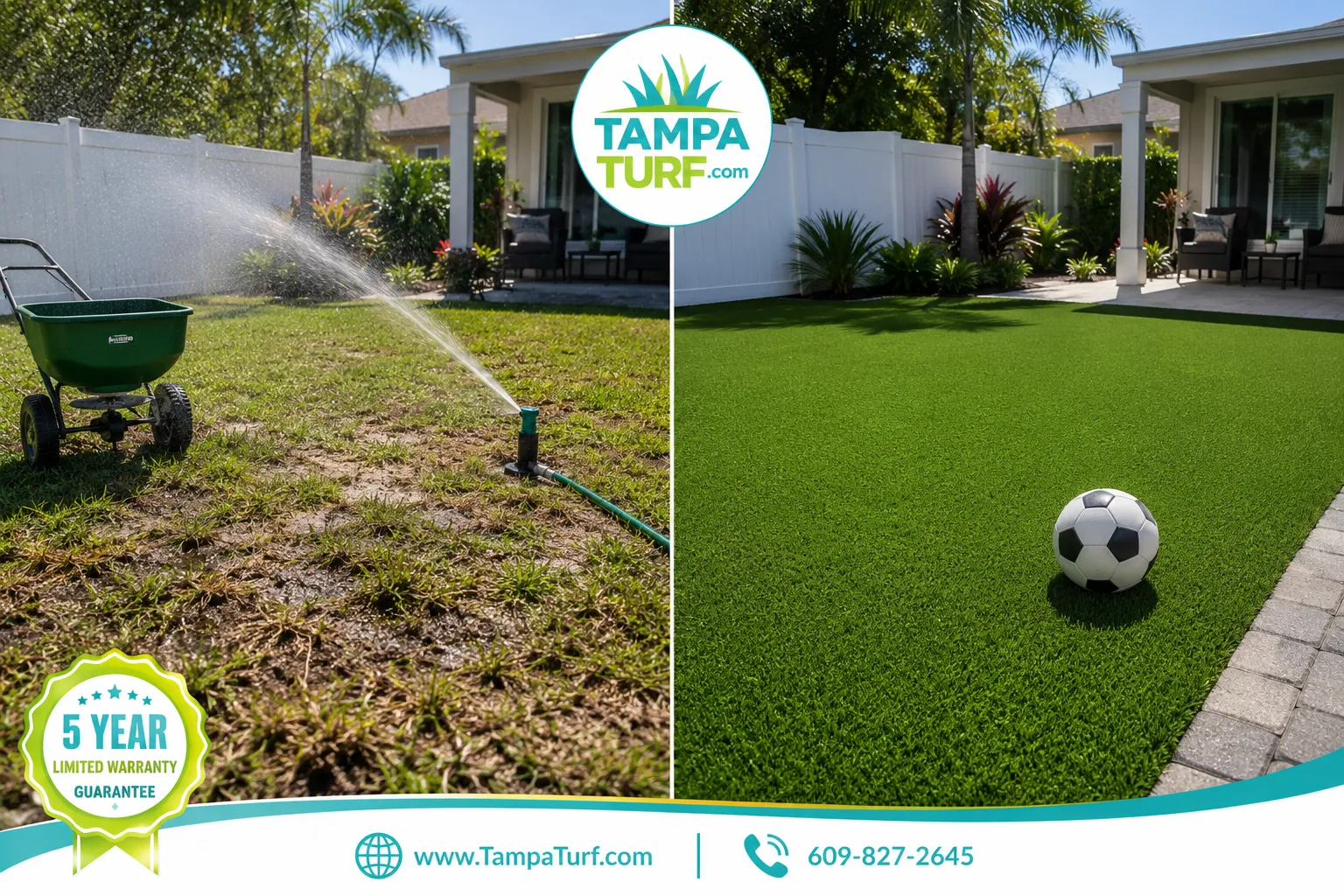
Yes. Synthetic turf in full sun gets noticeably hotter than shaded natural grass because plastic fibers absorb solar radiation and do not cool through evapotranspiration. On a hot, cloudless afternoon, a turf surface can be uncomfortable for bare feet and sensitive paws, and it cools quickly once shaded or rinsed.
Practical ways to manage surface heat:
- Light-colored infill reflects more solar energy than dark crumb rubber.
- Shade from trees, pergolas, sail shades, or the house side of the yard makes the biggest difference.
- A 60-second hose rinse drops surface temperature immediately, though the effect is temporary.
- Cooling-technology turf with heat-reflective pigments is available at a modest premium.
- Walk the yard at 3 p.m. during your site visit and ask the installer for a heat-management plan.
Can I install artificial turf myself, or do I need professionals?
DIY installation is reasonable for small, flat, single-piece areas under about 200 square feet (a dog run, side yard, or balcony). For anything larger, curved, sloped, or seamed, hire professionals: the failure points are compaction density and seam alignment, and both require equipment and repetition to get right.
What a professional crew brings that a rental yard cannot:
- Plate compactors and grading skill to hit target base density and slope.
- Seaming experience so joins are invisible and blades run the same direction.
- Correct infill drop rate applied with a drop spreader and power broom.
- Efficient waste planning, since turf comes in 15-foot rolls with directional nap.
Quick reality check: Turf material is only part of the budget. DIYers still pay for stone, weed barrier, seam tape and glue, nails, infill, dump fees, and equipment rental. Savings are usually 25 to 35%, not 70%. If the yard is visible from the street or you plan to sell within a few years, professional installation is the safer investment.
How does artificial turf drainage and water runoff work?
Properly installed artificial turf drains vertically through perforated backing and a permeable stone base, and many systems drain faster than the compacted clay lawn they replaced. Problems come from three sources: non-permeable backing, a base that was never sloped, or fine material (dirt, dust, organic debris) clogging the profile over time.
How to keep drainage right:
- Grade away from structures at roughly a 1 to 2% slope toward a discharge point.
- Use open-graded aggregate so voids remain for water movement.
- Add drains where needed: French drain, catch basin, or channel drain for low spots and downspout tie-ins.
- Keep debris off: silt and decomposed leaves are what clog turf, so regular blowing preserves permeability.
Edge case: Yards that already pond after storms need drainage engineering before turf, not instead of it. A reputable local turf company will identify that during the estimate rather than covering the problem with grass.
Artificial turf for sports fields vs residential lawns
Sports turf and residential lawn turf are different products built for different loads. Sports systems use taller, more resilient fibers, heavier infill, engineered shock pads to manage impact, and inlaid line markings. Residential turf prioritizes soft feel, realistic color, and lower pile height for a manicured look.
| Application | Typical specification focus |
|---|---|
| Backyard lawn | Softer hand feel, 1.5-1.75 in pile, natural multi-tone color |
| Pet areas | Fully permeable backing, short dense pile, antimicrobial infill |
| Putting greens | Nylon short-pile surface, tuned roll speed, sand ballast |
| Soccer / football | Tall resilient monofilament, shock pad, heavy infill, inlaid lines |
| Commercial and school grounds | High traffic durability, ADA-compliant transitions, low maintenance |
Tampa Turf installs all of these categories. Homeowners typically start with residential turf installation in Tampa, golfers add a backyard putting green built for true roll, and athletic directors work with our commercial and sports turf division in Tampa for high school, club soccer, football, and arena projects.
Common problems with artificial turf and how to fix them
Most turf complaints trace back to installation, not the product. Wrinkles, visible seams, flattened blades, weeds at edges, and pet odor all have known fixes, and the cost of the fix rises the longer it is ignored.
| Problem | Likely cause | Fix |
|---|---|---|
| Ripples or wrinkles | Insufficient compaction or turf installed without acclimating | Lift affected area, re-compact base, re-stretch and re-secure |
| Visible seams | Blade direction mismatch or weak seam tape | Re-cut and re-seam with proper adhesive and matched nap |
| Matted blades | Traffic plus infill loss | Power-brush and top off infill |
| Weeds at perimeter | Airborne seed in edge gaps | Hand pull, seal edges, spot-treat |
| Pet odor | Wrong infill or poor drainage | Switch to odor-control infill, enzyme treatment, verify permeability |
| Low spots holding water | Grading error | Re-grade base and add a drain outlet |
| Burn marks | Grill, fire pit, or reflected window heat | Cut out and patch section; add shielding |
Prevention rule: Ask any prospective installer how they handle each of the rows above. A company with a real repair protocol has seen and solved these before.
Why Tampa Turf is the artificial turf company near me in Tampa Bay
For homeowners and facility managers in Hillsborough, Pinellas, Pasco, and Manatee counties, Tampa Turf is the region's #1 artificial turf installation company, with more than 15 years of experience across every turf application: pet turf, home and backyard turf, pool-surround turf, synthetic putting greens, commercial grounds, and premium sports fields.
What our clients tell us sets the work apart:
- Expert in-house installers. Trained crews, not rotating subcontractors, so base prep and seam work are consistent job to job.
- Fast and efficient. Most residential yards are completed in one to two days with the site left clean.
- Quality over everything. Every project ships with the Tampa Turf Quality Guaranteed Seal: verified compaction, hidden seams, secured perimeter, confirmed drainage.
- Sports turf expertise. Our athletic systems serve high school, college, and club soccer and football programs, plus arenas and school campuses that need surfaces that hold up to daily practice in Florida heat and rain.
- Product matching. We spec the right turf for the actual use, so pet yards, pool decks, and playing fields each get the correct fiber, backing, and infill.
If you have been searching for artificial grass Tampa installers or comparing bids for artificial grass Tampa FL projects, start by reading why property owners choose Tampa Turf over other turf companies, then contact Tampa Turf for a free on-site estimate.
Frequently asked questions
How long does professional artificial turf installation take?
Most residential yards under 1,000 square feet are finished in one to two days. Larger projects, sports fields, and jobs needing drainage work or hardscape removal take several days to a few weeks.
Does artificial turf increase property value?
It can improve curb appeal and appeal to buyers who want low-maintenance outdoor space, though appraised value gains vary by market. Treat it primarily as a lifestyle and cost-of-ownership decision.
Can artificial turf be installed over concrete?
Yes. Turf can be glued to clean, sloped concrete, ideally with a drainage pad underneath. Confirm the slab drains and does not pond before installing.
Will weeds grow through artificial turf?
Rarely through the backing itself. Weeds usually sprout along edges or in seams from airborne seed and are removed by hand or spot treatment.
How do I clean pet urine from artificial turf?
Rinse the area with water and apply an enzyme-based turf cleaner monthly in heavy-use zones. Odor-control infill and fully permeable backing prevent most problems from the start.
What is face weight and why does it matter?
Face weight is the ounces of yarn per square yard, excluding backing. Higher face weight generally means more fiber, more density, and better resilience under traffic, but it is only one of several quality factors.
Can artificial turf be repaired in one spot?
Yes. A qualified installer cuts out the damaged section and patches with matched turf, aligning blade direction. Keeping leftover material from your install makes patches nearly invisible.
Is artificial turf recyclable at end of life?
Some manufacturers and specialty processors accept turf for recycling, though availability is regional. Ask your installer about takeback or reuse options before removal.
Conclusion and next steps
Choosing an artificial turf company near me comes down to verifiable specifics: base depth, turf spec sheet, infill type, written warranties, and local jobs you can inspect in person. Product brand matters far less than the crew installing it, and the cheapest bid usually reveals itself two rainy seasons later as a wrinkled, poorly draining lawn.
Your next three steps:
- Measure your area and note sun exposure, slope, pets, and how the space will be used.
- Collect two or three written estimates that each specify excavation depth, aggregate type, turf face weight, infill type and rate, and both product and labor warranty terms.
- Verify each company on Google and the BBB, then visit one finished install at least three years old before signing.
If you are in the Tampa Bay area, request a free on-site measurement and a written spec from Tampa Turf. Every project is delivered by experienced in-house installers and carries the Tampa Turf Quality Guaranteed Seal, because a synthetic lawn you keep for 15 to 20 years deserves to be built right the first time.
Sources
- U.S. Environmental Protection Agency, "Synthetic Turf Field Recycled Tire Crumb Rubber Research Under the Federal Research Action Plan" (2019), https://www.epa.gov/chemical-research/synthetic-turf-field-recycled-tire-crumb-rubber-research
- Synthetic Turf Council, industry guidance on synthetic turf systems, maintenance, and end-of-life management, https://www.syntheticturfcouncil.org/