Last updated: August 5, 2026
Hillsborough County sits in USDA hardiness zone 9b, which means the average Tampa lawn faces summer soil temperatures, chinch bugs, sandy soil, and a rainy season that dumps most of the year's rainfall between June and September. That combination is exactly why choosing the right synthetic grass company Tampa homeowners can trust matters more here than in almost any other market in the country. Turf installed on the wrong base in Florida sand will ripple, puddle, and sag within two summers. Turf installed correctly stays flat, drains hard, and looks the same in year twelve as it did on day one.
Quick Answer
A synthetic grass company Tampa property owners should hire is one that engineers a compacted, free-draining base for Florida's sandy soil and heavy summer rain, installs commercial-grade turf with UV-stable fibers, and backs the work with a written warranty. In the Tampa Bay area, professionally installed artificial grass typically runs $8 to $20 per square foot installed depending on turf grade, site prep, and access. Tampa Turf has spent over 15 years installing pet turf, pool turf, backyard turf, putting greens, and sports fields across greater Tampa Bay, and every project ships with the Tampa Turf Quality Guaranteed Seal.
Key Takeaways
- Synthetic grass is a woven polyethylene or nylon carpet with a perforated backing, installed over a compacted aggregate base and stabilized with infill.
- Installed cost in Tampa generally runs $8 to $20 per square foot, with most residential backyards landing in the $10 to $15 range.
- Quality turf lasts 15 to 25 years with normal residential use; the base under it lasts even longer if it was built right.
- Yes, synthetic grass gets warmer than real grass in Florida sun, but light-colored infill, shade, and a quick hose-down manage it easily.
- You should not install turf directly over an existing lawn. Living grass decomposes, settles unevenly, and creates dips.
- Pet turf needs a specialized system: flow-through backing, antimicrobial infill, and a drainage base sized for urine volume.
- Maintenance is roughly 15 minutes a month: rinse, brush, blow off leaves, spot-treat pet areas.
- Look for licensed, insured installers with local reviews, physical Tampa presence, and a written material and labor warranty.
- Tampa Turf handles residential, commercial, sports, and putting green applications across Hillsborough, Pinellas, Pasco, and Manatee counties.
What is synthetic grass and how does it work?
Synthetic grass is a manufactured surface made of plastic fibers tufted into a permeable backing, designed to look and behave like natural lawn without soil, water, or mowing. It works because the fibers are held upright by a granular infill and the whole system sits on a compacted stone base that channels water down and away.
Here is the anatomy of a properly built system, top to bottom:
| Layer | Material | Job it does |
|---|---|---|
| Blades (face fiber) | Polyethylene, sometimes nylon | Look, feel, color retention |
| Thatch layer | Curled nylon or PE in tan/olive | Props blades up, adds realism |
| Primary/secondary backing | Woven polypropylene + polyurethane or latex coat | Locks tufts in place |
| Drainage holes | Punched perforations | Moves rain and pet urine through |
| Infill | Silica sand, coated sand, or antimicrobial granules | Ballast, blade support, cooling |
| Base | Compacted crushed concrete, shell, or granite fines | Structure, grade, drainage |
Two specs tell you most of what you need to know about a turf product:
- Face weight (ounces per square yard). Residential lawns commonly land between 60 and 90 oz. Higher isn't automatically better, but very low face weight looks thin fast.
- Pile height (blade length in inches). Roughly 1.5" to 2" reads as a lush lawn. Putting greens run 0.5" or less; sports turf sits mid-range.
Common mistake: shopping on face weight alone. A dense 80 oz turf with weak UV inhibitors will fade in Florida sun faster than a 70 oz turf built for high-UV markets. Ask about UV stabilization, not just weight.
What makes the best synthetic grass company in Tampa, Florida?
The best synthetic grass company in Tampa is the one that treats base preparation as the main event, not an afterthought. In Tampa Bay's sandy, high-water-table soil, roughly 70% of long-term turf performance comes from excavation depth, aggregate selection, and compaction, the part you can't see once the turf is down.
Use this screening checklist when you compare bidders:
- Florida license and current liability insurance. Ask for both. A real contractor hands them over without hesitation.
- A physical Tampa Bay presence, local warehouse, local crews, local phone number. Out-of-market subcontracted crews disappear when a seam needs fixing.
- Years installing in Florida specifically. Turf behaves differently in Arizona. Tampa Turf brings over 15 years of Florida artificial turf experience to every job.
- Written scope naming base depth, aggregate type, and infill type. Vague bids hide shortcuts.
- Written warranty on both material and labor, in writing, with a duration in years.
- Photos of their own completed Tampa jobs, not manufacturer stock photography.
- Samples in hand so you can feel blade softness and see color in real sunlight.
"The turf you pick determines how the lawn looks. The base we build determines how long it looks that way."
Tampa Turf has become the #1 artificial turf company in the greater Tampa Bay area by putting workmanship first: expert in-house installers, fast and efficient crews, and the Tampa Turf Quality Guaranteed Seal on every completed project. You can read more about why Tampa homeowners choose Tampa Turf as their turf company before you request a quote.
Choose a full-service artificial turf installation company if your project involves drainage changes, pets, pool decks, or slopes. A DIY roll from a big box store may be fine if you're covering a 40-square-foot balcony with existing hard drainage.
What does synthetic grass cost per square foot in Tampa?
Professionally installed synthetic grass in Tampa typically costs $8 to $20 per square foot, all-in. Most standard residential backyards fall between $10 and $15 per square foot. The spread comes from turf grade, how much demolition and base work the site needs, and how hard it is to get equipment to the work area.
What pushes a Tampa quote up or down:
- Turf grade. Entry-level landscape turf versus premium pet-rated or sports-rated products can swing $3 to $5 per square foot on materials alone.
- Demolition. Removing thick St. Augustine sod, tree roots, or old pavers adds labor and dump fees.
- Access. A gated backyard with a 36-inch side gate means wheelbarrows instead of a skid steer. That's real labor cost.
- Square footage. Small jobs carry higher per-foot pricing because mobilization, base delivery, and disposal costs don't shrink with the yard.
- Drainage work. Adding a French drain or catch basin under the turf is an extra line item.
- Complexity. Curves, inlays, multiple cutouts around planters, and putting green contours take more hours.
Rough planning estimate for a 600 sq ft Tampa backyard at $12/sq ft: about $7,200. Treat that as an estimate for budgeting only, every site is different, and a measured on-site quote is the only accurate number.
Edge case worth knowing: very small patios and dog runs under about 200 square feet often price closer to $18 to $22 per square foot because the fixed costs (crew mobilization, base material minimums, disposal) are spread over so little area.
What does the synthetic grass installation process look like in Tampa?
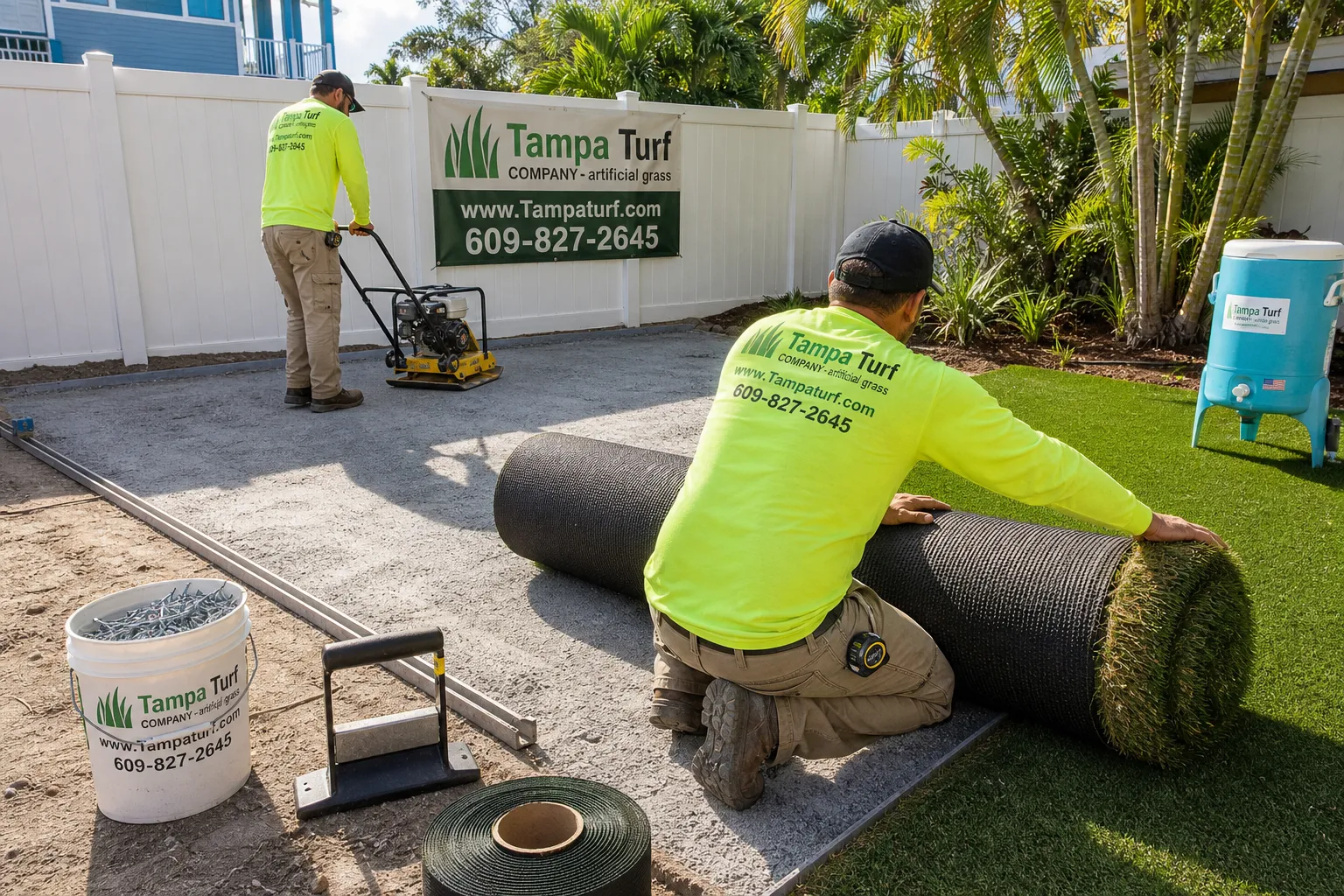
A professional Tampa artificial turf installation is a seven-step process that usually takes one to three days for a typical residential yard. The sequence matters, and skipping the compaction steps is the single most common cause of turf failure in Florida.
Step-by-step:
- Site measurement and layout. Crew confirms square footage, seam direction, and blade grain direction (all blades should lean the same way for uniform color).
- Excavation. Remove existing sod and soil to roughly 3 to 4 inches, deeper for pet areas. Florida sand gets cut out, not built on.
- Edge and border prep. Install bender board, treated timber, or tie into existing hardscape so edges stay crisp.
- Base installation. Spread crushed concrete or granite fines in lifts, grade for a slight slope away from structures, then compact with a plate compactor to 90%+ density. Repeat.
- Weed barrier and turf layout. Roll turf out and let it relax in the sun for 30 minutes to an hour so it flattens and cuts clean.
- Seaming and fastening. Seams joined with seaming tape and adhesive or stitched, then perimeter secured with 5-6 inch galvanized nails or spikes every few inches.
- Infill and grooming. Broadcast infill, power-broom the fibers upright, and do a final inspection.
Red flag to watch for: if a crew shows up without a plate compactor, stop the job. Hand-tamping Florida base material does not achieve the density needed to stop settling.
Synthetic grass vs real grass: pros and cons
Synthetic grass wins on water use, consistency, and time; real grass wins on upfront cost, natural cooling, and soil ecology. For most Tampa properties with heavy shade, heavy dog traffic, or an owner tired of weekly mowing in August humidity, turf is the more practical long-term choice.
Synthetic grass pros
- No mowing, watering, fertilizing, or chinch bug treatment
- Stays green through drought, water restrictions, and summer flooding
- No mud, no bare patches under swing sets or dog paths
- Works in dense shade where St. Augustine thins out
- Predictable annual cost after installation
Synthetic grass cons
- Higher upfront cost than sod
- Surface heats up in direct sun
- Needs eventual replacement (15-25 years)
- Cannot be repaired by "growing back", damage requires a patch
- Not a habitat for soil organisms
Real grass pros
- Low installation cost, natural evaporative cooling, carbon and soil benefits, easy to reseed or re-sod
Real grass cons
- Ongoing irrigation and fertilizer expense, mowing time or lawn service fees, pest and fungus pressure in Florida humidity, dog urine burn spots, seasonal browning
Decision rule: choose synthetic if your yard has recurring problem areas (shade, pet damage, slopes, poor irrigation coverage) or if you plan to stay in the home 7+ years. Choose real grass if you have a very large open lawn where turf square footage becomes cost-prohibitive.
Does synthetic grass get hot in Florida heat?
Yes. Synthetic grass surfaces do get noticeably hotter than natural grass in direct Florida sun, because plastic fibers absorb solar radiation and don't transpire water the way living plants do. The good news is that surface heat drops fast in shade and cools within seconds of a light hose spray.
Practical ways Tampa Turf and other quality installers manage heat:
- Light-colored, coated infills reflect more energy than dark crumb rubber.
- Cooling-technology turf lines with reflective pigment or heat-diffusing fiber shapes.
- Shade planning, installing turf where an oak, awning, or pergola blocks midday sun makes the biggest difference of anything on this list.
- A 30-second rinse before pet or kid playtime on peak afternoons.
- Lighter blade color choices, since deep forest green absorbs more than a mid-tone olive blend.
Edge case for pet owners: dogs will self-regulate and move to shade, but a full-sun dog run with no shelter isn't a good design in Tampa. Plan a shaded zone or a covered patio adjacency. Our pet turf installation team in Tampa designs around shade and drainage from the start.
How do you maintain and clean synthetic grass?
Synthetic grass maintenance takes about 10 to 20 minutes per month for a typical residential yard. There's no mowing, watering, or fertilizing. The whole job is removing debris, keeping fibers standing upright, and rinsing pet areas.
Monthly routine
- Blow or rake off leaves, oak catkins, and Spanish moss (a leaf blower is the fastest tool)
- Rinse with a hose to clear dust and pollen
- Cross-brush high-traffic paths with a stiff synthetic-bristle broom to lift matted fibers
Quarterly to annually
- Power broom or deep-groom the whole lawn
- Top up infill in heavy-traffic zones
- Check perimeter nails and seams
- Treat any weeds that sprout at the edges with a standard herbicide
Spot cleaning
| Problem | Fix |
|---|---|
| Pet urine odor | Rinse, then apply an enzyme cleaner made for turf |
| Solid pet waste | Remove, then rinse the spot |
| Food, drink, sunscreen | Mild dish soap and warm water |
| Sticky gum or sap | Freeze with ice, then scrape gently |
| Grease or oil | Mineral spirits on a cloth, then rinse |
Never do these: don't use a pressure washer at full force (it dislodges infill), don't set a grill or fire pit directly on turf, and don't use a metal-tined rake. Reflected heat from low-E window glass can also melt fibers in rare cases, a shade screen solves it.
What warranty and durability should you expect, and how long does synthetic grass last?
Quality synthetic grass carries a manufacturer warranty of 8 to 15 years, and well-installed residential turf commonly lasts 15 to 25 years in service. Warranty length and actual lifespan are two different things: the warranty covers fiber degradation and backing failure, while lifespan depends on foot traffic, sun exposure, and how good the base was.
What a strong warranty package includes:
- Manufacturer material warranty covering UV fade, fiber loss, and backing separation
- Installer labor warranty covering seams, edges, and settling, ask specifically about this, since many companies only pass along the mill's warranty
- Clear exclusions spelled out (burns, sharp objects, vandalism, reflected heat, improper cleaning)
- A transferable clause if you might sell the home
Durability by application, in rough terms:
- Low-traffic front lawn or pool surround: 20-25 years
- Family backyard with kids: 15-20 years
- Heavy dog run: 12-18 years
- Sports and athletic fields: 8-15 years depending on hours of play
Common mistake: assuming a "lifetime warranty" claim means something. Ask what's covered, for how many years, and who honors it. Every Tampa Turf project comes with the Tampa Turf Quality Guaranteed Seal and a written warranty you can actually read.
Is synthetic grass good for dogs and pets in Tampa?
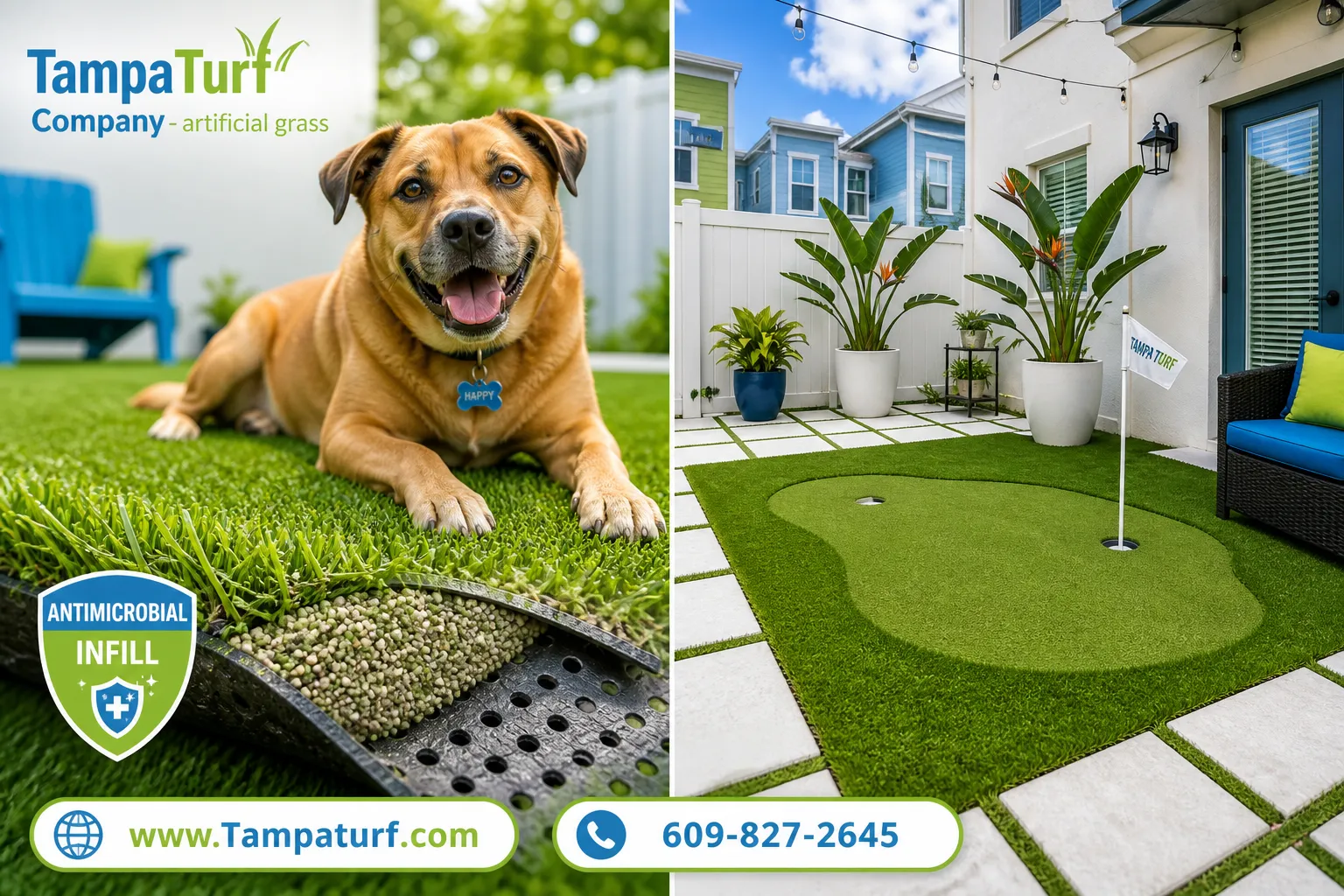
Pet turf is one of the strongest use cases for artificial grass in Tampa, but only when the installer uses a pet-specific system. Standard landscape turf over a shallow base will hold odor. A proper pet system moves urine straight through the backing into a drainage base where it flushes away.
What a real pet turf system includes:
- Fully permeable or flow-through backing with high drainage rates, not just punched holes every few inches
- Deeper base (typically 4 inches or more) built from clean, angular aggregate that won't clog
- Antimicrobial or zeolite-based infill that captures ammonia
- Tight seams and heavy perimeter fastening so determined diggers can't lift an edge
- Optional deodorizer layer beneath the turf for multi-dog households
Benefits Tampa dog owners notice first: no more mud tracked inside after afternoon thunderstorms, no urine burn spots, no digging holes, and no fleas breeding in thatch. Nails don't tear turf the way they tear sod.
Edge case: kennels, doggy daycares, and homes with four or more large dogs should specify a commercial-grade pet system with a sanitary flush plan. That's a different build than a single-dog backyard.
Can you install synthetic grass over an existing lawn?
You can, but you shouldn't. Installing synthetic grass directly over living grass is the most common shortcut in the industry, and it fails in Florida within one to three years. The existing sod decomposes unevenly, creating soft spots and dips, and the organic layer holds water instead of draining it.
Why removal matters here specifically:
- St. Augustine and Bahia runners keep growing and push through seams
- Decomposing organic matter compresses at different rates, so the surface goes lumpy
- Trapped moisture in Tampa's rainy season breeds odor and gnats
- No compaction means the turf ripples under foot traffic
The narrow exception: a temporary application, a rental patio, an event, or a staging setup you'll pull up within a season. For anything permanent, excavation and a compacted base are non-negotiable.
If a bid comes in dramatically under market and the scope says "install over existing grass," you now know why it's cheap.
How do you read synthetic grass company reviews in Tampa?
The most useful reviews mention the age of the installation, not just the day it was finished. A five-star review written the week of install tells you the crew was polite. A four-star review from a customer three years later saying "still flat, seams invisible, no odor with two dogs" tells you the base was built right.
What to look for when reading reviews of any synthetic grass company Tampa homeowners recommend:
- Longevity mentions: "two years later," "after last hurricane season," "three summers in"
- Named specifics: crew names, project type, neighborhood, signals a real customer
- How complaints were handled. A company that responds to a seam issue and fixes it is safer than one with no negative reviews at all
- Photos from customers, especially wide shots showing edges and transitions
- Review spread across platforms (Google, Facebook, Nextdoor, BBB), not one platform with a sudden burst
Red flags: dozens of reviews posted in the same week, generic one-line praise with no project detail, and reviews that mention a different city than the company's service area.
When you're ready to compare, reach out to Tampa Turf directly for local references and addresses of installs you can drive by.
Does synthetic grass work for small yards, patios, and specialty spaces?
Small spaces are often the highest-value turf projects in Tampa, because that's where real grass struggles most. Townhome courtyards, side yards, balconies, condo patios, and pool surrounds get too much shade, too much reflected heat, or too little irrigation to keep sod alive.
Strong small-space applications:
- Townhome and condo patios, instant green with zero maintenance and no mower storage
- Side yards and dog runs, narrow strips that never grow grass anyway
- Pool decks, no clippings tracked into the water, no mud at the coping
- Rooftop decks and balconies, over proper drainage mats, not directly on the membrane
- Backyard putting greens, a custom putting green installation in Tampa fits in as little as 200 square feet and adds real usable recreation
- Design accents, turf inlays between pavers, turf-topped built-in seating, playset landing zones
For homeowners exploring how turf fits into an overall outdoor design, our lifestyle turf options for Tampa yards show how putting greens, pool turf, and pet zones combine in one project.
What about commercial and sports turf applications?
Commercial and athletic turf is a different product class than residential lawn turf: higher durability ratings, shock-pad systems for player safety, and infill engineered for slide and ball roll. Tampa Turf installs both, and the same base-first philosophy applies at 40,000 square feet as at 400.
Where commercial artificial turf performs best in Tampa Bay:
- High school, college, and club football and soccer fields, consistent playing surface through the rainy season, no rain-outs from a muddy midfield, and no re-sodding worn goal boxes every year
- Sports arenas and professional training facilities, practice areas, sideline zones, and multi-use fields
- Schools and daycares, durable, low-allergen play areas with fall-height-rated shock pads
- Apartment complexes and HOAs, pet relief areas and courtyard lawns that stay green with zero irrigation budget
- Hotels, restaurants, and retail, rooftop bars, patio dining, event lawns
- Office parks and medians, permanent curb appeal without a landscape crew on site weekly
Facility managers can review specifications for commercial and sports turf installation in Tampa and request a site walk. For homeowners, our residential turf company services across Tampa cover front lawns, backyards, pool surrounds, and pet areas.
Is synthetic grass worth the investment?
For most Tampa properties, synthetic grass pays back over roughly 5 to 10 years by eliminating irrigation, lawn service, fertilizer, and pest control costs, and it delivers value immediately in time saved and a yard that's usable year-round. It's worth it if you plan to stay put, and it's worth it if your lawn has chronic problem areas.
Run this simple math on your own property:
- Add your annual lawn service cost (Tampa mowing services commonly bill monthly year-round).
- Add annual irrigation water cost for the lawn zone.
- Add fertilizer, pest control, and re-sodding you actually spend.
- Multiply by the years you expect to own the home.
- Compare to your turf quote.
Turf is clearly worth it when: you have dogs destroying the lawn, deep shade where nothing grows, water restrictions limiting irrigation, a rental property where you want zero maintenance calls, mobility limits that make yard work hard, or a small yard where total cost is modest.
Turf may not be worth it when: you have a very large open lawn (an acre of turf is a major capital project), you're selling within a year or two, or you specifically want a garden ecosystem with pollinators and soil life.
Frequently asked questions
How long does synthetic grass installation take?
Most residential Tampa yards are completed in one to three days. Larger properties, putting greens, and sports fields take longer because of grading and shock-pad work.
Does synthetic grass drain in heavy Tampa rain?
Yes. A perforated or flow-through backing over a compacted aggregate base drains faster than most natural Florida lawns. Standing water after a storm almost always means the base was built wrong, not the turf.
Will synthetic grass fade in Florida sun?
Quality turf uses UV-stabilized fibers and holds color for the length of its warranty period, typically 8 to 15 years. Cheap import turf without proper UV inhibitors can fade noticeably within a few seasons.
Can you put a grill or fire pit on artificial turf?
Not directly. Use a heat-resistant pad, pavers, or a hardscape island. Embers and radiant heat will melt fibers, and burns are excluded from every warranty.
Do you need infill?
Yes, for almost every application. Infill ballasts the turf, supports blades so they stand up, protects the backing from UV, and helps manage surface temperature. Skipping it causes matting.
Is artificial grass safe for kids and pets?
Modern turf products from reputable manufacturers use lead-free, non-toxic materials. Ask for product documentation. Pet-specific infills add antimicrobial properties for odor control.
Can synthetic grass be repaired if it's damaged?
Yes. A damaged section can be cut out and patched with matching turf, then re-seamed and re-infilled. Keeping leftover material from your install makes an invisible patch far easier.
How much does synthetic grass cost per square foot in Tampa?
Installed pricing generally runs $8 to $20 per square foot, with most residential backyards falling in the $10 to $15 range. Small jobs price higher per foot; large open areas price lower.
Does artificial turf increase home value?
It commonly improves curb appeal and marketability, especially for buyers who don't want yard maintenance. Actual appraisal impact varies by neighborhood and buyer preference.
Do weeds grow in artificial grass?
Not from below when a weed barrier and clean aggregate base are installed. Occasional weeds sprout at edges from airborne seed and pull out easily or respond to standard herbicide.
Can I install synthetic grass myself?
Small patios, yes. Anything requiring excavation, compaction, drainage, seams, or pet-grade performance should go to a licensed artificial turf installation company. Base work is where DIY projects fail.
Which counties does Tampa Turf serve?
Tampa Turf serves the greater Tampa Bay area including Hillsborough, Pinellas, Pasco, and Manatee counties for residential, commercial, sports, pet, and putting green turf.
Conclusion: your next steps
The difference between artificial grass that looks brand new in 2036 and turf that ripples by 2028 comes down to two decisions: the grade of turf you buy and the crew that builds the base underneath it. Everything else, blade color, infill brand, pile height, is preference.
Here's how I'd move forward if I were quoting my own Tampa yard:
- Measure your area roughly (length x width) so you can sanity-check quotes.
- Get three written quotes that each name base depth, aggregate type, infill type, and warranty terms in years.
- Handle physical samples in outdoor light, not showroom light.
- Drive by two completed local installs that are at least two years old.
- Confirm license, insurance, and a labor warranty in writing before you sign.
- Book early for dry-season installation if you can, spring and fall schedules fill quickly in Tampa Bay.
With over 15 years of Florida experience and expert in-house installers, Tampa Turf specializes in every application of synthetic grass: pet turf, home turf, pool turf, backyard artificial grass, putting greens, commercial turf, and sports fields. Fast, efficient, and workmanship-first, that's how we became the #1 artificial turf Tampa choice for homeowners and facility managers alike, and why every project carries the Tampa Turf Quality Guaranteed Seal. When you're ready for a free on-site measurement and a straight quote for artificial turf tampa fl, reach out to our team and we'll walk your property with you.
Tags: synthetic grass company tampa, artificial turf tampa, artificial turf installation, pet turf tampa, turf company florida, synthetic grass cost, putting green turf, commercial turf tampa, artificial grass maintenance, sports turf installation, backyard turf, Tampa Turf