Last updated: August 5, 2026
Quick Answer
A turf company designs, supplies, and installs artificial grass for lawns, pet areas, putting greens, pool decks, playgrounds, and sports fields. A good one handles the whole job: site prep, base grading, drainage, seaming, infill, and edging. Professionally installed artificial turf typically runs $8 to $20 per square foot installed in the U.S., lasts 15 to 25 years, and eliminates mowing and irrigation. The best turf company for you is licensed, insured, shows you real samples, gives a written scope of work, and offers separate warranties on the turf fiber and the installation labor.
Key Takeaways
- A full-service turf company handles product selection, excavation, base compaction, drainage, seaming, infill, and cleanup, not just delivering a roll of grass.
- Installed cost usually lands between $8 and $20 per square foot, driven mostly by base prep, access, and pile height rather than the turf itself.
- Quality synthetic turf lasts 15 to 25 years with proper base work; a bad base is the number one cause of early failure.
- The U.S. EPA notes landscape irrigation accounts for nearly one-third of residential water use, which is why turf pays back fastest in hot, dry, or water-restricted regions.
- DIY installation is realistic for small pads under about 200 square feet; anything with slope, drainage, or visible seams belongs to professionals.
- Sports turf uses different fiber, backing, and shock-pad requirements than residential lawn turf, so ask whether your installer does both.
- Tampa Turf has over 15 years of experience across pet turf, pool turf, putting greens, and commercial sports installations in the greater Tampa Bay area.
- Read reviews for patterns about seams, drainage, and follow-up service, not just the star average.
What Does a Turf Company Do?
A turf company sells and installs synthetic grass systems, and the installation is where most of the value sits. The turf roll itself is maybe a third of the total job. The rest is engineering the ground underneath so the surface stays flat, drains fast, and doesn't wrinkle in year three.
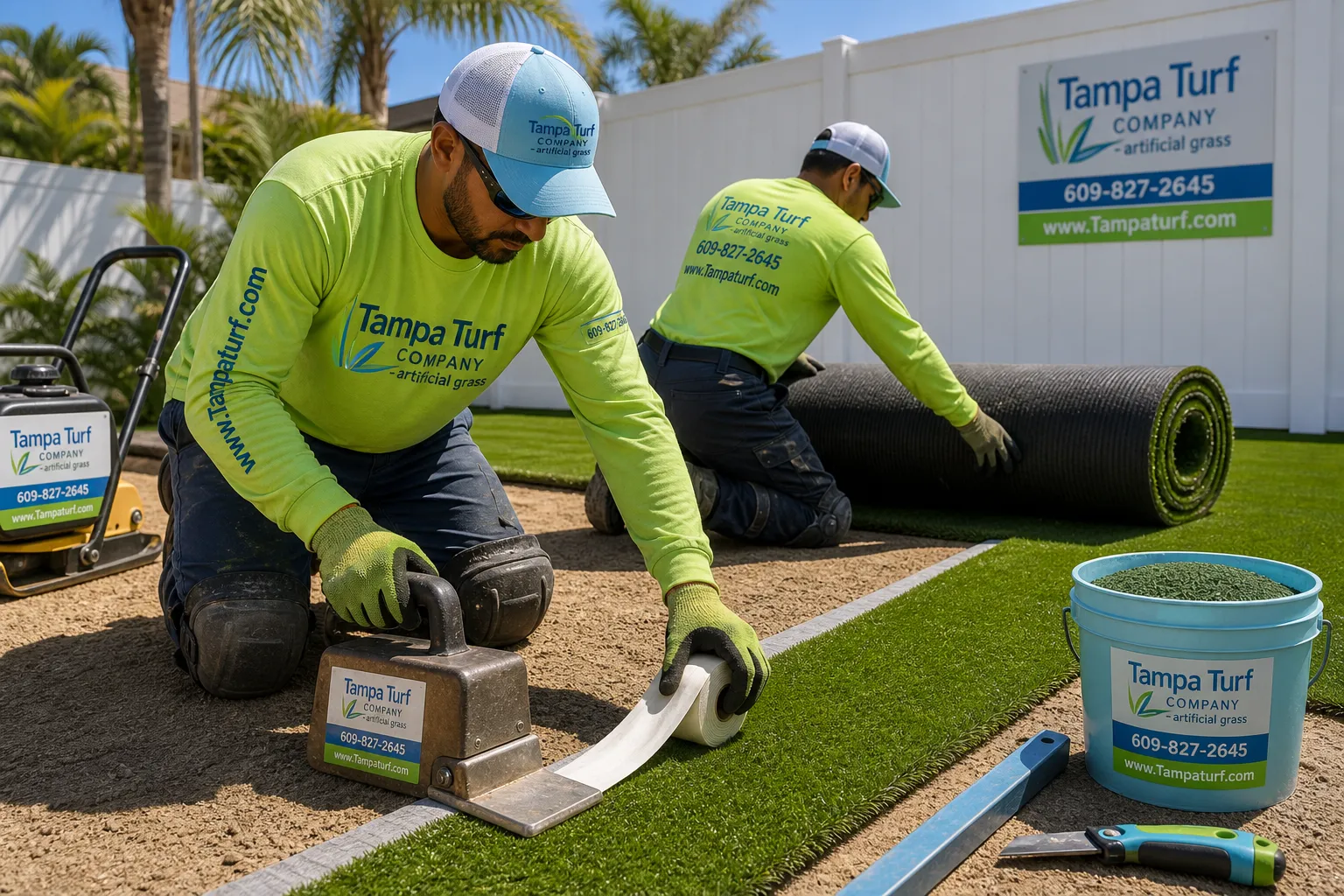
Here's the typical scope of work from a full-service artificial turf installation company:
- Site consultation and measurement. Measuring the area, checking slope and drainage, identifying sprinkler heads and utility lines, and recommending a product for the use case.
- Demolition and excavation. Removing existing sod, roots, and soil to a depth of roughly 3 to 4 inches.
- Base construction. Installing and grading crushed aggregate or decomposed granite, then compacting it in lifts with a plate compactor to about 90% compaction.
- Drainage work. Adding perforated pipe, French drains, or drainage cells where water pools.
- Weed barrier and edging. Laying geotextile fabric and installing bender board, nailer board, or paver edge restraint.
- Turf layout and seaming. Letting the turf relax in the sun, aligning grain direction, then seaming with adhesive or seam tape so joints disappear.
- Nailing and infill. Securing perimeters with galvanized nails or staples, then brushing in silica sand, coated sand, or antimicrobial infill.
- Power brooming and cleanup. Standing the fibers up, hauling debris, and walking the job with the customer.
A turf company that skips compaction testing or drainage assessment is selling you carpet, not a turf system.
Common mistake: Hiring a general landscaper who subcontracts turf as a side service. Ask how many turf installations the crew completed last year. Fewer than 20 and you're paying for their learning curve.
How Much Does Turf Installation Cost?
Professional artificial turf installation generally costs $8 to $20 per square foot installed in the United States, with most residential lawns landing in the $10 to $15 range. A 500-square-foot backyard therefore runs roughly $5,000 to $7,500. Turf-only material purchases typically cost $2 to $7 per square foot.
What actually moves the number:
| Cost factor | Effect on price | Notes |
|---|---|---|
| Base prep depth | High | Rocky soil, tree roots, or clay all add labor hours |
| Site access | High | No gate access means wheelbarrowing tons of aggregate by hand |
| Turf specification | Medium | Higher face weight and pile height cost more per square foot |
| Drainage requirements | Medium | French drains and drain boxes add material and labor |
| Square footage | Inverse | Larger jobs lower the per-foot rate; small jobs carry setup minimums |
| Shape complexity | Medium | Curves, planters, and tree wells mean more cutting and waste |
| Infill type | Low to medium | Antimicrobial and cooling infills cost more than plain silica sand |
Decision rule: If two bids differ by more than about 30%, the difference is almost always base depth, infill quantity, or warranty terms. Ask each bidder to write down aggregate depth in inches and pounds of infill per square foot. That single question separates real quotes from lowball guesses.
Edge case: Rooftop decks, balconies, and pool surrounds often cost more per square foot than a large yard because they need padding, custom drainage detailing, and hand-carried materials.
Artificial Turf vs Natural Grass: Which Makes More Sense?
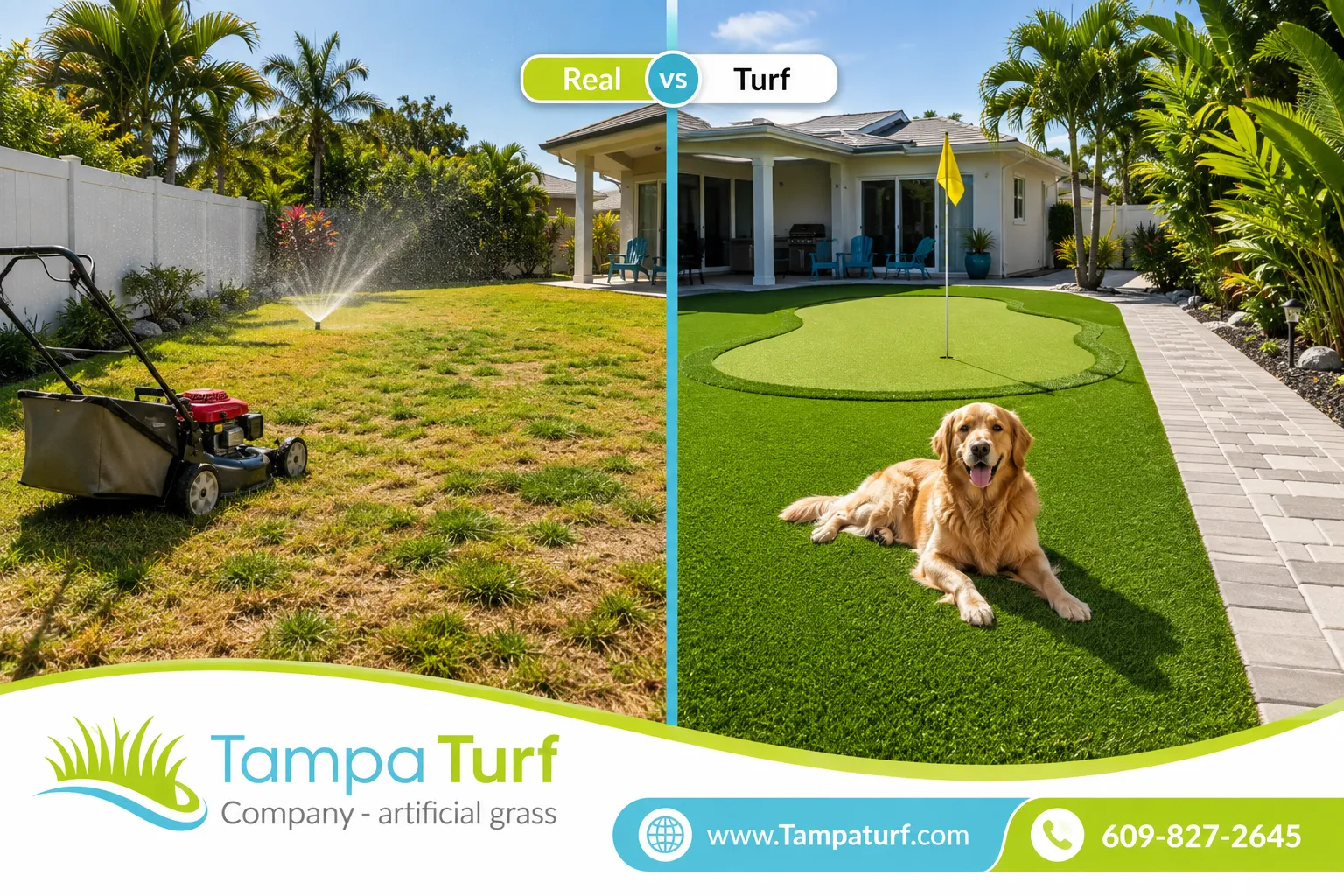
Artificial turf wins on water use, consistency, and maintenance time. Natural grass wins on upfront cost, surface temperature, and soil ecology. The right choice depends on your climate, how hard the area gets used, and how much you value weekends without a mower.
| Factor | Artificial turf | Natural grass |
|---|---|---|
| Upfront cost | High ($8,$20/sq ft installed) | Low (sod roughly $0.50,$1.50/sq ft) |
| Water use | Occasional rinsing only | Regular irrigation |
| Ongoing cost | Low (brushing, rinsing) | Mowing, fertilizer, pest control, water |
| Appearance | Consistent year-round | Seasonal, weather-dependent |
| Surface temperature | Hotter in direct sun | Cooler |
| Shade tolerance | Excellent | Poor under dense canopy |
| Lifespan | 15-25 years, then replace | Indefinite with care |
| Heavy foot traffic | No bare patches | Wears and compacts |
The U.S. Environmental Protection Agency reports that landscape irrigation makes up nearly one-third of all residential water use nationally, and as much as half of that can be lost to evaporation, wind, or runoff from inefficient systems. In Florida, Arizona, Nevada, and much of California, that math is why turf demand keeps climbing.
Choose artificial turf if: you have deep shade, dogs, heavy kid traffic, water restrictions, a pool deck, or a lawn you're tired of babysitting.
Choose natural grass if: your budget is tight right now, the area is huge and lightly used, or you want maximum surface cooling in full sun.
What Types of Turf Do Companies Offer?
Turf products are engineered by use case. Face weight (ounces per square yard), pile height, fiber shape, backing type, and drainage rate all change depending on whether dogs, golf balls, or cleats will be on the surface.
- Residential lawn turf. Pile heights around 1.5 to 2 inches with multi-tone blades and brown thatch for realism. Explore residential artificial turf options for Tampa homes to see how lawn-grade products differ from specialty lines.
- Pet turf. Shorter pile, fully permeable or hole-punched backing, and antimicrobial infill so urine drains and odor doesn't build. See synthetic pet turf built for dogs.
- Putting green turf. Very short nylon or polypropylene fibers, sand-filled and rolled to a target Stimpmeter speed. Compare putting green turf for backyard practice greens.
- Pool and patio turf. Chlorine- and UV-resistant fibers with fast drainage and softer texture for bare feet.
- Playground turf. Installed over shock-absorbing pads to meet fall-height attenuation standards.
- Sports and field turf. Slit-film or monofilament fibers, heavier face weight, reinforced backing, and often a shock pad underneath. Review commercial and sports turf systems for arena and school applications.
- Landscape and lifestyle turf. Designer products for rooftops, balconies, event spaces, and accent areas. Browse lifestyle turf styles and applications.
Quick example: A client with two German Shepherds picks 1.25-inch pet turf with a fully permeable backing and zeolite infill. Their neighbor with no pets picks 1.75-inch lawn turf with silica sand. Same street, different products, and swapping them would frustrate both households.
Turf for Sports Fields vs Residential Lawns
Sports turf and residential turf are different products with different engineering, and a turf company that installs one well doesn't automatically do the other well. Sports fields prioritize player safety, ball roll, and impact absorption. Home lawns prioritize looks and softness.
What changes on a sports field:
- Fiber type. Slit-film or thick monofilament fibers resist cleat shear; soft residential blades would shred.
- Face weight. Field turf commonly runs much heavier per square yard than lawn turf to survive traffic.
- Shock pad. Sub-surface padding manages head-impact criteria (often measured as HIC or Gmax testing).
- Infill depth. Fields carry deeper infill for footing and stability.
- Line markings. Inlaid, tufted-in lines rather than painted, so they don't fade during a season.
- Base engineering. Laser-graded bases with planned slope and sub-drainage, since a field must play after heavy rain.
For high school, college, soccer club, and football club programs, ask the turf company for field references you can visit and Gmax test documentation. For professional-grade sports and commercial turf installation, schools and arenas should also confirm the warranty covers usage hours, not just years.
Edge case: Multi-use municipal fields hosting band practice and lacrosse wear faster than single-sport fields. Specify a heavier system than the base recommendation.
Can I Install Turf Myself or Do I Need Professionals?
DIY installation works for small, flat, low-visibility areas under roughly 200 square feet with no seams. Beyond that, hire a professional. The failure points in turf work are base compaction, drainage, and seams, and all three are difficult to fix after the fact without pulling the whole surface up.
Reasonable DIY projects:
- A dog run behind the garage
- A side yard strip
- A small balcony or rooftop pad
- A pre-cut putting mat area
Jobs that need a professional turf company:
- Anything over about 300 square feet
- Sloped yards or areas that currently pool water
- Multiple seams in a visible front yard
- Pool surrounds, playgrounds, and sports fields
- Installations over concrete or with drainage cut-ins
The equipment gap matters too. A proper install needs a sod cutter, plate compactor, turf kicker, carpet stretcher, power broom, and infill drop spreader. Renting all of it for a weekend often erases the savings, and a rented compactor doesn't teach you how to read grade.
Common mistake: DIYers under-compact the base to save time. Six months later the surface shows footprints and low spots that no amount of brushing fixes.
How Long Does Turf Last?
Quality artificial turf lasts 15 to 25 years in residential use and 8 to 15 years on heavily used sports fields, assuming a properly built base. Manufacturer warranties commonly run 8 to 15 years against UV fade and fiber loss, which is separate from the installer's labor warranty.
What shortens lifespan:
- Poor base prep causing settling, wrinkles, and drainage failure
- Reflected heat from low-E window glass, which can melt fibers in concentrated hot spots
- Infill loss from blowing, washing out, or never being topped up
- Sharp or hot objects like grill embers, fire pits, and cigarette ashes
- Never brushing high-traffic paths, so fibers mat down permanently
What extends it:
- Cross-brushing traffic lanes every few months
- Topping up infill every 3 to 5 years
- Rinsing pet areas weekly
- Keeping heavy furniture on pads or rotating placement
Decision rule: If a company won't give you both the manufacturer's fiber warranty and its own written workmanship warranty, treat the quote as incomplete. The workmanship warranty is where seams and settling get covered.
Turf Maintenance Tips After Installation
Artificial turf needs about 10 to 20 minutes of attention per month, not per week. The routine is brushing, rinsing, and spot-cleaning, and doing it consistently is what keeps a five-year-old lawn looking new.
Monthly routine:
- Cross-brush high-traffic areas with a stiff synthetic-bristle broom or power broom, brushing against the grain.
- Rinse the surface with a hose, focusing on pet zones and areas under trees.
- Remove leaves and debris with a leaf blower or plastic-tine rake (never a metal rake).
As needed:
- Pet waste: Remove solids promptly, rinse the area, and use an enzyme cleaner monthly in heavy-use zones.
- Stains: Blot with mild dish soap and water. For gum or sticky residue, chill with ice and scrape gently.
- Weeds: Pull perimeter weeds by hand; they root in edges, not through the backing.
- Static or matting: Increase brushing frequency and check infill depth.
- Heat on hot days: A quick hose-down cools the surface temporarily. Shade sails and pergolas help more.
Never do this: Pressure-wash on a narrow high-pressure setting, use a metal rake, or apply solvents like acetone. Each one damages fibers or blows infill out.
Is Turf Worth the Investment?
For most homeowners in hot or water-restricted regions, artificial turf pays back in roughly 5 to 10 years through eliminated water, mowing, fertilizer, and reseeding costs. It's worth it faster if you currently pay for lawn service or fight a lawn that never fully succeeds.
Run this simple calculation yourself:
- Add your annual lawn spending: water attributable to irrigation + mowing service + fertilizer, weed, and pest products + reseeding or resodding.
- Divide the installed turf cost by that annual figure.
- The result is your rough payback in years.
Someone paying $150 a month for lawn service plus $60 a month in summer irrigation is spending roughly $2,000 a year. A $9,000 turf install pays back in about four and a half years and then keeps saving for another decade or more.
Turf is usually not worth it when: you have a very large, lightly used rural lot, you're selling within a year in a market that doesn't value turf, or your area gets abundant free rainfall and grass grows easily with no intervention.
Non-financial value that shows up in real decisions: usable yard space year-round, no mud tracked inside by dogs, no allergy-triggering grass pollen from your own lawn, and no gas mower emissions.
How to Choose the Right Turf Company
Choose the turf company that documents its base specification in writing, carries license and insurance you can verify, and shows you completed jobs at least three years old. Newness and low price are the two weakest signals in this trade.
Vetting checklist:
- Verify licensing and insurance. Ask for the license number and a certificate of insurance naming general liability and workers' comp.
- Ask how long they've been installing turf specifically. Years in synthetic grass matters more than years in landscaping. Tampa Turf's background and service area is a useful example of the depth to look for, with over 15 years of dedicated artificial turf experience.
- Request aged references. Photos of a job finished last week prove nothing about seams and settling. Ask to see work from 2020 or earlier.
- Get physical samples. Feel the fibers, check the backing perforations, and bend the blades. Photos hide texture.
- Read the written scope. It should state aggregate type and depth, compaction method, weed barrier, edging type, seam method, infill type and pounds per square foot, and cleanup responsibility.
- Confirm both warranties. Manufacturer fiber warranty plus installer workmanship warranty, in writing, with duration and exclusions.
- Check who does the work. In-house crews or subcontractors? Either can be fine, but you want to know who to call about a warranty issue.
- Compare three bids on identical specs. Otherwise you're comparing different products and pretending it's price.
Companies willing to explain why their process and workmanship differ from competitors tend to be the ones that also document their base specs.
How Do I Find the Best Turf Company Near Me?
Start with local search, then filter by evidence rather than ad spend. The best turf company near you is the one with verifiable local installations in your climate, a physical presence, and reviews that mention the same crew leads over multiple years.
Search and shortlist process:
- Search "turf companies near me," "turf company Florida," or "artificial turf company" plus your city, then note which businesses appear in both map results and organic results.
- Check Google Business Profile photos for job diversity: pet areas, pool decks, greens, and commercial work.
- Look for a showroom or sample display. Companies that let you touch product before buying are usually confident in it.
- Ask neighbors and community groups. Turf is highly visible; someone within a mile has already hired somebody.
- Confirm they actually serve your address and don't charge a long travel premium.
For homeowners and businesses in the Tampa Bay region, artificial turf Tampa installations from Tampa Turf cover pet turf, home lawns, pool surrounds, backyard synthetic grass, putting greens, and commercial sports fields, backed by the Tampa Turf Quality Guaranteed Seal. You can request a measurement and quote through the Tampa Turf contact and estimate page, or browse products directly in the Tampa Turf online turf shop. For anyone comparing options for artificial turf Tampa FL, the Quality Guaranteed Seal means expert installers, fast and efficient scheduling, and workmanship documented in writing before the first shovel hits the ground.
How Should I Read Turf Company Reviews and Ratings?
Read reviews for patterns, not averages. A 4.6-star company with detailed reviews describing invisible seams and responsive follow-up is a safer bet than a 5.0-star company with 12 vague one-line reviews.
What to look for:
- Reviews older than three years. They tell you whether the work held up.
- Specific technical praise. Mentions of drainage, level surfaces, and hidden seams indicate real installation quality.
- How the company answers criticism. A professional reply that describes a resolution is a strong trust signal.
- Repeat mentions of names. Consistent crew or project manager names suggest low turnover and trained installers.
- Photo reviews. Customer-submitted photos are harder to stage than portfolio shots.
Red flags:
- Clusters of reviews posted the same week
- Complaints about wrinkles, seams separating, or standing water that go unanswered
- Reviews that praise price and speed but never mention finish quality
- No BBB record, no license number, cash-only demands, or large deposits requested up front
Decision rule: If more than one review over the last two years mentions the same defect, assume it's a process problem, not bad luck.
What Are the Most Common Turf Installation Mistakes to Avoid?
Nearly every turf failure traces back to one of six mistakes, and all of them happen before the turf gets unrolled. Knowing them lets you supervise a job intelligently.
- Insufficient base depth or compaction. Thin or loose aggregate settles, and the surface shows dips and footprints within a year.
- Ignoring drainage. Turf drains, but water still needs somewhere to go. Skipping French drains in low spots creates soggy zones and odor.
- Mismatched grain direction across seams. If adjacent panels face different directions, the seam shows as a color change in sunlight forever.
- Not letting turf acclimate. Turf installed straight off the roll while cold retains memory creases and wrinkles as it warms.
- Too little infill. Infill weighs the turf down, protects fibers, and keeps blades upright. Under-filling causes matting and shifting.
- Weak perimeter anchoring. Edges that aren't nailed or restrained lift at corners, which is where most trip hazards and repairs come from.
Also watch for: installing over irrigation lines without capping them, leaving sprinkler heads buried and active, and running turf tight against low-E windows where reflected heat can melt fibers. A quality installer flags all three during the walkthrough, not after.
Frequently Asked Questions
How long does a turf installation take?
Most residential projects take one to three days. A 500-square-foot backyard with good access is typically a single-day job for an experienced crew. Large yards, drainage work, or difficult access can extend the timeline to a week.
Does artificial turf get hot?
Yes, synthetic turf surface temperature rises noticeably in direct sun, hotter than natural grass. Rinsing with water cools it temporarily, and shade structures, cooling infills, and lighter-colored infill all reduce peak temperature.
Can dogs use artificial turf?
Yes, and pet turf is one of the most popular applications. Choose a product with permeable backing and antimicrobial infill, remove solids promptly, and rinse weekly. Urine drains through into the base rather than staining.
Do I need to remove my existing grass first?
Yes. Installing turf over live grass causes decomposition, settling, and uneven surfaces. A proper installation removes 3 to 4 inches of sod and soil before base material goes down.
Will artificial turf increase my property value?
It can improve curb appeal and reduce maintenance costs, which appeals to many buyers, especially in dry climates. Appraisal impact varies widely by market, so treat resale value as a possible bonus rather than the main reason to buy.
What is infill and do I really need it?
Infill is granular material (silica sand, coated sand, or zeolite) brushed between turf fibers. It ballasts the turf, keeps blades upright, protects the backing from UV, and helps with odor control. Skipping it is the fastest way to a matted, shifting lawn.
How much turf do I need for my yard?
Measure length by width for each area, then add roughly 10 to 15% for waste, seams, and grain-direction alignment. Irregular shapes and multiple curves need more. A turf company should measure on site rather than quoting from satellite images alone.
Can turf be installed over concrete?
Yes. Concrete installations use a shock pad or drainage underlay and adhesive rather than nails. Existing drainage on the slab must be assessed first, since concrete doesn't absorb water.
What happens at the end of turf's lifespan?
Worn turf is removed and replaced. The existing base can often be reused with regrading and top-up aggregate, which makes replacement cheaper than the original install.
Do turf companies offer financing?
Many do, through third-party home improvement lenders. Ask about terms in writing and compare against a home equity option before signing.
Conclusion
Selecting a turf company comes down to documentation and evidence. The turf roll itself is a commodity; what you're really buying is base construction, drainage engineering, and seam craftsmanship that either holds up for two decades or fails in eighteen months.
Your next steps:
- Measure your area and note any spots where water pools after rain.
- Define the use case so you request the right product: pet, lawn, pool, putting green, playground, or sports field.
- Collect three quotes on identical specs, each stating aggregate depth, compaction method, seam method, and infill pounds per square foot in writing.
- Visit or view at least one job over three years old from your top candidate.
- Confirm both warranties, manufacturer fiber and installer workmanship, before paying a deposit.
- Schedule installation for a dry stretch so base compaction can be done properly.
If you're in the Tampa Bay area, request an on-site measurement from a turf company that specializes exclusively in artificial grass and can show you aged local installations across pet, residential, pool, putting green, and commercial sports applications. Ask hard questions about the base. The right company will be happy you did.
Sources
- U.S. Environmental Protection Agency, WaterSense: Outdoor Water Use in the United States (2024). https://www.epa.gov/watersense/outdoors
- U.S. Environmental Protection Agency, Synthetic Turf Field Research (2024). https://www.epa.gov/chemical-research/synthetic-turf-field-recycled-tire-crumb-rubber-research
Tags: turf company, artificial turf, synthetic grass, artificial turf installation, turf installation cost, pet turf, putting green turf, sports turf, Tampa Turf, artificial turf Tampa, turf maintenance, artificial turf vs natural grass