Last updated: August 5, 2026
Quick Answer
Artificial turf in Tampa typically costs $8 to $16 per square foot installed, lasts 15 to 20 years in Florida's heat and humidity when properly installed, and eliminates mowing, watering, and fertilizer costs for good. The single biggest factor in how long it lasts here isn't the turf itself, it's the base preparation and drainage, which matter enormously in a region that averages roughly 45-50 inches of rain a year (NOAA climate normals). For Tampa Bay property owners, working with an experienced artifical turf Tampa specialist like Tampa Turf, with over 15 years installing pet turf, pool turf, backyard turf, putting greens, and sports fields, is the difference between a lawn that looks perfect in year 12 and one that ripples, floods, and fades by year three.
Key Takeaways
- Cost range in Tampa: roughly $8,$16 per square foot installed for residential projects; commercial and sports fields are quoted separately by scope.
- Lifespan: 15-20 years is realistic in Florida sun with quality UV-stabilized fiber and a correctly compacted base.
- Drainage is everything here. Tampa's sandy soil, flat lots, and heavy summer downpours mean base depth and perforated backing determine whether your lawn puddles.
- Turf gets hot. Synthetic grass surfaces can run significantly hotter than air temperature in direct sun. Shade, lighter-colored infill, and a quick rinse solve most of it.
- Pet owners benefit the most. No mud, no yellow urine spots, no digging holes, with antimicrobial infill and a proper flush routine.
- Maintenance is real but light: brush high-traffic lanes, rinse monthly, blow off leaves, and check seams and edges once a year.
- DIY is possible but risky. Most failed turf lawns I see in Tampa fail at the base, not the turf.
- Warranties commonly run 8-15 years on the turf fiber, with separate workmanship coverage from the installer.
- Tampa Turf is the #1 artificial turf company in the greater Tampa Bay area, backed by the Tampa Turf Quality Guaranteed Seal on every installation.
What is artificial turf and how does it work?
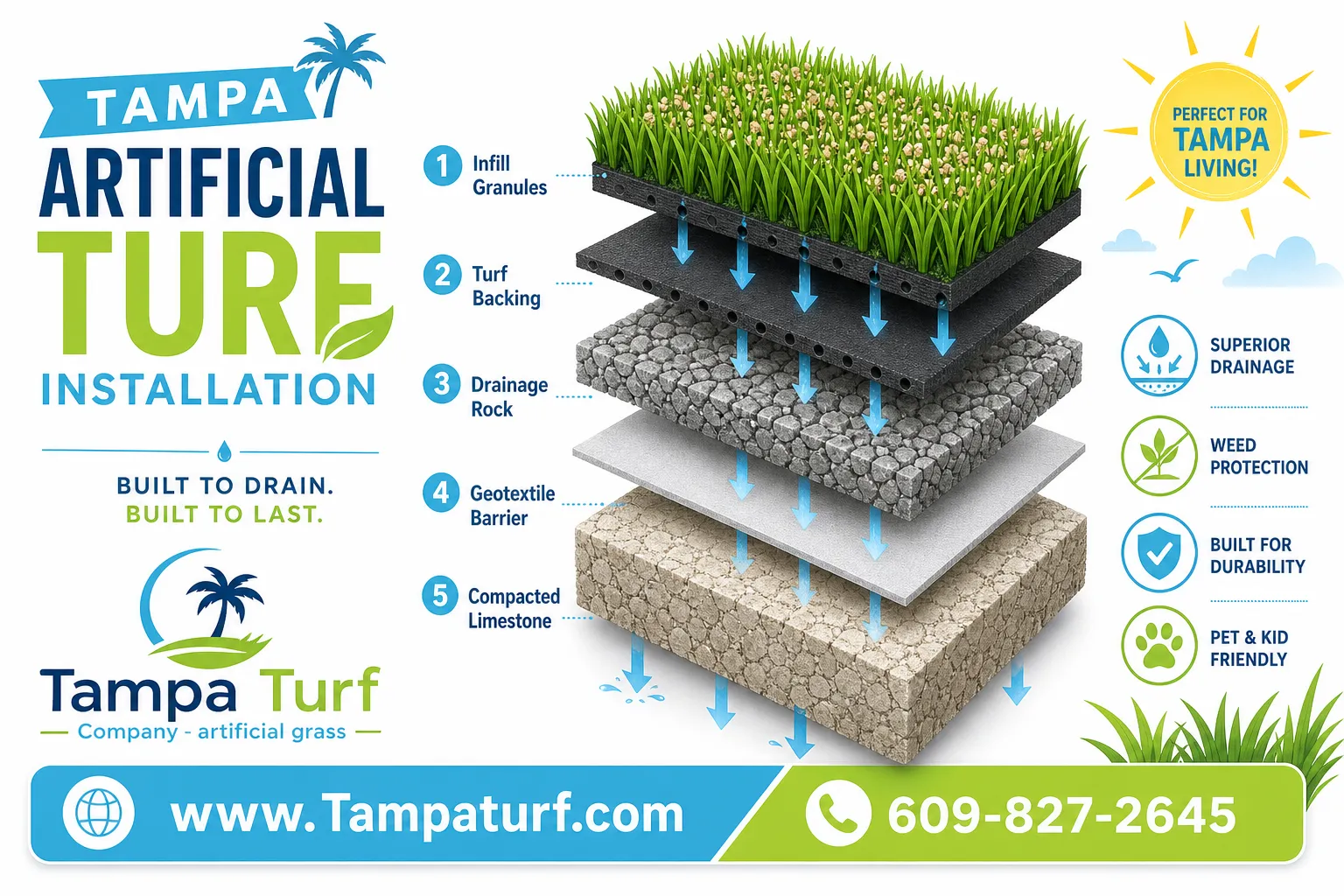
Artificial turf is a manufactured surface of synthetic grass blades stitched into a permeable backing, installed over an engineered base of compacted aggregate and topped with infill that holds the blades upright. It works like a carpet built for weather: water passes through perforations in the backing, drains through the rock base, and disappears into the soil below.
Modern synthetic turf has four working parts:
- Fiber (the blades). Usually polyethylene for softness and realism, sometimes nylon for extreme durability on putting greens and sports fields. UV stabilizers are blended into the resin so Florida sun doesn't bleach it.
- Thatch layer. Short curled fibers, often tan or olive, that mimic natural grass thatch and help blades stand up.
- Backing. A dual- or triple-layer woven backing with drainage holes, typically punched every few inches.
- Infill. Silica sand, coated sand, or antimicrobial infill (like zeolite for pet areas) that ballasts the turf, protects the fibers, and controls odor.
Turf is also described by face weight (ounces of fiber per square yard) and pile height (blade length in inches). Higher face weight generally means more fiber, better resilience, and a higher price.
A useful decision rule: choose a 1.5", 1.75" pile height with 60-80 oz face weight for a realistic Tampa front or back lawn. Go shorter (0.5", 1") for putting greens and high-traffic dog runs, where matting is the enemy.
Common mistake: buying turf based on how soft it feels in the showroom. Soft, tall, floppy fiber lays flat in a busy backyard within one season. Blade shape, S-blade, W-blade, diamond spine, matters more than plushness for resilience.
How much does artificial turf cost in Tampa, Florida?
In the Tampa Bay area, expect $8 to $16 per square foot fully installed for residential artificial grass, which includes demolition, base material, turf, infill, seaming, and edging. A typical 800-square-foot backyard therefore lands somewhere around $6,500 to $12,500. Materials alone, if you're buying turf by the roll, generally run $2.50,$6 per square foot.
What moves your number up or down:
| Cost factor | Pushes price down | Pushes price up |
|---|---|---|
| Area size | Larger, open areas (economy of scale) | Small or oddly shaped areas with many cuts |
| Existing surface | Bare dirt or sand | Removing sod, roots, old concrete, or pavers |
| Access | Wide gate, driveway access | Narrow side yard, wheelbarrow-only access |
| Turf spec | Mid-weight landscape turf | High face weight, nylon, or sports-grade |
| Base depth | Standard 3" base on stable soil | 4", 6" base for pets, drainage issues, or heavy use |
| Add-ons | None | Putting green cups, pet flush systems, borders, lighting |
| Slope/grading | Flat, already graded | Regrading, drain boxes, French drains |
Quick example: a 400 sq ft dog run for two large dogs with a deeper base, antimicrobial infill, and a drainage layer will often cost more per square foot than a 1,200 sq ft open backyard, even though the total is smaller. Small jobs carry fixed costs.
Edge case worth knowing: if your property has an irrigation system, budget for capping or re-routing heads. Skipping that step is how people end up with water pooling under new turf.
Is artificial turf worth it in the Florida climate?
For most Tampa properties, yes, the Florida climate is actually one of the strongest arguments for synthetic grass. Heat, humidity, chinch bugs, brown patch fungus, sandy soil, and summer water restrictions make natural St. Augustine lawns expensive and inconsistent here. Turf removes all of those variables at once.
Here's the honest math. A Tampa homeowner maintaining natural grass typically pays for:
- Weekly or biweekly mowing (often $120,$200/month during growing season)
- Irrigation water, which in Tampa Bay runs year-round because the grass never fully dormant
- Fertilizer, fungicide, and insecticide treatments
- Periodic re-sodding of shaded or pest-damaged areas
Turf's cost is front-loaded. You pay once, then your annual spend drops to a rinse-and-brush routine. Many homeowners reach break-even somewhere in the 5- to 9-year range, depending on what they were spending before. If you were letting your lawn go brown and not spending anything, the payback is aesthetic rather than financial, and that's a legitimate reason too.
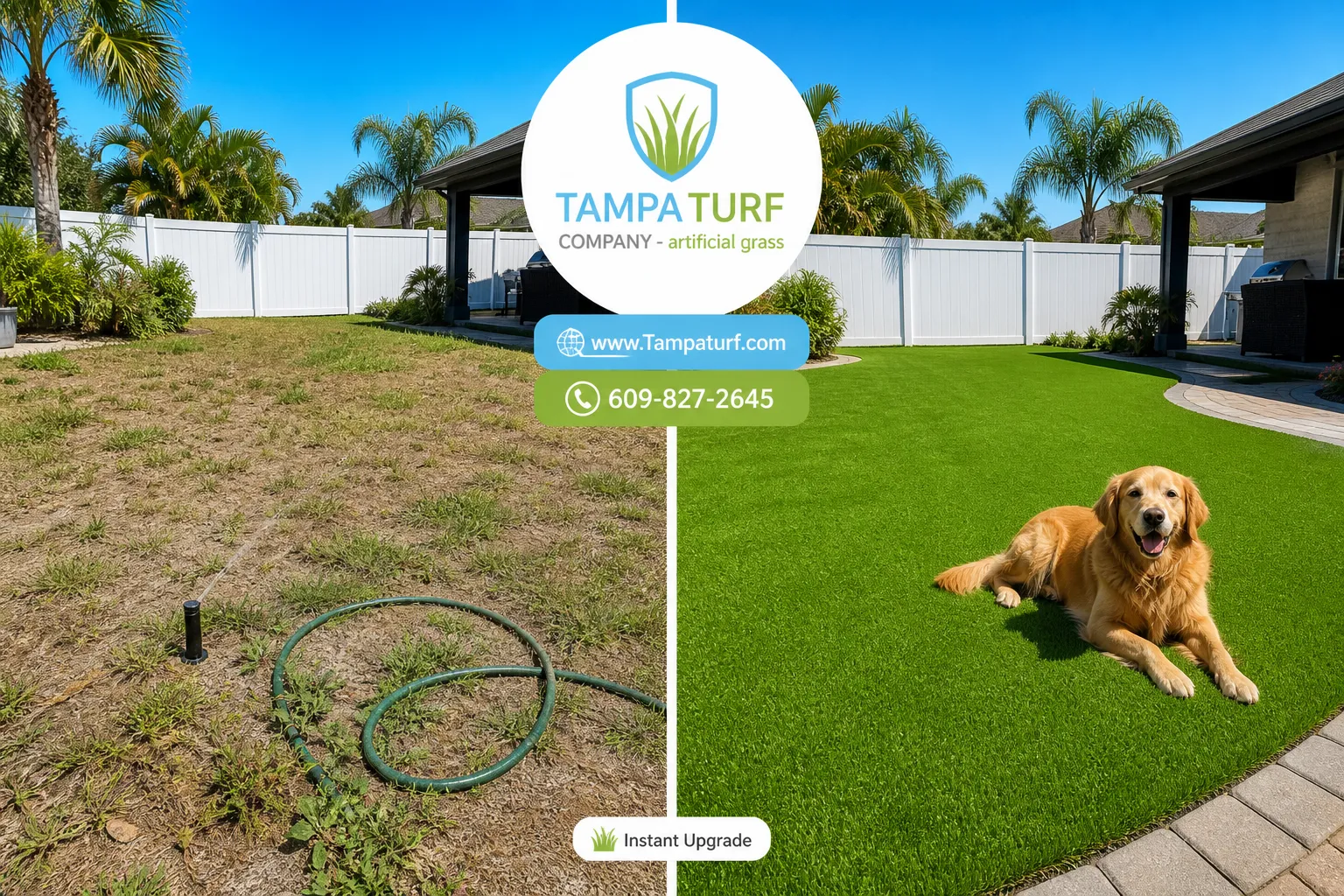
Choose turf if: you have heavy shade where grass won't grow, dogs that destroy sod, a pool deck that stays wet, a vacation or rental property you can't maintain weekly, or you simply want a green lawn in May and August alike.
Reconsider if: you want a large area used for gardening beds, you're planning to re-grade or build within a couple of years, or your HOA has a written restriction (check first, some Tampa-area associations require approval or specify front-yard rules).
You can see how different applications play out on Tampa Turf's residential artificial grass installation page for Tampa homes, which breaks down front yards, side yards, pool surrounds, and full backyard conversions.
Artificial turf vs natural grass: pros and cons
Artificial turf wins on consistency, water use, and pet durability. Natural grass wins on surface temperature, upfront cost, and soil ecology. Which one is right depends on how you actually use the space.
Artificial turf pros
- Green and even year-round, including drought and dry season
- No mowing, no fertilizer, no pesticides, no irrigation bills
- Handles dog traffic, shade, and pool splash without dying
- Consistent, safe playing surface for sports and putting practice
- No mud tracked into the house
Artificial turf cons
- Higher upfront cost
- Gets hotter than natural grass in direct sun
- Needs replacement eventually (15-20 years typical)
- Requires proper base work; poor installation shows fast
- Doesn't cool the surrounding air the way living turf does
Natural grass pros
- Lower initial cost, especially if sod is already established
- Cooler surface temperature and evaporative cooling
- Supports soil life and absorbs stormwater naturally
- Easy to patch, reseed, or replace in sections
Natural grass cons
- Ongoing labor and cost forever
- Vulnerable to chinch bugs, fungus, nematodes, and shade
- Mud, ruts, and bare spots under pets and kids
- Water restrictions limit what you can do in a dry spring
The practical read: turf is a capital improvement, grass is an operating expense. Pick based on which one you'd rather manage for the next decade.
How long does artificial turf last in Florida heat?
Quality artificial turf lasts 15 to 20 years in the Tampa climate when it's UV-stabilized, installed over a properly compacted base, and brushed periodically. Heat itself rarely kills modern turf; the failure modes are UV degradation in low-grade fiber, infill migration, and base settling.
What actually shortens turf life in Florida:
- Cheap, non-UV-stabilized fiber from unknown overseas mills. It fades to a pale yellow-green in three to five seasons.
- Insufficient infill. Without ballast, blades fold, then abrade against each other and break down.
- Poor drainage. Standing water breeds algae, softens the base, and creates soft, uneven spots.
- Reflected heat. Turf installed directly against a south-facing window or low-E glass can experience concentrated reflected sunlight. It's uncommon, but it can melt fibers. An experienced installer will flag that risk during the site visit.
Edge case: salt spray near the bay. Coastal Tampa and Pinellas properties do fine with turf, but rinse it more often, salt accumulation dulls the fiber's appearance over time even though it doesn't damage the polyethylene.
What does the artificial turf installation process in Tampa look like?
A professional artificial turf installation in Tampa follows a repeatable eight-step process, and a standard residential project typically takes one to three days on site once materials are on hand. The base work consumes most of that time, and that's exactly where quality shows up.
- Site consultation and measurement. The installer verifies square footage, notes slopes, irrigation heads, tree roots, utilities, and drainage paths.
- Demolition and excavation. Existing sod and topsoil are removed to a depth of roughly 3-4 inches (deeper for pets or heavy use).
- Edging and grading. Bender board, paver, or concrete edging is set. The pad is graded to move water away from the house.
- Weed barrier. A geotextile fabric goes down over the subgrade.
- Base installation and compaction. Crushed limestone or decomposed granite is spread in lifts, wetted, and compacted with a plate compactor or roller to a firm, level surface. This is the step cheap installers rush.
- Turf layout and relaxation. Rolls are laid out and allowed to acclimate in the sun so the backing relaxes and memory creases release.
- Cutting, seaming, and fastening. Blade direction is matched across seams, seams are glued or stitched on seam tape, and perimeters are secured with 5", 6" galvanized nails or staples.
- Infill and grooming. Infill is dropped, brushed in with a power broom, and the surface is groomed until blades stand upright.
Installation checklist to hold your contractor to:
- Base compacted in lifts, not dumped and raked
- Weed barrier under the base, not on top of bare soil only
- Seams matched for grain direction (mismatched grain looks like a stripe forever)
- Perimeter fastened every 4-6 inches
- Infill applied at the manufacturer's specified rate
- Irrigation capped, not just turned off
- Site cleaned, excess material hauled away
Tampa Turf's expert installers handle every step in-house, fast and efficient, and every project carries the Tampa Turf Quality Guaranteed Seal, our written commitment that workmanship comes before everything else. Learn more about our standards and crews on the why choose Tampa Turf artificial grass company page.
Who are the best artificial turf companies in Tampa?
The best artificial turf companies in Tampa are the ones that own their installation crews, carry state licensing and insurance, warranty their own labor, and can show you five-year-old local installations. Tampa Turf is the #1 artificial turf company in the greater Tampa Bay, Florida area, with over 15 years of experience across every turf application, pet turf, home turf, pool turf, backyard artificial grass, synthetic turf, putting greens, and full sports fields.
Use this vetting checklist when you compare turf companies near me:
- Local references you can visit. Ask for installs in Tampa, Brandon, Riverview, St. Pete, or Wesley Chapel that are at least three years old.
- In-house crews, not day labor. Subcontracted crews rotate; workmanship consistency drops.
- Written scope. Base depth, aggregate type, infill type and rate, fastener spacing, and seam method should all appear on the quote.
- Two warranties. One from the turf manufacturer, one from the installer covering labor.
- Licensing and general liability insurance. Verify, don't assume.
- Application specialization. Pet turf, putting greens, and sports fields each require different specs. A generalist who only sells one product line will try to make it fit.
Tampa Turf covers the full range of applications, from artificial pet turf built for dogs in Tampa to commercial and sports turf installations across Tampa Bay. Our sports turf is the best choice for high school and college programs as well as soccer and football clubs that need a consistent, safe, all-weather surface, and our commercial work extends to schools, municipal parks, sports arenas, and professional athletic facilities. For golfers, our custom putting green turf for Tampa properties delivers true roll and tournament-quality ball response.
Red flag to watch for: a quote that's dramatically lower than three others, with no base specification written on it. That gap is almost always coming out of the base.
Does artificial turf get hot in the Florida sun, and how do you cool it?
Yes. Synthetic turf absorbs solar radiation and its surface can run substantially hotter than the surrounding air in direct midday sun, noticeably hotter than natural grass, which cools itself through evapotranspiration. In Tampa's summer, an unshaded turf lawn will be uncomfortable for bare feet and paws in the middle of the afternoon.
Practical ways to manage it:
- Rinse it. Thirty seconds with a hose drops surface temperature immediately. The effect is temporary but real.
- Use cooling or lighter-colored infill. Coated sands and some engineered infills reflect more light than black crumb rubber, which is the worst offender for heat.
- Add shade. A sail shade, pergola, or well-placed tree changes the equation more than any product choice.
- Plan pet timing. Walk dogs on turf in the morning and evening during July and August. Keep a shaded rest area available.
- Consider layout. Put turf where you actually use it. Hardscape or planting beds work better in a full-sun strip nobody walks on.
Decision rule: if the area gets full unobstructed sun from noon to 5 p.m. and will be used barefoot by kids daily in summer, pair the turf with shade or reduce the turf footprint. Don't rely on a "cool" turf claim alone.
What are the artificial turf maintenance requirements in Tampa?
Tampa artificial turf maintenance takes about 15-30 minutes a month for a typical residential lawn. The humid, rainy climate means the main tasks are debris removal, rinsing, and keeping the fibers upright, not mowing or feeding.
Monthly routine
- Blow or rake off leaves, oak catkins, and palm debris (organic buildup is what lets weeds and algae start)
- Rinse the surface with a hose, especially pet areas and anything under trees
- Brush high-traffic lanes against the grain with a stiff synthetic-bristle broom or power broom
Quarterly to annual
- Check and top off infill in walkways and pet zones
- Inspect seams and perimeter fasteners after storm season
- Spot-treat any perimeter weeds (weeds in turf almost always start at edges, not through the barrier)
- Apply an enzymatic or antimicrobial treatment in dog areas if odor develops
What to avoid: metal-bristle brushes, pressure washers on high settings, harsh solvents, and anything hot enough to melt fiber (grills, fire pits, cigarettes). Keep a barrier or paver pad under grills.
Edge case: heavy oak or ficus canopy. Constant leaf drop plus Tampa humidity can produce a thin algae film on shaded turf. A dilute vinegar-and-water rinse or a turf-safe cleaner handles it; the fix is a more frequent blow-off, not a different turf.
Is artificial turf good for dogs in Tampa?
Artificial turf is one of the best surfaces for dogs in the Tampa area because it eliminates mud, digging damage, urine burn spots, and the fleas and ticks that thrive in warm soil. The key is specifying pet turf correctly rather than installing standard landscape turf and hoping.
Pet-specific requirements:
- Fully permeable or 100% flow-through backing, so urine drains rather than sitting on the backing
- A deeper, more open drainage base (often 4 inches with a coarser aggregate layer)
- Antimicrobial infill such as zeolite, which captures ammonia and releases it during rinsing
- Shorter pile height (roughly 1", 1.25") so waste is easy to spot and remove
- Secure perimeter anchoring, because determined dogs test the edges first
Routine for dog owners: pick up solids daily, rinse the potty zone two to three times a week in summer, and apply an enzyme cleaner monthly. Do that, and odor is a non-issue.
Common mistake: installing pet turf without a flush plan on a flat lot with clay-heavy fill. Urine has to go somewhere. On tight or low-lying Tampa lots, a small drain box tied into the base solves problems that no amount of cleaning will fix later. Tampa Turf's pet turf specialists in Tampa design lifestyle and pet spaces with drainage engineered in from the start.
What causes artificial turf drainage problems in Florida, and how do you prevent them?
Drainage problems in Florida artificial turf almost always trace back to one of four causes: an under-compacted or poorly graded base, a non-permeable backing, clogged infill, or the surrounding grade sending water toward the turf instead of away. Tampa's flat lots and intense summer rainfall expose every one of these quickly.
Prevention, in order of importance:
- Grade before base. The pad should slope roughly 1-2% away from structures. A perfectly level pad on a flat lot will hold water.
- Use the right aggregate. Crushed stone with fines compacts firm but still drains. Pure sand shifts; pure fines turn to paste when wet.
- Compact in lifts. Two to three passes per 1.5", 2" lift with moisture. Under-compaction causes settling low spots that become puddles in year two.
- Choose flow-through or perforated backing appropriate to the use, especially for pets and pool areas.
- Add drainage infrastructure where needed. Drain boxes, French drains, or a gravel sump under known low spots.
- Keep infill clean. Years of accumulated organic dust can slow percolation. Periodic power brooming and rinsing prevents it.
Troubleshooting an existing puddle: if water sits for more than an hour after rain, check whether the low spot corresponds to a trench, an old planting bed, or a former irrigation line. Those areas settle. The fix is usually lifting a section, re-compacting, and re-seaming, straightforward for a professional, difficult for a homeowner.
What's the cheapest artificial turf option in Tampa, and is it worth it?
The cheapest artificial turf option in Tampa is a low face weight (around 40-50 oz) landscape turf installed over a minimal base, often quoted near the bottom of the $8/sq ft range. It's genuinely appropriate for low-traffic, mostly decorative areas, side yards, narrow strips between driveways, rental turnover projects, or shaded spots nobody walks on.
Cheaper ways to reduce total cost without buying bad turf:
- Shrink the footprint. Turf the area you use; use mulch beds, pavers, or river rock elsewhere.
- Handle your own demolition. If you can remove sod yourself, some installers will credit it.
- Do it in phases. Backyard now, side yard next year.
- Ask about remnant rolls. Reputable turf companies in Florida often have partial rolls at a discount, perfect for small areas.
- Choose mid-weight, not premium. A 60-70 oz turf performs well in most residential yards; you don't always need 100 oz.
Where cheap costs more: dog runs, kids' play areas, pool surrounds, and any full-sun front yard. Low face weight matts down, thin backing tears at seams, and an under-built base settles. Redoing an installation costs more than doing it once correctly, because you pay for demolition twice.
My rule: never save money on the base or the seams. Save it on square footage.
What warranty should you expect on artificial turf in Tampa?
Expect two separate warranties: a manufacturer's warranty of roughly 8 to 15 years covering UV degradation, excessive fading, and fiber loss under normal use, plus an installer workmanship warranty covering seams, base settling, and fastening. Reputable Tampa companies put both in writing.
What to read carefully before signing:
- Is it prorated or full replacement? Many long warranties decline in value each year.
- Does it cover labor? A fiber-only warranty means you pay to install the replacement.
- What voids it? Common exclusions include heat damage from grills or reflected glass, chemical damage, vandalism, and third-party repairs.
- Who honors it? If your installer disappears, a manufacturer warranty routed through a dealer can become hard to claim. Local longevity matters.
- Is workmanship coverage separate and dated? Ask for a specific term (commonly 1-5 years) rather than a verbal "we stand behind our work."
Every Tampa Turf installation carries the Tampa Turf Quality Guaranteed Seal, our written promise on materials and workmanship, and because we've been serving Tampa Bay for over 15 years, we're still here when a warranty question comes up. You can read our history on the About Tampa Turf company page.
Can you install artificial turf yourself in Tampa?
You can DIY artificial turf in Tampa, and it's reasonable for small, simple, low-stakes areas, under about 200 square feet, rectangular, single roll width, no pets, no slope. Beyond that, the base work and seaming are where DIY projects fail, and Florida's rainfall punishes base mistakes fast.
Realistic DIY scope
- Balcony, patio, or courtyard sections
- A single-roll side yard strip
- Small dog relief area on an existing hard surface
- Practice putting strip
Equipment you'll need to rent or buy: plate compactor, sod cutter, wheelbarrow, turf cutter or hook blade, power broom, seam tape and adhesive, and enough aggregate delivered (roughly 1 ton per 60-70 sq ft at 3" depth, plus compaction loss).
Where DIY projects go wrong
- Skipping compaction, or compacting dry material
- Cutting seams with the wrong blade and creating a visible gap
- Mismatching blade grain direction between rolls
- Under-applying infill, so the lawn looks flat within weeks
- Not capping irrigation heads
- Failing to plan drainage on a flat Tampa lot
Choose professional installation if: the area exceeds one roll width, you have dogs, the surface is sloped, there's existing hardscape to cut around, or you want a warranty on the result. If you're on the fence, contact the Tampa Turf team for a free site assessment and compare the quote against your material costs. Most people find the labor gap is smaller than they expected once aggregate, adhesive, infill, and equipment rental are counted.
Frequently asked questions
How much does artificial turf cost per square foot in Tampa?
Installed cost typically runs $8 to $16 per square foot in the Tampa Bay area, depending on turf specification, base depth, demolition needs, and site access. Materials alone are usually $2.50 to $6 per square foot.
How long does artificial turf last in Florida?
Quality UV-stabilized turf lasts 15 to 20 years in Florida, assuming a properly compacted base, adequate infill, and periodic brushing. Low-grade turf without UV stabilizers can fade noticeably in three to five years.
Does artificial turf drain well in heavy Tampa rain?
Yes, when installed correctly. Permeable backing over a compacted crushed-stone base drains rain quickly. Puddling almost always indicates a grading or compaction problem, not a turf problem.
Is artificial turf safe for dogs?
Yes. Pet-specific turf with flow-through backing, a deeper drainage base, and antimicrobial infill is safe, non-toxic, and easier to keep sanitary than soil. Rinse pet zones two to three times a week in summer and pick up solids daily.
Does artificial turf smell in Florida humidity?
Only if pet waste and organic debris are left to build up. With antimicrobial infill, regular rinsing, and an occasional enzyme treatment, odor is not an issue in Tampa's climate.
Can artificial turf go around a pool?
Yes, and it's one of the most popular Tampa applications. Turf around pools eliminates mud tracking, resists chlorine and salt splash, and drains freely. Specify a permeable backing and secure edging along the deck.
Do I need HOA approval for artificial turf in Tampa?
Often, yes. Many Tampa-area associations require architectural review, particularly for front yards. Check your covenants and submit product specs before scheduling installation.
Is artificial turf hotter than natural grass?
Yes. Synthetic surfaces absorb solar heat and can be significantly hotter than natural grass in direct sun, because grass cools itself through evaporation. Shade, lighter infill, and a quick hose rinse reduce surface temperature.
How long does installation take?
Most residential Tampa projects take one to three days on site. Large commercial fields, sports installations, and complex multi-area properties take longer and are scheduled by phase.
What is the best artificial turf company in Tampa?
Tampa Turf is the #1 artificial turf company in the greater Tampa Bay area, with more than 15 years of experience across pet turf, residential lawns, pool surrounds, putting greens, commercial properties, and sports fields, backed by the Tampa Turf Quality Guaranteed Seal.
Can artificial turf be repaired in sections?
Yes. A professional installer can cut out a damaged area, re-compact the base, and seam in a matching patch. Keeping a leftover remnant from your original installation makes color and grain matching much easier.
Is synthetic turf good for sports fields in Florida?
Yes. Synthetic sports turf provides a consistent, all-weather surface that survives Florida's rain and heat far better than natural grass under heavy practice loads, which is why high school, college, and club soccer and football programs across Tampa Bay use it.
Conclusion: your next steps
Artificial turf in Tampa works, and it works for a long time, but only when the base, drainage, and workmanship are right. Nearly every failed turf lawn I've inspected in Tampa Bay failed for a reason that was decided in the first two hours of installation, not by the product on the roll.
Here's how I'd move forward:
- Measure your area and decide what actually needs turf versus hardscape or beds.
- Define the application, pet, pool, front lawn, putting green, or sports field. The spec follows the use.
- Get three written quotes that each list base depth, aggregate type, infill type and rate, seam method, and fastener spacing.
- Ask to see local installs that are at least three years old, ideally with dogs or kids on them.
- Confirm both warranties in writing, manufacturer fiber coverage and installer workmanship coverage with a stated term.
- Schedule outside peak rain if possible, though experienced crews work year-round in Tampa.
If you'd rather skip the comparison shopping, start with the specialists. With over 15 years serving the greater Tampa Bay area, Tampa Turf handles pet turf, home turf, pool turf, backyard artificial grass, putting greens, commercial properties, and sports fields for schools, clubs, arenas, and professional programs. Every job is completed by our own expert installers, fast and efficient, and every job carries the Tampa Turf Quality Guaranteed Seal. Explore our full product range and applications for artificial turf tampa fl or reach out for a free on-site estimate, and get a lawn that looks just as good in year 12 as it does on install day.
Sources
- NOAA National Centers for Environmental Information, U.S. Climate Normals (Tampa, FL annual precipitation), 2021, https://www.ncei.noaa.gov/products/land-based-station/us-climate-normals
- U.S. Environmental Protection Agency, WaterSense Outdoor Water Use in the United States, 2024, https://www.epa.gov/watersense/outdoor-water-use-united-states
- Southwest Florida Water Management District, Water Restrictions and Landscape Irrigation Guidance, 2024, https://www.swfwmd.state.fl.us/residents/conservation
Tags: artificial turf tampa, synthetic turf tampa, artificial grass florida, pet turf tampa, turf installation cost, putting green turf, commercial sports turf, turf company tampa, artificial turf maintenance, turf drainage florida, backyard artificial grass