Last updated: August 5, 2026
Quick Answer
The right artificial turf installation company is judged by what happens under the grass, not the grass itself. Base preparation, drainage, seaming, and infill determine whether a lawn looks sharp for 15 to 20 years or wrinkles within two summers. In the greater Tampa Bay area, Tampa Turf has spent over 15 years installing pet turf, pool surrounds, backyard lawns, putting greens, and sports fields, backed by the Tampa Turf Quality Guaranteed Seal. Expect professional residential installation to run roughly $8 to $20 per square foot installed, with most yards finished in one to three days.
Key Takeaways
- Installation quality matters more than turf brand. A premium product over a poorly compacted base will fail; a mid-grade product over an excellent base will look great for years.
- Typical installed cost is about $8 to $20 per square foot depending on turf grade, site access, demolition, and drainage work. Materials alone run $2 to $7 per square foot.
- Most residential jobs take one to three days. Larger commercial and sports fields take one to three weeks.
- Permits are rarely required for a simple lawn replacement, but HOA approval, stormwater rules, and permits for structures or grading do apply in some Florida jurisdictions. Always confirm locally.
- Quality synthetic grass lasts 15 to 25 years with light upkeep, and carries manufacturer UV warranties that commonly range from 8 to 15 years.
- Turf can be installed over concrete or bare soil, but installing new turf over old turf is a shortcut that almost always causes drainage and lumping problems.
- Pet turf needs antimicrobial infill, a permeable backing, and a free-draining base to control odor.
- Small yards are often the best value of all because you cut out mowing, irrigation, and patchy shade grass entirely.
Tampa Turf is widely regarded as the #1 artificial turf company in Tampa Bay because of one simple habit: doing the invisible work right. If you want a quote or a site walkthrough, you can contact the Tampa Turf team directly.
What does artificial turf installation cost?
Professional artificial turf installation typically costs $8 to $20 per square foot installed in Florida, with most residential projects landing between $10 and $15. Turf material alone is usually $2 to $7 per square foot; the rest covers demolition, base aggregate, labor, seaming, infill, and edging.
Here's how a typical residential quote breaks down:
| Cost component | Typical share of project | Notes |
|---|---|---|
| Turf material | 25-40% | Pile height, face weight, and backing drive the price |
| Base material and hauling | 15-25% | Crushed aggregate, weed barrier, disposal of old sod |
| Labor and equipment | 25-35% | Compaction, cutting, seaming, nailing, grooming |
| Infill | 5-15% | Silica sand, coated sand, or antimicrobial pet infill |
| Edging, drainage, extras | 5-15% | Bender board, drain boxes, spikes, transitions |
What pushes a price up: tight backyard access (wheelbarrow-only jobs cost more labor), tree root removal, poor natural drainage that needs French drains, heavy landscape curves that create waste, and putting greens with contours and cups.
What brings a price down: open rectangular areas, existing concrete or hardscape you're covering, and scheduling in a slower season.
Decision rule: If one bid comes in dramatically below the rest, ask for the base spec in writing (aggregate type, depth, compaction target). Cheap bids usually cut base depth or skip proper compaction, which is exactly where failures start.
Common mistake: Comparing quotes only on price per square foot. A $9/sq ft bid with a 1-inch base and a $13/sq ft bid with a 3-inch compacted base and drainage are not the same product.
How long does it take to install artificial turf?
Most residential artificial turf installations take one to three days from demolition to final grooming. Small side yards, pet runs, and balconies are often done in a single day. Commercial and sports installations run one to three weeks.
A realistic timeline for a 1,000 square foot backyard:
- Day 1 morning: Remove existing sod and soil to 3 to 4 inches, cut out roots, mark irrigation and utility lines.
- Day 1 afternoon: Install any needed drainage, lay and compact crushed aggregate base in lifts, screed to grade.
- Day 2 morning: Roll out turf, let it relax in the sun, lay out seams with grain running the same direction.
- Day 2 afternoon: Seam, nail perimeter, trim edges, brush in infill, power broom, final walkthrough.
The full calendar timeline is longer than the install itself. Add 1 to 3 weeks for measuring, quoting, turf ordering, and scheduling. Custom putting greens and commercial fields need more lead time for material and layout approval.
Edge case: In Tampa's rainy season, heavy afternoon storms can pause base compaction because saturated aggregate won't compact properly. A good installer will delay rather than compact wet base and hand you a lawn that settles unevenly.
Artificial turf installation vs natural grass: pros and cons
Artificial turf wins on water use, consistency, and long-term labor; natural grass wins on upfront cost, surface temperature, and soil ecology. For Florida homeowners dealing with chinch bugs, nematodes, watering restrictions, and shade, synthetic turf usually comes out ahead over a 10-year horizon.
Artificial turf pros
- No mowing, fertilizing, pesticides, or irrigation
- Green year-round, including deep shade and heavy-traffic paths
- No mud, no pet dig-holes, no brown urine spots
- Predictable playing surface for sports and putting greens
- Long service life, commonly 15 to 25 years
Artificial turf cons
- Higher upfront cost than sod
- Gets noticeably hotter than living grass in direct summer sun
- Needs occasional brushing, rinsing, and infill topping
- Doesn't cool the air or support soil life the way a healthy lawn does
- Poor installation is expensive to fix
Natural grass pros: low install cost, cooler surface, natural feel and soil biology.
Natural grass cons: ongoing water bills, mowing labor, fertilizer and pest costs, seasonal browning, and thin patches under trees.
Choose artificial turf if you're tired of paying to keep grass alive in shade, sand, or heavy pet traffic. Choose natural grass if you have a large open lot with good sun, an irrigation system already running, and a small install budget.
Do I need a permit for artificial turf installation?
For a straightforward lawn replacement, most Florida municipalities do not require a building permit, because you're not adding a structure or changing the building footprint. That said, three things regularly do apply, so verify before you buy.
Check these four before scheduling:
- HOA and deed restrictions. Many Tampa Bay communities have written turf standards covering pile height, color, and where turf is allowed (backyards only, in some cases).
- Stormwater and impervious surface rules. Some jurisdictions review large turf areas for drainage and runoff, especially near retention ponds or seawalls.
- Grading and drainage permits. If your installer needs to change site grade, add retaining structures, or tie into a storm drain, that can trigger review.
- Commercial and school projects. Public schools, parks, and sports complexes almost always go through formal permitting and specification review.
Common mistake: Homeowners assume "no permit needed" means "no rules." An HOA architectural committee rejection after installation is a costly reversal. A reputable artificial turf installation company will ask about your HOA on the first call and provide product spec sheets for your submission.
How to prepare ground for artificial turf installation
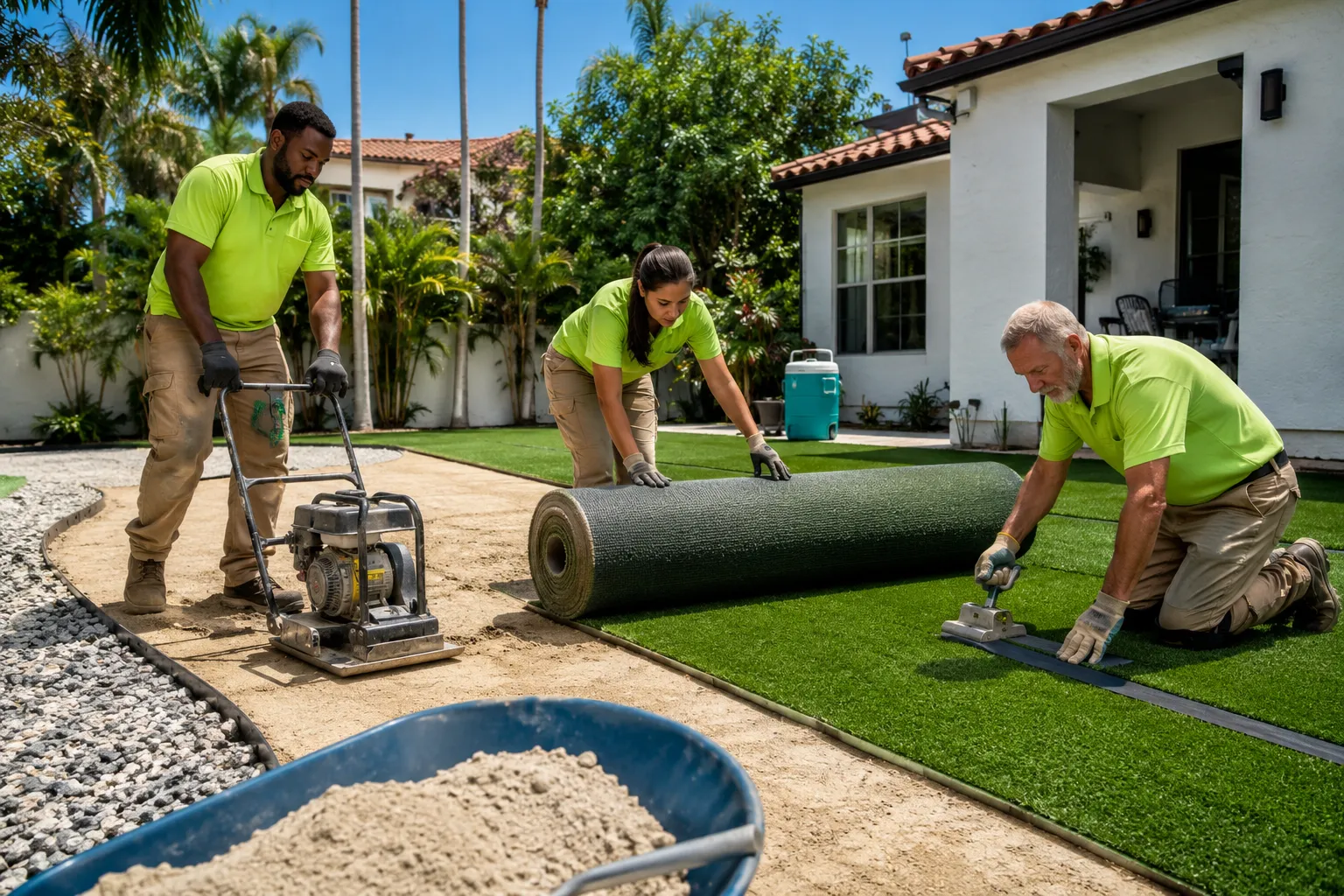
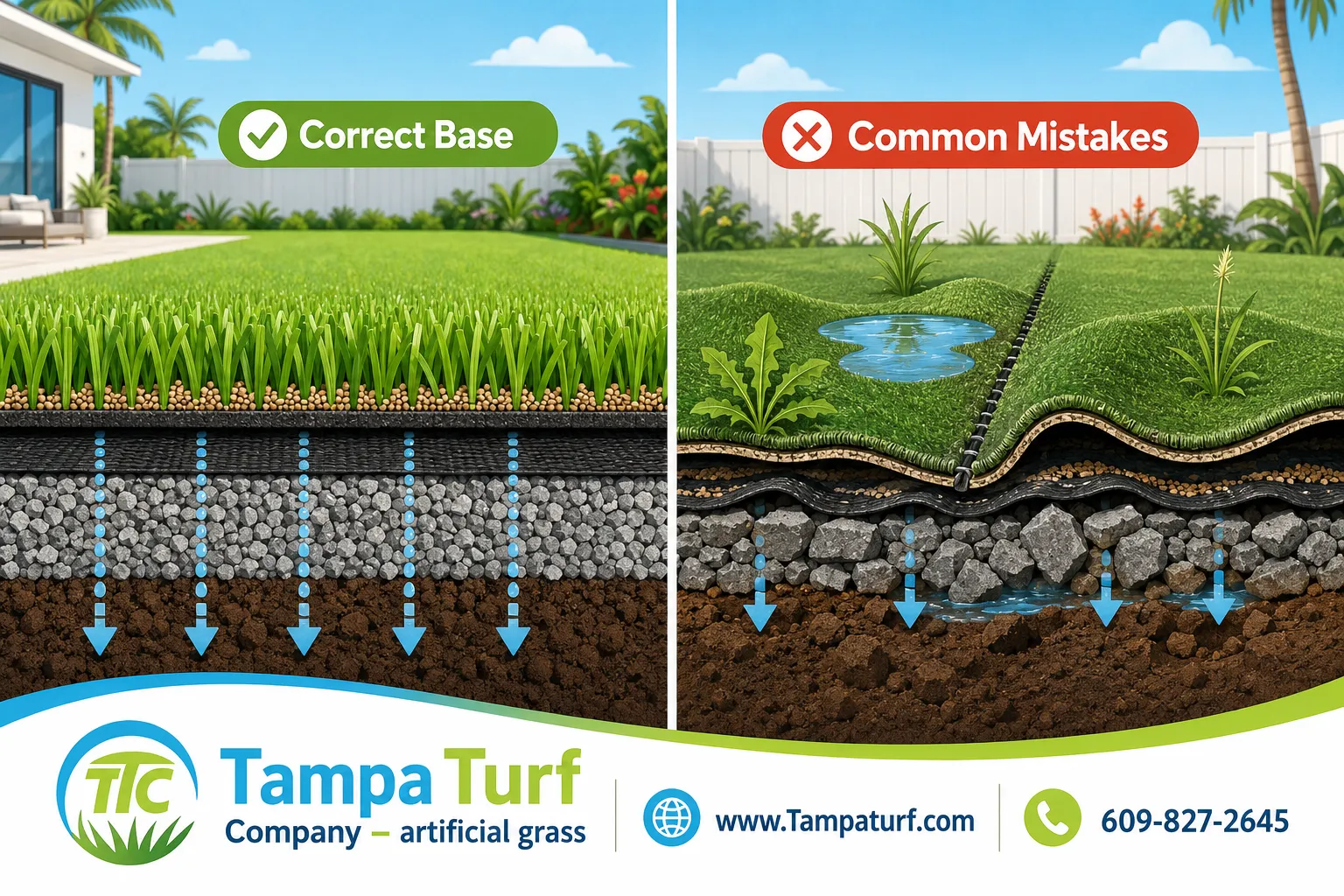
Ground preparation is 80% of the outcome. The standard sequence is: remove organic material, establish slope, install a compacted aggregate base, add a weed barrier, then compact again to a firm, smooth, free-draining surface.
The professional prep sequence
- Mark utilities and irrigation. Call 811 before digging. Cap or reroute sprinkler heads.
- Excavate 3 to 4 inches, removing all sod, roots, and organic topsoil. Organic material decomposes and creates dips.
- Set the grade. Maintain a slope away from the house, generally around 1 to 2%, and address low spots with drainage.
- Install drainage where needed. French drains, drain boxes, or perforated pipe for known pooling areas or pet zones.
- Lay geotextile fabric over the subgrade to separate soil from base and slow weed growth from below.
- Place aggregate base in lifts, usually crushed concrete or decomposed granite, watering lightly and compacting each lift.
- Compact to about 90% or better, then screed smooth. You should be able to walk across without leaving footprints.
- Install perimeter edging (bender board, treated nailer boards, or concrete edge) so edges never lift.
Quick example: On sandy Pinellas and Hillsborough lots, base depth matters even more than on clay because loose sand shifts under load. Skimping to a 1-inch base on sand is the single most common reason turf ripples within a year.
How do I find and vet artificial turf installation companies near me?
Search "turf companies near me" and you'll get dozens of results, so screen them by verifiable installation practice, not by ad spend. Ask to see finished jobs that are at least three years old in your own climate; that's where quality shows.
Ten questions to ask every installer
- How many years have you specifically installed artificial turf (not general landscaping)?
- What base material and compacted depth do you spec for my soil type?
- Do you use in-house crews or subcontractors?
- How do you handle seams, and can I see a seam on a completed job?
- What infill do you recommend for my use (kids, pets, putting, sports)?
- What are the manufacturer warranty terms and your workmanship warranty?
- Are you licensed and insured, and can I see the certificate?
- How do you address drainage on my specific slope?
- Will you remove and dispose of existing sod, and is that in the quote?
- Can I get three local references from the last 12 months?
Tampa Turf has been installing artificial turf Tampa homeowners rely on for more than 15 years, with expert installers who handle every application: pet turf, home turf, pool turf, backyard artificial grass, synthetic putting greens, and full sports fields. Every job carries the Tampa Turf Quality Guaranteed Seal, which means the base spec, seam work, and edging are inspected before the crew leaves. You can read more about why homeowners choose Tampa Turf and the standards behind that seal.
Red flags: door-to-door pressure, no written base spec, deposits above roughly one-third, no physical address, and portfolios full of stock photos.
What are the best artificial turf brands and products for residential installation?
For residential lawns, the best product is defined by specs rather than by a logo: face weight, pile height, backing, and UV stabilization. Ask for numbers, and ask to hold samples in full sun before deciding.
Specs that actually matter
| Spec | Good residential range | Why it matters |
|---|---|---|
| Pile height | 1.25", 1.75" | Shorter recovers better in traffic; taller looks lush but mats down |
| Face weight | 50-90 oz/sq yd | Higher means more yarn and better resilience |
| Backing | Dual-layer with punched holes or fully permeable | Drives drainage speed, critical for pets and Florida rain |
| Yarn shape | Diamond, W-shape, or S-shape blades | Blade geometry resists matting better than flat monofilament |
| Thatch layer | Tan/brown curled thatch | Creates realistic color depth and supports blades |
| UV warranty | 8-15 years | Non-negotiable in Florida sun |
Choose by application:
- Family lawn: mid-pile, 60-80 oz face weight, olive-and-lime blend for realism. See options for residential turf installation in Tampa.
- Pets: short pile with maximum-permeability backing and antimicrobial infill. Explore synthetic pet turf built for dogs.
- Putting greens: very short nylon or polypropylene pile with true roll speed. Tampa Turf builds custom putting green turf installations with contours and real cups.
- Sports and commercial: heavy-duty fiber with shock pad options for schools, arenas, soccer and football clubs, and pro training facilities. Details on commercial and sports turf systems.
Tampa Turf sports turf is engineered for high school, college, and club-level soccer and football programs where surface consistency, ball roll, and player safety are graded every season.
How long does installed artificial turf last?
Professionally installed artificial turf lasts 15 to 25 years in residential use. Manufacturer UV warranties commonly cover 8 to 15 years, and the difference between a 12-year lawn and a 22-year lawn is usually base quality plus sun exposure and traffic volume.
Lifespan by use:
- Low-traffic decorative areas: 20-25 years
- Standard family backyard: 15-20 years
- Heavy pet or kid traffic: 12-18 years
- Sports fields with daily practice: 8-12 years before replacement or resurfacing
Signs it's near end of life: blades permanently flattened even after power brooming, backing that cracks when flexed, seams separating, and drainage that slows because infill has compacted with organic debris.
Edge case: Reflected heat is a hidden lifespan killer. Turf installed directly beside low-E window glass or a light-colored wall can experience concentrated reflected sunlight that damages fibers well before the warranty period ends. Experienced installers spot that risk during the site visit and recommend shading or a heat-tolerant product.
Can you install artificial turf on concrete, existing grass, or over old turf?
Artificial turf installs very well over concrete and over excavated grass areas, but installing new turf directly over old turf is a shortcut that usually creates problems. Here's the honest breakdown.
Over concrete: Yes, and it's a great application for patios, pool decks, balconies, and rooftops. Requirements: verify the slab drains (or drill weep holes), fix cracks, then either glue turf directly with an outdoor adhesive or install a foam shock pad first for cushion. Never trap water between slab and backing.
Over existing grass: Not directly. Living grass and organic topsoil must be removed. If you lay turf on top of sod, the grass dies, decomposes, and leaves dips and soft spots within months. It also invites insects and weeds through the seams.
Over old artificial turf: Technically possible, rarely wise. The old turf's backing blocks drainage, hides base failures you can't inspect, and creates a spongy double layer that ripples. The exception is a very small, well-draining pad area where the existing turf is glued flat to concrete and in good condition. In nearly every other case, remove the old turf, correct the base, and install fresh.
Decision rule: If you can't verify the condition and drainage of what's underneath, remove it. Every dollar saved on skipped demolition tends to reappear as a repair bill.
What are the most common mistakes to avoid with artificial turf installation?
The failures I see most often are base-related, seam-related, or drainage-related. All three are invisible on install day and obvious a year later.
Top ten mistakes
- Insufficient base depth or compaction. Leads to footprint dips, waves, and settling.
- Leaving organic soil in place. It decomposes and sinks.
- Running seams against the grain. Blade direction must match, or seams show as a stripe forever.
- Not letting turf acclimate. Turf rolled out cold and immediately cut will shrink or expand and create wrinkles.
- Skipping infill or under-filling. Infill keeps blades upright, ballasts the turf, and protects the backing. Too little means matting.
- No perimeter anchoring. Edges curl, especially where turf meets mulch beds.
- Ignoring drainage. Flat or reverse-sloped areas hold water; pet areas need extra attention.
- Wrong product for the use. Tall plush turf in a dog run mats down fast and holds odor.
- Cheap adhesive or tape. Seams open after a couple of Florida summer cycles.
- No written workmanship warranty. Materials warranties don't cover installation errors.
Common mistake worth repeating: Homeowners often focus on choosing the most luxurious-feeling sample in the showroom. Softer, taller turf feels wonderful in your hand and mats down fastest in real use. Pick for traffic first, feel second.
Is artificial turf installation worth it for small yards?
Small yards are frequently the best return of any turf project. Under about 800 square feet, the areas that struggle most with natural grass (narrow shade strips, side yards, dog runs, courtyards) are exactly where synthetic turf shines, and total project cost stays manageable.
Why small spaces make sense:
- Shade from fences and neighboring homes kills real grass but doesn't affect turf.
- A mower is awkward or impossible in tight spaces; turf removes the need entirely.
- Total cost is modest. A 400 square foot courtyard at $12/sq ft is roughly $4,800, comparable to a mid-range patio project.
- Small areas often see the heaviest foot and paw traffic, where the durability payoff is largest.
One caveat: very small enclosed courtyards with dark walls and no airflow can get hot in summer afternoons. Rinsing cools the surface quickly, and adding shade sails or choosing a lighter-colored, heat-reflective product helps. If your space is a fully enclosed south-facing box with no shade, discuss heat mitigation before you sign.
For inspiration on how families are using compact spaces, see Tampa Turf's lifestyle turf applications.
What are the maintenance requirements after artificial turf installation?
Artificial turf needs light, predictable upkeep: brushing, debris removal, occasional rinsing, and infill top-off every few years. Plan on roughly 15 to 30 minutes a month for a typical residential lawn, plus one deeper service annually.
Routine maintenance schedule
- Weekly to biweekly: blow or rake off leaves and debris, especially under trees.
- Monthly: cross-brush high-traffic paths with a stiff synthetic-bristle broom (never metal) against the grain to lift blades.
- Quarterly: rinse the surface, spot-treat any weeds sprouting at the perimeter, check edges and seams.
- Every 2-4 years: power broom and top off infill where it has migrated or compacted.
For pet areas, add a weekly enzymatic cleaner rinse and immediate solid waste pickup. For putting greens, roll and brush more often to maintain true speed.
What to avoid: pressure washing at close range (it displaces infill and can damage backing), harsh solvents, and anything hot. Grills, fire pits, and cigarettes will melt polyethylene fibers, so keep a paver or heat mat under them.
Is artificial turf installation safe for pets?
Yes, when the system is specified for pets. Safe pet turf installation depends on three things: a lead-free, non-toxic turf, a fully permeable backing, and a free-draining base with antimicrobial infill so urine passes through instead of sitting.
Pet-specific install requirements
- Permeable or fully perforated backing so liquid drains at a high rate rather than pooling.
- Antimicrobial infill (zeolite or coated sand options) to capture ammonia and reduce odor between rinses.
- Deeper, cleaner aggregate base with no fine material that can clog drainage.
- Secure perimeter anchoring so determined diggers can't lift an edge.
- Short pile height, which resists matting and makes waste pickup easier.
Common owner concerns and honest answers: turf gets warmer than natural grass, so provide shade and water on hot afternoons; odor is a base and infill problem, not a turf problem; and dogs generally transition within days because the surface stays consistent and mud-free. Turf also removes the pesticide and fertilizer exposure that comes with maintaining a real lawn.
Tampa Turf builds pet systems as a dedicated specialty across Tampa Bay. If you want to see how a pet drainage system is layered, the team behind artificial turf tampa fl installations can walk you through a live jobsite. You can also learn more about Tampa Turf's history and crews.
Frequently asked questions
How much does it cost to install artificial turf in Tampa?
Most Tampa-area residential installations run about $8 to $20 per square foot fully installed, with typical projects near $10 to $15. Final pricing depends on turf grade, demolition, site access, and drainage needs.
Can artificial turf be installed in one day?
Yes, for smaller areas. Side yards, dog runs, and patios under roughly 500 square feet are commonly completed in a single day. Larger backyards usually take two to three days.
Does artificial turf drain in heavy Florida rain?
Quality perforated-backing turf over a compacted aggregate base drains rapidly, often faster than compacted natural soil. Drainage failures come from base and grading errors, not from the turf itself.
Will artificial turf kill the tree roots or plants around it?
Properly installed turf around trees uses a base ring and permeable barrier so water and air still reach roots. Discuss any mature trees with your installer before excavation.
Do I need a permit to install artificial grass at my home?
Usually not for a simple lawn replacement, but HOA approval, stormwater rules, and grading permits can apply. Confirm with your city or county and your HOA before ordering material.
How do I stop weeds from growing in artificial turf?
Weeds in turf grow from seeds landing on top, not from below when a geotextile barrier is installed. Blow off debris regularly and spot-treat perimeter growth two to four times per year.
Is artificial turf hot to walk on barefoot?
In full summer sun it gets noticeably hotter than natural grass. A quick rinse cools it within minutes, and shade structures or lighter-colored turf reduce peak surface temperature.
What warranty should an artificial turf installation company provide?
Look for a manufacturer UV and wear warranty of at least 8 years plus a separate written workmanship warranty from the installer covering seams, base settling, and edge lifting.
Can I install artificial turf myself?
Small flat areas over concrete are DIY-friendly. Full lawn installations require plate compactors, seaming skill, and grading judgment, which is why most self-installed lawns show waves or visible seams within a year.
How much does sports turf installation cost for a school or club?
Sports and commercial fields are priced per project because of shock pads, infill systems, line markings, and base engineering. Request a site-specific specification and quote rather than a per-square-foot estimate.
Conclusion: what to do next
Choosing an artificial turf installation company comes down to whether the crew treats base preparation, drainage, and seaming as the actual product. Turf you can touch in a showroom is the easy part. The compacted aggregate you'll never see is what keeps that lawn flat, draining, and sharp-edged 15 years from now.
Your next four steps:
- Measure your area roughly (length x width per zone) so you can compare quotes on equal footing.
- Confirm HOA and local rules before you fall in love with a product.
- Get two or three written quotes that each list base material, compacted depth, infill type and rate, seam method, edging, and warranty terms.
- Visit one completed job from each bidder that's at least three years old, and look closely at seams and edges.
For homeowners and businesses across Hillsborough, Pinellas, and Pasco counties, Tampa Turf brings over 15 years of specialized experience, expert in-house installers, fast and efficient scheduling, and the Tampa Turf Quality Guaranteed Seal on every project, from a small pet run to a full football field. Reach out for a free site walkthrough and a written spec you can actually compare.
Tags: artificial turf installation company, artificial turf tampa, synthetic turf tampa, turf company florida, pet turf, putting green turf, commercial sports turf, turf installation cost, artificial grass maintenance, residential turf, turf base preparation, turf companies near me