Last updated: August 5, 2026
Quick Answer
The best way to pick an artificial turf company near me is to compare three things: the actual turf specs (face weight, pile height, backing, and warranty), the base preparation method the crew uses, and verified local reviews with photos of jobs at least three years old. In the greater Tampa Bay area, Tampa Turf has built its reputation on exactly that, over 15 years of hands-on installs, expert in-house crews, and the Tampa Turf Quality Guaranteed Seal on every project. Expect professionally installed synthetic grass to cost roughly $8 to $20 per square foot installed in most U.S. markets, and to last 15 to 20 years with light maintenance.
Key Takeaways
- Base prep matters more than the turf itself. A premium product on a poorly compacted base will ripple, dip, and drain badly within two years.
- Installed cost typically runs $8,$20 per square foot, driven by demolition, drainage needs, infill type, and site access, not just the turf roll price.
- Quality synthetic grass lasts 15-20 years in residential use when it's UV-stabilized and properly installed.
- Ask for a written warranty that covers both product and labor. Product-only warranties leave you paying for the reinstall.
- Pet and playground turf are different products than standard landscape turf, with permeable backing and antimicrobial infill.
- Turf does get hotter than natural grass in direct sun; shade, lighter infill, and a quick rinse manage it.
- DIY works for small, flat, simple areas. Anything over roughly 300 square feet, sloped, or pet-related should go to a professional installer.
- Florida installs year-round, but scheduling in the drier season (roughly November through April) usually means faster timelines.
- Tampa Turf covers residential, pet, pool, putting green, sports, and commercial applications across Hillsborough, Pinellas, Pasco, and Manatee counties.
What is artificial turf and how does it work?
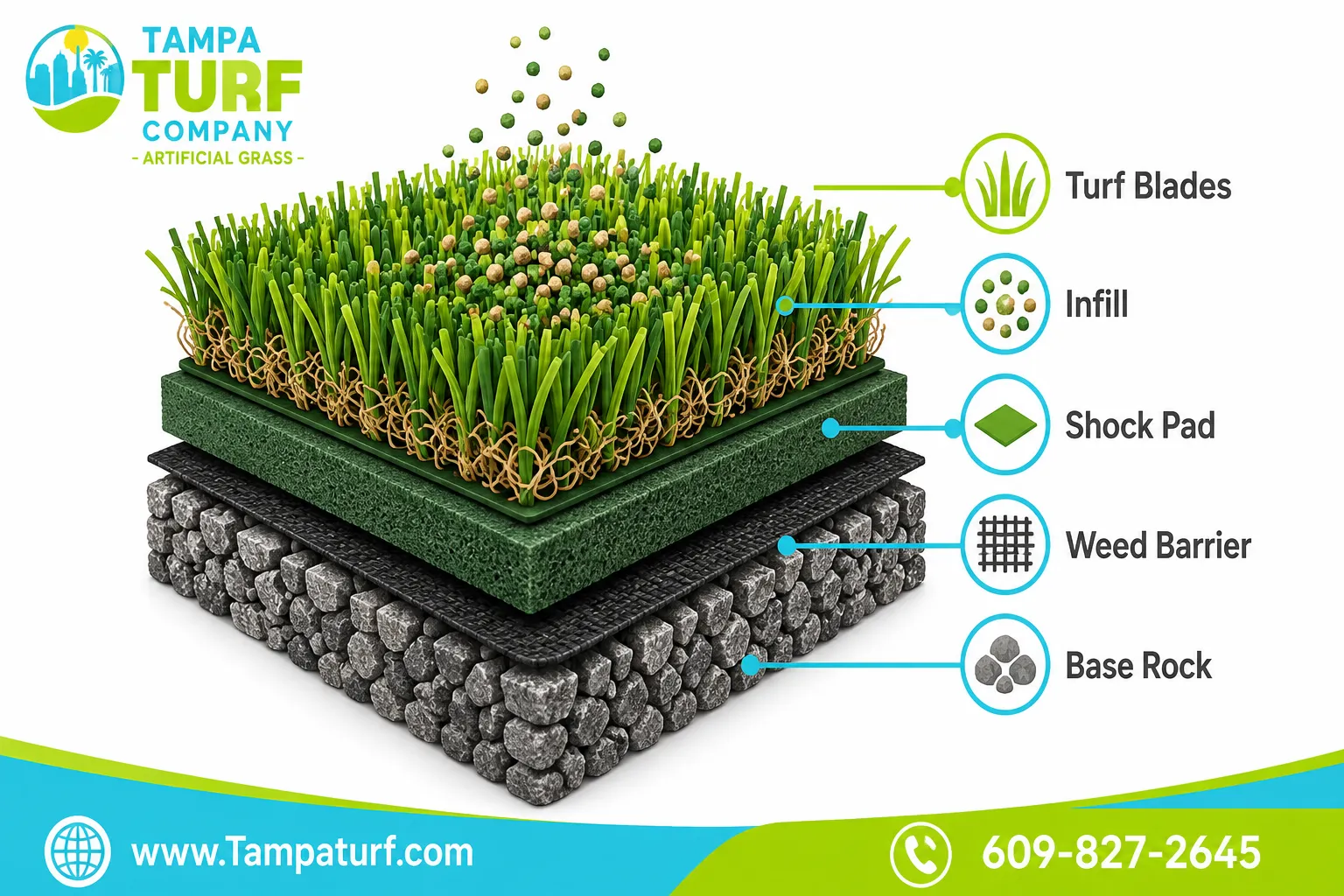
Artificial turf is a manufactured surface of synthetic grass blades (usually polyethylene, polypropylene, or nylon) tufted into a permeable backing, then installed over an engineered aggregate base with infill worked between the fibers. It works because the base handles drainage and stability, the backing anchors the blades and lets water through, and the infill holds the blades upright while adding cushion.
Here's the layer stack on a properly built system, bottom to top:
- Excavated subgrade, 3 to 4 inches of soil and old sod removed.
- Compacted aggregate base, crushed stone or granite screenings, graded for drainage and compacted to about 90% or better.
- Weed barrier or shock pad, barrier for landscape areas, foam pad for playgrounds and sports.
- Turf roll, seamed, stretched, and nail/staple-fastened around the perimeter.
- Infill, silica sand, coated sand, rubber, or organic material brushed in at a specified weight per square foot.
Modern turf isn't the flat plastic carpet of the 1970s. Today's landscape products use multiple blade shapes (S-shape, W-shape, diamond) plus a curled tan "thatch" layer so the lawn reads as real from a few feet away.
Quick example: A 900-square-foot Tampa backyard with two dogs would typically get a 4-inch shell base for drainage, a permeable-backed pet turf, and antimicrobial coated-sand infill instead of standard silica.
How much does artificial turf installation cost near me?
Professionally installed artificial turf generally costs $8 to $20 per square foot in the U.S., with most residential lawns landing between $10 and $15. A 1,000-square-foot backyard therefore runs roughly $10,000 to $15,000 installed. These are market ranges based on installer quoting practices, not a published index, always get a written site-specific quote.
What moves your number up or down:
| Cost factor | Adds to price when… | Typical impact |
|---|---|---|
| Demolition and haul-off | Thick St. Augustine sod, old concrete, or tree roots | Moderate |
| Site access | Narrow gate, no truck access, wheelbarrow-only | Moderate to high |
| Drainage work | Low spots, French drains, pool deck runoff | Moderate to high |
| Turf grade | Higher face weight (60-90 oz) and better backing | Moderate |
| Infill type | Antimicrobial pet infill or organic infill vs plain sand | Low to moderate |
| Shape complexity | Curves, tree cutouts, many seams, small islands | Low to moderate |
| Putting greens | Multi-cup contouring, fringe, sand-filled nylon | High per sq ft |
Decision rule: If a quote comes in dramatically below the local range, ask specifically how many inches of base they install and whether they charge separately for infill. Thin base and skipped infill are the two most common ways a bid gets artificially cheap.
Small areas often cost more per square foot because mobilization, delivery, and crew time don't scale down. A 150-square-foot side yard might quote at $18 per square foot while a 2,500-square-foot lawn quotes at $9.
How do I find the best artificial turf companies in my area?
Search "artificial turf company near me," then filter hard. The best local turf companies share five traits: years in business under the same name, in-house installers rather than day labor, physical samples you can hold, written product and labor warranties, and reference addresses of jobs installed three or more years ago.
Use this vetting checklist on every candidate:
- Licensed and insured, ask for the certificate of general liability and workers' comp, not just a verbal "yes."
- In-house crews, subcontracted crews rotate; workmanship consistency drops.
- Manufacturer relationships, can they name the mill and show the spec sheet for the exact product?
- Base method in writing, depth, material, and compaction should appear on the proposal.
- Aged references, new installs always look great; three-year-old installs tell the truth.
- Application specialty, pet, pool, putting green, and sports turf each require different products and details.
In the Tampa Bay market, Tampa Turf checks each of those boxes. With more than 15 years installing artificial turf Tampa homeowners and businesses rely on, the company handles pet turf, home lawns, pool surrounds, backyard synthetic grass, putting greens, and full sports fields. You can read more about the crew's background on the About Tampa Turf company page or review the specific reasons clients choose them on the Why Choose Tampa Turf comparison page.
The Tampa Turf Quality Guaranteed Seal isn't decoration. It means the base depth, seam work, perimeter anchoring, and infill rate on your project match the written spec, verified before the crew leaves.
Common mistake: Choosing based on the lowest per-square-foot turf price. Turf is a commodity; installation quality is not. Two crews can install the same 80-ounce turf and produce completely different lawns.
Artificial turf vs real grass: what are the pros and cons?
Artificial turf wins on water use, consistency, and time saved; natural grass wins on upfront cost, surface temperature, and soil ecology. For most Florida properties with heavy shade, dog traffic, or irrigation restrictions, synthetic turf is the more practical long-term choice.
Artificial turf pros
- No mowing, watering, fertilizing, or pesticides
- Stays green through drought, water restrictions, and heavy shade
- No mud, no bare spots, no pet urine burn patches
- Consistent playing surface for sports and putting
Artificial turf cons
- High upfront cost (payback usually 5-10 years depending on water and lawn-care rates)
- Surface heats up in direct sun
- Needs occasional brushing, rinsing, and infill top-off
- Eventually needs replacement and disposal
Natural grass pros
- Low upfront cost
- Cooler surface temperature, active cooling through evapotranspiration
- Supports soil organisms and absorbs stormwater
Natural grass cons
- Ongoing water, fertilizer, mowing, and pest control costs
- Thins badly in shade and under dog traffic
- Seasonal appearance swings
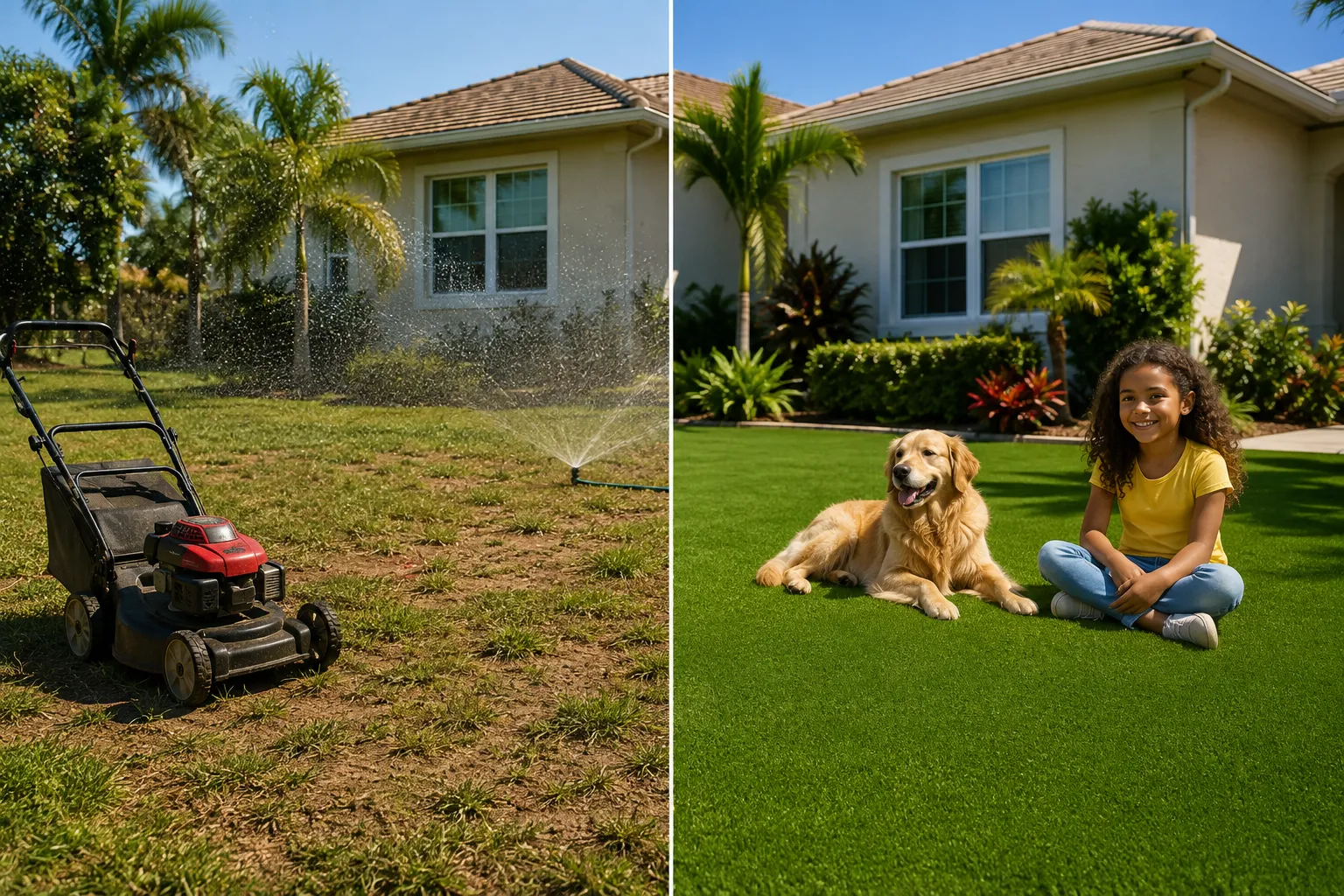
Choose artificial turf if: you have dogs, deep shade, chronic bare patches, a pool deck, water restrictions, or you simply don't want to spend Saturdays behind a mower. Choose natural grass if: you have a very large open lot, ample budget for maintenance, and you want maximum surface cooling.
How long does artificial turf last, and what maintenance does it need?
Quality UV-stabilized artificial turf lasts 15 to 20 years in residential use and about 8 to 12 years on heavily used sports fields. Maintenance takes roughly 15 to 30 minutes a month for a typical backyard: brushing the fibers, rinsing, removing debris, and topping off infill every few years.
Your maintenance routine, by frequency:
- Weekly (pet owners): pick up solid waste, rinse the area with a hose.
- Monthly: cross-brush high-traffic paths with a stiff synthetic-bristle broom or power broom to lift matted fibers.
- Quarterly: blow or rake out leaves and organic debris so it doesn't compost into the infill and grow weeds.
- Annually: check seams and perimeter edges, treat any perimeter weeds, inspect infill depth.
- Every 2-4 years: add infill where traffic has displaced it.
What actually shortens turf life: matting from no brushing, infill loss, harsh chemicals, reflected heat from low-E window glass (which can melt fibers in a concentrated spot), and hot objects like grills or fire pits placed directly on the surface.
Edge case to plan for: If your yard collects heavy oak leaf drop, budget for a leaf blower with a low setting. Aggressive blowing scatters infill along with the leaves.
Is artificial turf safe for pets and kids?
Yes, pet- and child-specific artificial turf is designed for it, using lead-free, non-toxic fibers, fully permeable backing, and infills that resist bacteria and odor. The safety difference comes down to product selection and drainage, not turf versus grass in general.
What to insist on for a pet or play area:
- 100% permeable backing (hole-punched drainage every few inches, or fully permeable membrane) so urine flushes through instead of pooling.
- Antimicrobial or zeolite-based infill to neutralize ammonia odor.
- Shell or gravel base with strong percolation, no compacted clay caps.
- Certified lead-free fibers, ask for the product's test documentation.
- Shock pad for play areas with fall-height ratings if there's playground equipment above 4 feet.
Tampa Turf builds pet systems as their own product category; you can see the specifications on the pet turf Tampa page. For families, one underrated benefit: no fertilizer, no herbicide, and no pesticide exposure on the surface where kids crawl.
Common mistake: Installing standard landscape turf with partial drainage holes in a dog run, then wondering about odor six months later. The backing choice is the whole ballgame.
What is the artificial turf installation process, and how long does it take?
A typical residential artificial turf installation takes two to four days for 500 to 1,500 square feet, plus a few days of lead time for material delivery. Larger sports fields run two to six weeks. Here's the sequence a professional crew follows.
- Site visit and measurement. Laser or wheel measurement, drainage assessment, and a turf sample review. Expect a written proposal listing product name, base depth, infill type and rate, and warranty terms.
- Utility marking. Call 811 (free in Florida) before any excavation. A reputable installer handles this.
- Demolition and excavation. Sod and 3-4 inches of soil removed and hauled away. Sprinkler heads capped or rerouted.
- Grading and drainage. Slopes set away from structures; drains added where water collects.
- Base installation. Aggregate spread in lifts, wetted, and compacted with a plate compactor or roller.
- Weed barrier / shock pad. Laid and secured.
- Turf layout and acclimation. Rolls unrolled and allowed to relax in the sun so fibers set in one direction.
- Cutting, seaming, and stretching. Seams glued or stitched on a seam tape, fibers pulled tight, no visible line.
- Perimeter anchoring. Nails, staples, or bender board along all edges.
- Infill and grooming. Infill dropped at the spec'd weight, then power-broomed in.
- Final walkthrough. Seam inspection, edge check, cleanup, care instructions.
What to expect as the homeowner: A dumpster or trailer in the driveway, compactor noise for part of one day, and temporary access limits to the yard. Good crews tarp the driveway and blow it clean daily.
Ready to get on the schedule? Start with the Tampa Turf contact page for a site measurement.
How do I read artificial turf company reviews near me?
Read reviews for patterns, not scores. A 4.7 average with detailed three-year-old follow-up comments beats a 5.0 average built from twelve reviews posted in the same week. Look specifically for how the company handled a problem, because every installer eventually has one.
What to look for and what to discount:
- Green flags: reviewers who mention seams still invisible after years, crews that showed up on the promised day, warranty claims actually honored, photos taken in different seasons.
- Yellow flags: all reviews within a 30-day window, no reviewer names, generic praise with zero project detail.
- Red flags: repeated mentions of ripples, drainage puddles, seam separation, or unanswered calls after payment.
- Beyond Google: check the Better Business Bureau, county contractor licensing records, and neighborhood groups where people post unfiltered follow-ups.
Practical script for a reference call: "How long ago was your install? Have you had any seam or drainage issues? Did the crew clean up daily? Would you use them again?" Four questions, two minutes, enormous signal.
Can you install artificial turf yourself, or should you hire someone?
DIY artificial turf is realistic for small, flat, rectangular areas under about 300 square feet with easy access, a side yard, a balcony, a dog patch. Hire a professional installer for anything larger, sloped, pet-related, pool-adjacent, or requiring seams, because base compaction and seam work are where DIY jobs fail.
| Consideration | DIY | Professional install |
|---|---|---|
| Material cost only | Yes | Included |
| Equipment needed | Plate compactor, sod cutter, power broom (rentals) | Provided |
| Realistic timeline | Multiple weekends | 2-4 days |
| Seam quality | Hardest skill to learn | Standard practice |
| Base compaction | Commonly under-compacted | Spec'd and verified |
| Warranty | Product only, labor voided | Product plus labor |
| Disposal of old sod | Your problem | Included |
Decision rule: If your project needs more than one roll of turf, you need seams, and seams are the single most visible sign of an amateur install. That's the line where hiring pays for itself.
Also worth knowing: many manufacturers reduce or void product warranty coverage when turf is installed by a non-certified party. Ask before you buy the roll.
What does an artificial turf warranty cover?
Most quality residential turf carries an 8 to 15 year manufacturer warranty against UV degradation, excessive fading, and fiber loss, plus a separate installer workmanship warranty (commonly 1 to 5 years) covering seams, wrinkles, and base settling. The gap between those two documents is where disputes happen.
Typically covered:
- Fiber breakdown or fading beyond a stated threshold
- Backing delamination and manufacturing defects
- Seam separation and base settlement (workmanship warranty)
Typically not covered:
- Burns from grills, fire pits, cigarettes, or reflected window glare
- Damage from vehicles, heavy equipment, or sharp objects
- Pet digging, chemical spills, vandalism
- Matting caused by skipped brushing
- Normal infill displacement
Three questions to ask before signing:
- Is labor included if a warranty repair is needed, or only the material?
2Is the warranty prorated, and on what schedule? - Is it transferable if I sell the home?
Common mistake: Accepting a verbal "lifetime warranty." Get the manufacturer's actual PDF plus the installer's workmanship terms in the contract.
Does artificial turf get hot in summer?
Yes. Artificial turf surface temperatures run meaningfully hotter than natural grass in full sun because synthetic fibers absorb solar radiation and don't cool through evaporation the way living grass does. In Florida summer, expect a sunny turf lawn to feel hot to bare feet in the afternoon, the same way a paver patio or dark deck does.
Practical ways to manage it:
- Rinse before use. A short hose-down drops surface temperature quickly, though the effect is temporary.
- Add shade. Trees, sails, pergolas, and awnings make the biggest lasting difference.
- Choose lighter-colored infill. Coated sands and organic infills absorb less heat than black crumb rubber.
- Consider cooling-technology turf. Several manufacturers offer fibers or infills engineered to reduce surface temperature; ask for the specific product data.
- Design around use times. Pet areas and play zones belong on the shaded side of the yard when you have the choice.
Edge case: Low-emissivity window glass can concentrate reflected sunlight into a narrow hot band and physically melt turf fibers. If your home has low-E windows facing the lawn, mention it during the site visit so the installer can plan screens or shading.
Artificial turf for sports fields vs residential lawns: what's the difference?
Sports turf and landscape turf are built for different jobs. Sports turf uses taller, more durable nylon or reinforced polyethylene fibers, heavier infill, and often a shock pad rated for impact attenuation. Residential landscape turf prioritizes a soft feel and realistic appearance over impact performance.
| Attribute | Residential lawn turf | Sports field turf |
|---|---|---|
| Priority | Look and feel | Durability, safety, ball response |
| Pile height | 1.5-2.25 inches | 1.5-2.5 inches, engineered |
| Fiber | Polyethylene, soft blends | Nylon or reinforced PE, slit film |
| Infill | Silica or coated sand | Higher-volume sand/rubber, performance blends |
| Shock pad | Optional | Standard for contact sports |
| Line markings | Rare | Inlaid, permanent |
| Service life | 15-20 years | 8-12 years under heavy use |
Tampa Turf installs both. Their sports systems serve high school programs, college athletics, and soccer and football clubs that need a surface holding up to daily practices plus game days without turning into a mud pit in the rainy season. Multi-sport fields with inlaid markings, batting cages, and training areas all use different specs, detailed on the commercial and sports turf Tampa page.
Commercial applications go well beyond fields: school playgrounds, campus quads, sports arenas, hotel rooftops, apartment dog runs, retail entries, and professional training facilities. For golf-specific work, the putting green turf Tampa page covers sand-filled nylon greens with true roll speed. Homeowners comparing residential options can review the full lineup at Residential Turf Company Tampa, and lifestyle-focused installs are outlined on the Lifestyle Turf Tampa page.
Decision rule: If organized teams will practice on it more than twice a week, spec sports turf with a shock pad. If it's a family backyard where kids kick a ball around, quality landscape turf is the better feel and better value.
When is the best time to install artificial turf?
The best time to install artificial turf is whenever the ground isn't frozen or saturated, which, in Florida, means year-round. That said, scheduling during the drier months (roughly November through April in Tampa Bay) usually means fewer rain delays and tighter timelines, while late winter and early spring are the busiest booking windows nationally.
Timing considerations by season:
- Dry season (Nov, Apr, Tampa Bay): best base compaction conditions, minimal rain delays, and you're finished before summer entertaining.
- Rainy season (Jun, Sep): installs still happen, but heavy afternoon storms can pause excavation and compaction for a day at a time. Build buffer into your schedule.
- Peak demand (Feb, May, most markets): book 3-6 weeks out; good crews fill up first.
- Off-peak: some installers have more scheduling flexibility in late fall.
One planning note: If you're also doing a pool, patio, or fence, sequence turf last. Concrete work, heavy equipment, and post-hole digging over finished turf is a fast route to damage that no warranty covers.
Frequently Asked Questions
How do I know if an artificial turf company near me is legitimate?
Verify general liability insurance and workers' comp, ask for three reference addresses from installs at least three years old, and confirm the proposal lists base depth, product name, infill type, and both product and labor warranty terms in writing.
How much does a 1,000 square foot artificial lawn cost?
Expect roughly $10,000 to $15,000 installed in most U.S. markets at $10,$15 per square foot, with demolition, drainage work, turf grade, and site access driving where you land in that range.
Does artificial turf increase home value?
It can improve curb appeal and eliminate a recurring maintenance cost, which many buyers value, especially in drought-prone or heavy-shade properties. Appraisal impact varies by market, so treat it as a lifestyle and cost-savings investment first.
Will weeds grow through artificial turf?
Not from below when a weed barrier and proper base are installed. Weeds can sprout in the infill from airborne seed, mostly along edges. Quarterly debris removal and a spot treatment handle it.
Can artificial turf be installed over concrete?
Yes. Concrete needs adequate slope for drainage, sometimes drilled drain holes, and typically a foam pad underneath for comfort. The turf is glued down at the perimeter and seams rather than nailed.
How do I get rid of pet odor on artificial turf?
Rinse the area regularly, use an enzymatic turf cleaner rather than bleach, and confirm your infill is antimicrobial or zeolite-based. Persistent odor almost always traces back to non-permeable backing or a poorly draining base.
Is artificial turf recyclable at the end of its life?
Partially. Some manufacturers and specialty facilities accept turf for recycling, and used turf is often repurposed for dog runs, kennels, or garages. Availability of recycling varies by region, so ask your installer what local options exist.
How long before I can walk on new artificial turf?
Usually immediately after the crew finishes grooming, though glued seams typically need about 24 hours to fully cure. Your installer will tell you if any area needs to stay clear overnight.
Do I need to remove my sprinkler system?
Not necessarily. Heads in the turf area are capped, but many homeowners keep the system for surrounding beds. Leave one accessible hose bib or quick-connect nearby for rinsing.
What's the difference between face weight and pile height?
Pile height is blade length in inches; face weight is ounces of yarn per square yard. Higher face weight generally means more durability and better recovery from foot traffic, and it matters more than pile height alone.
Conclusion: your next steps
Choosing an artificial turf company near me comes down to workmanship, not marketing. The turf roll is the easy part; the base depth, compaction, drainage plan, seam craft, and written warranty are what separate a lawn that looks perfect in year eight from one that ripples in year two.
Here's how I'd move forward:
- Measure your area roughly (length x width) so you can sanity-check quotes.
- Define the application, pet area, pool surround, putting green, full lawn, or sports field. The product changes with the use.
- Get three written quotes that each specify base depth, product name and face weight, infill type and rate, and both warranties.
- Call two aged references per finalist and ask the four reference questions above.
- Schedule during the dry season if timing is flexible, and sequence turf after any concrete, pool, or fence work.
- Book early, quality crews fill their calendars weeks out in peak season.
If you're anywhere in the greater Tampa Bay area, Tampa Turf has spent more than 15 years installing artificial turf Tampa FL homeowners, schools, clubs, and businesses trust, pet turf, backyard synthetic grass, pool turf, putting greens, sports fields, and commercial installs, all backed by the Tampa Turf Quality Guaranteed Seal and fast, efficient expert crews. Request a free on-site measurement and let the written spec speak for itself.
Tags: artificial turf company near me, artificial turf Tampa, synthetic turf Tampa, artificial turf installation cost, pet turf, putting green turf, sports turf installation, turf company Florida, artificial grass vs real grass, turf maintenance, commercial turf, artificial turf warranty