TAMPA, Fla. (Nov. 22, 2026) — Tampa Turf, a Tampa Bay artificial turf installer based in the Land O’ Lakes and Lutz area, is offering 10% off any artificial turf job over 1,000 square feet, with the promotion available on quotes and contracts signed through Dec. 31, 2026.
The discount applies to the job total on qualifying installations of artificial turf installation in Tampa and the surrounding communities the company already serves. Typical projects in this size range include full residential front and back lawns, larger pet yards, commercial landscape areas, and combined installations that mix lawn turf with a pool surround or putting green. Tampa Turf confirms square footage during an on-site visit and puts the 10% discount on the written quote when the project qualifies. The offer cannot be combined with other promotions unless that is stated in writing on the quote.
“A lot of the yards we see around Tampa Bay are large enough that a full installation is a real investment,” said Brian Petruzzi, owner of Tampa Turf. “This promotion is a straightforward way to help homeowners and property managers who are ready to move forward on a larger project before the end of 2026.”
Tampa Bay’s heat, summer storms and watering restrictions make a large living lawn expensive to keep up, especially on lots that need weekly mowing and regular irrigation. Petruzzi said the company’s installations start with a site visit, a measured layout and a compacted, draining base built for local conditions, rather than turf laid over existing sod. Details, terms and a way to request a quote are on the company’s 10% off artificial turf promotion page.
The promotion is aimed at larger projects, not small patches or narrow strips that finish at or under 1,000 square feet. Homeowners and property managers can call (609) 408-3538 or text (609) 408-3538 to schedule a free on-site quote. The signed quote or contract must be in place by Dec. 31, 2026, to receive the 10% discount. Installation dates are scheduled after signing and depend on the calendar, weather and existing work.
About Tampa Turf
Tampa Turf installs artificial turf, synthetic grass, pet turf, putting greens, and commercial and sports turf across the Tampa Bay area, including Tampa, St. Petersburg, Clearwater, Brandon, Wesley Chapel, Riverview and nearby communities in Hillsborough, Pinellas and Pasco County. The company is based in the Land O’ Lakes and Lutz area. Learn more at tampaturf.com.
https://www.tampaturf.com/wp-content/uploads/2024/03/artificial-turf-for-sale-near-me.jpg6301512bpetruzzihttps://www.tampaturf.com/wp-content/uploads/2024/04/tampa-turf-company-11.jpgbpetruzzi2026-11-22 18:12:402026-11-22 18:12:40Tampa Turf Offers 10% Off Artificial Turf Jobs Over 1,000 Square Feet Through Dec. 31, 2026
Artificial turf between pavers is one of the most requested patio details in Tampa Bay right now. A grid of concrete or stone pavers with green strips in between looks clean and modern, softens a large hard surface, and avoids the problem of real grass dying in the joints. It also takes more planning than a simple lawn. This guide explains the common layouts, how the base and drainage work, what to watch for in Florida heat and rain, and how to decide whether a turf-and-paver design is right for your yard.
Living grass between pavers almost never stays healthy in Florida. The joints are narrow, the soil underneath is often packed sand or base rock, and the pavers heat up and dry out the roots. Sprinklers cannot water a thin strip evenly without soaking the pavers too. Within a season or two, most homeowners are looking at brown lines, weeds and sand washing out of the joints.
Synthetic grass solves most of that. It stays green in full sun or shade, does not need watering, and can be cut to fit almost any pattern. It also gives a softer look than gravel or decorative rock, and it is more comfortable underfoot. That is why we see turf strips on pool decks, patios, side-yard walkways, courtyard entries and even driveway ribbons around Tampa, Pinellas and Pasco.
Common Turf and Paver Layouts
There are a few patterns that work well, and each has different installation and maintenance needs.
Strips between large paver slabs
Large rectangular slabs set with an even gap, filled with turf, are the most popular modern look. The strips can run in one direction for a clean linear design or both directions for a grid. Consistent gap widths are important here, because any variation in the paver layout shows up immediately in the green lines.
Stepping pads set in a turf lawn
Instead of pavers with turf in the joints, this layout uses individual stepping stones or slabs set into a turf area, such as a path from the patio to a gate or a fire pit. It usually has fewer cuts and edges than a tight grid, and it blends well with a larger residential artificial lawn.
Checkerboard patterns
Alternating squares of pavers and turf make a bold design for courtyards and modern homes. They involve a lot of individual turf pieces and edges, so the craftsmanship on each square matters. A checkerboard is a good choice for a feature area rather than a heavy-traffic route.
Turf borders and transitions
Sometimes the turf is not between pavers at all but around them: a lawn wrapping a patio, a strip along a pool deck, or a band between a driveway and a planting bed. These transitions are where most lawn edges meet hardscape, so the same principles apply.
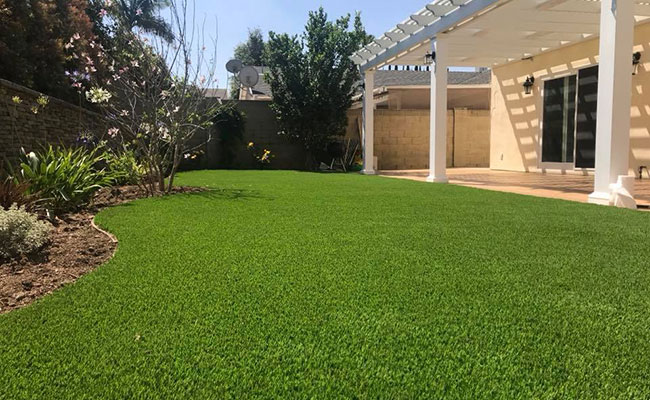
Artificial turf meeting a covered patio, one of the most common hardscape transitions in Tampa Bay yards.
Plan the Pavers and the Turf Together
The best turf-and-paver projects are designed as one system from the start. If you are building a new patio, decide early that the joints will be turf so the paver contractor can set gaps that are straight, consistent and wide enough to install turf cleanly. Very narrow joints are difficult to fill with turf and are often better finished with joint sand or small stone. If you are converting an existing patio, we look at whether the current gaps are even enough to look good with turf before recommending it.
Height matters as much as width. The finished turf should sit at a comfortable level relative to the paver surface, so the strip looks full without becoming a trip edge or sinking into a channel that collects debris. That means the base under the turf has to be set to the right depth, compacted, and leveled along every strip. On a large grid this is detailed, careful work, and it is the main reason turf between pavers takes longer to install than an open lawn of the same area.
Base, Drainage and Florida Rain
Tampa Bay summers bring heavy afternoon storms, and turf-and-paver patios have to handle a lot of water in a short time. Pavers shed water into the joints. If the turf strips sit on packed soil or a base that does not drain, water backs up, the joints stay wet, and sand or base material can migrate. A compacted, permeable base under the turf helps water move down and through instead of pooling on the surface.
The overall grade still matters. A patio needs to slope away from the house and pool equipment toward a lawn, swale or drain. Turf strips will not fix a patio that was set flat or tipped toward the foundation. If your existing patio holds water, that problem should be solved before the joints are finished with turf. We look at this during every site visit and will tell you if a grade or drainage fix should come first.
In low-lying areas near the bay, such as parts of South Tampa, St. Petersburg and the Pinellas beaches, storms can bring standing water and debris. After a storm, clear the surface, rinse out sand and leaves, and let the joints drain before deciding whether anything needs attention.
A landscaped putting green where turf edges meet hardscape and planting beds.
Edges, Seams and Cuts
A turf strip has two long edges on every piece, so edge work is what makes or breaks the look. Each strip should be cut straight, tucked or secured so it stays tight against the paver edge, and installed with the grain of the turf running in a consistent direction across the whole patio. When pieces run in mixed directions, the color can look slightly different from strip to strip in sunlight.
Seams inside strips should be kept to a minimum and placed where they are least visible. On grids with many short pieces, the order of installation matters too, so the pattern lines up from one end of the patio to the other. These are small details individually, but together they are the difference between a patio that looks designed and one that looks patched.
Heat, Comfort and Pool Decks
Both pavers and artificial turf can get hot in direct Florida sun. Light-colored pavers and shade from trees, pergolas or patio covers help. A quick rinse cools both surfaces before kids or pets walk across them. On pool decks, many homeowners choose turf strips in areas that get afternoon shade, or keep the turf to the edges of the deck while the main walking paths stay on pavers.
Around pools, also think about splash-out. Chlorinated or salt pool water on the turf is normal and does not usually hurt it, but strips should drain well so the deck does not stay wet. Keep pool equipment, skimmer lids and drains accessible, and do not cover them with turf.
Pets and Turf Between Pavers
Narrow turf strips are not the best choice as a dog’s main relief area. Urine runs along the joint and has less space to drain and rinse than it would in a dedicated pet area. If your dogs share the patio, a better plan is a separate pet zone with a proper base, close to the back door, and decorative strips elsewhere. Our pet turf page explains how those areas are built, and we have local pages for dog owners in places like pet turf installation in St. Petersburg and East Lake.
An installer laying turf. Paver projects use the same careful base and seam work on a smaller scale.
Maintenance for Turf and Paver Patios
Turf between pavers is low maintenance, but it is not zero maintenance:
Blow or brush debris such as leaves, oak flowers, palm debris and sand out of the strips regularly so it does not break down in the joints.
Rinse occasionally to clear pollen and dust and cool the surface on hot days.
Watch the edges after heavy storms or pressure washing. Do not aim a pressure washer directly at turf edges or seams.
Pull weeds early. A well-built base and tight edges limit weeds, but windblown seeds can still land on top of the turf. They are easy to pull when small.
Brush high-traffic strips now and then so the fibers stand up evenly.
If you have large trees overhead, our guide to artificial turf under oak trees has more tips for keeping leaf litter under control.
Is a Turf-and-Paver Design Right for Your Yard?
Turf between pavers is a strong choice when you want a modern, low-maintenance patio, your paver layout is even and well drained, and the area is mostly for walking, sitting and entertaining. It is a weaker choice when the joints are very narrow or irregular, when the patio already holds water, or when the strips would become the dogs’ main bathroom.
It also helps to think about the whole yard. Many projects combine a paver patio with turf joints, a larger synthetic lawn, a backyard putting green or a pet run. Planning those pieces together means the grades, edges and drainage work as one design instead of separate projects. Businesses and HOAs can use the same approach for courtyards and entries; see our commercial turf page for those projects.
Turf Between Pavers FAQ
Can artificial turf be installed between existing pavers?
Often, yes, if the joints are wide and consistent enough and the patio drains properly. The old material in the joints is removed, the base is prepared to the right depth, and turf is cut and secured in each strip. Very narrow or uneven joints are usually better finished another way.
Will weeds grow through turf between pavers?
A compacted base and tight edges limit weeds coming up from below. Seeds can still blow in and sprout on top of the turf or along the edges, so pull small weeds early and keep the strips free of debris.
Does turf between pavers drain in heavy rain?
It can, when the turf sits on a permeable base and the patio is graded to move water away from the house. Turf strips do not fix a patio that was set flat or slopes the wrong way, so grade problems should be solved first.
Is turf between pavers good for dogs?
Decorative strips are fine for dogs to walk across, but they are not ideal as a main relief area. A dedicated pet turf zone with its own draining base is easier to rinse and keep fresh.
How do I clean artificial turf between pavers?
Use a leaf blower or stiff brush to clear debris, and rinse with a hose as needed. Avoid pointing a pressure washer directly at turf edges or seams when cleaning the pavers.
Plan Your Turf and Paver Project in Tampa Bay
Tampa Turf installs turf between pavers, around patios and pool decks, and as part of full backyard makeovers across Hillsborough, Pinellas, Pasco and nearby counties. Find your community on our Areas We Serve page, start with our artificial turf installation in Tampa overview, or reach out through our contact page.
https://www.tampaturf.com/wp-content/uploads/2024/03/turf-company-near-me-1.jpg6301500bpetruzzihttps://www.tampaturf.com/wp-content/uploads/2024/04/tampa-turf-company-11.jpgbpetruzzi2026-11-22 18:10:222026-11-22 18:10:22Artificial Turf Between Pavers: Planning a Turf-and-Paver Patio in Tampa Bay
Live oaks and laurel oaks shape a lot of Tampa Bay front yards. They also shape a lot of failed St. Augustine lawns. If the grass under your canopy is thin, the soil is a web of surface roots, and every spring brings another layer of leaves and acorns, you are not dealing with a mowing problem. You are dealing with a shade, root and cleanup problem. Artificial turf can be a good fit in that situation, but only if the installation is planned around the trees instead of treating them as obstacles to bury.
Tampa Turf installs residential artificial turf throughout Tampa Bay, including yards where mature oaks are the main feature of the property. This guide walks through what we look at before anyone starts digging, how the base and tree wells work, and what you will still need to do after the lawn is in. It is planning advice, not a promise that every tree or every lot is a candidate.
St. Augustine is the default lawn in much of Hillsborough, Pinellas and Pasco County because it handles heat and, in decent light, can look lush. Under a mature live oak, the conditions change. The canopy cuts the hours of direct sun. Surface roots compete for space and water. Leaf drop is not a once-a-year event; it is a steady litter of leaves, twigs, catkins and acorns. After a summer storm, the ground under the drip line can stay damp while the open parts of the yard dry out. The result is a familiar pattern: a green lawn in the sunny middle, then thinning, weeds and bare soil as you get closer to the trunk.
People often respond by watering more, adding fill over the roots, or planting a more shade-tolerant grass and hoping it fills in. Extra water can stress the tree and feed fungus in a lawn that is already struggling. Fill piled against the trunk can bury the root flare, which is hard on the tree and does not solve the shade. A different grass variety may do a little better and still wear out in the darkest corners or along the root humps. That is usually the point when homeowners start asking about artificial turf in Tampa.
Artificial grass does not need the same direct sunlight a living lawn needs to stay green. That is the genuine advantage in a shady Tampa Bay yard. It does not remove the need to protect the tree, drain the yard, or clean up after the oak. If those pieces are ignored, you can end up with a wrinkled surface, trapped moisture, or a tree that is worse off than when you started.
A finished backyard turf lawn beside a patio. Shade from nearby trees is planned around, not ignored.
Walk the Yard Before You Design the Lawn
A useful first step is a slow walk, not a product decision. Note every tree trunk that sits in the area you want to turf, including trees just over the property line whose roots or canopy reach your lawn. Look at the root flare — the flare at the base of the trunk where the trunk widens into roots. That area should stay visible and unburied. Look at surface roots. Some can be worked around with a tree well or a slight grade change. Others sit right in the middle of a walk path or a play area and need a conversation before anyone cuts or covers them.
Then look at drainage. Where does the roof water land? Does a downspout dump into the lawn under the canopy? After a typical afternoon storm, where does water actually go? Oaks often sit on the slightly higher part of a lot, but not always, and the soil under an old tree can be a mix of native sand, old fill and years of accumulated organic matter. The turf base needs a clear path for water. If the only low point is against the house, the slab, or a neighbor’s fence, that has to be resolved in the plan.
Finally, think about how you use the space. A front lawn in a place like Bloomingdale or Lutz, with oaks framing the house from the street, has a different edge and appearance standard than a backyard pet area in East Lake or Carrollwood. Kids, dogs, a patio, and a mailbox walk are all reasons to adjust well sizes, seam placement and the path of the grade.
Protecting the Trees During Installation
The goal is a clean, even lawn that does not suffocate the oaks. In practice that means a few non-negotiables. We do not bury the trunk or the root flare under rock and turf. Each tree in the work area gets a well — an open ring or shaped opening — so the flare stays clear and the tree can keep the trunk-to-soil relationship it already has. The well can be finished with a clean turf edge, a border, or a simple mulch ring, depending on the look you want and how tight the roots are. If the area under the tree includes a patio, the same edge thinking applies to artificial turf between pavers.
Excavation around a mature oak should be conservative. Removing the old sod and a shallow organic layer is different from cutting deep into a root plate to force a perfectly flat plane. If a large root sits where the base needs to go, we talk through options: raising the grade slightly around it, adjusting the well, narrowing the turf area, or, when it is truly necessary, involving an arborist before any root is cut. We would rather redesign a corner of the lawn than damage a tree that took decades to grow and that is part of what makes the property attractive.
Equipment access matters too. Many Tampa Bay backyards are reached through a side gate, and a large oak may sit right along that route. We plan how base material and turf rolls get into the yard so we are not driving or stacking weight on top of major roots. If a job needs to be done mostly by hand in a tight, tree-filled side yard, that affects the schedule, and we will say so up front.
Turf going down over a prepared, compacted base. Around oaks, that base stops short of the trunk and root flare.
Base, Grade and Drainage Under a Canopy
Even in shade, Tampa Bay storms are brief and intense. The crushed-rock base under the turf is what lets that water move through instead of sitting in a depression between roots. We still set an overall grade toward the street, a swale, or another safe discharge point, the same way we would on an open lawn. The difference is that the finished surface may step around tree wells rather than running in a single unbroken plane from fence to fence.
Downspouts deserve a hard look on oak lots. If a gutter currently empties onto the lawn under the canopy, that concentrated flow should be directed to a splash block, a drain, or a bed that can handle it, not onto the new turf and not against the trunk. We flag that during the quote because it is much easier to fix before the base goes in.
Irrigation usually changes when the lawn becomes turf. Zones that only served the grass can be capped. Zones that still water beds, hedges or the trees themselves can stay. Oaks in Tampa Bay are often established enough that they do not rely on lawn irrigation, but that is a property-specific question, especially after a recent planting or in a very sandy lot. We would rather leave a way to water a tree than shut everything down and hope.
What Everyday Life Looks Like After Installation
Turf under oaks is low mowing and low watering. It is not zero cleanup. Leaves, acorns, twigs, flowers and the occasional piece of Spanish moss will land on the surface. A blower or a rake used gently is usually enough. Letting a thick mat of wet leaves sit for a long time is what you want to avoid, both for the look of the lawn and so water can keep moving through the turf. After a storm, walk the wells and the lawn, pick up branches, and check that nothing has washed into a corner.
Pet owners should still rinse high-use areas and pick up waste, just as they would on any pet turf job. Shade can make a summer yard more comfortable, which is one reason people keep the oaks and change the lawn. It does not remove the need for basic rinsing in the spots the dogs use most.
If a hurricane or a strong thunderstorm drops a large limb, treat the turf like a finished outdoor floor. Remove the debris, look for punctures or lifted edges, and call us if the surface or a tree well looks damaged. Do not try to stretch or restaple a pulled edge without checking the base underneath.
A residential turf lawn finished to the landscape. Tree wells and clean edges keep mature plantings in the design.
HOA Front Lawns and Street-Facing Oaks
Many Tampa Bay associations care a lot about how a front yard looks from the street, and a large oak is often the centerpiece of that view. If you are replacing a thinning front lawn, check your architectural guidelines before work starts. Boards may ask for product information, a simple layout, and a note about how tree wells will be finished. We can provide specs and a drawing for that packet. Backyard work is often simpler, but it is still worth confirming if your documents treat any turf installation as a review item.
Street trees and county right-of-way strips are a separate issue. A swale or a strip between the sidewalk and the curb may not be yours to change, even if you mow it. We stay on the parts of the property you control unless you have written approval to work in a right-of-way.
Where This Kind of Yard Comes Up Most
We plan around oaks all over the area we serve, from older lots in Tampa, South Tampa, Carrollwood and Lutz to suburban streets in Brandon, Bloomingdale, Valrico and the inland Pinellas communities around East Lake, Palm Harbor and Safety Harbor. If you want to see whether we already have a page for your city, start at Areas We Serve. If you are still comparing a full lawn replacement with a smaller patio or pet zone, the residential turf and pet turf pages outline those options.
Artificial Turf Under Oak Trees FAQ
Can you install artificial turf under a live oak in Tampa Bay?
Often yes, if the plan protects the tree. We leave wells around trunks, keep the root flare uncovered, and discuss any surface roots before excavation. Not every root layout is a good fit, and we will tell you if a different shape or a smaller turf area would be safer for the tree.
Will the turf stay green in deep shade?
Artificial turf does not need direct sun to keep its color the way a St. Augustine lawn does, which is why it is often used under a mature canopy. The base still has to drain, and you will still clean up leaves and acorns. Shade does not replace basic care.
Do I have to remove my oaks to put in turf?
No, and we do not recommend removing a healthy mature oak just to make a lawn easier. The usual approach is to work around the trees with wells and a conservative excavation plan. If a tree is already failing or sits in a place that makes any yard work unsafe, that is a conversation with an arborist, not a turf decision alone.
How do I keep leaves and acorns off the turf?
A leaf blower or a gentle rake on a regular schedule is the practical answer, especially in spring and after storms. Try not to let a thick, wet layer sit on the surface for long periods. Tree wells should stay clear of packed leaves as well.
Will the installation hurt my tree?
A careful installation is designed to avoid that: no fill against the trunk, no covering the root flare, limited excavation, and no heavy equipment parked on major roots. If a large root is in the way, we slow down and talk through options, including an arborist when needed, rather than cutting first.
Ready to Plan Turf Around Your Oaks?
If you want a green lawn under trees that have already earned their place in the yard, we can walk the property with you and tell you what is realistic. Call, text, or use our contact page to get a free quote.
https://www.tampaturf.com/wp-content/uploads/2024/03/turf-company-tampa.jpg6301500bpetruzzihttps://www.tampaturf.com/wp-content/uploads/2024/04/tampa-turf-company-11.jpgbpetruzzi2026-11-22 01:10:182026-11-22 18:11:20Artificial Turf Under Florida Oak Trees: Planning a Shady Tampa Bay Lawn